A geometric gate cut displaced source error by 60%, while one diffusion proposal took 41.7 milliseconds.
Editorial illustration
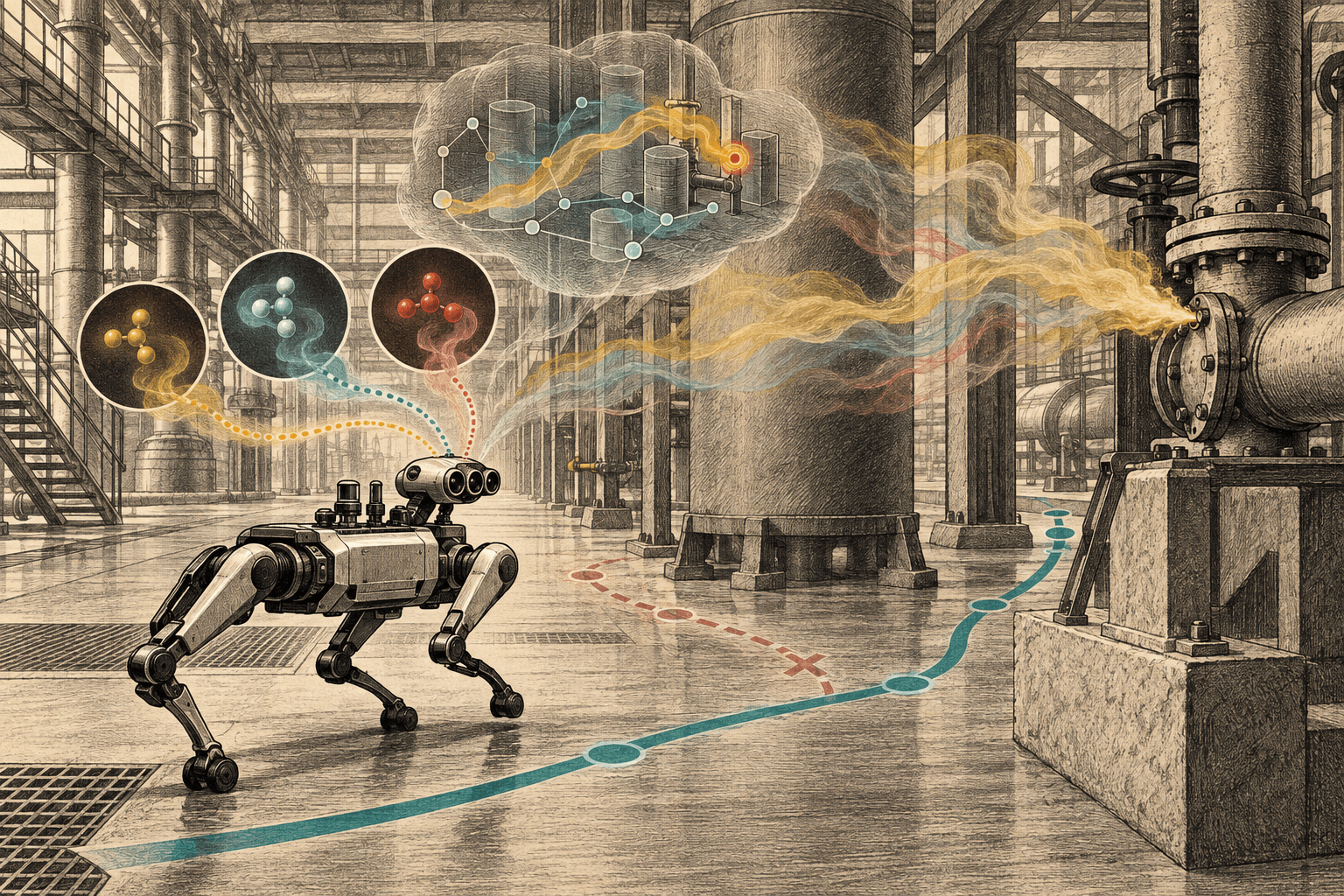
Concept illustration: a quadruped follows species-specific gas plumes toward a source; it is not a SmellDiffusion interface, measured trajectory or documentary photograph. Original editorial illustration generated with built-in Codex Image Gen for The Machine Press, 2026-09-19.
SmellDiffusion represents species-specific gas zones in an open-vocabulary scene graph, estimates a named leak's source, and gives the same goal to classical and diffusion planners. In 424 solved source-wind configurations, 28 concentration peaks sat more than half a meter from the true source. A gate trained only on the training split detected nine of ten held-out displacements at 0.64 precision and reduced mean error on displaced cases from 1.468 meters to 0.592 meters. One diffusion proposal ran faster than gas-guided A*, but best-of-ten sequential sampling cost more overall; plain A* remained the fastest shortest-path method.
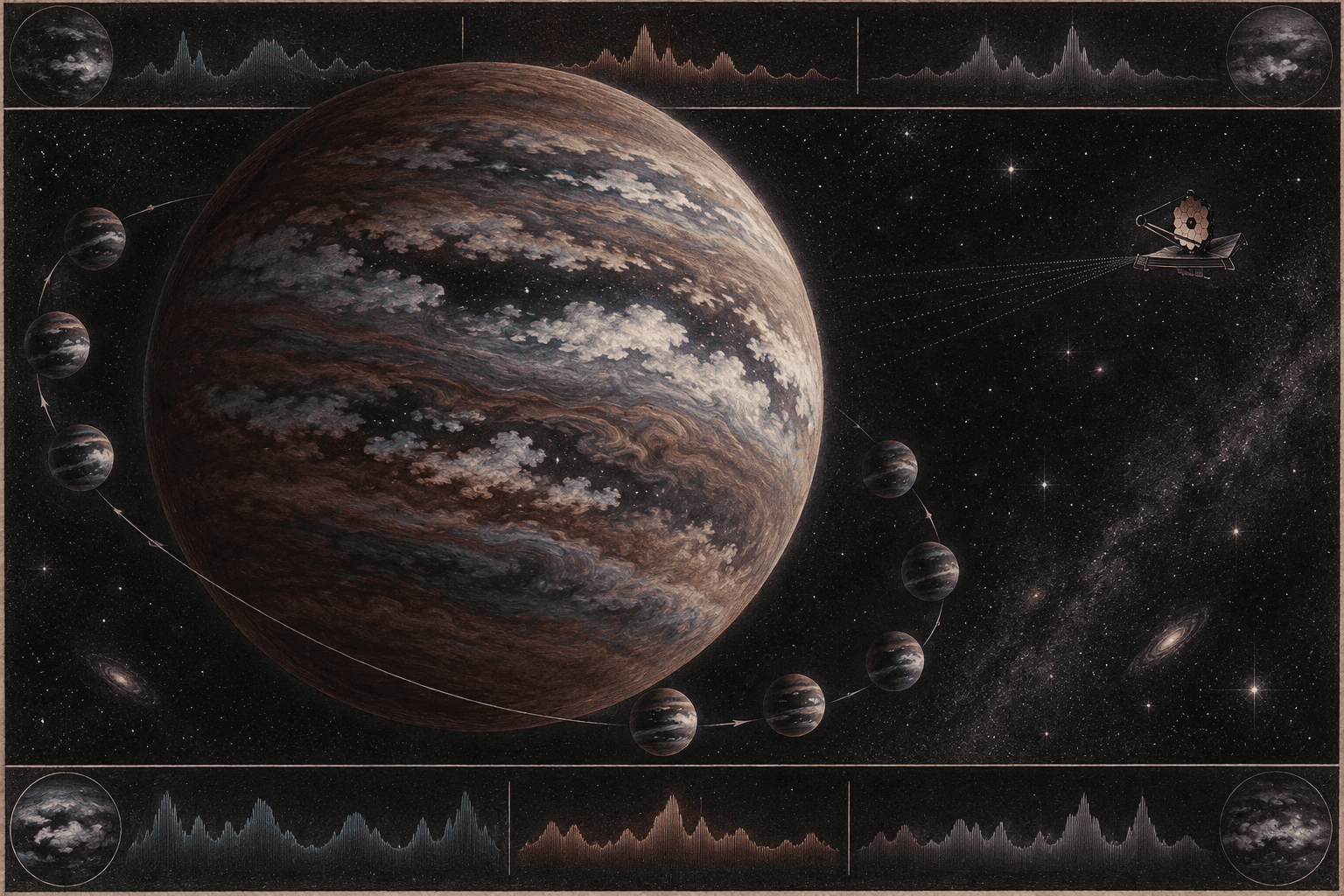
Concept illustration: patchy clouds rotate across WISE 0855 during time-series observation; it is not a direct JWST image or measured spectrum. Original editorial illustration generated with built-in Codex Image Gen for The Machine Press, 2026-09-19.
JWST watched WISE 0855 for 11 hours and found carbon-monoxide modulation up to 10% at some wavelengths.
JWST/NIRSpec followed WISE 0855, a 265-kelvin brown dwarf, every 15 minutes across 2.87 to 5.27 micrometers. Carbon monoxide produced the strongest variable spectral feature, reaching a peak-to-peak amplitude of 10% at some wavelengths. Principal-component analysis linked the carbon-monoxide and phosphine variations, while comparisons with atmosphere and structure models supported patchy water clouds. The authors place the chemical variations at deeper quenched pressures and the changing cloud thickness higher in the atmosphere; the result is accepted to The Astronomical Journal but remains an interpretation of spectra, not a direct image of clouds.
At 20× stronger spot contrast, hydrogen-versus-helium mismatch shifted radius estimates while leaving acceptable residuals.
Synthetic NICER pulse data modeled on the roughly 2.1-solar-mass pulsar PSR J0740+6620 showed little radius bias from choosing hydrogen instead of helium, or vice versa, at the observed spot-to-background ratio. When the ratio increased about twentyfold with total counts held near 550,000, the wrong atmosphere produced significant radius bias while still fitting with statistically acceptable residuals. Bayesian evidence consistently preferred the correct composition, making model comparison—not residual inspection alone—the safeguard.
Tim West's conceptual Visualising AI artwork, used illustratively; it does not depict SoL-Pi, an agent harness, token traffic or benchmark evidence. Tim West / Google DeepMind / Pexels; cropped, resized, metadata stripped, and converted to WebP by The Machine Press.
SoL-Pi matched its comparison harness while reducing recorded token traffic 44.7% to 49.0%.
The SoL-Pi team scaled automated harness experiments across many environments, then retained four mechanisms covering action execution, context compaction, observation handling and delegated reading. On the 51-task EdgeBench evaluation, the resulting harness performed comparably to Pi across GPT-5.6 Sol and Opus 5 while cutting recorded token traffic by 44.7% to 49.0% and reported API cost by about one third. The savings are evaluation estimates from the tested models, prices and tasks, not a universal operating-cost guarantee.
Matched language-model groups exceeded human consensus by 34.0 to 44.4 percentage points in sensitivity analyses.
Researchers replayed 100 held-out human Wason-task groups with language-model agents anchored to each participant's initial answer. Human consensus estimates moved from 24% to 57% depending on who counted as participating, yet two sensitivity analyses still found model groups 34.0 to 44.4 percentage points more consensual. Reasoning-mode agents agreed nearly unanimously after a change designed to remove a memorizable answer, but usually agreed on the wrong answer. In this setting, synthetic agreement did not estimate human deliberation or collective accuracy.
One gradient method mitigated part of the effect at token level, but results changed across models and preferences.
Subliminal learning can transmit behavioral traits through training examples that do not state those traits, limiting semantic filters. The study tested GradCos, a contrastive variant and EK-FAC against divergence tokens across three models. Token-level EK-FAC removed a meaningful part of the effect, while the other attribution methods offered little benefit and generally trailed the counterfactual-teacher baseline. Whole-sample filtering was weaker for every method, and no approach worked consistently across model-preference combinations.
RAFT matched the live incident to an intermediate historical state, then returned the surrounding resolution path.
Static retrieval can find a similar closed ticket without recognizing which stage of its history resembles the active incident. RAFT converts each resolved case into a chain of timeline entries, retrieves at entry level, and returns the parent trajectory around the matched state; an optional graph links similar cases. It beat vanilla RAG and GraphRAG on a synthetic Windows Server benchmark at every stage, with statistically significant gains over the strongest baseline. Apache Jira duplicate labels supplied directional real-case evidence, not a production-agent deployment test.
A small vision-language model distilled teacher explanations into real-time stage-transition decisions.
Long-horizon robot systems must decide when to stop one skill and start the next, but hand-built completion checkers are brittle and large cloud models are slow. StageGuard combines teacher-model reasoning with demonstrations to generate explanations of policy switching, then trains a lightweight vision-language model to emit compact self-explanations and transition decisions. Evaluation covered two trajectory benchmarks, BEHAVIOR-1K closed-loop control and real robots. The abstract reports substantial prediction gains without enough figures to support a broader quantitative claim.
Golden Gate Bridge file photograph, used illustratively; it does not depict OPTED, its simulated routes, vehicles, scores or safety performance. Belli Kins / Pexels; cropped, resized, metadata stripped, and converted to WebP by The Machine Press.
A vector-input teacher lifted two camera-policy driving scores by 1.6× and 9.5× in AlpaSim.
OPTED separates reinforcement learning from camera-policy post-training. A privileged teacher learns from vectorized maps and boxes, then supervises pretrained TransFuser and VaVAM students in closed loop on neural reconstructions of real driving logs. The reported driving scores increased 1.6 times and 9.5 times. In controlled experiments, the approach matched direct reinforcement-learning post-training with roughly one-thousandth as many simulator interactions while remaining closer to the human demonstration prior; this is simulation evidence, not public-road validation.
A target-specific depth mask and two motion models kept the vehicle's control problem small enough for real time.
The underwater tracking system selects target depth pixels using color, disparity and temporal cues, then filters depth and image-center estimates separately. Its controller handles yaw apart from translation, avoiding a larger coupled optimization, while predictive control blends constant-velocity and stationary-target models according to recent errors. Actuation, following distance and field of view remain explicit constraints. Simulations and physical experiments beat the authors' comparison frameworks, though the abstract does not quantify that margin.
A PX4 extension added marine modes and mixed air-water waypoints without removing the flight safety stack.
Hybrid drones can fly to an aquatic site and then navigate on the surface, but the mission software must change modes without splitting the plan. This PX4 extension adds manual and autonomous marine navigation, keeps existing flight functions and safety mechanisms, and exposes distinct aerial and marine waypoints through the standard mission pipeline and QGroundControl. Simulated missions produced stable surface navigation in calm and wavy conditions. The paper validates firmware behavior in simulation, not a completed field campaign.
OceanSim generated labeled underwater scenes with configurable appearance, structure and sensors.
Labeled underwater imagery is costly, so the team extended an IsaacSim-based OceanSim environment with an automatic synthetic-data pipeline. It can vary scene appearance, structure and sensor settings while producing photorealistic images and labels. A real-world sea-urchin detector served as the sim-to-real test, with experiments probing how kinds of scene variation affect transfer. The authors release code and emphasize remaining limits in rendering fidelity, diversity and generalization rather than claiming that synthetic data replaces field collection.
Dynamics-completed demonstrations cut quadruped velocity-tracking error 63.1% on a Cartesian command grid.
Animal demonstrations usually show only a few directions. OmniMimic combines time reversal, constrained dynamics completion and sagittal reflection to create robot-specific supervision beyond those motions, then widens commands toward target velocity ranges. A shared policy uses gait-specialized residual experts for corrections. Across four simulated gaits, it reduced foot-position error 12.9% at forward and backward reference speeds and velocity-tracking error 63.1% on a uniform command grid versus the matched baseline.
Generic processor-pin file photograph, used illustratively; it does not depict a transmon, tunable coupler, control pulse or leakage result. Pixabay / Pexels; cropped, resized, metadata stripped, and converted to WebP by The Machine Press.
An analytic pulse correction suppressed simulated fast-iSWAP leakage without a second control channel.
Leakage-suppression recipes such as DRAG commonly assume two orthogonal controls, but baseband flux architectures may provide only one real-valued field. A Magnus-expansion construction shapes that single field for a tunable-coupler two-transmon gate. With realistic simulated parameters, the correction reduced non-adiabatic leakage from the coupler ramp by as much as three orders of magnitude. The result is a general analytic control proposal supported by device simulation, not an experimental gate demonstration.
The server size now scales with non-Clifford gates rather than the full delegated computation.
Blind quantum computation lets a low-resource client hide a delegated computation, but conventional server resources grow with the whole circuit. By using Pauli-based computation, this protocol makes server size depend only on the non-Clifford gate count. It inherits fault tolerance and qubit virtualization from that model and adds a dual entanglement-based protocol for resource-state computation with lower execution cost. The work is a protocol result, not a hardware deployment.
Neural networks can locate phase transitions but rarely explain their order parameters. TetrisCNN runs differently shaped convolutional filters in parallel and learns sparse latent variables expressed as spin correlators. On experimental snapshots from two-dimensional Ising and XY quantum simulators measured in several bases, it detected transitions and crossovers while turning its representation and decision boundary into symbolic formulas. The claim is interpretability on the tested systems, not automatic discovery of every phase of matter.
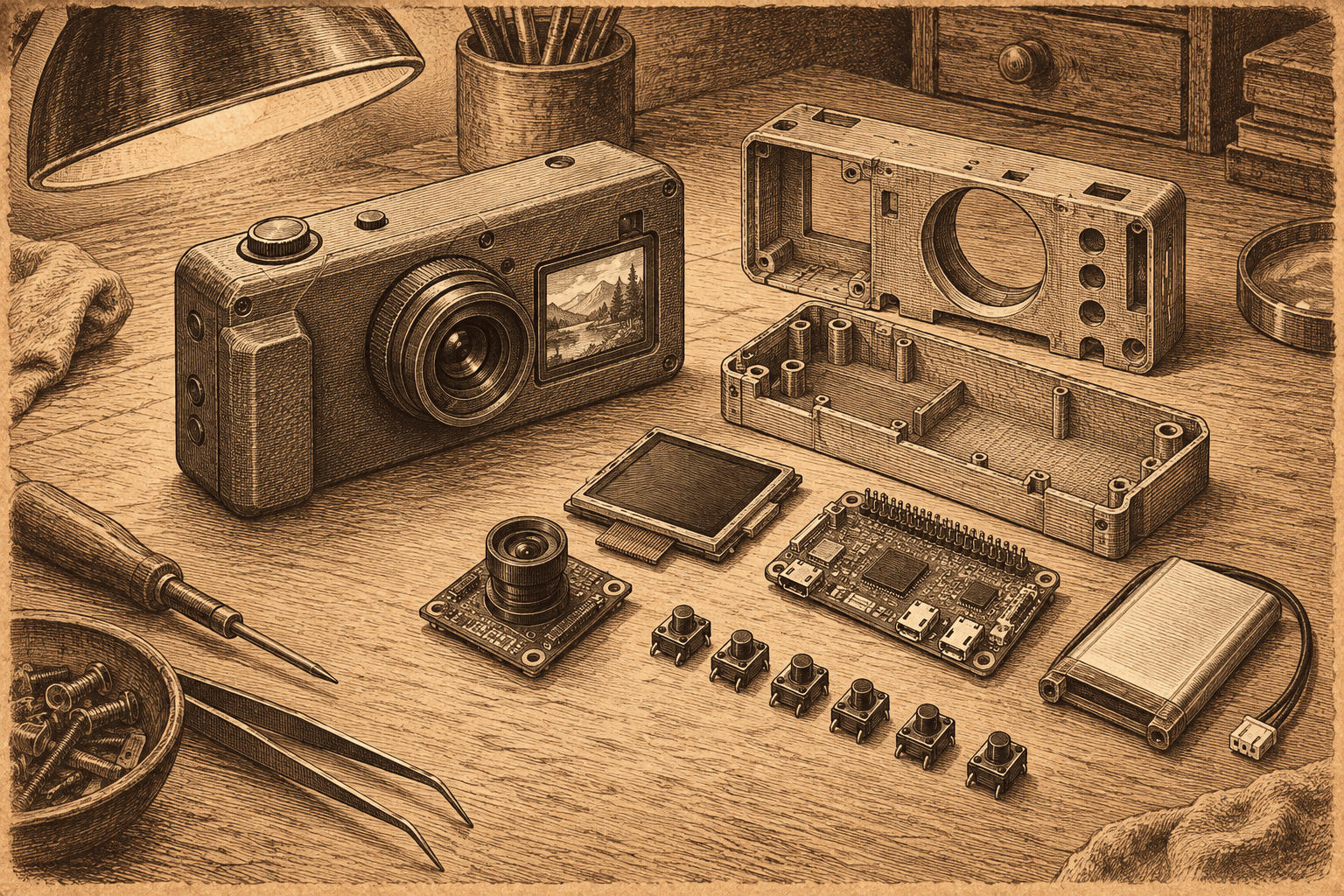
Builds a tactile digital camera around a Raspberry Pi Zero 2 W, an autofocus sensor, a small viewfinder, and mechanical-switch controls while publishing the software and printable hardware files.
Visit SATURNIXOriginal editorial concept art generated with built-in Codex Image Gen for The Machine Press, 2026-09-13.
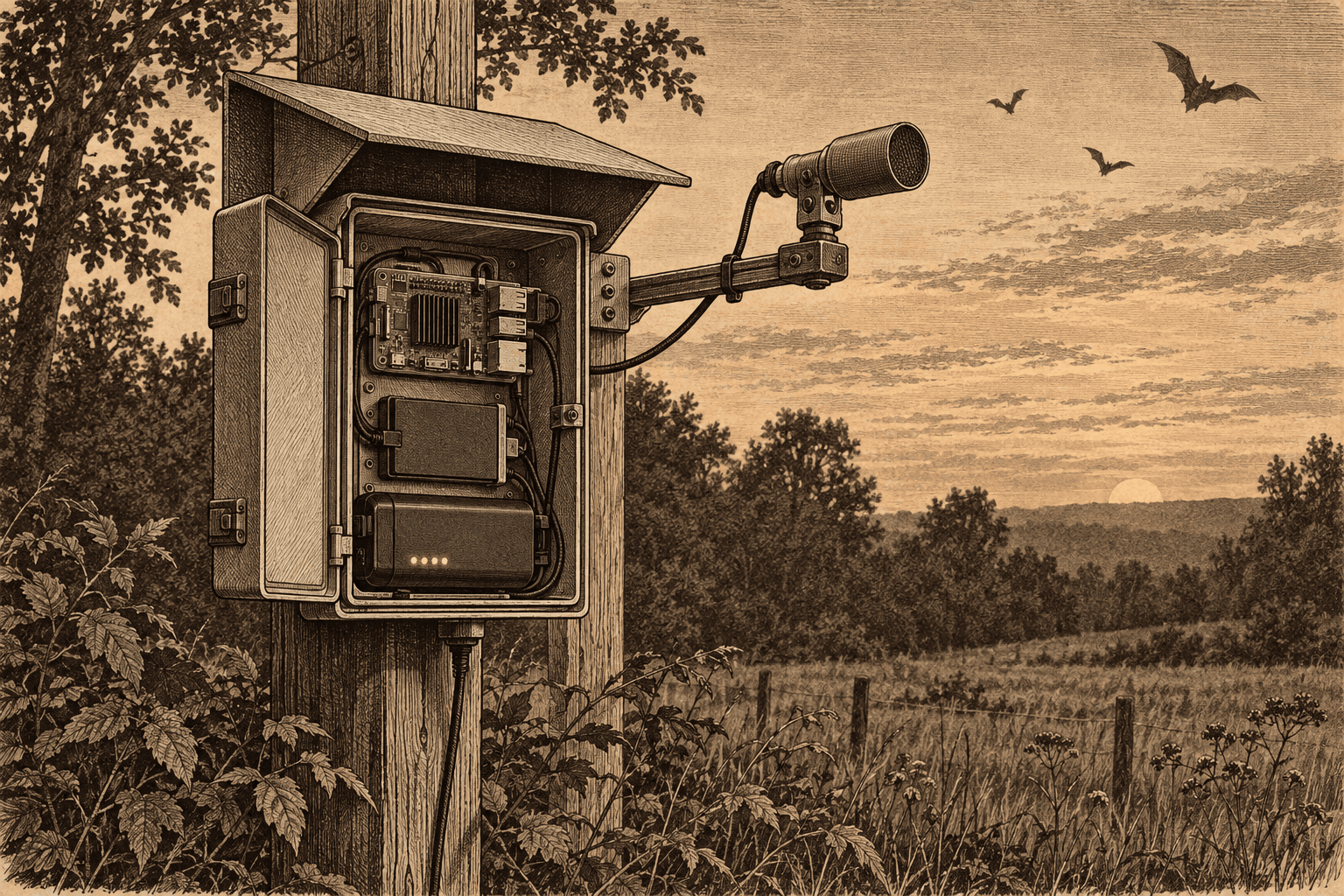
Combines a Raspberry Pi-class computer, an ultrasonic microphone, local storage, and a web interface into a modular recorder for active or unattended bat monitoring.
Visit WURB-2026Original editorial concept art generated with built-in Codex Image Gen for The Machine Press, 2026-09-13.
BuilderOceanography for Everyone core team and contributors
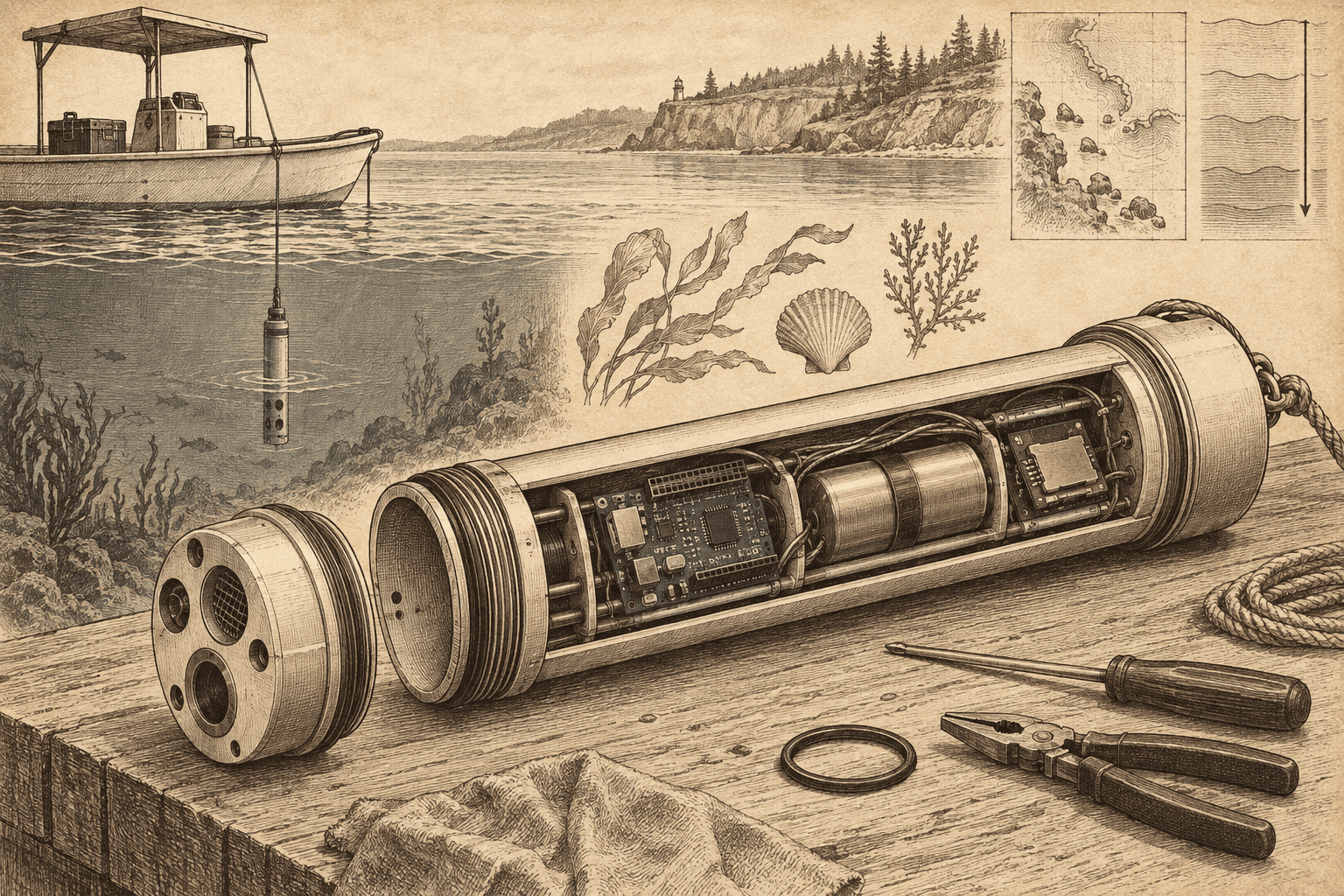
Packages conductivity, temperature, and depth sensors with an Arduino-compatible controller, battery, and SD storage inside a user-built housing for nearshore research and education.
Visit OpenCTDOriginal editorial concept art generated with built-in Codex Image Gen for The Machine Press, 2026-09-13.
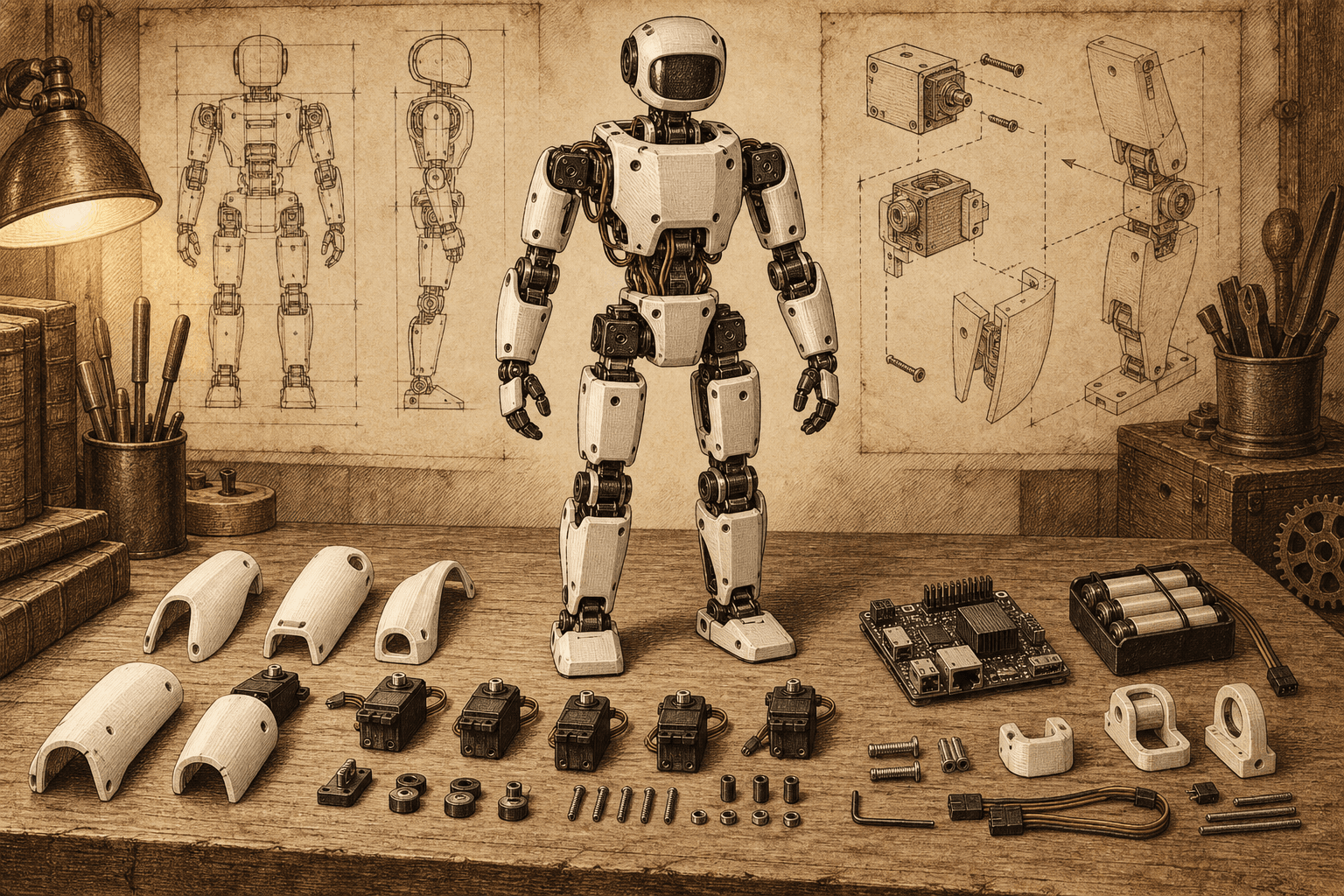
Turns printable body parts, nineteen servomotors, a Raspberry Pi Zero 2 W, batteries, and shared control software into a compact humanoid platform for hands-on robotics work.
Visit MicrobanOriginal Codex Image Gen concept art from 2026-07-10; carried forward from the validated 2026-09-18 edition.
Desk Picks are selected by the newsroom. Sponsored placement purchases visibility, never endorsement, and always remains visibly separated from editorial selection.
 Editorial illustration