research
Water Clouds Moved Across the Coldest Brown Dwarf
JWST watched WISE 0855 for 11 hours and found carbon-monoxide modulation up to 10% at some wavelengths.
Summary
JWST watched WISE 0855 for 11 hours and found carbon-monoxide modulation up to 10% at some wavelengths.
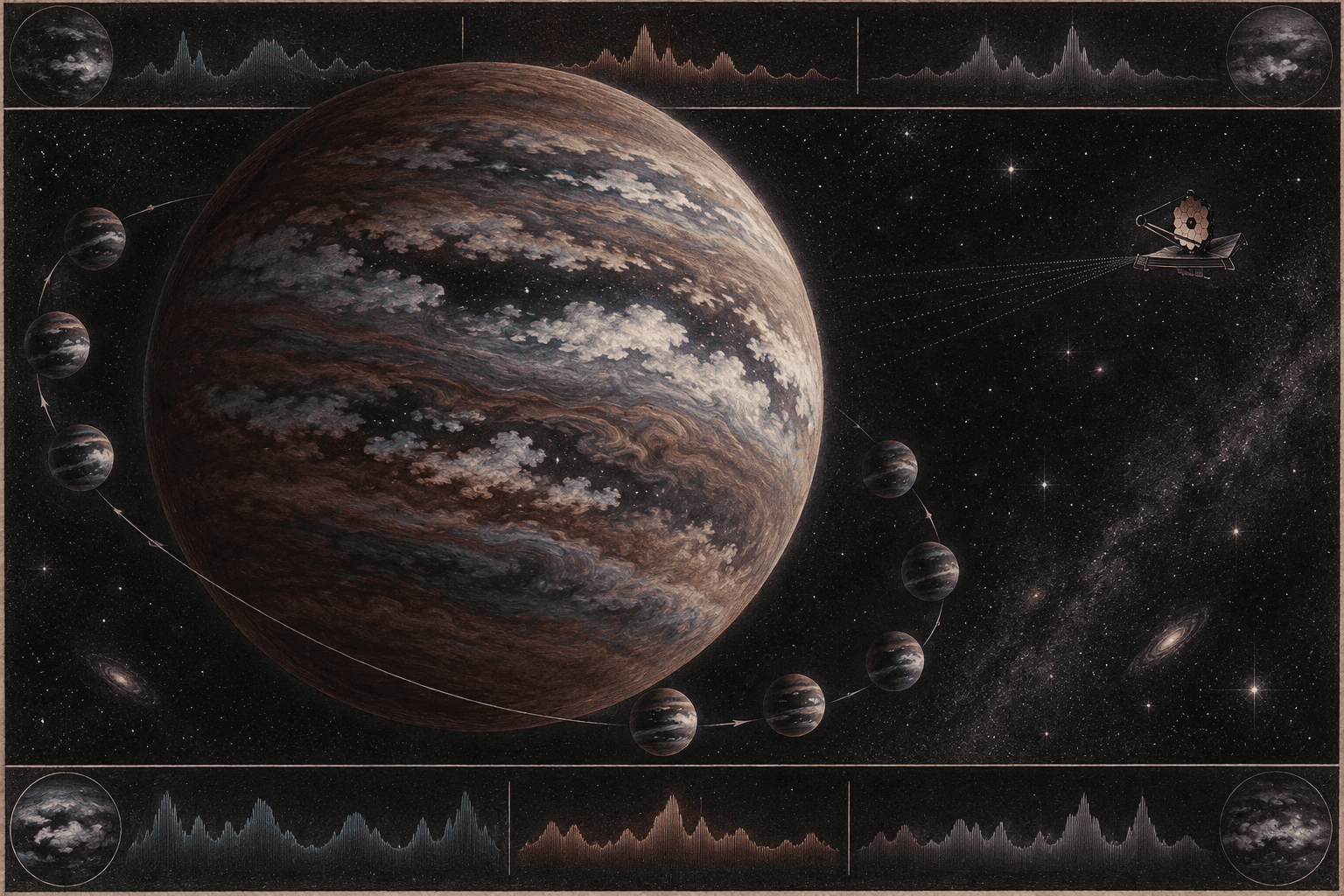
JWST/NIRSpec followed WISE 0855, a 265-kelvin brown dwarf, every 15 minutes across 2.87 to 5.27 micrometers. Carbon monoxide produced the strongest variable spectral feature, reaching a peak-to-peak amplitude of 10% at some wavelengths. Principal-component analysis linked the carbon-monoxide and phosphine variations, while comparisons with atmosphere and structure models supported patchy water clouds. The authors place the chemical variations at deeper quenched pressures and the changing cloud thickness higher in the atmosphere; the result is accepted to The Astronomical Journal but remains an interpretation of spectra, not a direct image of clouds.
Why it matters
JWST watched WISE 0855 for 11 hours and found carbon-monoxide modulation up to 10% at some wavelengths.
Limits and context
- The authors place the chemical variations at deeper quenched pressures and the changing cloud thickness higher in the atmosphere; the result is accepted to The Astronomical Journal but remains an interpretation of spectra, not a direct image of clouds.
Key claims
JWST watched WISE 0855 for 11 hours and found carbon-monoxide modulation up to 10% at some wavelengths.
Qualification: The authors place the chemical variations at deeper quenched pressures and the changing cloud thickness higher in the atmosphere; the result is accepted to The Astronomical Journal but remains an interpretation of spectra, not a direct image of clouds.
Evidence: source-2026-09-19-002
Sources
- arXiv preprint 2609.20664arXiv · primary research
Corrections
No corrections have been recorded for this story.