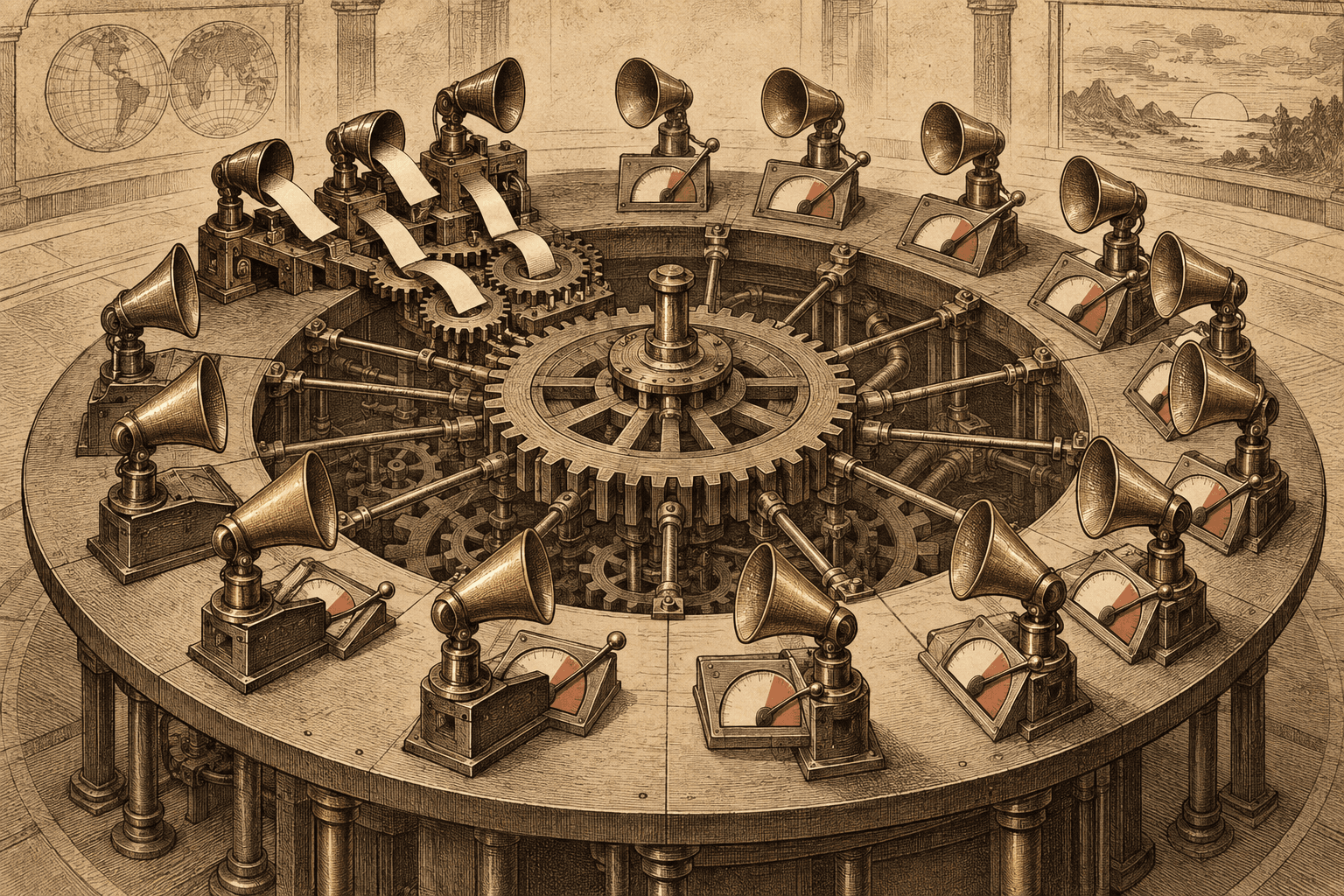
In multi-agent deliberation, defection rose with the proportion of deceptive agents—not the size of the group.
Editorial illustration
Concept illustration of proportional adversarial influence in multi-agent deliberation; not an actual model group, benchmark interface or incident. Original editorial illustration generated with built-in Codex Image Gen for The Machine Press, 2026-09-27.
A new preprint tested how deceptive participants alter collective decisions by varying both group size and the share of adversarial agents. Across the reported setups, defection rose roughly linearly with the proportion of deceivers, while simply adding more agents did not produce the same scaling effect. Language-model agents could be swayed even when deceivers remained a minority, although private coordination sometimes made the attackers less effective by preventing public reinforcement. The result is a benchmark finding about controlled deliberation, not evidence that every deployed agent team will behave the same way. It points system designers toward adversarial composition and communication structure as separate risks to measure.
Concept illustration of reconstructing a hidden, uniquely solvable question from documents; not an EnigmaForge instance, dataset record or result. Original editorial illustration generated with built-in Codex Image Gen for The Machine Press, 2026-09-27.
EnigmaForge asked models to infer both the puzzle and its answer from documents, producing a 22-fold spread in intuition.
EnigmaForge replaces the usual explicit question with a packet of documents whose facts imply both what must be solved and the one admissible answer. Its generator uses satisfiability checks to create puzzles with a unique solution and to verify that every clue is load-bearing. Across 25 frontier models, 600 instances and 17,400 evaluation records, the authors report a 22-fold spread in reconstructing the hidden problem, compared with a 1.6-fold spread in recovering stated facts. They also filter refusals separately so a model that declines the task is not confused with one that reasons incorrectly. This is a synthetic benchmark preprint, but it isolates a practical failure mode: gathering facts can be much easier than discovering the question those facts were meant to answer.
MorphIK reached roughly five-centimeter error before refinement and sub-centimeter error after one DLS step.
MorphIK is trained entirely on synthetic kinematic chains so one model can propose solutions for previously unseen robots with six to nine degrees of freedom. The authors report about five-centimeter error on real platforms before refinement, below one centimeter after one damped-least-squares step and below one millimeter after three steps in most tested cases. Its samples also cover diverse null-space solutions, but the results remain tied to the evaluated chains, targets and refinement procedure.
Conceptual Visualising AI artwork used illustratively; it does not depict the reported compressor, agent state, reasoning trace or benchmark result. Novoto Studio / Google DeepMind / Pexels; cropped, resized, metadata stripped, and converted to WebP by The Machine Press.
A training-free compressor cut input, output and cache tokens while raising reported reward on WorkBuddyBench.
The ICLR method ranks completed reasoning blocks by whether they still matter after an agent has externalized useful state into files, tools or the environment. On 260 WorkBuddyBench tasks, the authors report reward rising from 0.699 to 0.718 while input, output and cache tokens fell by 25.5%, 14.4% and 33.3%, respectively. The study argues that internal reasoning can become replaceable once its consequences are safely recorded, though the result is benchmark-specific and does not license deleting audit evidence.
Hard and soft constraints became explainable objects that could be checked, ranked and renegotiated.
The proposed framework encodes multi-stakeholder requirements in an OWL ontology, separating hard limits from preferences before a planner acts. It can identify unsatisfiable combinations, explain which constraints conflict and support structured renegotiation rather than silently relaxing a rule. A FLEXI microgrid case study illustrates the approach; the preprint is an architecture and demonstration, not a broad operational deployment.
Qwen-Planner-Agent aligned data, training and deployment through a common action representation.
Qwen-Planner-Agent uses the same contract for collecting trajectories, training a planner and executing actions on devices. Its CARE process is designed to correct action representations before errors propagate across that pipeline. The authors report the best overall result in their MobilePA-Bench evaluation while preserving general capabilities, but the claim belongs to the paper's chosen tasks, baselines and device conditions.
A survey organized neuro-symbolic copilot designs around inference, fine-tuning and training-time integration.
The preprint argues that unconstrained language generation is too unreliable for configuration work governed by compatibility rules, catalogs and engineering limits. It classifies hybrid systems by where symbolic knowledge enters: at inference, during fine-tuning or inside training objectives. An industrial configuration copilot grounds the discussion, while the paper also flags scaling, maintenance and evaluation problems that remain unresolved.
ENDOPROMPT optimized harmful prefixes from unlabeled instructions and produced losses across almost every tested split.
ENDOPROMPT uses white-box optimization to derive input prefixes without requiring labeled attack examples. Across four models, seven benign benchmarks and 28 model-benchmark combinations, the authors report a mean utility loss of 26.8 percentage points and negative effects in 27 of 28 cases. Their controls did not establish a compensating request-matching benefit; the preprint promises code upon acceptance, so independent reproduction remains a next step.
Programming file image used illustratively; it does not show the attribution study, tested code, model output or reported scores. Nemuel Sereti / Pexels; cropped, resized, metadata stripped, and converted to WebP by The Machine Press.
Across 15 model-benchmark combinations, balanced accuracy stayed near chance and tracked solution length.
A study of model self-attribution found balanced accuracy between 49% and 58% across 15 model-benchmark combinations. Pairwise attribution scores correlated at r=0.93 with longer solutions, suggesting that style and verbosity were doing much of the work. After normalization, 10 of 12 tested conditions fell to chance and the remaining two continued to follow length, erasing the apparent self-preference in this setup.
NNV3 joined new star-set abstractions with fairness checks for modern neural architectures.
NNV3 introduces ModelStar, VolumeStar and GraphStar abstractions for neural-network reachability, including probabilistic analysis and a FairNNV module. The authors benchmark the toolkit on malware, power, medical, time-series and action-recognition models. Those experiments show breadth across architectures, but the preprint does not make every network or safety property automatically tractable.
SciWalker organized 8,178 problems across five domains into operator graphs that could be tested while solving.
SciWalker contains 8,178 scientific coding problems spanning five domains and 32 subdomains, with solutions represented as operator graphs. The framework uses execution feedback to revise intermediate programs rather than grading only a final answer. In the reported experiment, Qwen3.5-9B accuracy rose from 29.3% to 39.2%; that gain applies to this benchmark and training recipe, not scientific software in general.
Generator programs supplied an open-ended self-play curriculum built from a universal Turing machine.
The proposed pretraining scheme pits a generator program against a learner that predicts the generator's output, using reinforcement learning to keep the curriculum challenging. The authors report that zero-shot loss on natural data scales with compute even though natural examples never enter pretraining. They also observe in-context learning and mathematical-sequence behavior, but this remains a controlled preprint result rather than a replacement recipe for production language-model training.
HEXIS turned reusable procedures into extended state machines with static checks and replay.
HEXIS compiles agent skills into extended finite-state machines whose transitions, guards and tool calls can be inspected before execution. Across four benchmarks and four executors, the authors report a 16.1-point gain over Skill+ReAct. For Qwen3.8-27B, token use fell between 38.4% and 88.9%, while accepted traces could be replayed; the results depend on the tasks and skill library tested.
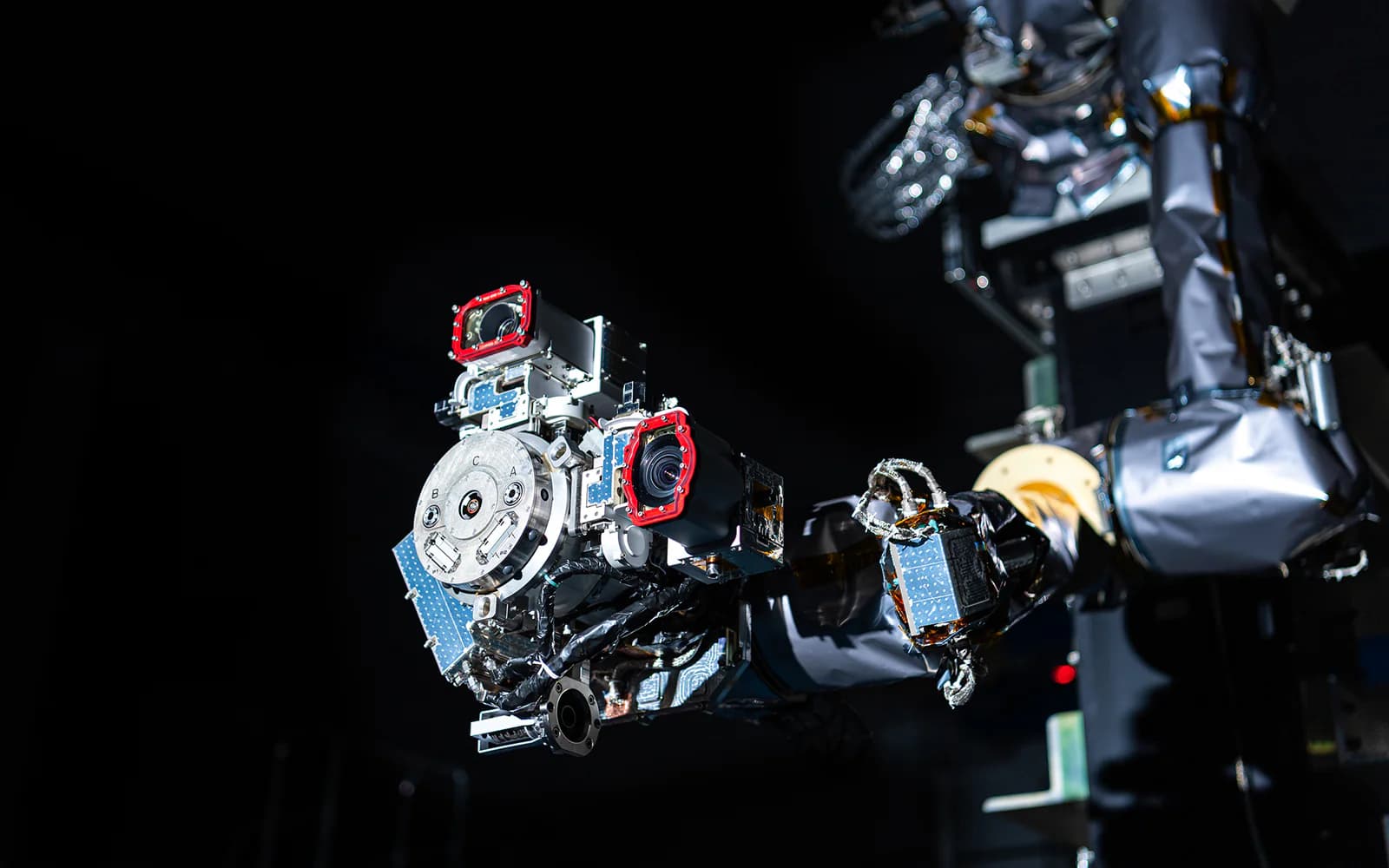
NASA OSAM-1 file photograph used illustratively; it does not depict the reported Kinova system, sensors, reconstruction or experiment, and NASA does not endorse this report. NASA Goddard Space Flight Center / Michael Guinto; cropped and converted to WebP by The Machine Press. Use does not imply NASA endorsement.
The inspection stack combined RGB-D, thermal and lidar sensing on a Kinova arm for large-structure reconstruction.
Researchers built a markerless multimodal inspection stack around a Kinova Gen2 arm, an RGB-D camera, a thermal camera and 2D lidar. The system plans viewpoints and motion while synchronizing the sensor streams into geometric and thermal reconstructions. Gazebo studies and preliminary laboratory work produced usable models in the reported setup; this iSpaRo-accepted paper is an early inspection result, not an on-orbit demonstration.
PolyUMI packages vision, tactile, audio and proprioception into a transferable wireless demonstration tool.
PolyUMI combines a wrist camera, optical tactile finger, microphone and proprioceptive sensing in a wireless gripper for collecting demonstrations. Its transferable sensing finger and VisTA dataset are meant to preserve more contact information than vision alone. In the paper's experiments, touch and audio added useful signals and matched or exceeded existing policies on selected tasks; the evidence remains bounded to those demonstrations and hardware.
BPC used demonstration windows, Hankel structure and action correction to fit in seconds and run above 75 hertz.
Behavioral Predictive Control retrieves relevant windows from demonstrations, organizes them through Hankel structure and corrects the proposed action online. The authors report competitive performance with learned policies and better results on some tested tasks while cutting fitting time from hours to seconds on consumer GPUs. They also report control above 75 hertz on a Jetson Orin Nano, with each action traceable to demonstration windows; wider robustness is not yet established.
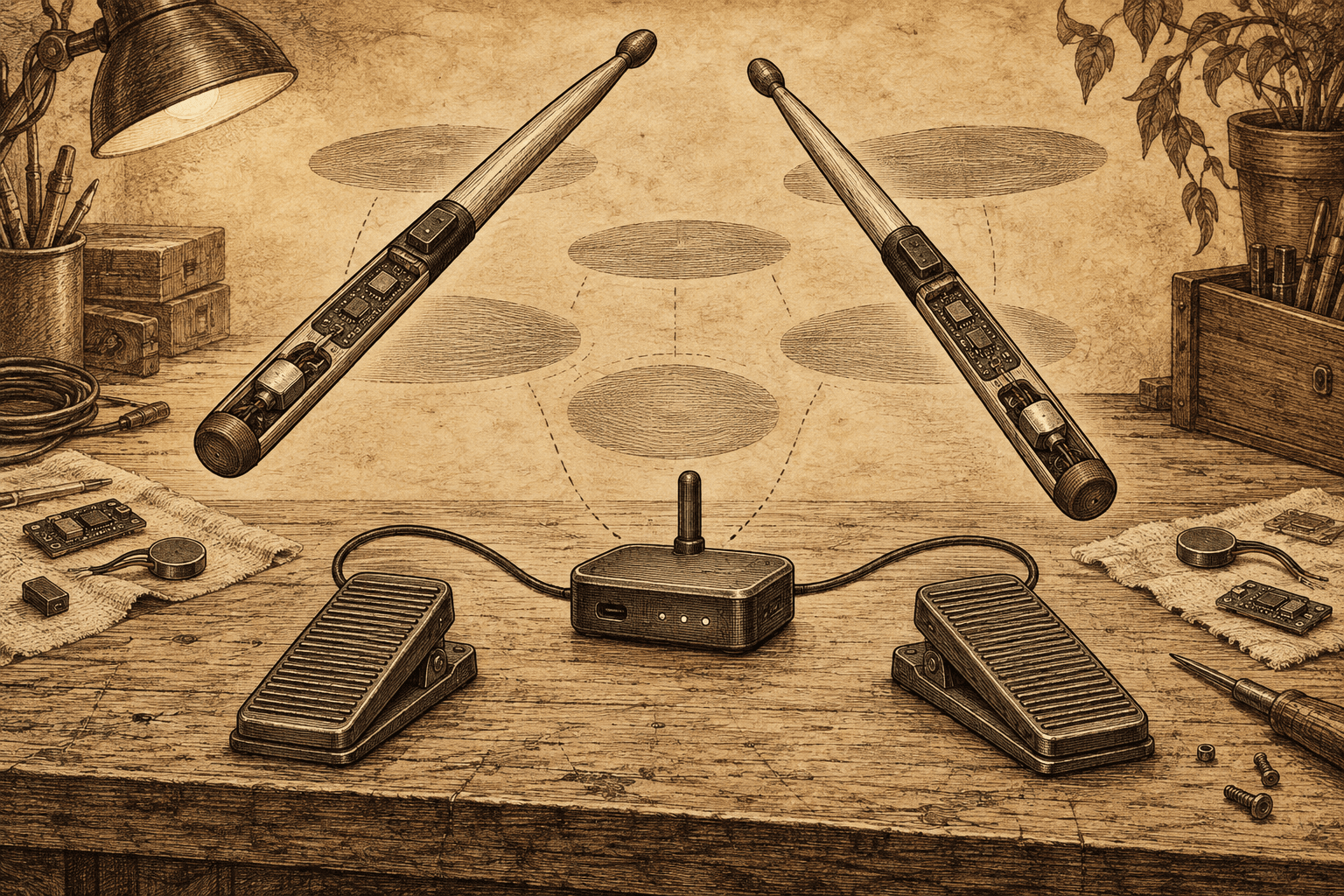
Moves motion tracking onto two ESP32-S3 drumsticks, adds haptic hits and a two-pedal hub, and sends velocity-sensitive drum events to open PC or Android playback software.
Visit Space Drums 2.0Original editorial concept art generated with built-in Codex Image Gen for The Machine Press, 2026-09-27.
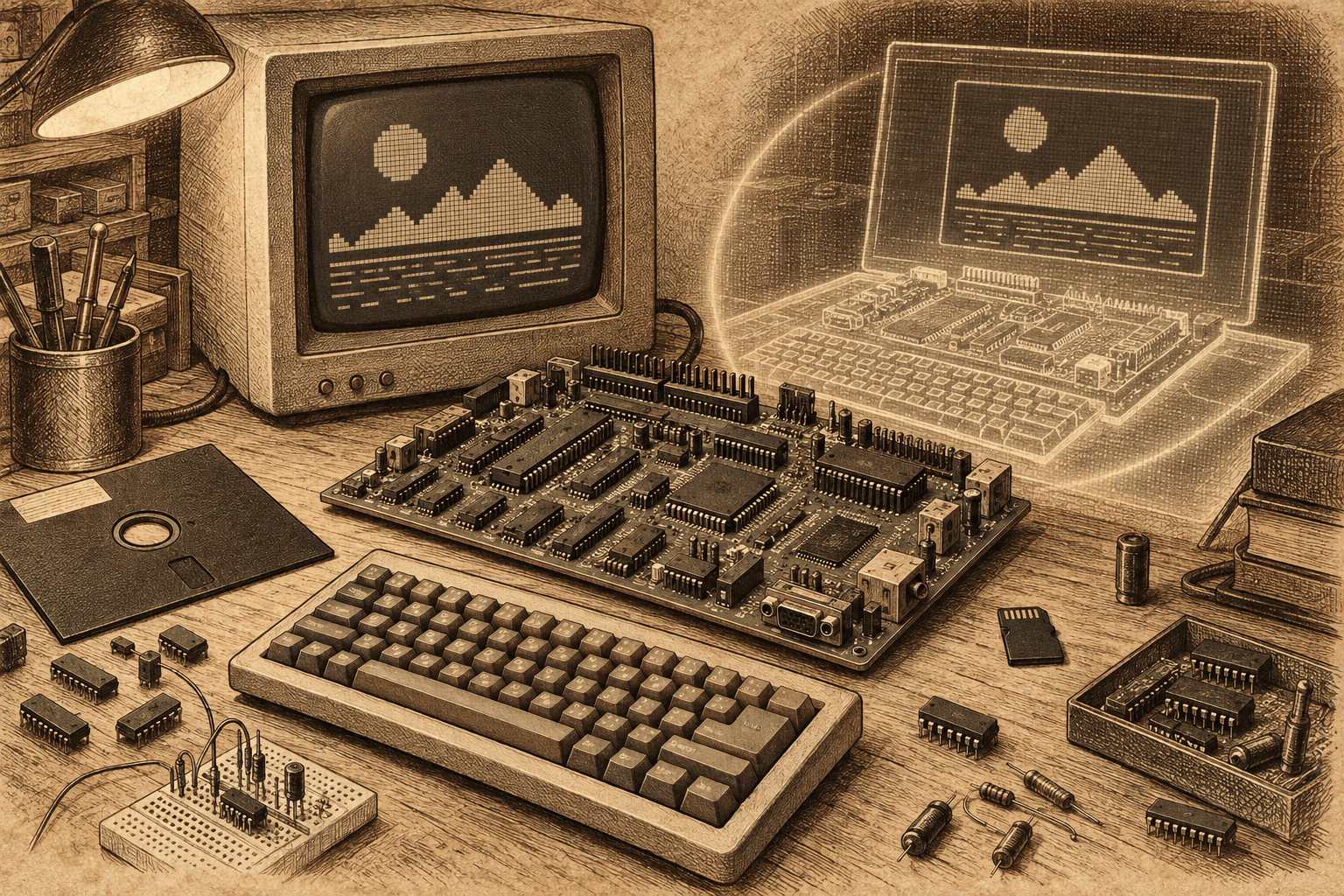
Pairs a chip-level 65C02 computer with custom hardware, video, sound, floppy, and microSD support with a cycle-honest emulator and browser assembler built around the same machine.
Visit 3RICOriginal editorial concept art generated with built-in Codex Image Gen for The Machine Press, 2026-09-27.
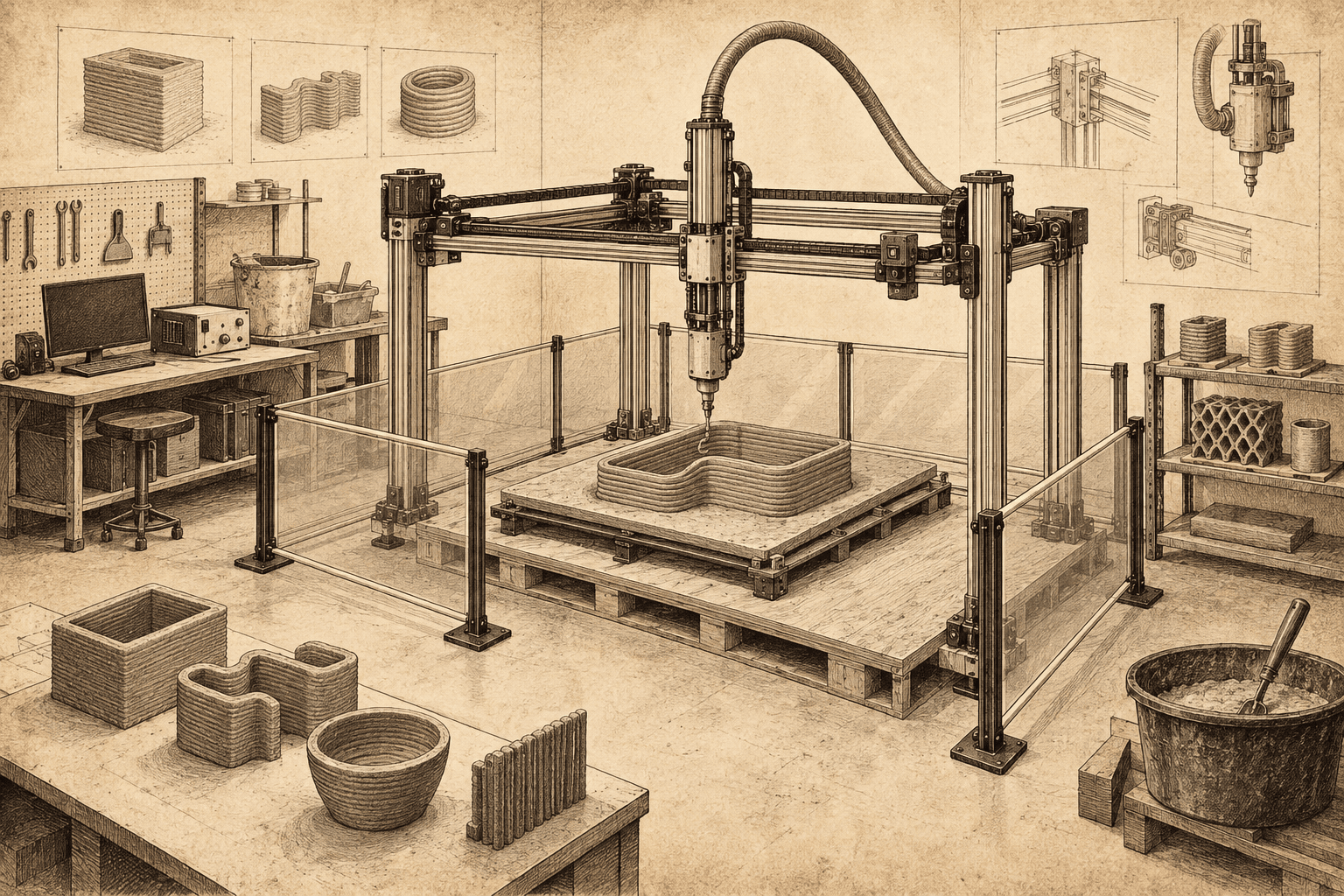
Publishes a pallet-scale cartesian motion reference, CAD, BOM, and low-voltage controls for supervised cementitious-extrusion research while explicitly excluding certified structural use.
Visit M3-CRETEOriginal editorial concept art generated with built-in Codex Image Gen for The Machine Press, 2026-09-27.
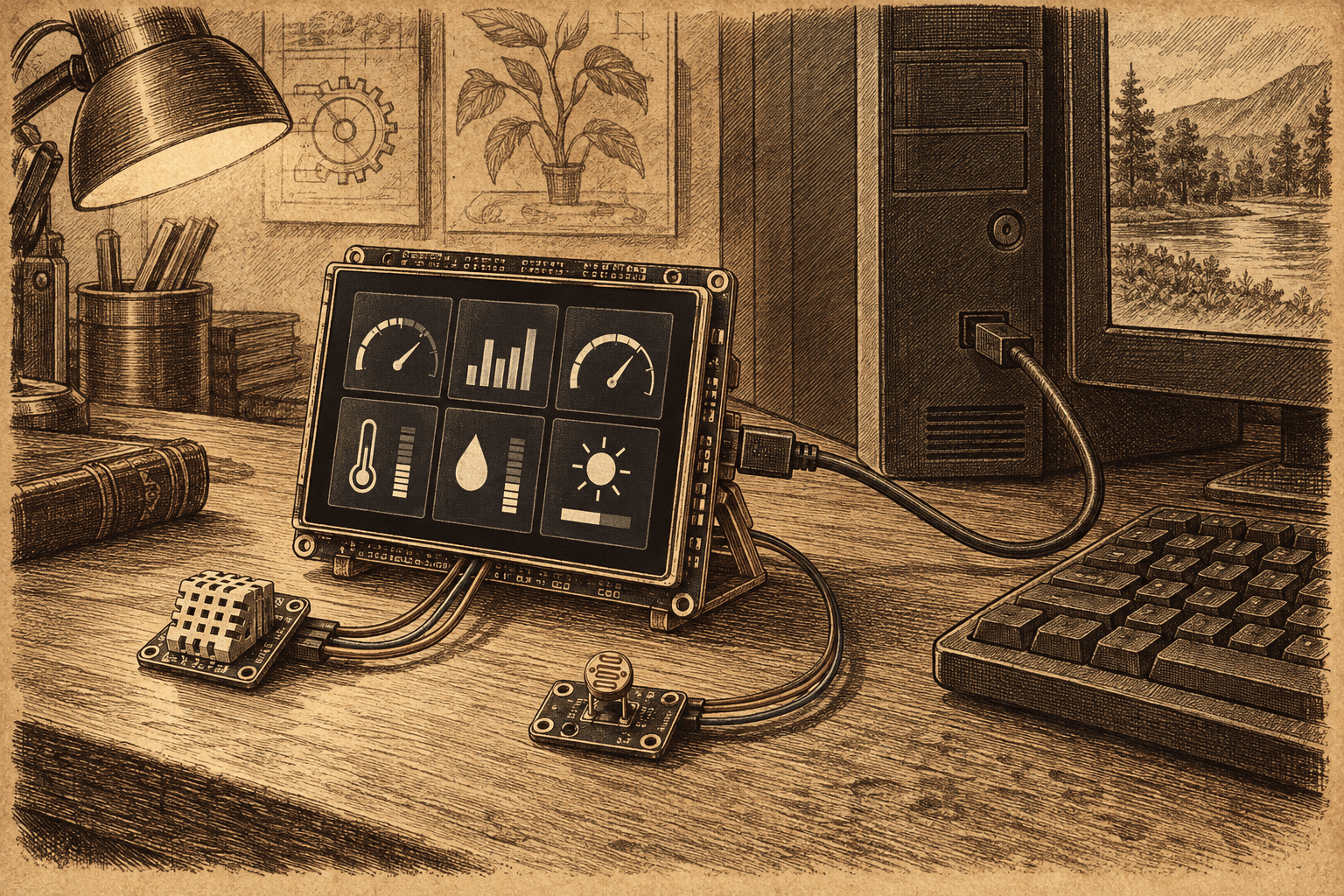
Turns a bare ESP32-S3 touchscreen into a USB-connected desk instrument for PC activity and optional room temperature, humidity, and light measurements.
Visit DeskNodeOriginal Codex Image Gen concept art from 2026-07-10; carried forward from the validated 2026-09-26 edition.
Desk Picks are selected by the newsroom. Sponsored placement purchases visibility, never endorsement, and always remains visibly separated from editorial selection.
 Editorial illustration