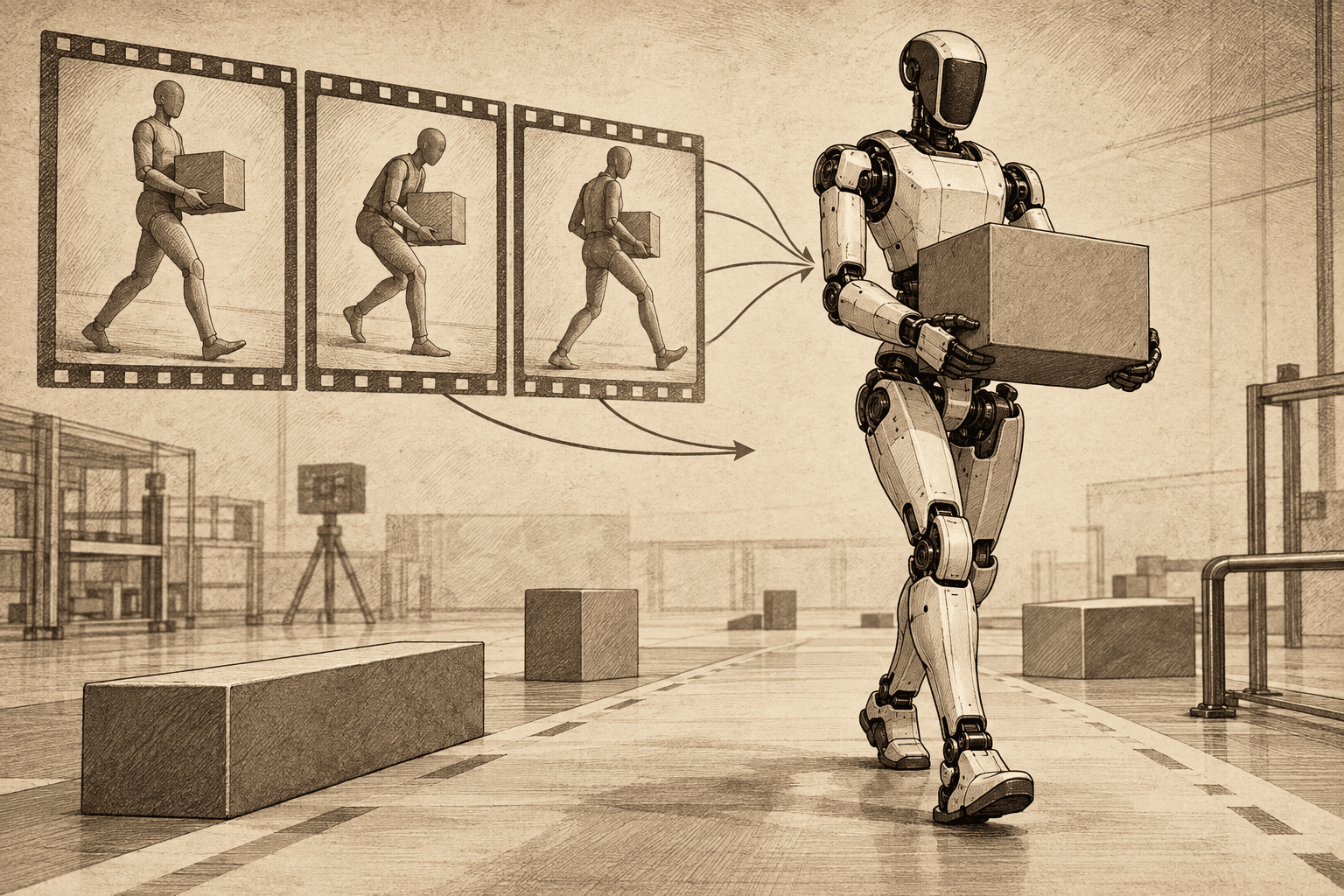
PRISM multiplied a small set of human examples into varied training motion, then grounded the result in physics.
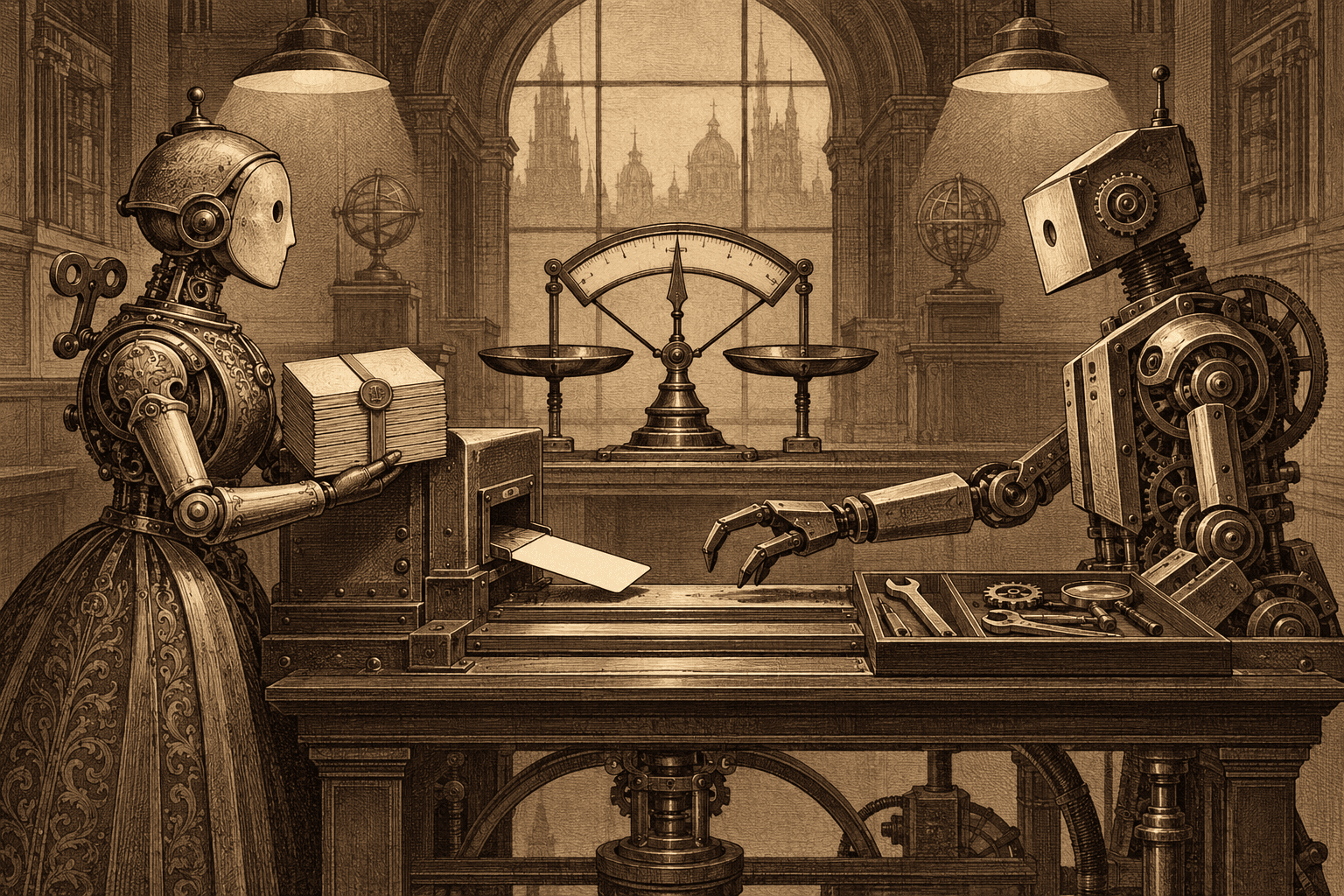
Editorial illustration
Concept illustration of counterfactual-video training for humanoid carrying; not PRISM hardware, a participant, test site or documentary trial image. Original editorial illustration generated with built-in Codex Image Gen for The Machine Press, 2026-09-30.
PRISM starts with a few real videos of people carrying objects, uses video-to-video generation to make hundreds of counterfactual variations, and reconstructs human and object motion through a contact-anchored real-to-sim pipeline. Those physically plausible trajectories train one policy across object categories. The authors report that a real humanoid, using onboard depth and no real-world fine-tuning, picked up, carried and dropped unseen boxes, barrels, bins and balls across new sizes and starting configurations. This is a submitted preprint and a reported demonstration, not proof that generated video removes the need for diverse physical testing.
Concept illustration of a simulated user changing an agent evaluation; not a UserProxyBench task, model trace or documentary benchmark interface. Original editorial illustration generated with built-in Codex Image Gen for The Machine Press, 2026-09-30.
UserProxyBench found that agent reward can stay high even when a proxy user breaks its private instructions.
UserProxyBench evaluates the language model assigned to play the user in interactive agent tests, scoring adherence to private instructions independently of whether the agent completes the task. With the agent fixed and only the user proxy varied across 375 enterprise tasks, mean reward moved by 15.2 points. The authors found user-specification violations in 24.4% of successful episodes; premature disclosure was the dominant failure, and successful episodes with it used 1.06 fewer tool calls on average. The result shows that task reward can conceal a changed interaction, within the tested tau-bench-derived setting and seven proxy models.
MGPO credited each rewrite only for the downstream value it added beyond what the old memory already supplied.
Memory Gain Policy Optimization treats persistent textual memory as a delayed credit-assignment problem. It measures a rewrite's marginal contribution to current and future utility instead of rewarding value inherited from information already stored. On document-level information extraction, the authors report improved extraction with average memory length nearly 80% lower than the initial policy before optimization. The learned policy also transferred across domains and downstream models without more training. These results are task-specific and do not show that every long-running agent should optimize memory the same way.
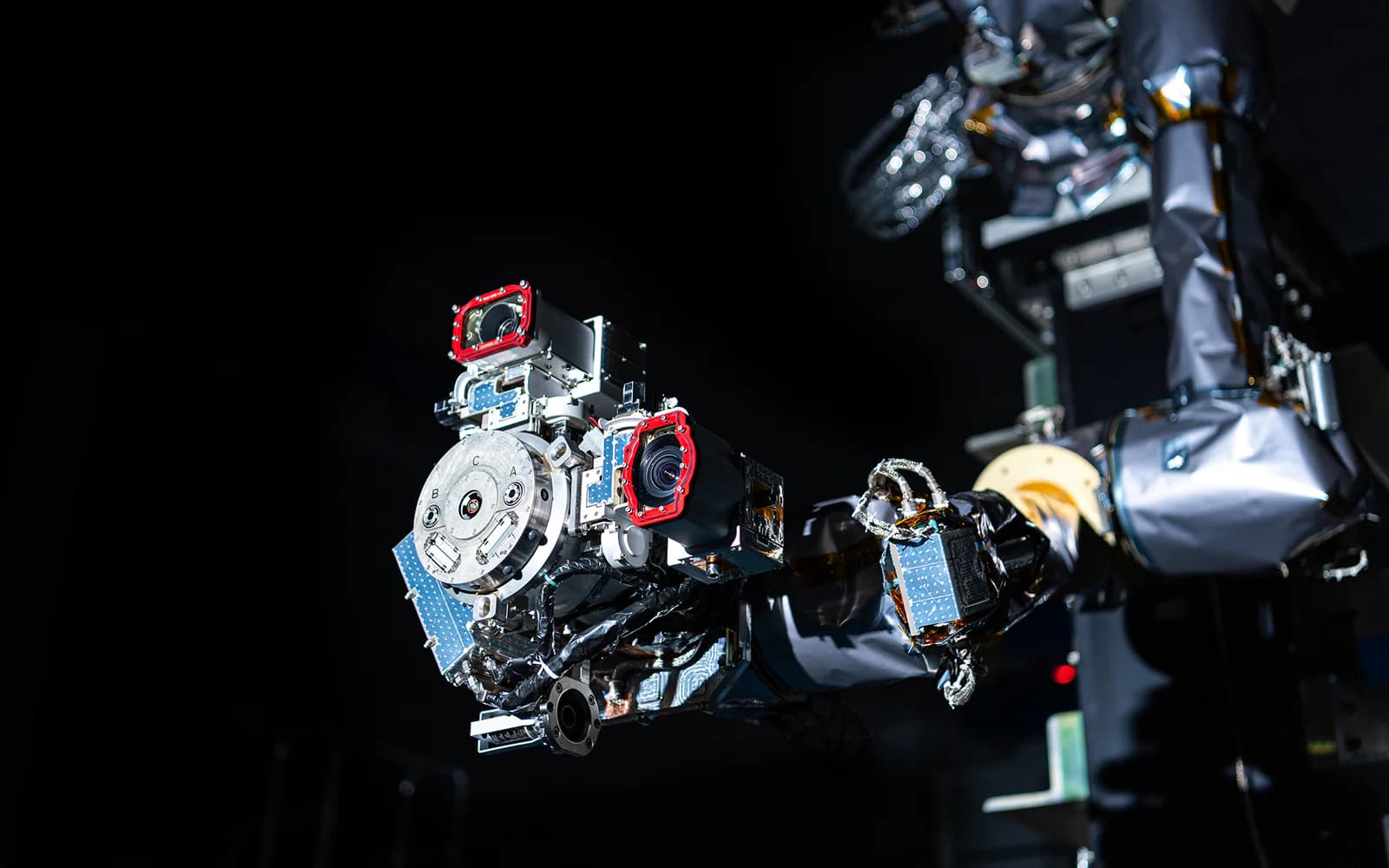
NASA OSAM-1 file photograph used illustratively; it does not depict skill-space shooting, a tested policy or reported correction, and NASA does not endorse this report. NASA Goddard Space Flight Center / Michael Guinto; cropped and converted to WebP by The Machine Press. Use does not imply NASA endorsement.
Skill-space shooting turned successful foundation-model-guided trials into supervision for the policy itself.
Skill-space shooting searches for corrections through short reusable behaviors that a foundation model can select from a scene. Successful trials become new policy supervision rather than remaining a one-off agent plan. The authors report repeated autonomous improvement in real-world policies and show that skills can be shared across tasks to reduce new teaching. The abstract establishes the mechanism and reported pattern, but does not provide a universal success rate or remove the need to validate corrections on each robot and task.
Imagine3D-LLM decoded summary tokens into a compact Gaussian-splat representation across viewpoints.
Imagine3D-LLM appends learnable summary tokens after image tokens, decodes them into a compact 3D Gaussian Splatting representation and trains that representation with photometric reconstruction alongside next-token prediction. Although direct reconstruction supervision reaches only the summary tokens, the authors report stronger cross-frame correspondence in the underlying image features and improvements across multiple spatial-reasoning and 3D-understanding benchmarks. The result supports the tested training recipe; it does not establish human-like spatial understanding.
A post-training loss restored missing high-frequency power without changing the sampler or architecture.
The researchers kept a pretrained pixel diffusion model's original objective and added an adversarial loss to predicted outputs at non-high-noise timesteps. Across two pixel backbones, they report joint gains in distribution fidelity, coverage, prompt alignment and perceptual quality, with spectral analysis showing restored high-frequency content. Matched controls were used to test memorization, mode dropping and extra optimization. Under the latent-diffusion configurations they tested, the same procedure did not produce comparable joint gains, marking a reported boundary rather than a general GAN recipe.
SimpleICL defined what a visual demonstration should transfer, then paired it with low-cost data collection.
SimpleICL separates the information packed into a robot's visual demonstration—action, semantics, affordances, spatial relations and goal—by defining the intended learning target explicitly. Its minimalist framework combines a visual prompt encoder with a low-cost collection protocol and, according to the authors, performs strongly in simulation and real-world tests without massive pretraining or specialized infrastructure. Experiments probe action, semantic, composition and affordance discrimination. The paper promises an open release, so reproducibility will depend on the final data and training pipeline.
Rho kept its flow-matching action expert fixed while a lightweight latent policy learned from feedback.
Rho is an open-weights family of vision-language-action models for bimanual manipulation across three dual-arm embodiments. Controlled simulation and physical tests in the report favor embodiment midtraining for downstream adaptation. For online adaptation, a small latent policy learns from corrective feedback to choose observation-conditioned noise for the frozen action expert; the authors say as few as 15 corrected episodes handled situations at the fringe of the offline distribution. Those results belong to the reported tasks and hardware, and the released checkpoints still need independent evaluation.
Generic Pexels server-hardware file image used illustratively; it does not show STEPQuant, a named model, serving workload or benchmark system. panumas nikhomkhai / Pexels; cropped, resized, metadata stripped, and converted to WebP by The Machine Press.
STEPQuant assigned precision by error impact and memory lifetime instead of quantizing every state uniformly.
STEPQuant targets the fixed-size recurrent states used by Delta-rule linear attention, where rounding errors can persist through later updates. It assigns precision across both time and state structure, fitting key-row and value-column scales to distributions and output impact. On Qwen3.8-27B and Kimi-Linear-48B-A3B-Instruct, the authors report near-FP32 accuracy at a nominal six-bit budget and better four-bit results than uniform INT8. Their SGLang implementation compressed recurrent state by more than fivefold and reduced total serving memory by as much as 68.7% on the tested workloads.
ReWAM routed action loss into a compact bottleneck while its world model learned how that state evolved.
ReWAM tests the representation shared by robot control and future-observation prediction. Feature calibration and a temporal bottleneck organize pretrained DINO features into compact states, while action-grounded shaping sends only action-loss gradients into that bottleneck. Without generative video pretraining, the authors report 93.6% success on RoboTwin 2.0; on RoboDojo they report an average score of 12.29 and 8.28% success after roughly 600 hours of embodied pretraining. Those numbers come from different evaluations and should not be read as one common scale.
Grounded Entity Biographies linked the same physical instance across clips without discarding each moment's context.
Grounded Entity Biographies groups visually grounded observations of one physical object into a retrievable history, then supplies that biography alongside episodic evidence when answering questions. Across four benchmarks containing day- and week-long recordings, the authors report improvements for both multiple-choice and open-ended answers. On EgoLifeQA, accuracy reached 72.0%, 4.4 percentage points above the best published result cited in the paper. Ablations attribute gains to both identity association and biography reading; extra descriptions alone did not recover the full improvement.
PowerSim coupled power-diagram primitives directly to material-point dynamics without a second scene representation.
PowerSim maps the geometry and appearance of a pretrained PowerFoam scene onto quantities already tracked by a Material Point Method simulation. That direct coupling lets deformation update both scene shape and rendering. The authors demonstrate user-driven dynamics, recovery of spatially varying materials, simulation-ready composition of independently captured primitives and reflections that change with deformation. They report stronger physically grounded dynamics than compared frameworks. The claims come from the submitted evaluation and project demonstrations, not a guarantee for arbitrary captured scenes or materials.
FracGen predicted RGB frames and dense physical fields together, with controls for crack origin and propagation.
FracGen trains on FracSim, which adds a continuum-damage model to Material Point Method simulation and produces paired fracture videos with pixel-aligned physical fields. The generator predicts those fields alongside RGB video and uses physics-informed losses to keep them consistent. The authors report material-specific stretching and tearing, plus controls for tear location, crack speed and pre-failure deformation, and say it beats tested video baselines in physical and visual fidelity. It remains a learned approximation evaluated on the paper's benchmark, not an engineering fracture solver.
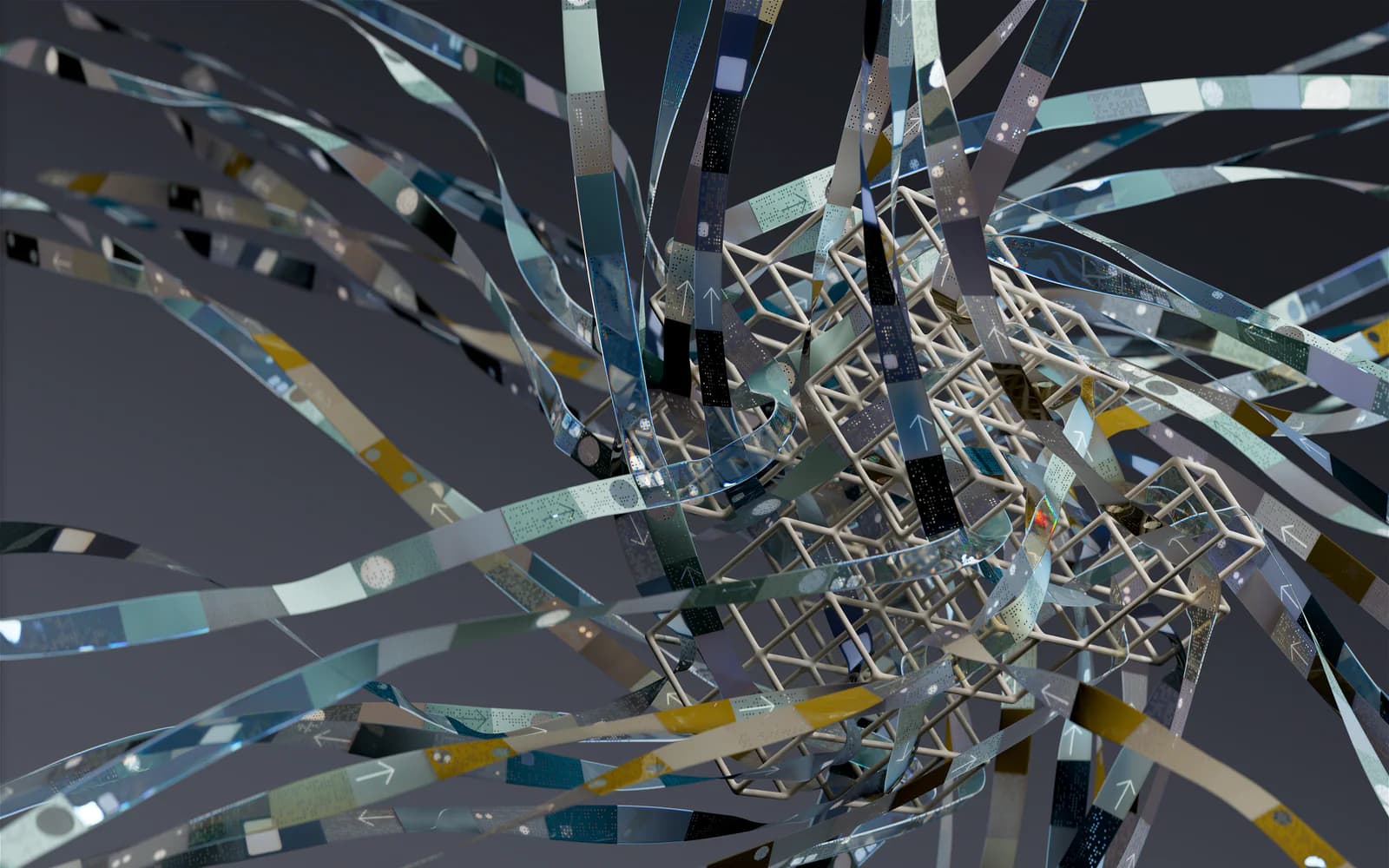
Conceptual Visualising AI illustration used illustratively; it is not a WorldLine architecture diagram, simulator frame or experimental result. Tim West / Google DeepMind / Pexels; cropped, resized, metadata stripped, and converted to WebP by The Machine Press.
WorldLine separated transferable visual dynamics from action grounding across incompatible robot bodies.
WorldLine learns manipulation dynamics from more than 10,000 hours of action-free robot video, then grounds those dynamics with over 2,000 hours of action trajectories spanning more than ten embodiments. An image-space action representation provides a shared control interface, while failure-enriched and multi-view training target interaction fidelity. The authors report 74% mean trajectory-success prediction across RoboTwin and AgiBot, and gains of up to 21.4 percentage points when its rollouts guide tasks without RoboTwin training or adaptation. Those are benchmark results, not a substitute for hardware safety checks.
EVO-WAM kept generated prefixes only when video showed completion and inverse dynamics agreed with the actions.
EVO-WAM adapts a world-action model to unseen tasks without executing each candidate rollout externally. It selects prefixes that a vision-language model judges task-completing, checks video-action consistency with inverse dynamics and retrains iteratively on the verified subset. Across seven unseen RoboTwin 2.0 tasks, reported average success rose from 26.9% to 68.0% for Cosmos3 and from 28.5% to 46.4% for DreamZero. On three real long-horizon composites, Cosmos3 rose from 20.0% to 76.7%. The verifier stack can still inherit model error, so external validation remains necessary.
EgoGears separated local perception from the harder job of binding evidence across independent route videos.
EgoGears contains 567 single-video and 1,487 multi-video questions from 126 egocentric recordings of 39 outdoor routes; 531 questions require alignment across recordings. Among 20 model configurations tested comparably on both splits, every one performed worse on multi-video questions, with a mean decline of 22.5 percentage points. Controls indicate that additional video volume or recording boundaries alone do not explain the gap. The authors identify observation-evidence binding and ordered route-state tracking as the central tested bottlenecks.
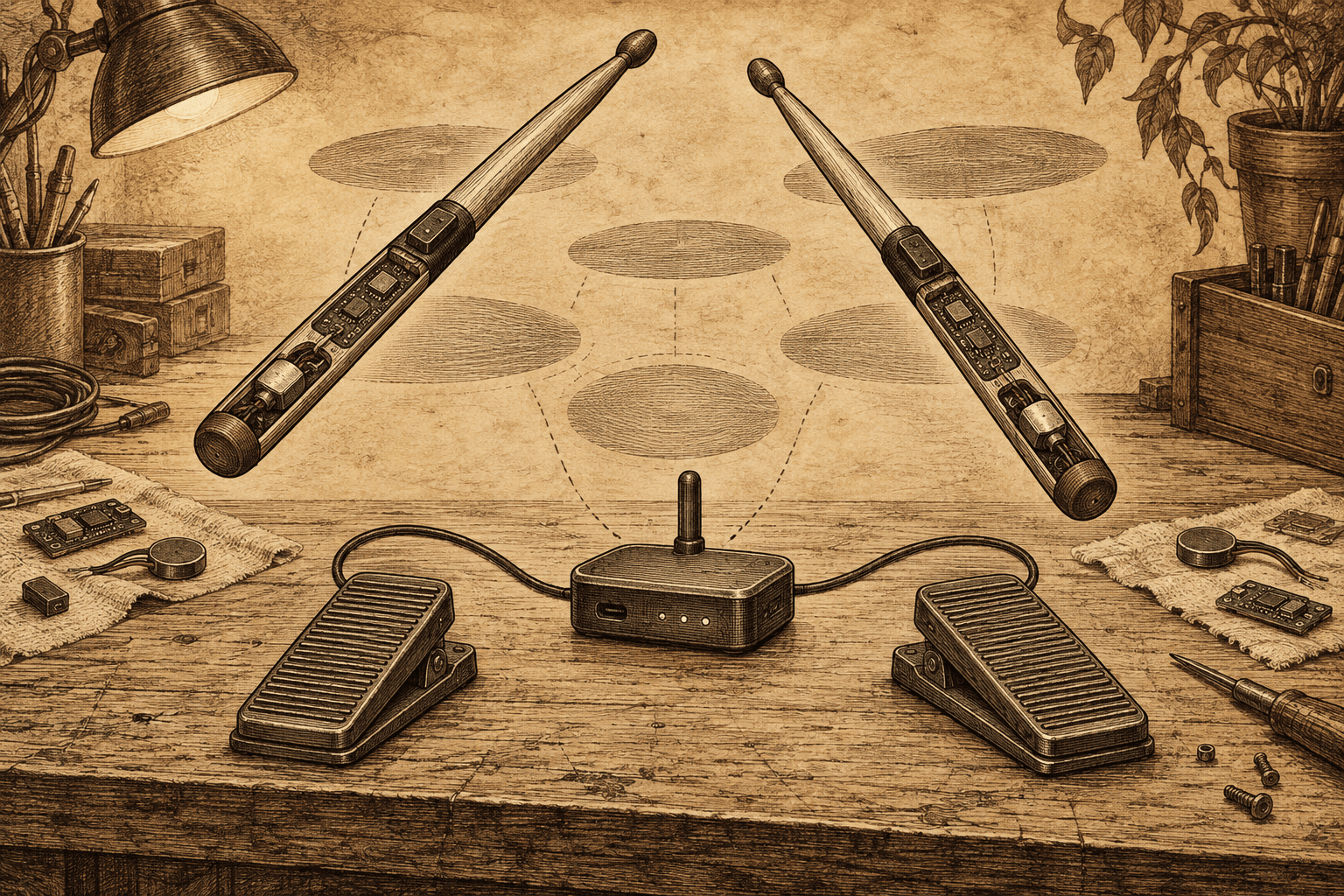
Moves motion tracking onto two ESP32-S3 drumsticks, adds haptic hits and a two-pedal hub, and sends velocity-sensitive drum events to open PC or Android playback software.
Visit Space Drums 2.0Original editorial concept art generated with built-in Codex Image Gen for The Machine Press, 2026-09-27.
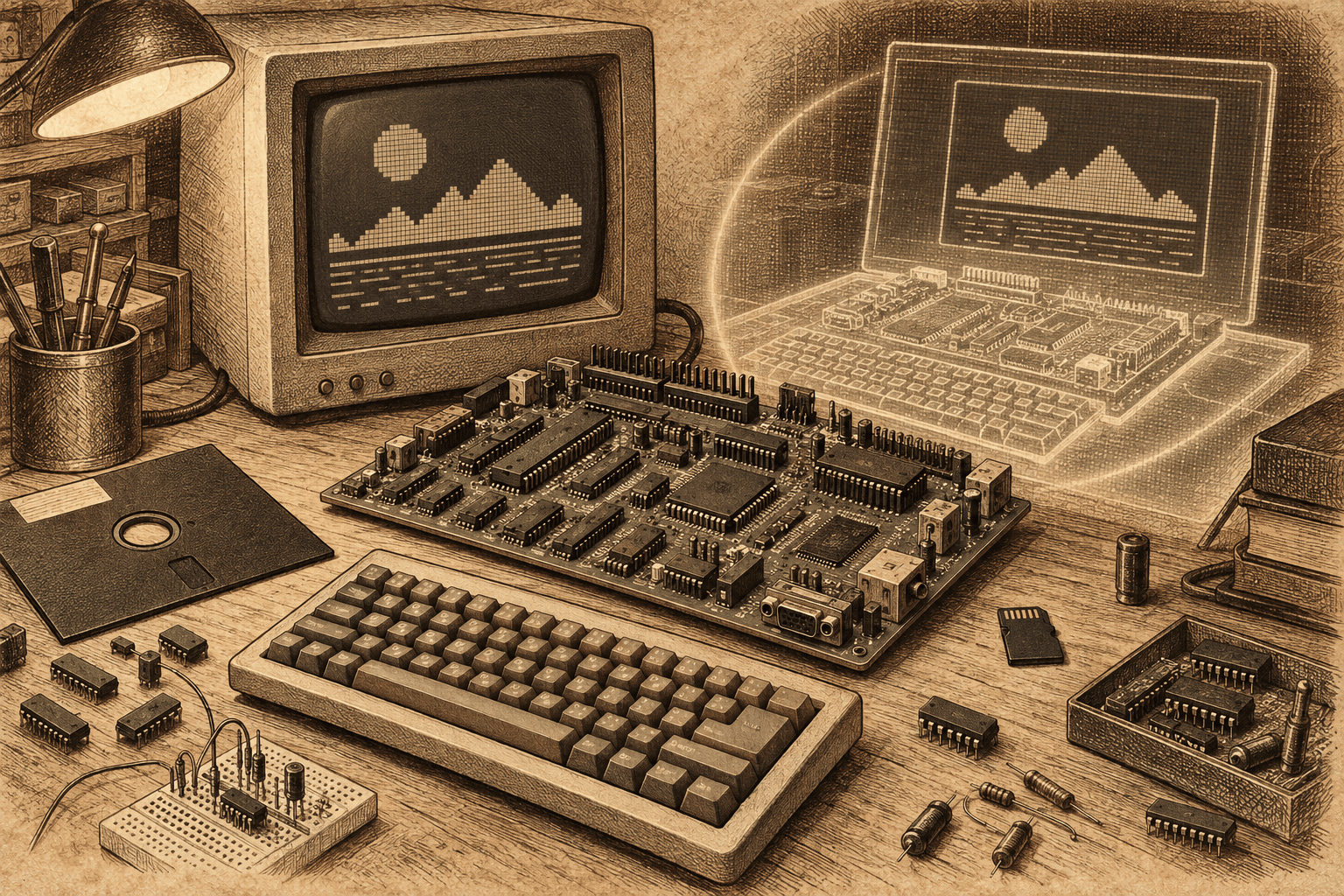
Pairs a chip-level 65C02 computer with custom hardware, video, sound, floppy, and microSD support with a cycle-honest emulator and browser assembler built around the same machine.
Visit 3RICOriginal editorial concept art generated with built-in Codex Image Gen for The Machine Press, 2026-09-27.
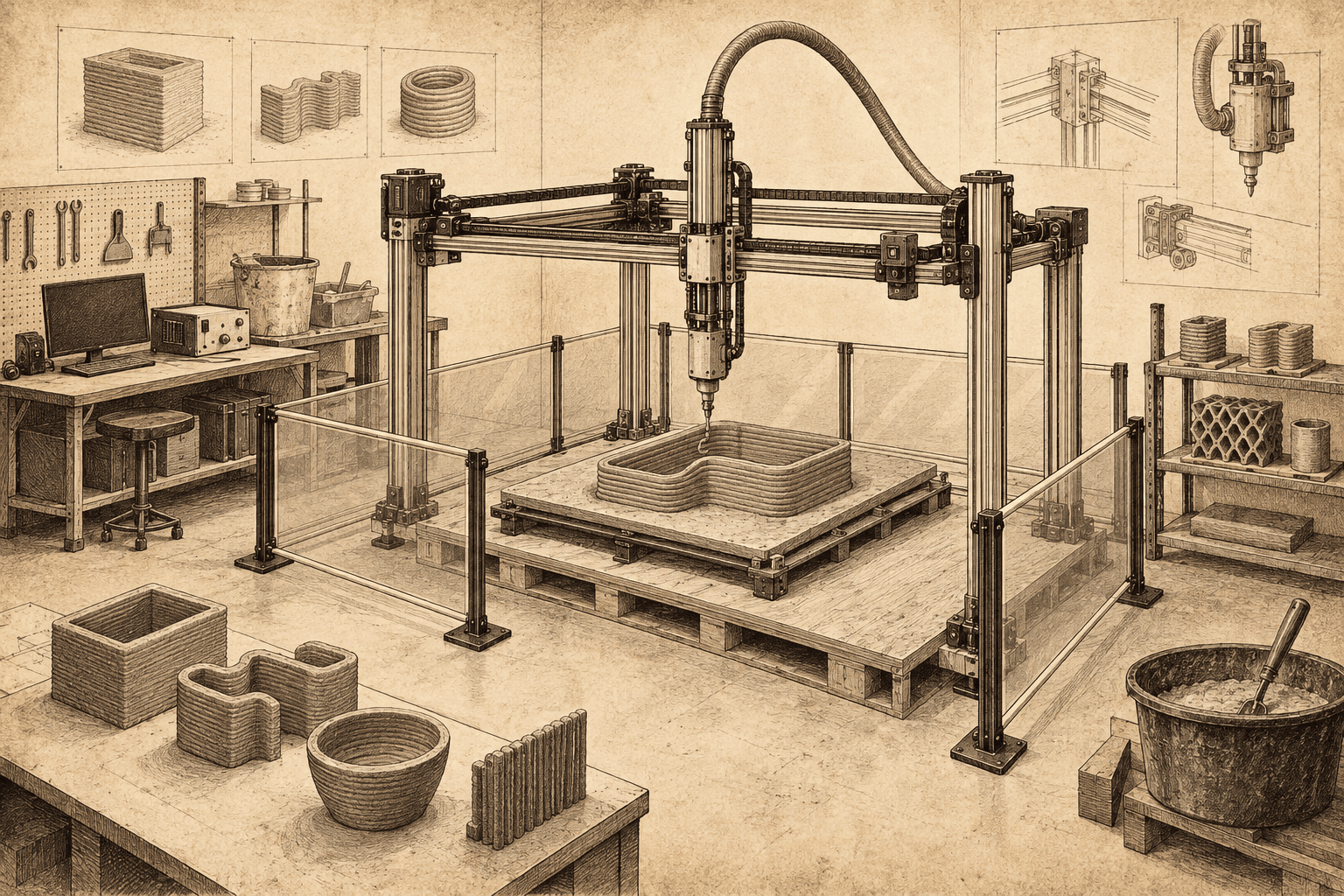
Publishes a pallet-scale cartesian motion reference, CAD, BOM, and low-voltage controls for supervised cementitious-extrusion research while explicitly excluding certified structural use.
Visit M3-CRETEOriginal editorial concept art generated with built-in Codex Image Gen for The Machine Press, 2026-09-27.
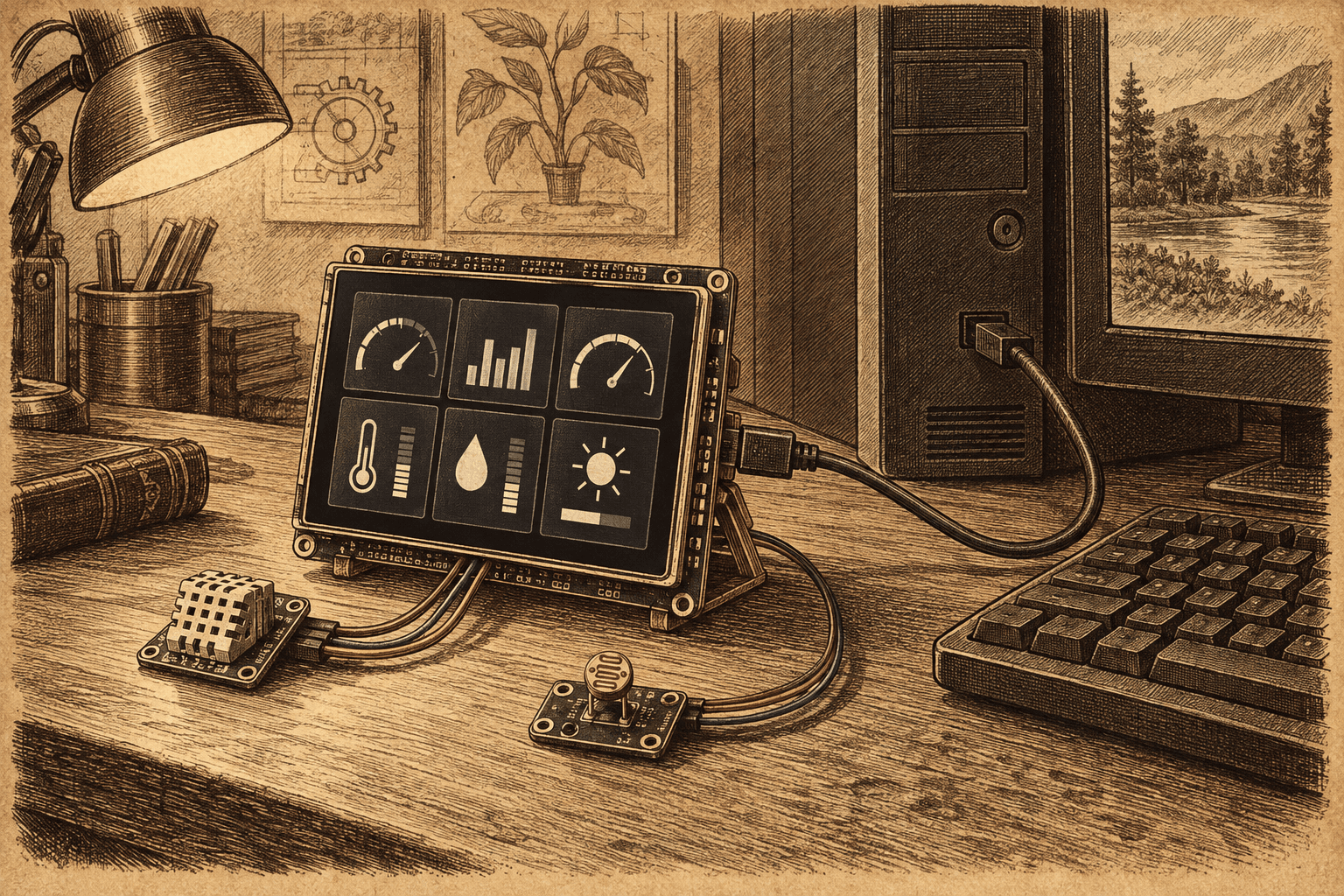
Turns a bare ESP32-S3 touchscreen into a USB-connected desk instrument for PC activity and optional room temperature, humidity, and light measurements.
Visit DeskNodeOriginal Codex Image Gen concept art from 2026-07-10; carried forward from the validated 2026-09-26 edition.
Desk Picks are selected by the newsroom. Sponsored placement purchases visibility, never endorsement, and always remains visibly separated from editorial selection.
 Editorial illustration