robotics
A Few Videos Taught a Humanoid to Carry New Objects
PRISM multiplied a small set of human examples into varied training motion, then grounded the result in physics.
Summary
PRISM multiplied a small set of human examples into varied training motion, then grounded the result in physics.
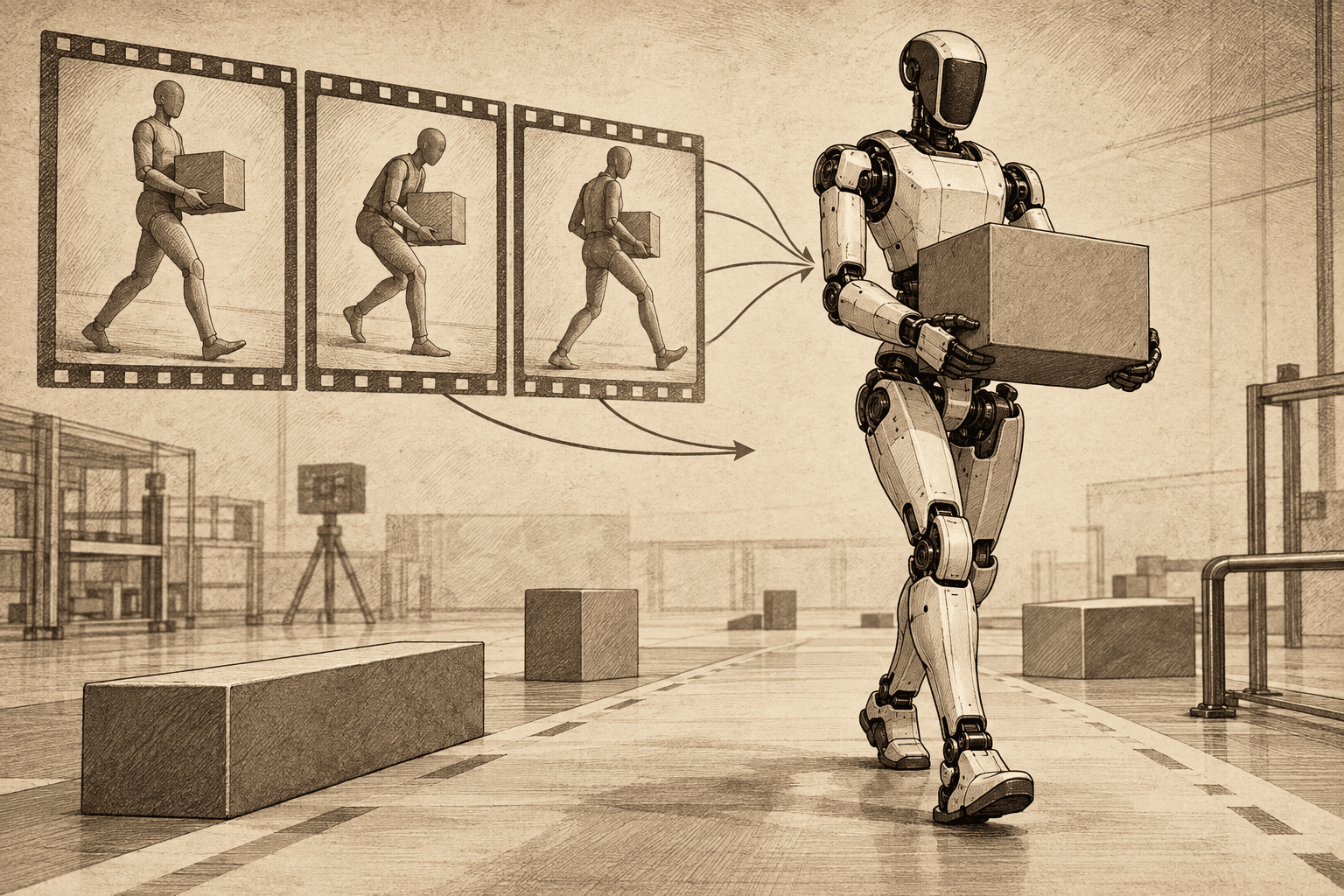
PRISM starts with a few real videos of people carrying objects, uses video-to-video generation to make hundreds of counterfactual variations, and reconstructs human and object motion through a contact-anchored real-to-sim pipeline. Those physically plausible trajectories train one policy across object categories. The authors report that a real humanoid, using onboard depth and no real-world fine-tuning, picked up, carried and dropped unseen boxes, barrels, bins and balls across new sizes and starting configurations. This is a submitted preprint and a reported demonstration, not proof that generated video removes the need for diverse physical testing.
Why it matters
PRISM multiplied a small set of human examples into varied training motion, then grounded the result in physics.
Limits and context
- This is a submitted preprint and a reported demonstration, not proof that generated video removes the need for diverse physical testing.
Key claims
PRISM multiplied a small set of human examples into varied training motion, then grounded the result in physics.
Qualification: This is a submitted preprint and a reported demonstration, not proof that generated video removes the need for diverse physical testing.
Evidence: source-2026-09-30-001
Sources
- arXiv preprint 2609.38172arXiv · primary research
Corrections
No corrections have been recorded for this story.