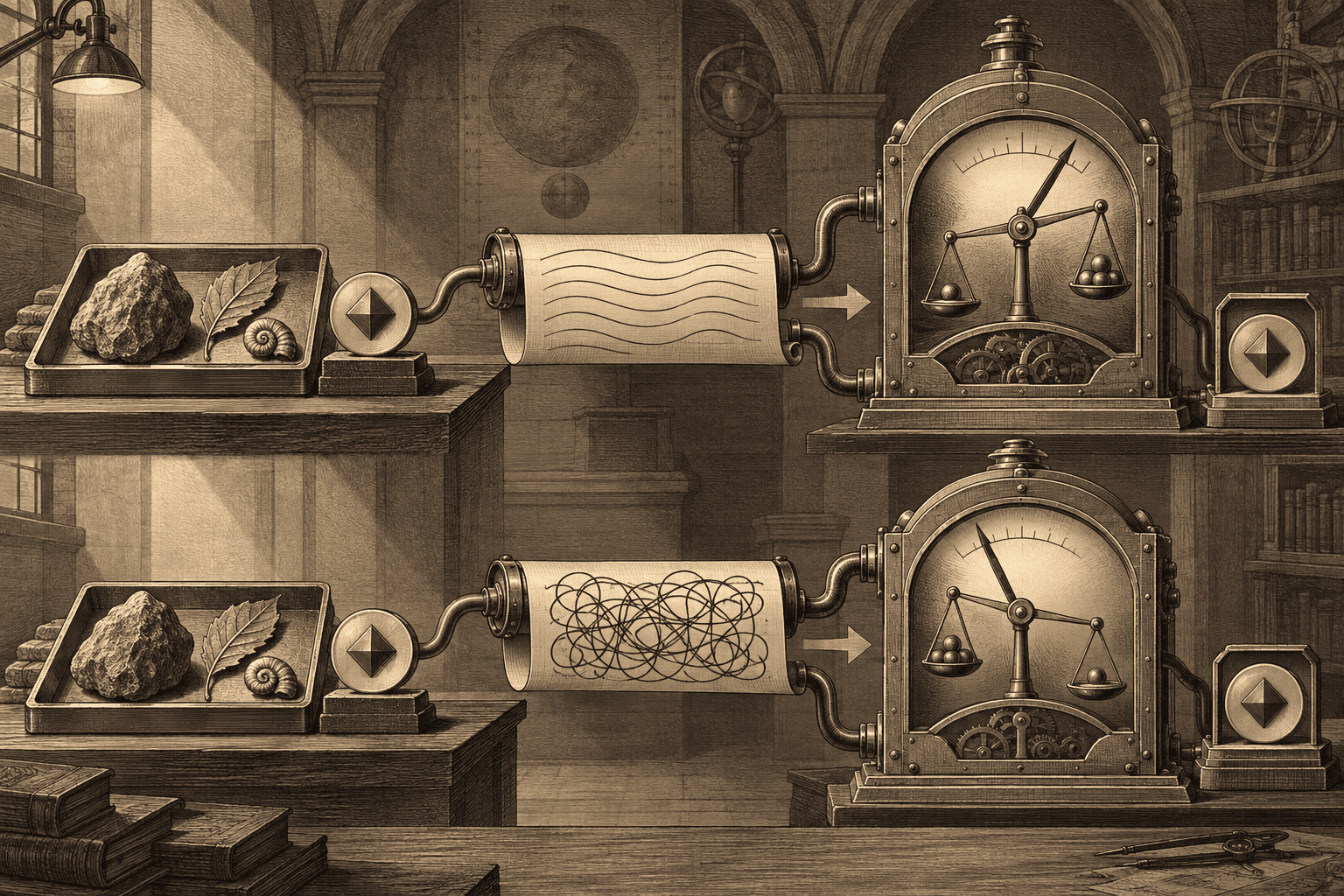
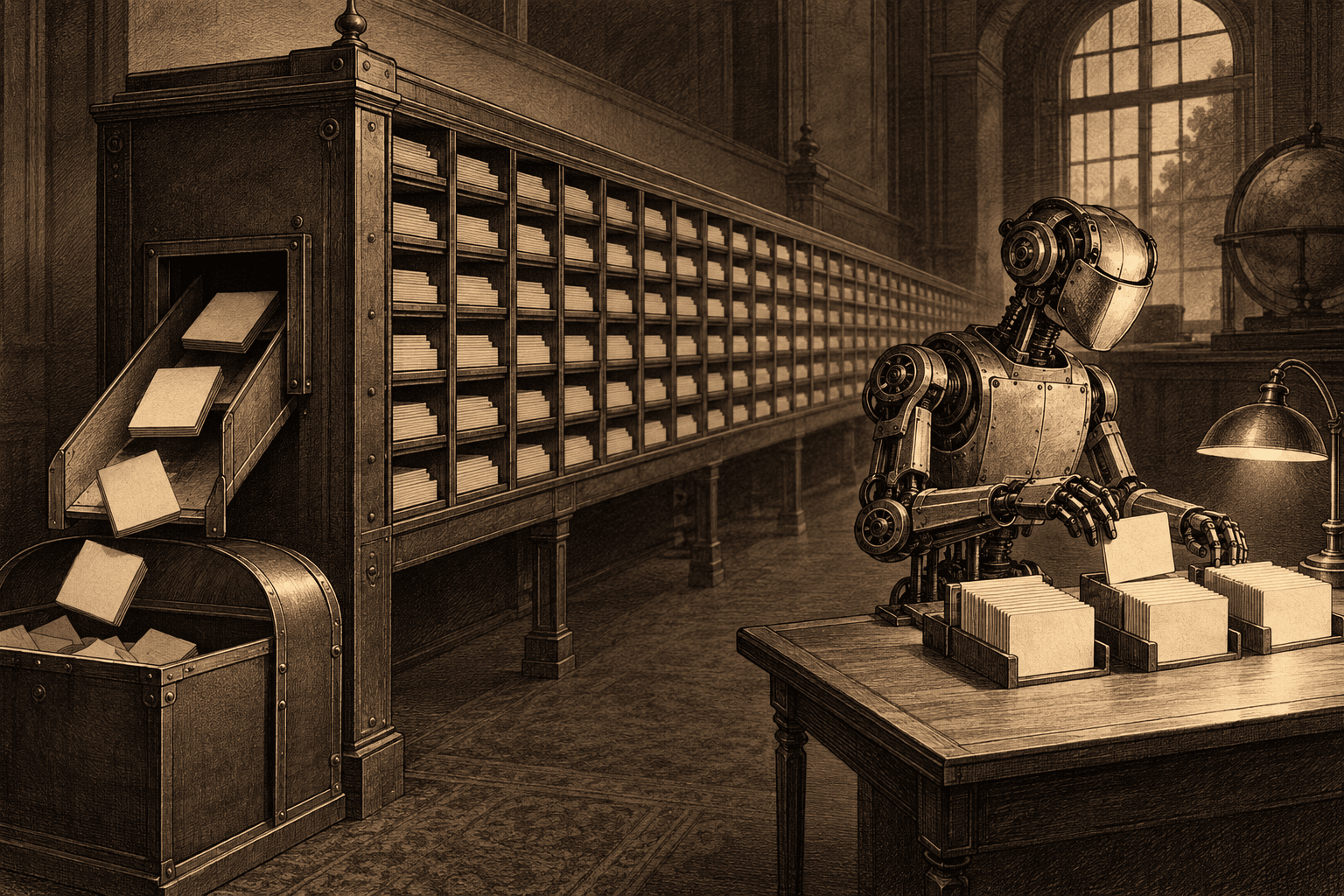
Causal Memory Policy intervened on retrieval itself after store-level tests left memory utility unidentified.
Editorial illustration
Concept illustration of causal retrieval and bounded agent memory; not the CMP system, an execution trace or documentary image. Original editorial illustration generated with built-in Codex Image Gen for The Machine Press, 2026-10-02.
Memory systems often estimate whether a stored item matters only after the retriever surfaces it. Causal Memory Policy shows that this creates a positivity failure: store-level interventions cannot identify the value of a memory that is never retrieved. In the authors' tests, utility was unidentified for 54 percent of required LongMemEval memories and 67 percent on LoCoMo, including in a deployed system. Reserving context slots for memories sampled with known propensities raised required-versus-nonrequired discrimination from 0.54 to 0.66 AUC. Even then, utility estimated for one query did not predict value on unseen queries, limiting its use for irreversible retention decisions.
Concept illustration of external model oversight and changed internal evidence channels; not a hidden-state probe, model interface or documentary image. Original editorial illustration generated with built-in Codex Image Gen for The Machine Press, 2026-10-02.
Cross-model hidden-state probes matched or beat generators at locating the onset of semantic drift.
Rather than label each output token independently, the study probes internal activations to locate the onset and continuation span of a hallucination. The authors report substantial precision-recall AUC improvements over random baselines despite extreme class imbalance. Their cross-model setup lets one model inspect hidden representations elicited by another model's generation; an external observer matched or exceeded the generator's own onset detection, even when the observer was smaller. The result is a preprint evaluation of the tested model pairs and probes, not evidence that smaller models generally know truth better or that access to internal states is available across ordinary hosted systems.
A zero-mean projection kept polynomial approximations inside their safe range without ciphertext bootstrapping.
Fully homomorphic reinforcement learning replaces nonlinear operations with polynomials, which can recursively amplify Bellman error. The Homomorphic Advantage Operator centers temporal-difference targets to remove the uniform value baseline that drives this drift while preserving action rankings. Across tabular, encrypted CartPole and logistics tests, reported agents had zero boundary breaches in all seeds, versus breaches in three of five regularized seeds and 83.8 percent of unstabilized episodes. These controlled results do not establish production security or broad RL performance.
The National Archives server room used illustratively; it does not depict RPG, robot practice, simulator state or the reported trials. The National Archives (UK), via Wikimedia Commons, CC BY 3.0; cropped and converted to WebP by The Machine Press.
RPG revised symbolic skills and prompts from simulated execution feedback without updating model weights.
Reconstruct, Practice, Go Real identifies capabilities in offline robot data, builds related simulation tasks and uses execution feedback, privileged simulator state and videos to diagnose failures. Candidate skill and prompt revisions are tested across tasks before retention. On 22 manipulation tasks, reported success rose from 28.6 percent after the first practice round to 95 percent after 15, above the tested baselines; after calibration and hardware adaptation, the frozen system completed all 30 physical trials across three tasks. These are source-reported results on a limited task and hardware set.
Embedding retrieval reached 0.48 Recall@20; an agent calling that retriever scored 0.42.
ScholarCatalyst asked 184 lead authors of 207 computer-science papers which earlier work did or could have advanced their projects, with rationales and a time-bounded literature pool. Agentic search reached 0.42 Recall@20, below embedding retrieval at 0.48, while the strongest tested agent reached 0.51 despite possible training exposure to completed papers. The benchmark turns scientific inspiration into an author-judged retrieval task; it does not establish that the labeled papers were the only valid catalysts.
KaliBench tests 8,504 intent-to-command pairs across 1,642 Kali Linux tools.
KaliBench measures whether models can translate analyst intent into executable command lines, with deterministic canonicalization, alias-aware scoring, sandbox execution and human refinement. Across 24 configurations, no open-weight model exceeded 42 percent exact-command accuracy without tool hints. Fine-tuning and verifiable-reward training substantially improved an eight-billion-parameter model to performance comparable with a tested 685-billion-parameter mixture-of-experts model. Exact-command accuracy is a benchmark metric, not authorization to run generated security commands unsupervised.
Lossless observation memory let one multimodal model finish all 25 public ARC-AGI-3 games.
VISTA preserves past visual observations in original form and lets a multimodal model retrieve and reorganize them during long-horizon reasoning. On ARC-AGI-3, the authors report that it raised Claude Opus 5.0's Relative Human Action Efficiency from 40.68 to 100, completing all 25 public games with 57.4 percent fewer actions than first-time human participants. It also improved results on three other visual-game and puzzle benchmarks. The score depends on the reported harness, model and public game set and is not a general measure of visual intelligence.
A shared linear blendshape basis replaced heavy per-frame neural decoding across three avatar systems.
GALA distills pretrained Gaussian-avatar animation into a shallow coefficient predictor and a linear blend of identity-independent basis shapes. Block-local PCA under a rendering-aware metric controls fidelity and memory. Across three facial and full-body avatar systems, the authors report up to three orders of magnitude lower CPU animation cost while preserving most rendering quality and reaching as much as 60 frames per second on mobile devices. The claim applies to the evaluated models and held-out identities, not every avatar architecture.
Conceptual Visualising AI illustration used illustratively; it does not show SILSA, slice latents, generated geometry or benchmark evidence. Tim West / Google DeepMind / Pexels; cropped, resized, metadata stripped, and converted to WebP by The Machine Press.
Sliding-window slice latents preserved cross-sections and long-range topology in one stage.
SILSA represents shapes with overlapping slice latents along three axes rather than fragmented voxel tokens. A sparse decoder and shared volumetric anchor lattice coordinate the slice streams, while persistence-diagram supervision tracks topology between neighbors. Against the strongest reported baseline, SILSA improved PSNR by 8.7 percent, coverage by 5.96 points and Betti error by 9.2 percent while using 70 percent fewer tokens than the next-most compact baseline. These are benchmarked generation results, not guarantees for arbitrary geometry.
Argo-Bench hides ground truth behind 235 tables and grades decisions by simulated consequences.
Argo-Bench simulates a 2024 New York food-delivery platform at scale, exports it as a 235-table, 7.5-billion-row ERP warehouse and asks agents to reconstruct facts before actions such as fraud bans, incentives or back pay. Each of its 210 tasks has an executable reference solution. The strongest of 14 tested frontier and open-weight models scored at least 95 on only 34.8 percent of tasks and averaged 59.5 points. The warehouse is synthetic but designed from public data, literature and filings.
Privileged coordinates used only in training raised six real-world vision benchmarks by 3.23 points on average.
Where-OPD gives a teacher textual spatial guidance from procedurally generated scenes while the student sees only the image and question. The teacher locates and combines evidence across relevant regions; the student learns that behavior without human grounding labels or an external teacher model. Training only on synthetic scenes improved counting, document and chart tasks and produced a 3.23-point average gain across six real-world perception benchmarks. The transfer is measured on the reported models and tests.
Higher-order production rules captured rings while remaining compatible with ordinary sequence models.
Higher-order Grammar Representation lifts molecules into combinatorial complexes and serializes them as context-free production rules. On the new ring-enriched RingDiv benchmark and five generation tests, the authors report 100 percent validity by construction and leading distributional alignment; its foundation model also led mean AUC across seven MoleculeNet benchmarks under probing and full fine-tuning. The representation's advantage is benchmarked against the selected baselines and does not itself establish chemical usefulness or synthesizability.
Artists compose camera paths and local object handles in a shared scene scaffold.
Generative Cinematographer lifts one image into an editable 3D scaffold, where camera paths and local handles describe foreground motion relative to the scene. Guidance maps project those controls into a pretrained video model while retaining consistent handle identities and world coordinates as the camera moves. The authors train lightweight guidance and LoRA components and report more consistent camera-relative motion and geometry across diverse scenes. The system approximates non-rigid motion without a physics simulator and is an authoring tool, not a physical-motion model.
Generic Pexels programming file image used illustratively; it does not show HumanoidToolBench, robot policies, tools or reported execution results. Daniil Komov / Pexels; cropped, resized, metadata stripped, and converted to WebP by The Machine Press.
HumanoidToolBench spans 18 tasks and exposes a gap from selection to mobile execution.
HumanoidToolBench combines tool choice, manipulation and locomotion across 18 simulated tasks, with ToolBook providing 3,100 demonstrations from simulation and a real Unitree G1. Seven simulated policies and three real-robot policies showed a substantial gap between selecting a suitable tool and completing the task. Focused probes also found lower selection accuracy on unseen tools and continued execution under unrelated instructions. The benchmark is a controlled evaluation, not a safety certification for humanoid deployment.
A training-free first tier preserved reviewer accuracy while reducing LLM review load by 35 to 38 percent.
HydroJEV tested a fast probabilistic screen for distinguishing cyberattacks, physical faults, transients and faulty sensors in simulated water networks. Across four sealed rounds, the training-free model matched a rule tree in distribution and beat a supervised classifier on unseen event subtypes. Passing only benign verdicts confirmed by the rule tree spared an LLM reviewer 35 to 38 percent of windows without macro-F1 loss, and transfer tests stayed within a declared non-inferiority margin. Results come from benchmark networks, not live utility operations.
Four open-source modules scan, ink, vectorize and lay out archaeological drawings.
PyPottery combines handwriting extraction, automated inking, semantic vectorization and layout generation for ceramic documentation. On 50 hand-drawn sheets containing 240 drawings from the Terramara di Montale, usability participants reported a median perceived speedup of 40 times, with a 17.5-to-120 range. The figure is user-perceived workflow acceleration, not a stopwatch guarantee, and the paper frames the suite as redistributing expert cognitive work rather than replacing archaeological judgment.
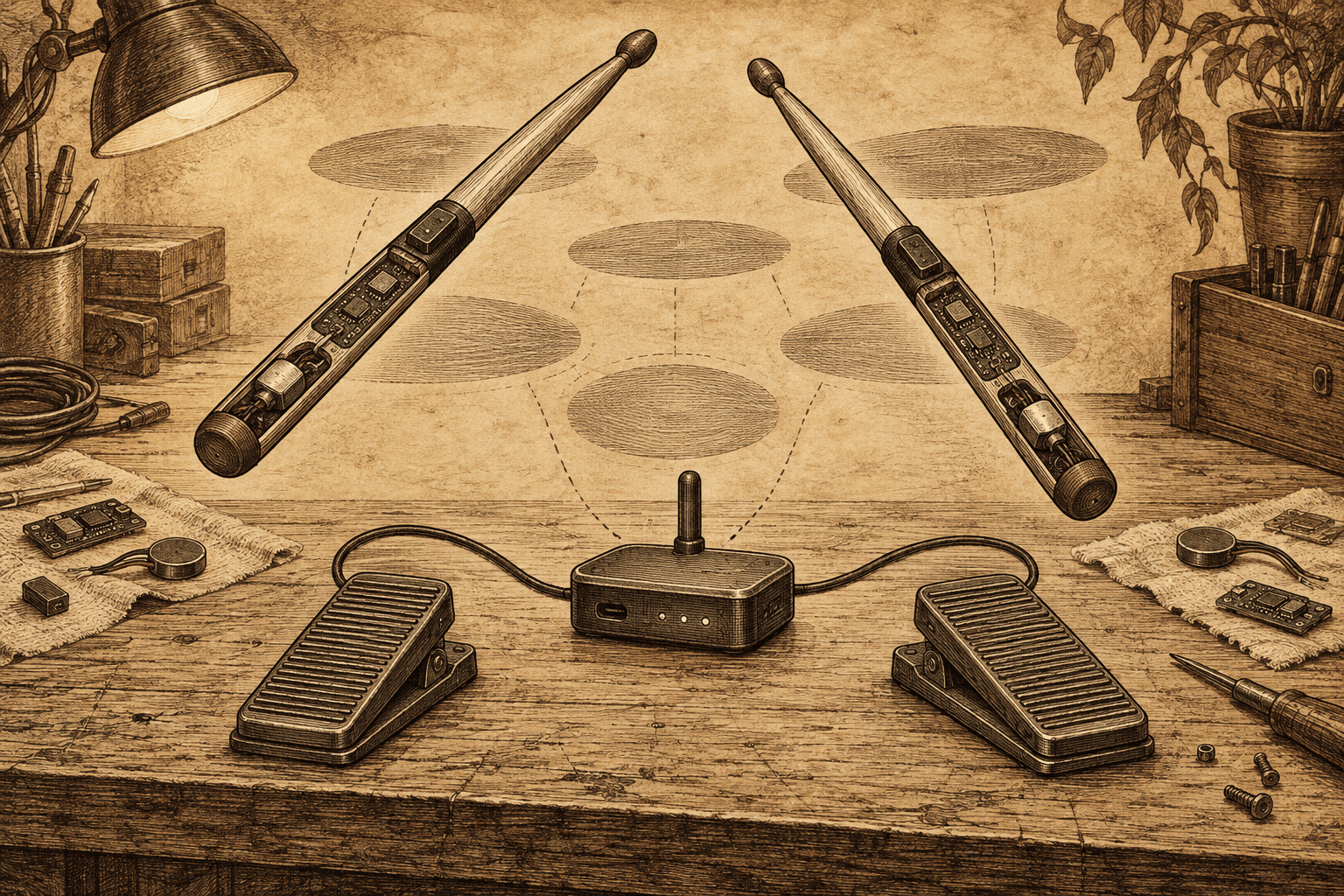
Moves motion tracking onto two ESP32-S3 drumsticks, adds haptic hits and a two-pedal hub, and sends velocity-sensitive drum events to open PC or Android playback software.
Visit Space Drums 2.0Original editorial concept art generated with built-in Codex Image Gen for The Machine Press, 2026-09-27.
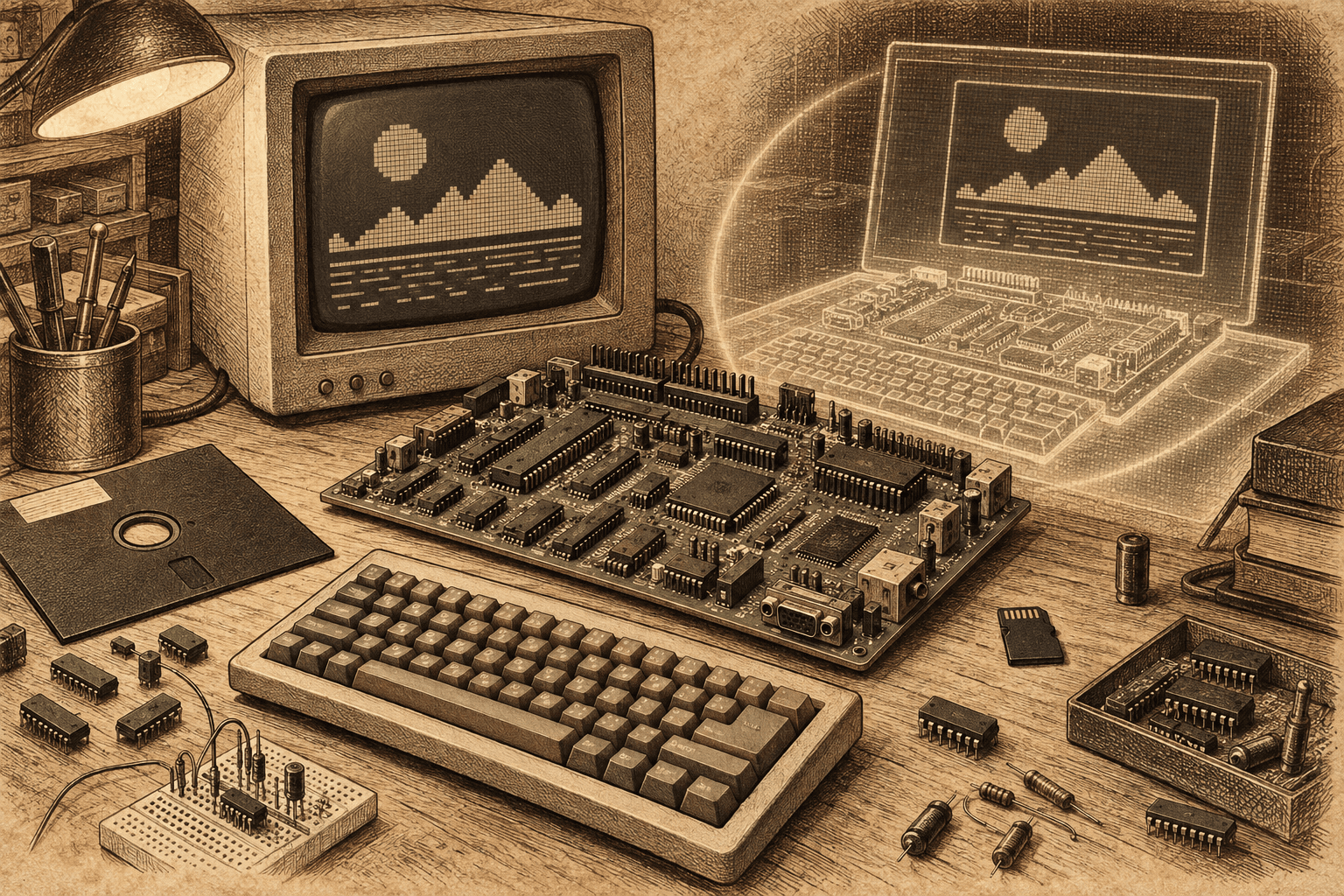
Pairs a chip-level 65C02 computer with custom hardware, video, sound, floppy, and microSD support with a cycle-honest emulator and browser assembler built around the same machine.
Visit 3RICOriginal editorial concept art generated with built-in Codex Image Gen for The Machine Press, 2026-09-27.
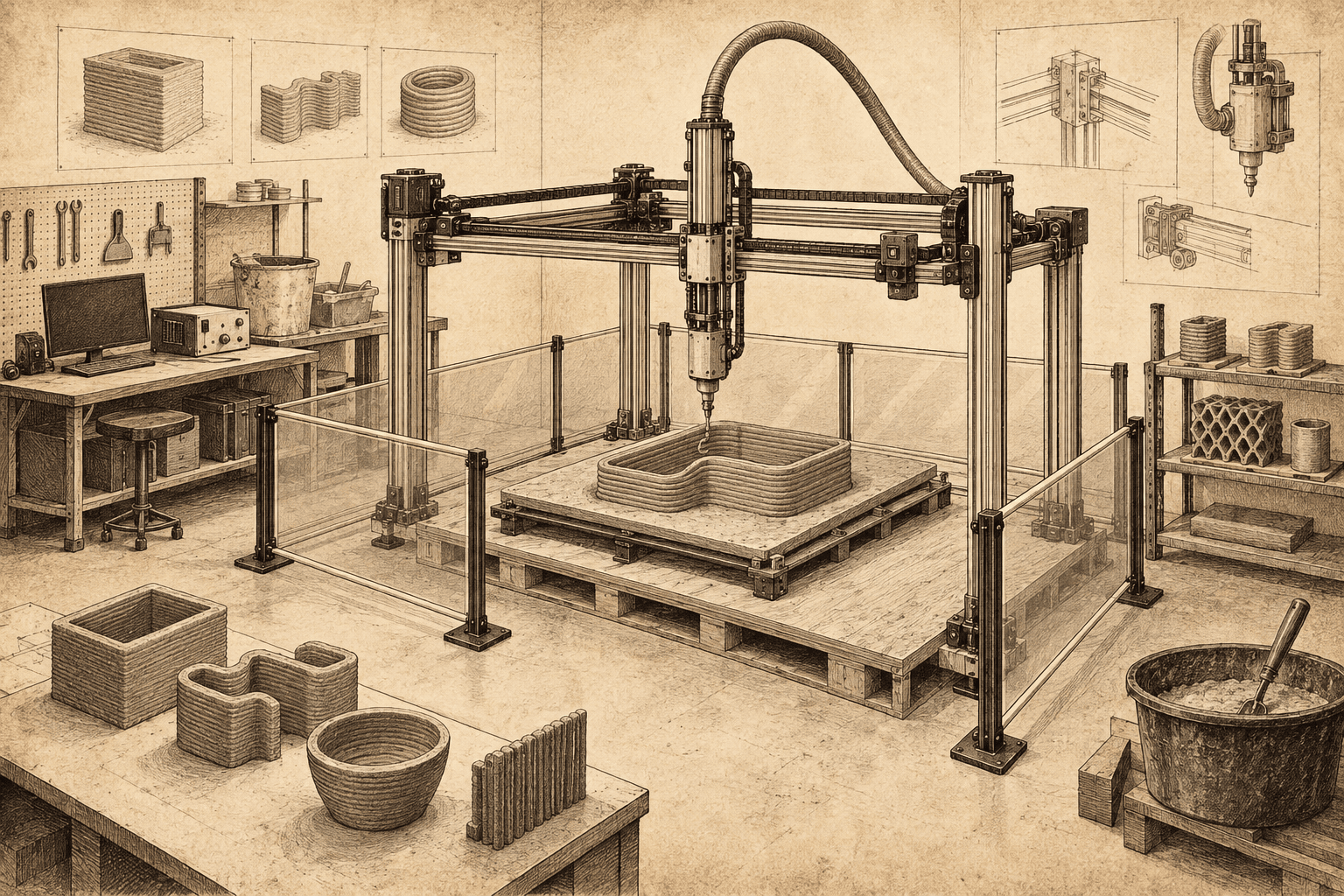
Publishes a pallet-scale cartesian motion reference, CAD, BOM, and low-voltage controls for supervised cementitious-extrusion research while explicitly excluding certified structural use.
Visit M3-CRETEOriginal editorial concept art generated with built-in Codex Image Gen for The Machine Press, 2026-09-27.
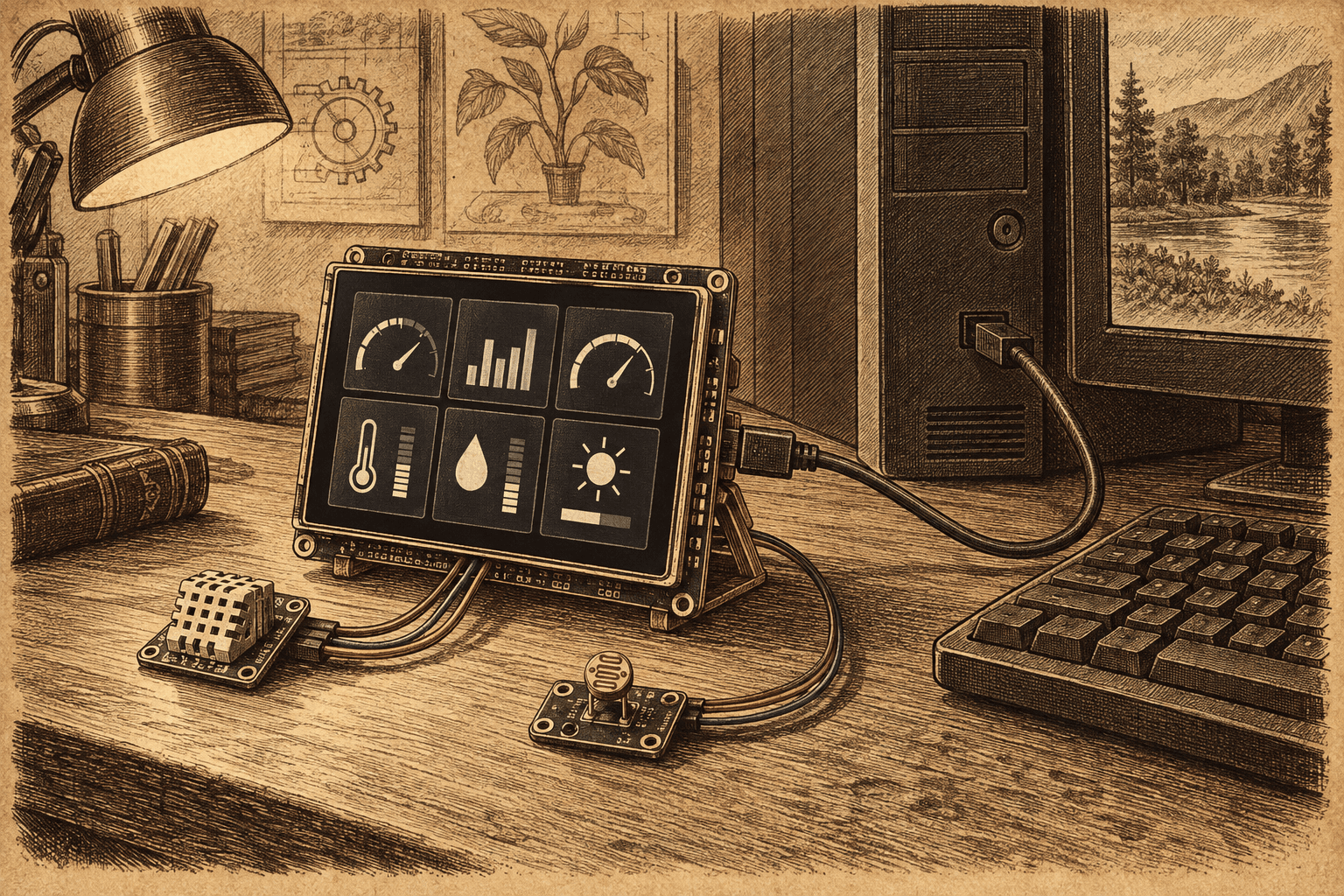
Turns a bare ESP32-S3 touchscreen into a USB-connected desk instrument for PC activity and optional room temperature, humidity, and light measurements.
Visit DeskNodeOriginal Codex Image Gen concept art from 2026-07-10; carried forward from the validated 2026-09-30 edition.
Desk Picks are selected by the newsroom. Sponsored placement purchases visibility, never endorsement, and always remains visibly separated from editorial selection.
 Editorial illustration