GlassGuard covered 85 percent of architectural glass while explicitly testing whether reconstructed obstacles polluted free space.
Editorial illustration
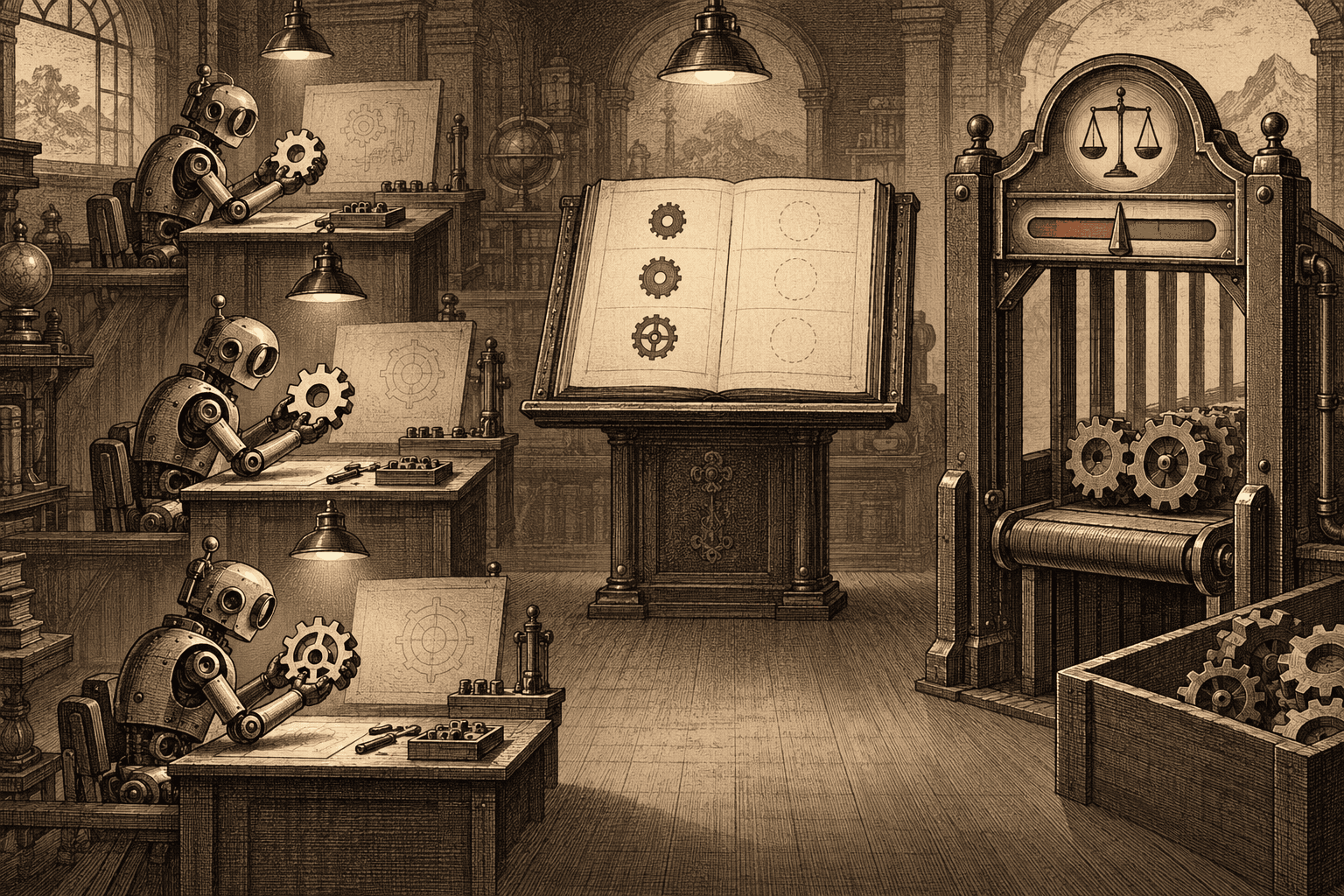
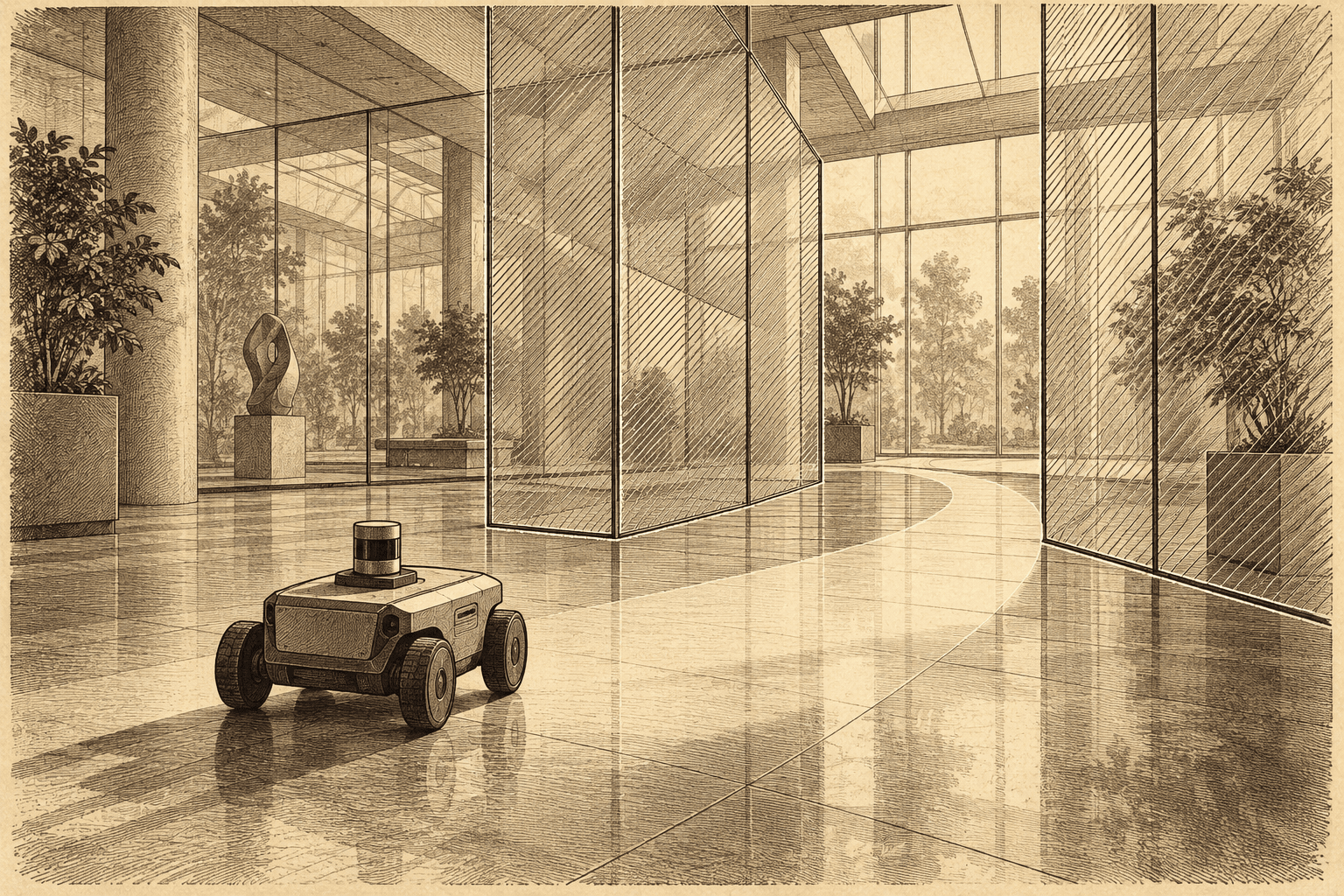
Concept illustration of verified glass-plane mapping for navigation; not the GlassGuard system, a project image or documentary evidence. Original editorial illustration generated with built-in Codex Image Gen for The Machine Press, 2026-10-03.
LiDAR can pass through glass and omit a collision boundary, but an inaccurate repair can be just as dangerous if it blocks real free space. GlassGuard combines vision masks, structural 3D cues and depth-free projective checks before consolidating planar glass into a navigation map. Across nine building-scale scenes, more than an hour and 2.1 kilometers of robot traversal, the panoramic system reported 85 percent glass coverage; under identical pinhole inputs it reached 82 percent versus at most 61 percent for tested baselines, with five to seventeen times fewer false voxels per frame. These are source-reported results from the authors' evaluation, not certification for arbitrary buildings or lighting.
Concept illustration of local decisions, shared state and commit enforcement; not a software interface, benchmark run or documentary image. Original editorial illustration generated with built-in Codex Image Gen for The Machine Press, 2026-10-03.
A study argues that missing shared state, not weaker reasoning, sets a hard boundary on multi-agent coordination.
The global-coherence study formalizes a failure in which every agent's local choice is valid but the combined action violates a shared constraint because decisive state is invisible. In controlled tests, a frontier model scored 40 of 40 when the deciding event was visible, fell to 12–17 of 40 when it was hidden, and returned to 40 of 40 when one authoritative fact was restored. On a shared-budget task, ordinary teams exceeded the limit in all five runs; a visible live count still left four violations, while commit enforcement left none. The results support the paper's architectural claim for its tested settings: models may propose, but a harness that owns shared state must govern commit.
Mimir kept the physical model and actuator limits fixed while letting experience revise contextual guidance.
Mimir separates fast repair from slow learning in season-long irrigation control. A deterministic simulator checks and bounds each language-model proposal before execution, while repeated failures become persistent contextual principles without changing the physical model or safety constraints. Under the authors' retrospective evaluator across multiple sites, crops and years, Mimir reported the lowest aggregate control cost among tested references and about 51 percent less irrigation than historical schedule replay; the study does not establish prospective farm performance.
NASA OSAM-1 hardware used illustratively; it does not depict InterEvolve, a Unitree G1, reward programs or reported trials. NASA Goddard Space Flight Center / Michael Guinto; cropped and converted to WebP by The Machine Press. Use does not imply NASA endorsement.
InterEvolve revised staged reward programs at test time and verified candidates before retaining them.
InterEvolve pairs an object-aware behavioral foundation model with reward programs whose stages, completion tests and constants can be revised from execution feedback. An LLM agent changes program structure while a numerical optimizer tunes constants; candidates are verified across parallel simulations before joining a skill library. The authors report diverse simulated loco-manipulation behaviors and autonomous execution of evolved skills on a physical Unitree G1, but the evidence remains specific to the tested controller, tasks and hardware.
AutoCompact makes context compression a policy decision about timing, retained state and continuation.
Long repository tasks accumulate stale searches and edits long before a context window fills. AutoCompact trains an agent to decide when to compact, what working state to preserve and how to continue, using judged trajectories whose flawed compaction choices and summaries are corrected before execution continues. The preprint reports stronger long-horizon coding behavior than fixed or heuristic compaction baselines; the result is an evaluation of the tested agent and task suite, not evidence that learned summaries are universally lossless.
MEVA joined cortical surface geometry to MRI volumes before using the learned features in UK Biobank association studies.
MEVA encodes voxel intensity together with cortical curvature and thickness from a surface mesh into one self-supervised representation. The combined inputs produced modest gains in age and sex prediction over either modality alone. Used as phenotypes for genome-wide association studies in the UK Biobank, the joint features revealed more genome-wide significant loci than volume-only or mesh-only features, suggesting that the two anatomical views carry complementary heritable variation.
TACO keeps one signed maximum-magnitude gradient component per column for full-parameter language-model tuning.
TACO follows an operator-norm steepest-descent view but selects only the sign of the largest-magnitude entry in each column of two-dimensional weights. On OPT-13B, the authors report 0.16 gigabytes of persistent optimizer state versus 27.7 gigabytes for AdamW8bit, with peak training memory falling from 80.6 to 27.5 gigabytes at comparable accuracy and runtime. The method also enabled full-parameter tuning of tested 30–32-billion-parameter models on one 80-gigabyte H100; those source-reported results do not establish the same tradeoff for every architecture or task.
SkeleWAM represents joints, object centers and interaction points instead of reconstructing full video.
SkeleWAM builds a sparse 3D skeleton online from RGB-D observations and robot proprioception, then uses it both for action generation and future-state prediction. On LIBERO-Plus, the 57.1-million-parameter system reported 85.9 percent overall success, 3.7 percentage points above Cosmos-Policy. The finding supports compact geometric state for the tested manipulation suite; it is not a general comparison across every visual world model or physical robot.
Generic Pexels code-screen photograph used illustratively; it does not show the keyword harness, a tested command or evaluation evidence. Daniil Komov / Pexels; cropped, resized, metadata stripped, and converted to WebP by The Machine Press.
A diagnostic ladder found that small-model tool-use claims could survive weak lexical checks while failing execution structure.
The Keyword Harnesses Fail Open study examines evaluations that reward outputs for containing expected words rather than forming valid tool calls. Its staged diagnostic separates lexical overlap from argument binding, ordering and executable structure, exposing cases in which a reported success disappears under stricter checks. The lesson is narrow but practical: tool-use claims need verifiers tied to the real interface contract, not a permissive keyword proxy.
Intervention faithfulness misranked equally sized mechanisms even when their held-out behavior was less faithful.
Mechanistic-interpretability searches assume the objective will recognize a better circuit once it appears. This study shows an objective-level recovery gap: under ordinary resampling, KL-based faithfulness misranked 9.4 to 41.2 percent of candidate pairs across several discovery methods on human-reference tasks. Restoring selected recipient-side signals repaired 96 of 100 persistent misrankings without changing the circuits, suggesting that context distortion in the evaluation can reward the wrong mechanism.
Joint behavior revealed a partner constraint that the constrained robot alone could hide.
In coupled manipulation, a healthy robot may compensate for a partner's actuator limits, making the faulty machine look capable when observed alone. Watch, Infer, Coordinate scores candidate constraints from both robots' joint behavior, then uses the inferred limitation on a new task. Across three benchmark settings, the method improved zero-shot coordination and approached an oracle with the true constraints, according to the authors; the result is limited to the simulated and experimental settings described in the preprint.
LoopCD contrasts the final prediction of a looped transformer with an earlier recurrent pass without training another model.
Looped transformers expose aligned weak and strong predictions because the same block produces decodable states at successive passes. LoopCD uses an earlier pass as a contrastive signal for the final prediction. The authors report AIME 2024 pass@1 rising from 61.88 to 73.33 percent for Ouro-2.6B-Thinking and HumanEval pass@1 from 22.56 to 31.71 percent for Huginn, while some configurations matched full-depth baselines with 22.5 to 48.2 percent fewer forward FLOPs.
OmniSeek retrieves short audio or video windows as tools instead of processing every long recording in one pass.
OmniSeek turns evidence acquisition into a multi-turn decision: the model chooses whether to inspect audio or video and which time window to retrieve, then appends the raw segment for further reasoning. Training begins with 170,000 synthesized interleaved trajectories and continues with reinforcement learning that rewards genuinely cross-modal evidence use. The authors report consistent gains across their audio-visual benchmarks, but the result depends on their generated trajectories, tools and evaluation design.
Conceptual Visualising AI illustration used illustratively; it does not show PROWBench, a world record, generated video or benchmark result. Tim West / Google DeepMind / Pexels; cropped, resized, metadata stripped, and converted to WebP by The Machine Press.
PROWBench checks generated scenes against timestamped world records, including events outside the camera view.
PROWBench contains 170 programmatically constructed episodes and 600 proxy videos with logged entity states and timestamped events. Because the record persists beyond any one camera view, evaluators can test whether a generated video realizes the observable consequences of the actual program rather than merely looking plausible. The benchmark adds metrics for entity control, long-horizon memory, logic-render alignment and interaction success; it evaluates adherence, not whether a model is a complete game engine.
SimpleTimeBench found zero-shot failures on monotonic trends, periodic signals and leading indicators.
SimpleTimeBench treats basic temporal relationships as unit tests that a broad forecasting model should nearly solve. Chronos-2, Moirai and Toto frequently produced suboptimal zero-shot forecasts on simple univariate and multivariate patterns, and fine-tuning Chronos-2 for some tasks degraded others. The authors also report underuse of leading indicators in real sensor forecasting, arguing that benchmark scale can hide missing inductive biases for elementary temporal logic.
HiPhy trains local physical dynamics and whole-scene coherence together when several principles must unfold simultaneously.
HiPhy targets scenes where physical effects interact, such as buoyancy and fluid motion occurring in the same generated clip. Its reinforcement-learning objective scores individual temporal dynamics locally and the complete scene globally, supported by a 50,000-prompt dataset and the MultiPhyBench benchmark. The authors report the largest gains where multiple principles co-occur and competing methods degrade most, but the result measures benchmark alignment rather than a general-purpose physical simulator.
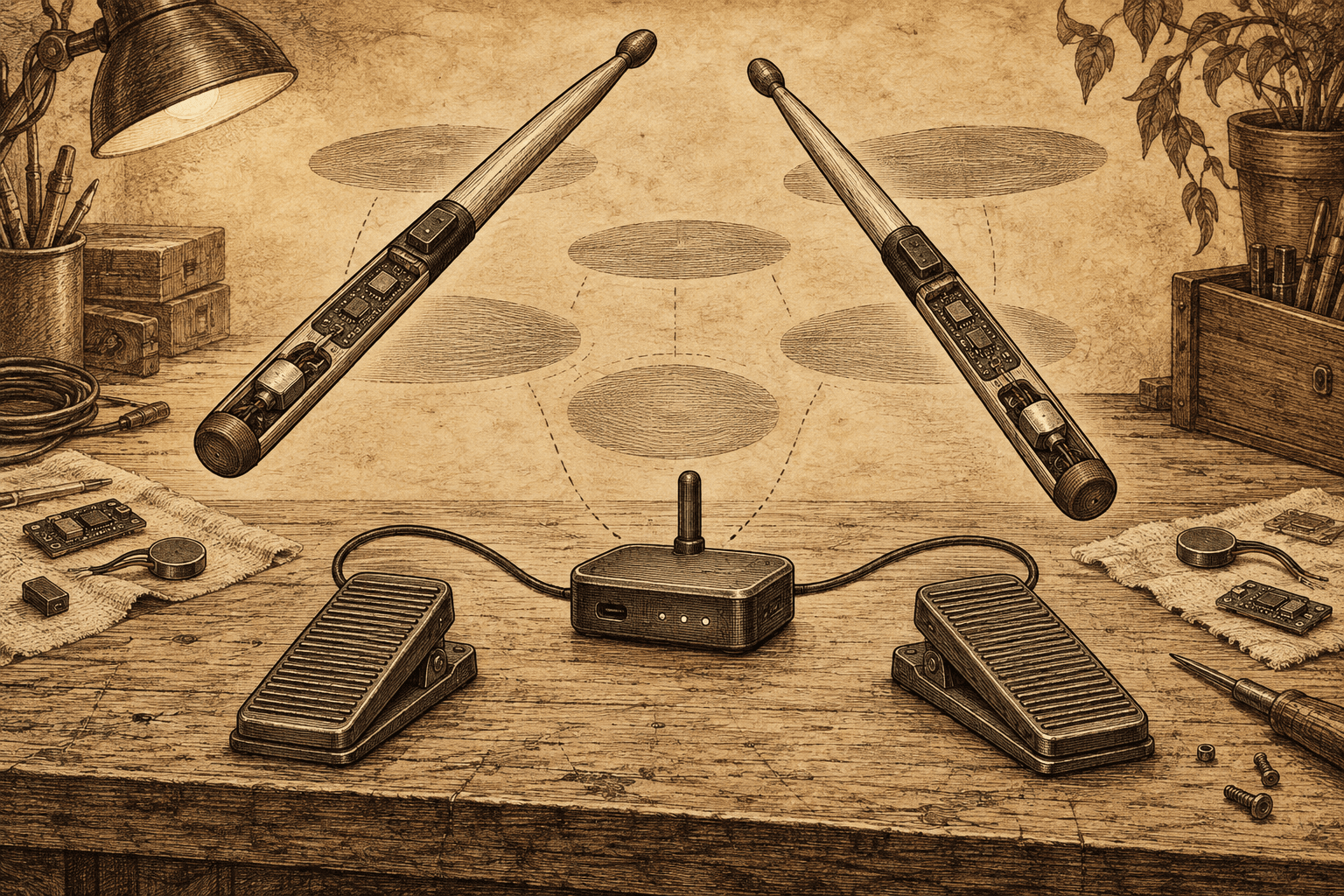
Moves motion tracking onto two ESP32-S3 drumsticks, adds haptic hits and a two-pedal hub, and sends velocity-sensitive drum events to open PC or Android playback software.
Visit Space Drums 2.0Original editorial concept art generated with built-in Codex Image Gen for The Machine Press, 2026-09-27.
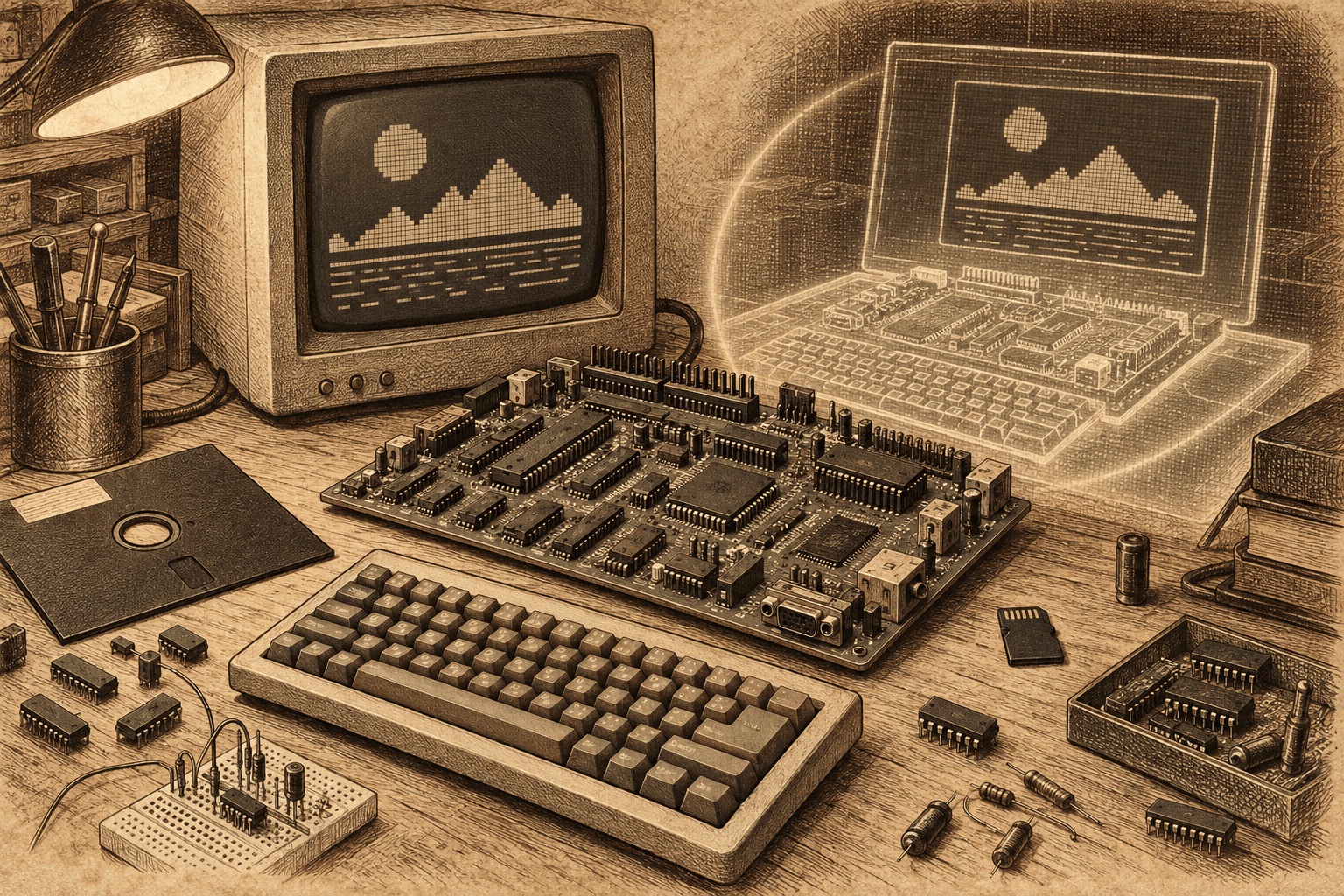
Pairs a chip-level 65C02 computer with custom hardware, video, sound, floppy, and microSD support with a cycle-honest emulator and browser assembler built around the same machine.
Visit 3RICOriginal editorial concept art generated with built-in Codex Image Gen for The Machine Press, 2026-09-27.
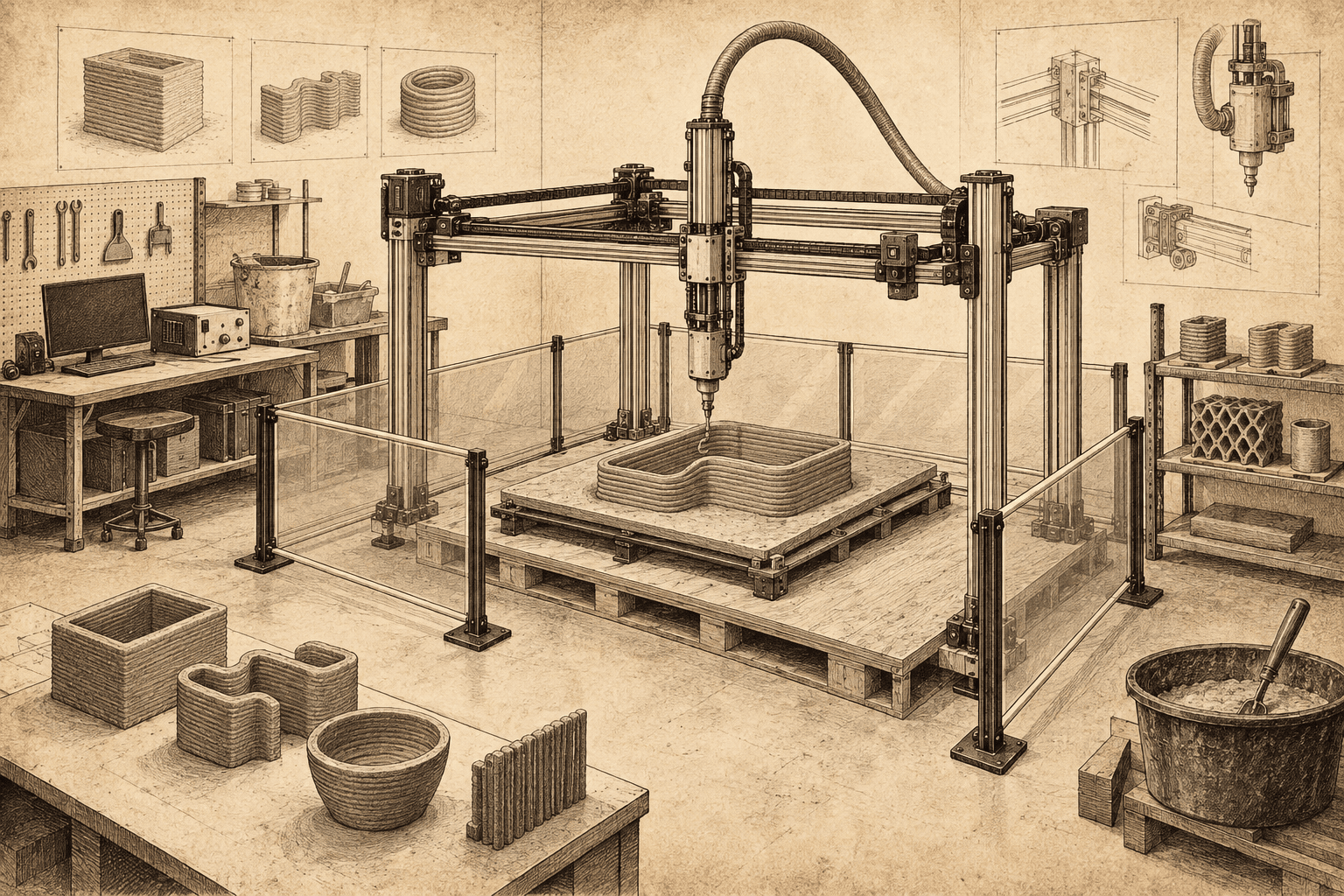
Publishes a pallet-scale cartesian motion reference, CAD, BOM, and low-voltage controls for supervised cementitious-extrusion research while explicitly excluding certified structural use.
Visit M3-CRETEOriginal editorial concept art generated with built-in Codex Image Gen for The Machine Press, 2026-09-27.
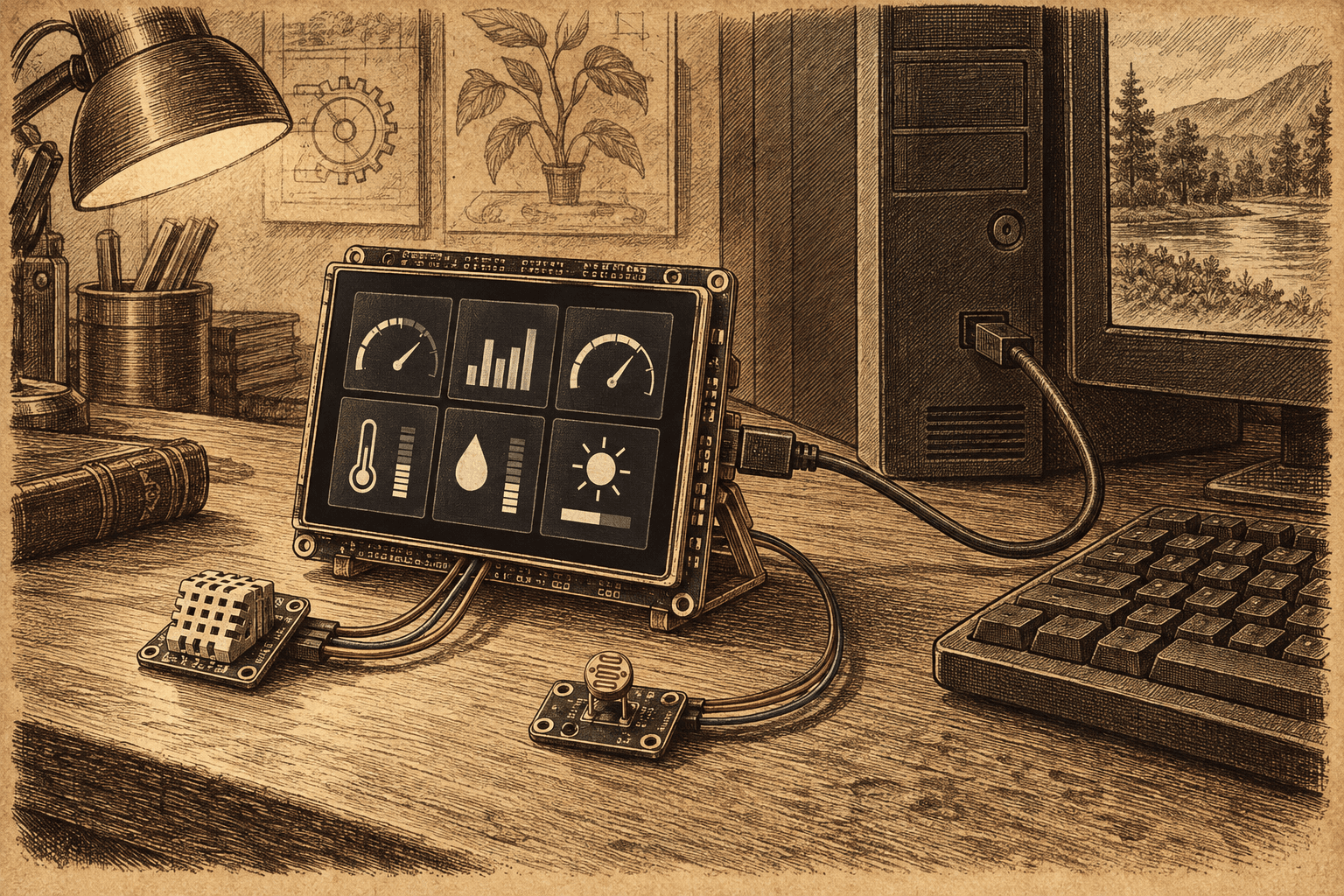
Turns a bare ESP32-S3 touchscreen into a USB-connected desk instrument for PC activity and optional room temperature, humidity, and light measurements.
Visit DeskNodeOriginal Codex Image Gen concept art from 2026-07-10; carried forward from the validated 2026-09-30 edition.
Desk Picks are selected by the newsroom. Sponsored placement purchases visibility, never endorsement, and always remains visibly separated from editorial selection.
 Editorial illustration