robotics
The Map Learned Where the Glass Really Was
GlassGuard covered 85 percent of architectural glass while explicitly testing whether reconstructed obstacles polluted free space.
Summary
GlassGuard covered 85 percent of architectural glass while explicitly testing whether reconstructed obstacles polluted free space.
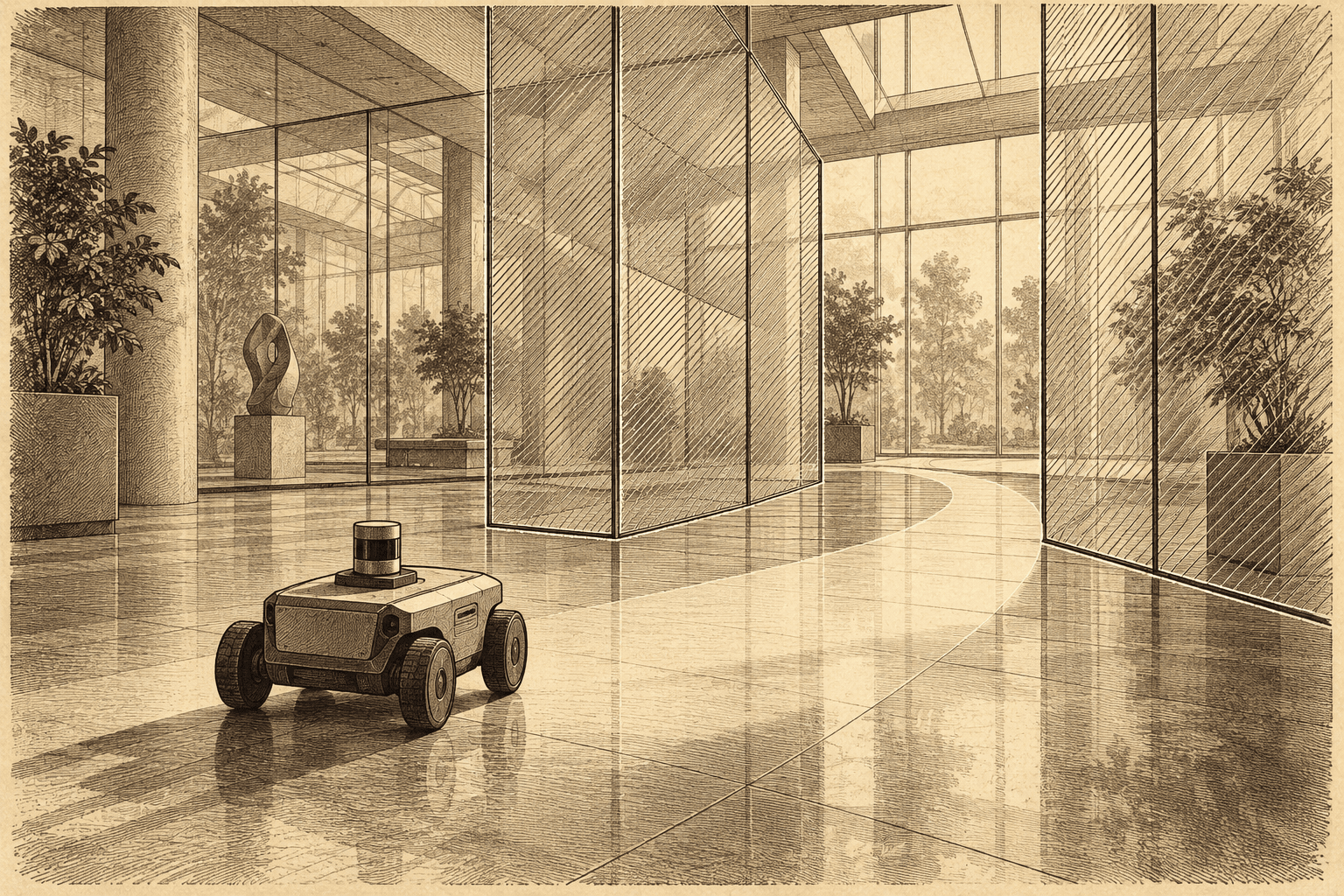
LiDAR can pass through glass and omit a collision boundary, but an inaccurate repair can be just as dangerous if it blocks real free space. GlassGuard combines vision masks, structural 3D cues and depth-free projective checks before consolidating planar glass into a navigation map. Across nine building-scale scenes, more than an hour and 2.1 kilometers of robot traversal, the panoramic system reported 85 percent glass coverage; under identical pinhole inputs it reached 82 percent versus at most 61 percent for tested baselines, with five to seventeen times fewer false voxels per frame. These are source-reported results from the authors' evaluation, not certification for arbitrary buildings or lighting.
Why it matters
GlassGuard covered 85 percent of architectural glass while explicitly testing whether reconstructed obstacles polluted free space.
Limits and context
- These are source-reported results from the authors' evaluation, not certification for arbitrary buildings or lighting.
Key claims
GlassGuard covered 85 percent of architectural glass while explicitly testing whether reconstructed obstacles polluted free space.
Qualification: These are source-reported results from the authors' evaluation, not certification for arbitrary buildings or lighting.
Evidence: source-2026-10-03-001
Sources
- arXiv preprint 2610.02110arXiv · primary research
Corrections
No corrections have been recorded for this story.