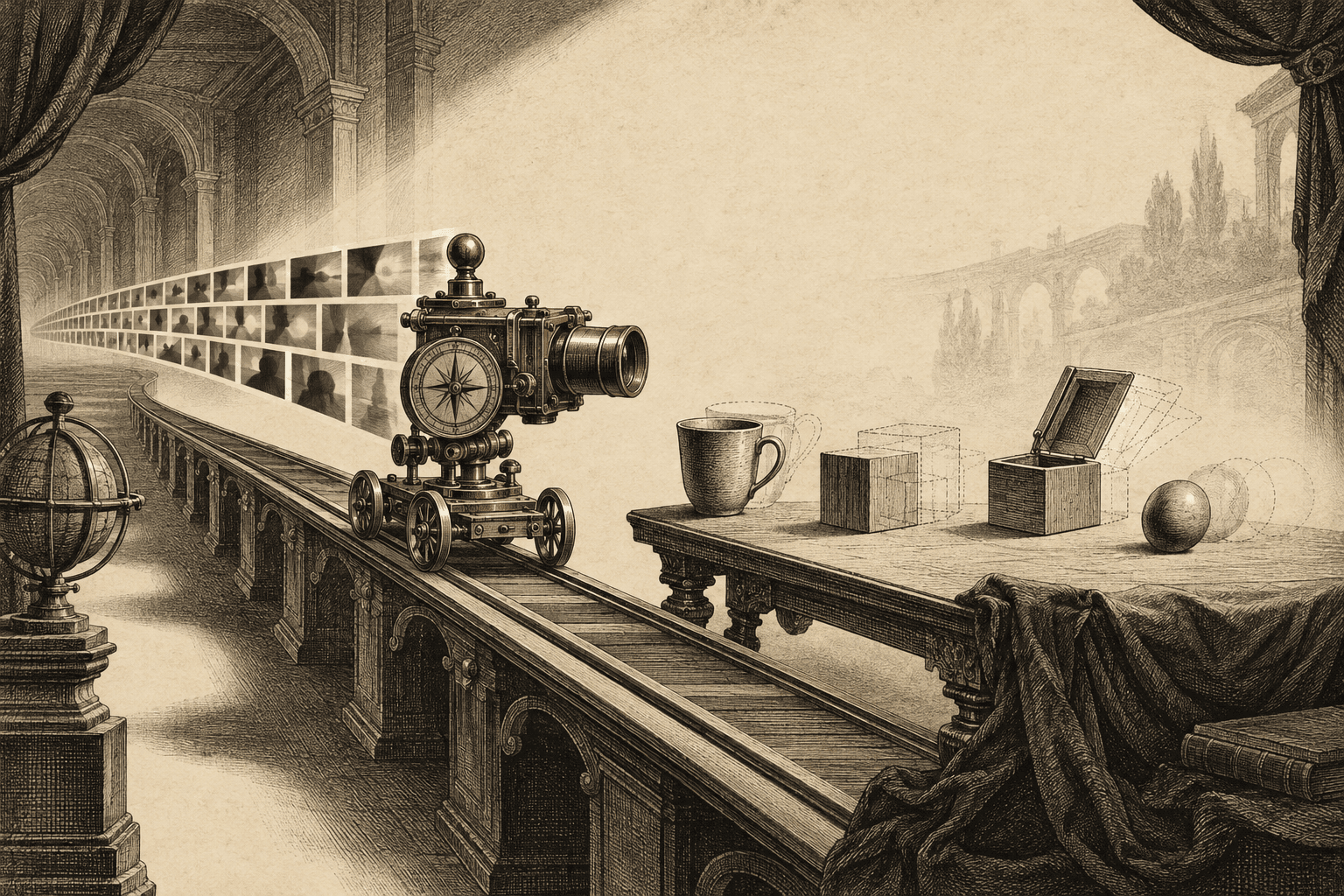
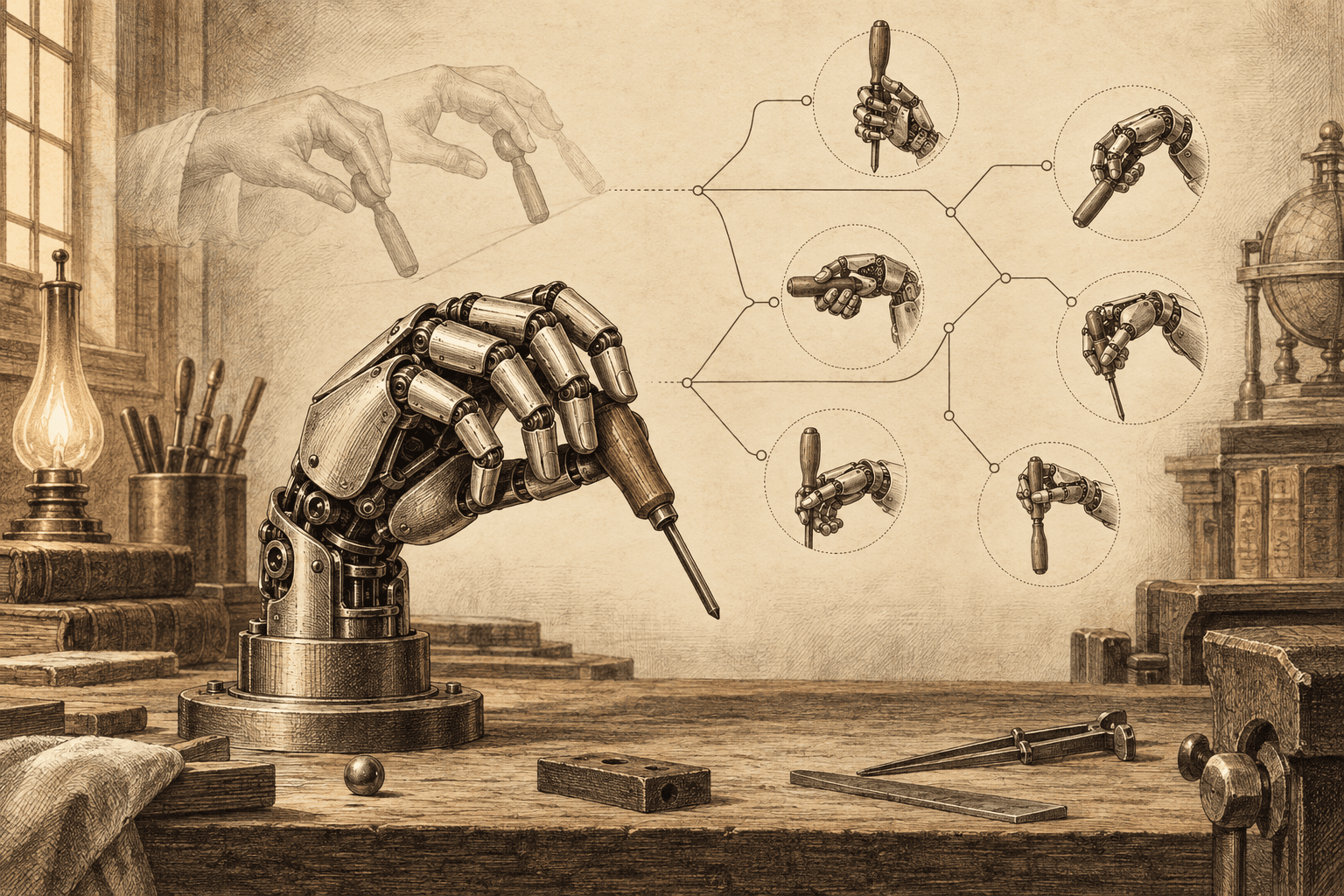
Relational scene graphs guided reinforcement learning beyond the exact poses and grasps shown in a single human video.
Editorial illustration
Concept illustration of relational guidance for dexterous learning; not a paper figure, tested robot, experiment photograph or performance result. Original editorial illustration generated with built-in Codex Image Gen for The Machine Press, October 10, 2026 edition.
Dex-One2Many converts one human demonstration into sequential scene graphs that describe relations rather than exact motions. Those graphs generate varied reset states and dense rewards for each stage, shortening exploration while exposing the policy to new object poses, goals and grasps. Trained in simulation, the policy transferred without additional training to a real multi-fingered hand. Across five tool-use and manipulation tasks, the authors report a 6.5% advantage in seen configurations and a 71% gap over baselines in unseen scenarios. These are reported task results, not evidence that one video can teach arbitrary dexterity.
Concept illustration of uneven world-model learning; not dataset footage, a benchmark output or documentary evidence. Original editorial illustration generated with built-in Codex Image Gen for The Machine Press, October 10, 2026 edition.
A 100-fold data increase improved egocentric world models unevenly: the modeled agent strengthened while object interactions lagged.
Researchers scaled egocentric training video to 30,000 hours across more than 1,000 scene types and 14,000 contributors, then tested agent motion and object-interaction fidelity separately. A 100-fold increase improved both, but the agent was modeled much better than the objects it affected, and object fidelity improved slowly. Better visual conditioning reproduced much of the agent gain with less data, while a supervision change redirected capacity toward object dynamics and narrowed—but did not close—the gap. The study argues that more video alone is unlikely to solve physical interaction. Its conclusions are benchmark findings, not a universal ceiling for world models.
LEGO generates egocentric video from exocentric footage without relying on a separately rendered intermediate view.
LEGO tackles a view-transfer problem: turning third-person video into a plausible first-person sequence. Its lifting-free design maps exocentric evidence directly into egocentric generation, avoiding an intermediate rendering stage that can compound geometric and appearance errors. The approach is evaluated on generated and captured video, with the goal of preserving action while changing viewpoint. Such synthesis could broaden training data for embodied models, but the output remains generated evidence, not a record of what a wearer actually saw. The paper reports a video-generation method rather than a solved account of hidden objects or precise 3D scene geometry.
NASA OSAM-1 hardware used illustratively; it does not depict DreamTrue, its training data, tested robots or reported results. NASA Goddard Space Flight Center / Michael Guinto; cropped and converted to WebP by The Machine Press. Use does not imply NASA endorsement.
Counterfactual post-training broadened action and contact coverage while a learned reward model screened physical defects.
DreamTrue addresses two weaknesses in robot video prediction: imperfect action calibration and datasets dominated by successful interactions. The system projects action trajectories into image space, applies offline geometric calibration, and post-trains on altered trajectories that create counterfactual contacts and outcomes. A reward model trained on human annotations scores robot, object and interaction defects. On AgiBot, the authors report state-of-the-art action following and a drop in human-assessed interaction defects from 48.12% to 6.25%. The model also ranked first in a 2026 challenge track. Those results are reported evaluations, not proof of physically correct prediction in every setting.
A frozen internal critic rejected edits that looked plausible but missed the request or damaged preserved content.
Rubric-CEPR improves an image editor using its own generations rather than human-edited targets or an external reward model. A planner proposes edits, the editor creates candidates, and a frozen critic applies separate checks for making the requested change, removing the old state and preserving everything else. Non-compensatory gates reject candidates that fail any essential condition before adapter training distills the best survivors. On Qwen-Image-Edit, the authors report an ImgEdit increase from 4.36 to 4.60 and a 24.9% gain on object isolation; a second editor improved 7.8%. These are benchmark gains from self-distillation, not a guarantee against editing errors.
Contextual safety filtering grounds language rules in paired safe and unsafe trajectories without retraining the motion generator.
A text-conditioned motion generator may produce the same movement near an object or near a person without understanding why the second context changes its risk. Contextual Safety Filtering turns active natural-language rules into safe and unsafe reference trajectories, then enforces an affine safety value through a control-barrier optimization layer. Across four pretrained generators, the filter activated the intended rule in every explicit and scene-triggered unsafe case, cut danger events by as much as 90%, and preserved 88% to 100% of benign motions. A Unitree G1 demonstration extended the test to real hardware. The findings remain limited to the tested rules and scenarios.
A statistical reanalysis finds that human task time maps unevenly onto AI difficulty, especially between two and thirty minutes.
METR’s time horizon expresses capability as the human completion time of tasks an AI solves with 50% probability. Reanalyzing 228 tasks and 26 systems with splines and item-response theory, the authors find that the mapping from human time to AI difficulty is nearly flat from roughly two to thirty minutes and closer to linear elsewhere. That makes a jump from three to thirty minutes statistically easier than one from thirty minutes to five hours, despite the same multiplier. Cross-validated scoring favored the new estimates. The paper does not invalidate time horizons; it argues that point estimates should travel with diagnostic plots and construct-validity checks.
A three-dimensional radiation simulation links disk thickness to longer optical lags and weaker correlation with X-rays.
A 3D multi-frequency radiation-magnetohydrodynamic simulation produced an active-galactic-nucleus disk that was thinner above its midplane and thicker below. Light from the thin side broadly followed traditional X-ray reprocessing expectations. The thicker side absorbed more X-rays, showed stronger intrinsic variability and produced continuum lags three to five times longer than light-travel time—features closer to several recent observations. The authors argue that disk structure could help explain the long-standing apparent disk-size problem without requiring the broad-line region to dominate the lag. This is a simulation-based interpretation, not a direct measurement of a particular galaxy.
CC0 wafer-scale integrated-circuit rendering used illustratively for large-scale simulation; it does not depict the reported environments, policies or hardware. Wikideas1 / Wikimedia Commons (CC0 1.0); cropped and converted to WebP by The Machine Press.
Success Guided Sampling concentrates robot training near the frontier between mastered and not-yet-reachable task configurations.
Uniformly sampling simulator resets wastes training on situations a robot has already mastered or cannot yet attempt. Success Guided Sampling adapts the reset distribution toward configurations around the policy’s current capability frontier. In experiments scaling to more than one million parallel environments, that change let reinforcement learning solve multi-terrain locomotion and contact-rich assembly tasks that the tested prior methods did not solve. The authors then distilled manipulation policies into RGB-based controllers and report zero-shot transfer to real hardware. The paper’s claim is about using each simulated batch more effectively; it does not show that raw simulator count alone produces general-purpose robot control.
OuroWorld adds periodic motion to Gaussian-splatting scenes while absorbing cross-view inconsistency into a grounded drift field.
OuroWorld turns a static 3D Gaussian-splatting scene into a looping 3D cinemagraph without requiring hand-drawn masks. A vision-language model proposes plausible dynamics, a video model creates a reference sequence, and the system lifts that motion across viewpoints. Fourier-series deformation makes the loop periodic by construction, while a drift field absorbs inconsistencies anchored to the reference view. On 39 reconstructed and generated scenes, the authors report wins in 70.8% to 99.0% of user-study comparisons across vividness, naturalness, loop coherence and scene quality. The evaluation is ground-truth-free and perceptual, so it measures judged quality rather than physical accuracy.
OmniCapBench replaces one whole-caption score with atomic checks for entities, shots and audio events.
OmniCapBench decomposes audio-visual captions into verifiable units across entity references, visual shots and audio events. Its 786 densely annotated videos support deterministic constraint checks and localized semantic comparisons, exposing where a polished caption loses temporal grounding, swaps identities, misaligns sound and image, or invents details. Testing frontier multimodal models found strong local perception but weaker long-horizon reasoning, especially for identity continuity and cross-modal alignment. The benchmark is intended as a diagnostic map rather than a single leaderboard number. Its judgments still depend partly on model-based semantic comparison, but the atomic structure makes errors easier to locate and audit.
SpatialHarness changes test-time spatial observability for fine manipulation instead of retraining the foundation model.
SpatialHarness starts from the idea that a strong robot policy can fail because critical spatial relationships are poorly visible from the installed cameras. The test-time harness adds spatial scaffolding that reveals those relationships before a multimodal model chooses fine manipulation actions. The paper evaluates the approach with frontier multimodal systems and physical manipulation tasks, presenting observability as a separate bottleneck from policy capability. That distinction matters operationally: a model upgrade cannot recover evidence a camera never captured. The reported method is a research harness, not a claim that arbitrary camera movement or extra views will safely repair every manipulation failure.
Hybrid cinematography previsualizes generative reshoots while tracking hallucination risk instead of treating every synthetic frame as interchangeable.
Hybrid Cinematography frames generative video reshooting as both a creative planning problem and a risk-management problem. The workflow helps filmmakers preview changes and identify places where generated motion, objects or continuity may depart from the source intent. By making hallucination risk visible during previsualization, it aims to separate useful synthetic alternatives from shots that require more supervision or conventional capture. The paper presents a production-oriented framework, not evidence that generated footage is automatically reliable or legally cleared. Its practical contribution is to place uncertainty alongside shot design before a reshoot decision is made.
Visualising AI concept art used illustratively; it is not a WorldGuide frame, architecture diagram or task result. Tim West / Google DeepMind / Pexels; cropped, resized, metadata stripped, and converted to WebP by The Machine Press.
WorldGuide couples a planner and executor in visual world space, deciding actions from generated progress rather than a fixed script.
WorldGuide treats procedural video generation as closed-loop execution. From an initial image and a goal, its planner selects an atomic action, its executor generates the corresponding clip, and the next decision uses the generated result or stops when the task appears complete. A hierarchical memory keeps long tasks bounded, while a new dataset supplies about 59,000 step annotations across 245 tasks. The authors report 33.33% task success on WorldGuide-Bench versus 29.90% for a comparison model given reference plans, and 47.69% versus 32.73% on VideoCraft-Bench under goal-only conditioning. These remain benchmark videos, not verified physical task execution.
A multi-agent framework treats beliefs about teammates as explicit state that can be tested and revised.
The Mental-Models framework asks multi-agent systems to represent what other agents know, intend and may do, instead of relying only on the latest message. That explicit state gives coordination a place to record disagreement, uncertainty and changed assumptions. The paper positions mental models as an organizing layer for agent teams, where the quality of collaboration depends on whether those models are updated when behavior contradicts expectations. This is a research proposal and evaluation framework, not evidence that software agents possess human social understanding. Its useful test is operational: can an agent explain which teammate assumption drove a plan and revise it after contrary evidence?
A new search of the Parkes archive reports previously overlooked extragalactic pulsar candidates in observations collected for other purposes.
Researchers reprocessed archival Parkes radio-telescope observations to search for periodic signals that earlier pipelines had missed. The work reports hidden extragalactic pulsar candidates recovered from data already on disk, showing how improved search methods can extend the scientific life of an observatory archive. Because distant pulsars are faint and propagation effects can distort their signals, candidate validation remains essential. The paper is a discovery report from archival analysis, not a claim that every candidate has already been independently confirmed. Its broader point is methodological: better computation can turn old observations into a new survey without taking another night of telescope time.
Independent builders turning improbable ideas into real things.
Four editorial selections
$7 for seven days
Paid work is clearly labeled
Placement is never endorsement
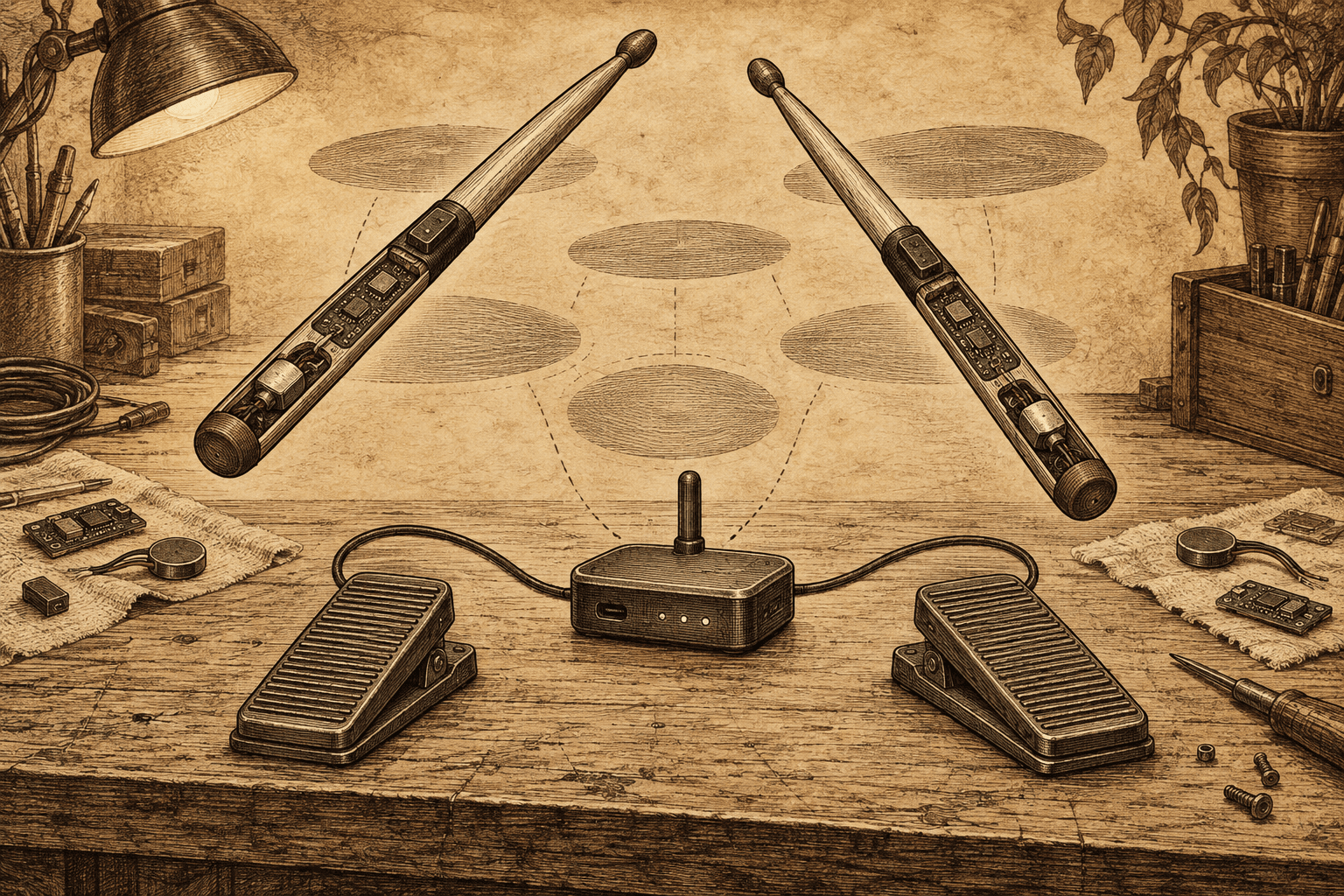
Original editorial concept art generated with built-in Codex Image Gen for The Machine Press, 2026-09-27; carried over because the 2026-10-04 handoff remains validation pending.
Moves motion tracking onto two ESP32-S3 drumsticks, adds haptic hits and a two-pedal hub, and sends velocity-sensitive drum events to open PC or Android playback software.
Visit Space Drums 2.0Original editorial concept art generated with built-in Codex Image Gen for The Machine Press, 2026-09-27; carried over because the 2026-10-04 handoff remains validation pending.
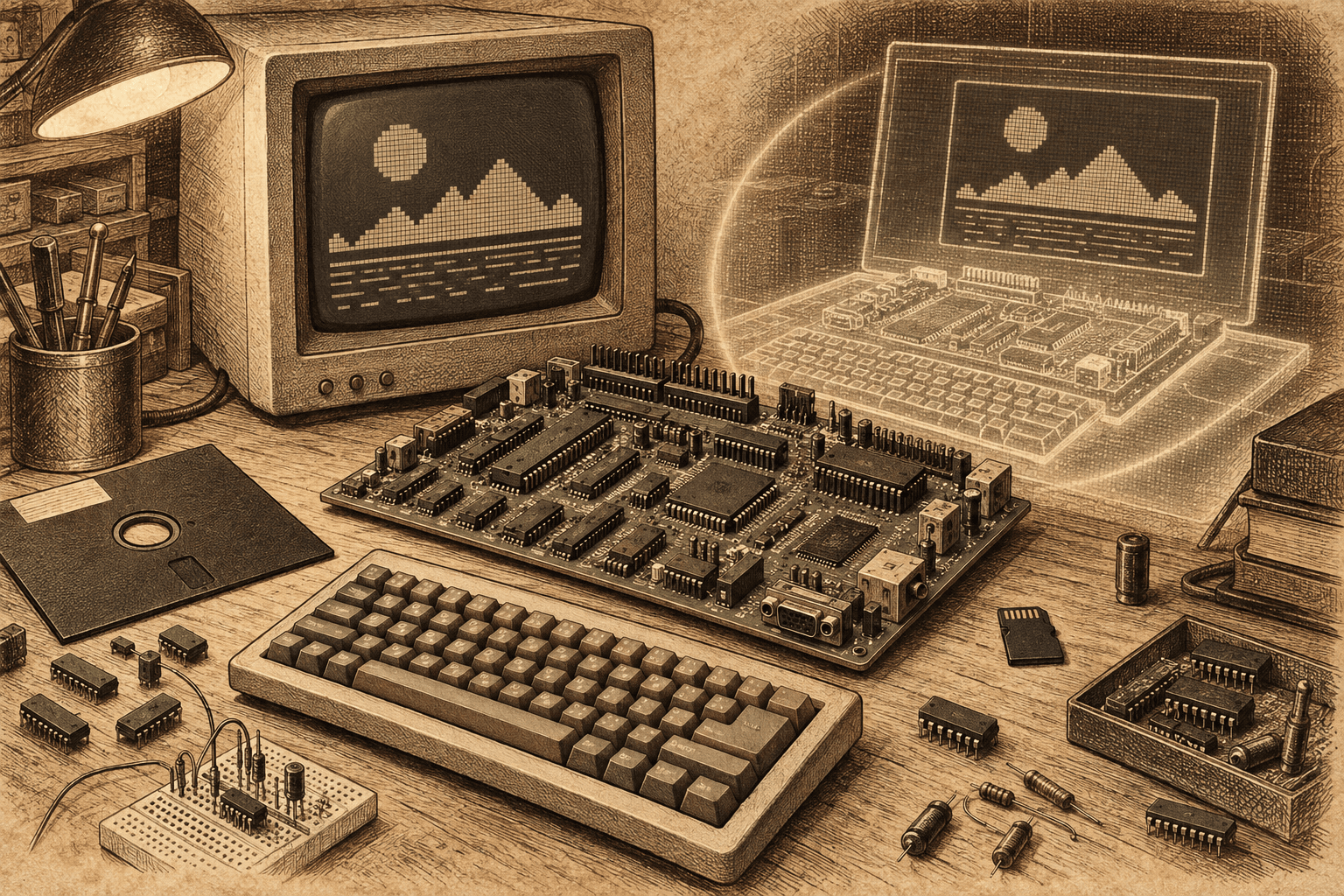
Pairs a chip-level 65C02 computer with custom hardware, video, sound, floppy, and microSD support with a cycle-honest emulator and browser assembler built around the same machine.
Visit 3RICOriginal editorial concept art generated with built-in Codex Image Gen for The Machine Press, 2026-09-27; carried over because the 2026-10-04 handoff remains validation pending.
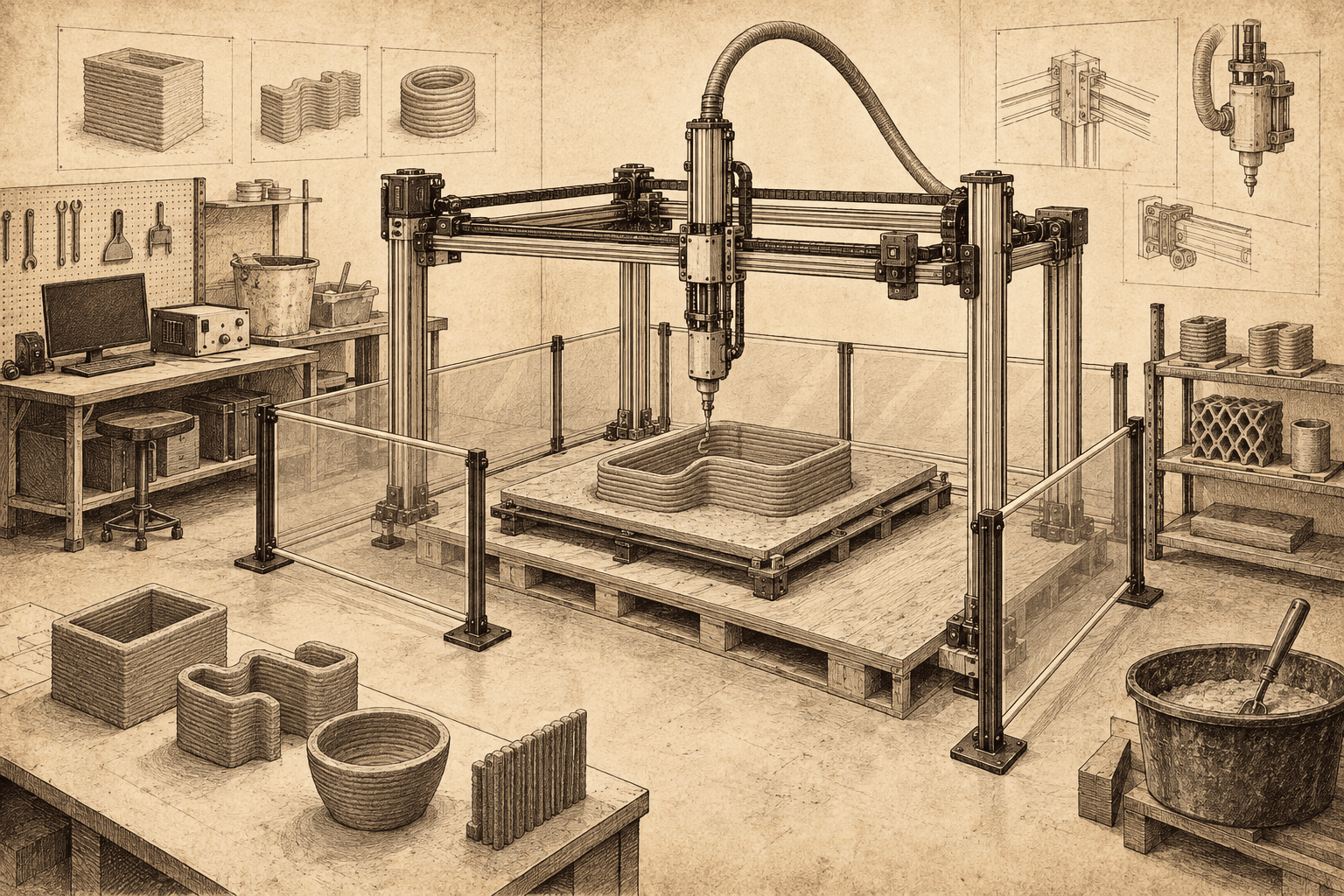
Publishes a pallet-scale cartesian motion reference, CAD, BOM, and low-voltage controls for supervised cementitious-extrusion research while explicitly excluding certified structural use.
Visit M3-CRETEOriginal editorial concept art generated with built-in Codex Image Gen for The Machine Press, 2026-09-27; carried over because the 2026-10-04 handoff remains validation pending.
Turns a bare ESP32-S3 touchscreen into a USB-connected desk instrument for PC activity and optional room temperature, humidity, and light measurements.
Visit DeskNodeOriginal Codex Image Gen concept art from 2026-07-10; carried forward from the validated 2026-10-03 edition.
Desk Picks are selected by the newsroom. Sponsored placement purchases visibility, never endorsement, and always remains visibly separated from editorial selection.
 Editorial illustration