AegisAsync follows event order, object identity, exceptions and cancellation through CPython bytecode. Developers had fixed 16 reported bugs by submission.
Editorial illustration
Concept illustration of tracing asynchronous event order and cancellation; not AegisAsync output, Python bytecode or a documented software defect. Original editorial illustration generated with built-in Codex Image Gen for The Machine Press, October 14, 2026 edition.
Python's asynchronous failures can depend on which event happens first, whether two operations touch the same object and what continues after cancellation. AegisAsync models those relationships in an Async Event Transition Graph, then symbolically simulates bounded paths and cancellation at await points. On a 180-risk benchmark, its authors report finding every labeled issue with no false positives across CPython 3.10 through 3.14. A review of 910 candidates from 2,500 PyPI package versions confirmed 457 unique bugs; 166 proof-of-concept programs reproduced findings, 157 reports went to developers and 16 had been confirmed and fixed by submission. Those rates describe the evaluated packages and review process, not every asynchronous Python program. The important advance is the evidence trail: each candidate includes a witness connecting ordering and state across calls, turning a timing-sensitive suspicion into something maintainers can reproduce.
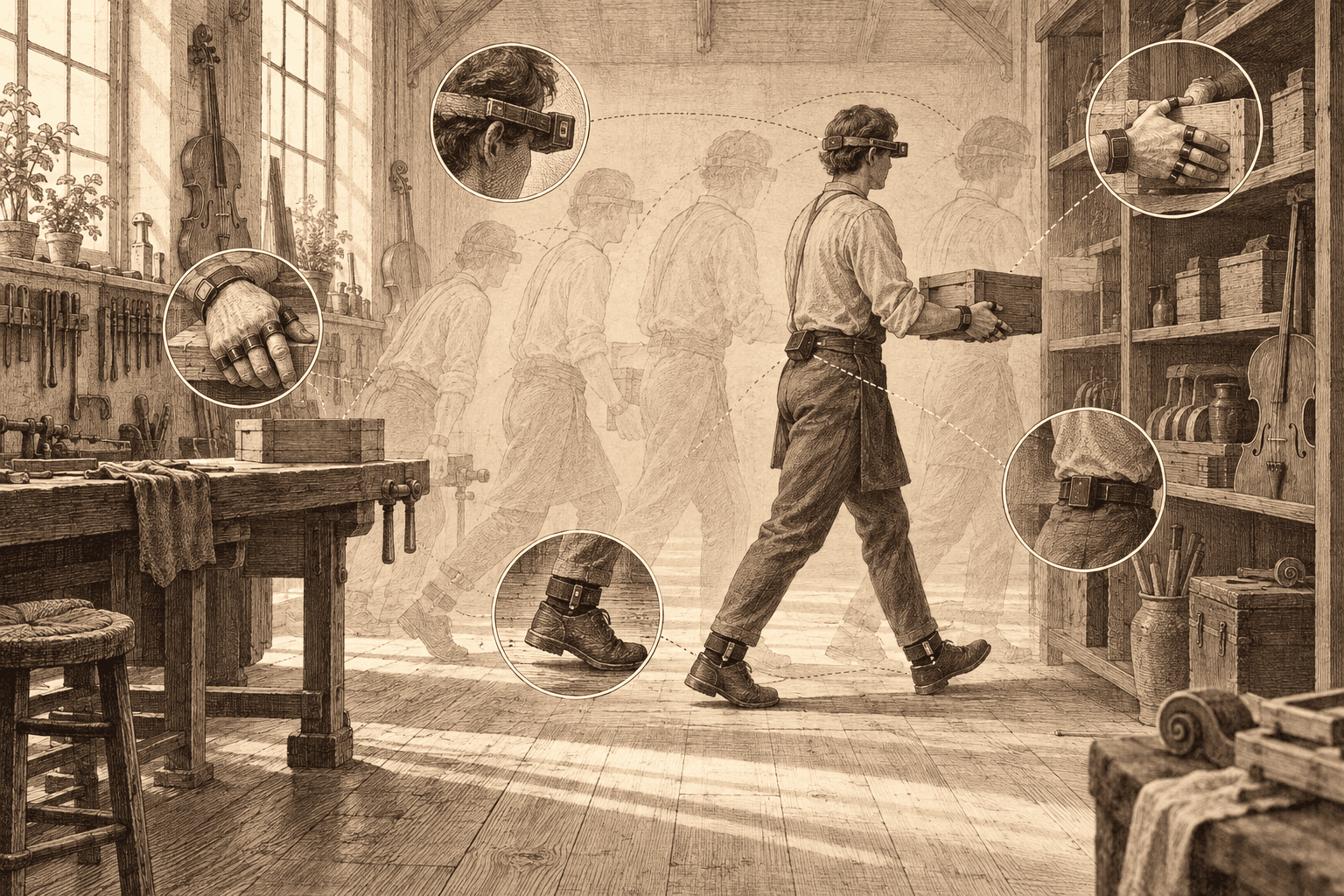
Concept illustration of aligned vision, body-motion and touch capture; not an EgoExplorer participant, recording or dataset frame. Original editorial illustration generated with built-in Codex Image Gen for The Machine Press, October 14, 2026 edition.
EgoExplorer aligns 100 hours of first-person video with reconstructed body motion, articulated fingers, touch observations and step-level descriptions.
Robot-learning datasets often capture only part of a physical task: a camera view, body pose or hand contact. EgoExplorer's authors built a portable wearable system intended to observe those signals together during professional activities. The resulting 100-hour collection aligns egocentric video with reconstructed whole-body motion, detailed finger articulation, tactile observations and step-level descriptions. Its Calibrate-Complete-Constrain pipeline first fixes participant geometry and sensor placement, fills in unobserved joints with a temporal prior and then imposes measurement, continuity and geometry constraints. Against tracker-fitted references, the authors report a 71.9 percent reduction in body-point error relative to the strongest baseline, plus improvements in hand stability and contact estimation. Preliminary studies explore generation, conditioning and humanoid retargeting in simulation. This remains a research dataset and reconstruction method, not a guarantee that a robot can safely reproduce the recorded work.
An evaluation of disaster situation reports finds that surface similarity does not measure provenance or official coverage.
A new evaluation derives a 15-slot schema from professional humanitarian situation reports, then compares 121 human and 261 machine-generated reports across five disasters. On one Cyclone Idai setting, a Gemini-based score put the best machine arm nominally above the empirical human ceiling, but the difference was statistically indistinguishable from zero and did not replicate with another model. Across three primary events, machine reports reproduced only 5.4 to 11.0 percent of same-day official figures. Date, organization, series and authority were underrepresented in every observed event-judge cell. The results are tied to this corpus and judging design, but they warn against treating a fluent, complete-looking situation report as grounded operational evidence.
NASA OSAM-1 hardware used illustratively; it does not depict ChunkAct, a language-model planner or a LIBERO-Pro evaluation. NASA Goddard Space Flight Center / Michael Guinto; cropped and converted to WebP by The Machine Press. Use does not imply NASA endorsement.
ChunkAct compiles remembered robot routines into action chunks, reserving language-model calls for decisions and failures.
Agentic robot systems can ask a language model to reason before every primitive action, repeatedly rereading the same history. ChunkAct's authors instead compile memory into chains of primitives that execute autonomously until a failure returns control to the planner. On LIBERO-Pro, they report a five-point success-rate gain over their agentic-robotics baseline while using 2.9 times fewer model calls, 4.4 times fewer input tokens and 2.3 times fewer output tokens. These are benchmark results, but the design isolates a practical systems idea: use expensive reasoning at decision boundaries, not at every movement.
LoopWAM learns from successful, weak and failed deployment rollouts instead of imitating everything or discarding mistakes.
Real deployment logs contain successes, poor actions and failures. LoopWAM uses source-dependent noise, quality steering and weighted supervision to keep video evidence across that spectrum while limiting imitation of bad behavior. The authors report that three deployment-and-training rounds lifted Table30-V2 task success from 23.67 to 43.33 percent, while two rounds on a shirt-folding task moved success from 13.20 to 55.56 percent. Results on RoboTwin and RoboCasa are also reported. The experiments do not prove that every robot improves safely from its own failures; they show a way to learn physical consequences without treating every action as an expert example.
MiniDog pretrains a 22-million-parameter dog-image model in 55 minutes and fine-tunes it in another 15.
MiniDog is a deliberately narrow demonstration that text-to-image pretraining need not begin at frontier scale. Its authors cache image and text features, combine a small transformer with a semantic latent autoencoder and use 26,000 ImageNet dog images for pretraining plus 2,000 generated images for fine-tuning. They report 55 minutes for pretraining and 15 for fine-tuning on four RTX 3090 GPUs. The work concerns a restricted dog-breed domain and does not imply that a general-purpose generator can be trained this cheaply. Its value is pedagogical: it makes an end-to-end diffusion-transformer experiment reachable on workstation-class hardware.
Tev-Gym supplies 1,170 verified environments with dense stepwise rewards for training long-horizon agents.
Long-horizon agent tasks can supply a final pass or fail signal while leaving thousands of intermediate choices unexplained. Tev-Gym begins with a hidden specification of the domain, workflow and expected state, then renders 1,170 environments across seven domains. That latent specification also yields a progress measure, which the authors turn into per-step reward shaping. They report gains for a 27-billion-parameter model on computing, math and terminal benchmarks. Comparisons to named frontier models are claims from the paper's evaluation and depend on its task subsets and Pass@5 protocol. The durable contribution is the training structure: verified progress can make sparse, multi-hour work more learnable.
DoubtLess uses contrasting brief and verbose predictions from a small model to steer reasoning without retraining the large one.
DoubtLess reads a large model's reasoning trace with a smaller model twice: once under a brief instruction and once under a verbose one. The difference between those token predictions nudges the larger model during decoding. Across seven math, science and programming benchmarks, the authors report cutting Qwen3-32B reasoning length by 31 percent without changing accuracy; a self-debugging coding agent used 20 percent fewer thinking tokens per turn. The method still adds a second model at inference and its unchanged accuracy is measured on the selected tasks. It offers a training-free route to reducing repeated checking after a correct answer has already emerged.
Generic CSS code-screen file image used illustratively; it is not AesCode output, training code or a scored visual artifact. Pixabay / Pexels; cropped, resized, metadata stripped, and converted to WebP by The Machine Press.
AesCode separates verifiable content from visual quality when generating editable slides, posters and dashboards as code.
Code can produce structured, editable visual artifacts, but a language model may not see how its layout and color choices render. AesCode supplies an image generated from the same prompt as aesthetic guidance, represents the target as a design graph and separates rewards: deterministic checks cover properties that code and rendering can verify, while a vision-language judge scores harder visual relations with a sample-specific rubric. The authors report visual-quality gains of 31.1 and 22.4 percentage points for their 8B and 32B models over same-scale baselines with the same references. Those scores come from the new benchmark and its judging protocol. The system's central move is to keep factual correctness and appearance as distinct optimization channels.
A 1.6-million-parameter module assigns each image a query-aware token budget without retraining the base multimodal model.
Multi-image questions can drown a multimodal model in visual tokens even when only a few regions matter. The mmVB module allocates a query-conditioned budget across images using cross-image context and does not require access to attention matrices at inference. The authors report ninefold fewer visual input tokens, fivefold faster time to first token and sevenfold fewer prefill operations while retaining 94.4 percent of full-resolution accuracy across eight benchmarks. Those figures are averages over the tested models and tasks, not a universal compression guarantee. The result suggests that multi-image systems should decide how much of each image to carry forward rather than compressing every frame equally.
A reinforcement-learning method feeds property improvements and structural similarity back into the next optimization turn.
Molecular optimization must often improve several properties while keeping the candidate recognizably close to its starting structure. MFG trains a language model to use a feedback vector describing both property changes and similarity after each turn, with a reward that favors progressive improvement. Across ten multi-objective tasks, the authors report an 81.50 percent average similarity-constrained success rate, versus 70.81 percent for the base model. These are computational optimization results, not laboratory validation or evidence of a viable drug. The work formalizes the iterative loop medicinal chemists expect: a proposed change should respond to what happened on the previous one.
WorldRecon uses noisy camera estimates as a scaffold, then propagates geometry and material context across scene blocks.
WorldRecon reconstructs complete meshes from unposed views by first estimating a coarse point cloud and camera poses, then partitioning the space into overlapping blocks. A generative 3D model fills sparse structure, geometry and physically based materials, while neighbour-aware latent inpainting passes context from one block to the next. The authors report lower Chamfer distance and higher F-scores than their strongest baselines on synthetic and real indoor scenes. Generated completion remains an inference about surfaces that were not observed. The approach makes that inference scalable while trying to keep adjacent blocks structurally and visually consistent.
LIBERO-RIG changes hardware and setup while leaving the robot tasks themselves fixed.
Robot policies often meet a different camera mount, table height, controller rate or worn gripper pad at deployment. LIBERO-RIG perturbs eleven such setup axes at five severity levels while holding tasks constant. Across nine vision-language-action models and 500 episodes per condition, pooled success fell from 0.932 in the reference setup to 0.767 at middle severity and 0.509 at the highest. Training on visual perturbations did not solve faults invisible to the camera. These are simulated benchmark conditions, but they expose a deployment gap: robustness to scenes is not the same as robustness to the machine carrying out the policy.
Visualising AI concept art used illustratively; it is not a Plan-Bench sample, model architecture or experimental result. Novoto Studio / Google DeepMind / Pexels; cropped, resized, metadata stripped, and converted to WebP by The Machine Press.
Plan-Bench isolates spatial, temporal and constraint reasoning from the execution of physical actions.
Plan-Bench asks whether vision-language models can build multi-step plans for embodied worlds without mixing in failures from the robot controller. Its 699 curated samples span 16 subclasses across spatial information, temporal state and task constraints. Among 28 evaluated models, the strongest reached 75.0 percent accuracy. The paper reports that larger models generally did better, but a quarter of the test still remained unsolved by the leader. Because execution is deliberately removed, the benchmark measures high-level planning rather than end-to-end robot competence.
Game2Real-Bench aligns executable game tasks with real images by reasoning requirement instead of appearance.
Game2Real-Bench pairs 1,000 procedurally verified game samples with 400 real-world samples that demand the same kinds of perception, spatial reasoning, constraints and planning. Across 25 vision-language models, game and real-world scores had Pearson and Spearman correlations of 0.935. One-shot game examples improved constraint reasoning for several tested models but hurt fine-grained perception. Correlation does not mean every synthetic skill transfers. The benchmark's useful distinction is that a controllable toy can diagnose a reasoning operation even when its pixels look nothing like the target world.
OmniCompass tests when, where and what happens in video under visual-only and audio-visual conditions.
OmniCompass separates temporal grounding, spatial grounding and question answering across a visual-language track and an audio-visual track. The main collection contains 820 videos and 2,460 instances; a narrative and audio-rich subset contains 240 videos and 720 instances. Each target appears in paired text-only and text-plus-image specifications. Evaluations of 50 multimodal models found persistent temporal and spatial errors and inconsistencies between those paired prompts; the authors also report an open-source gap on audio-visual understanding. The benchmark diagnoses multiple dimensions, but its scores do not establish general video understanding outside the curated domains.
Independent builders turning improbable ideas into real things.
Four editorial selections
$7 for seven days
Paid work is clearly labeled
Placement is never endorsement
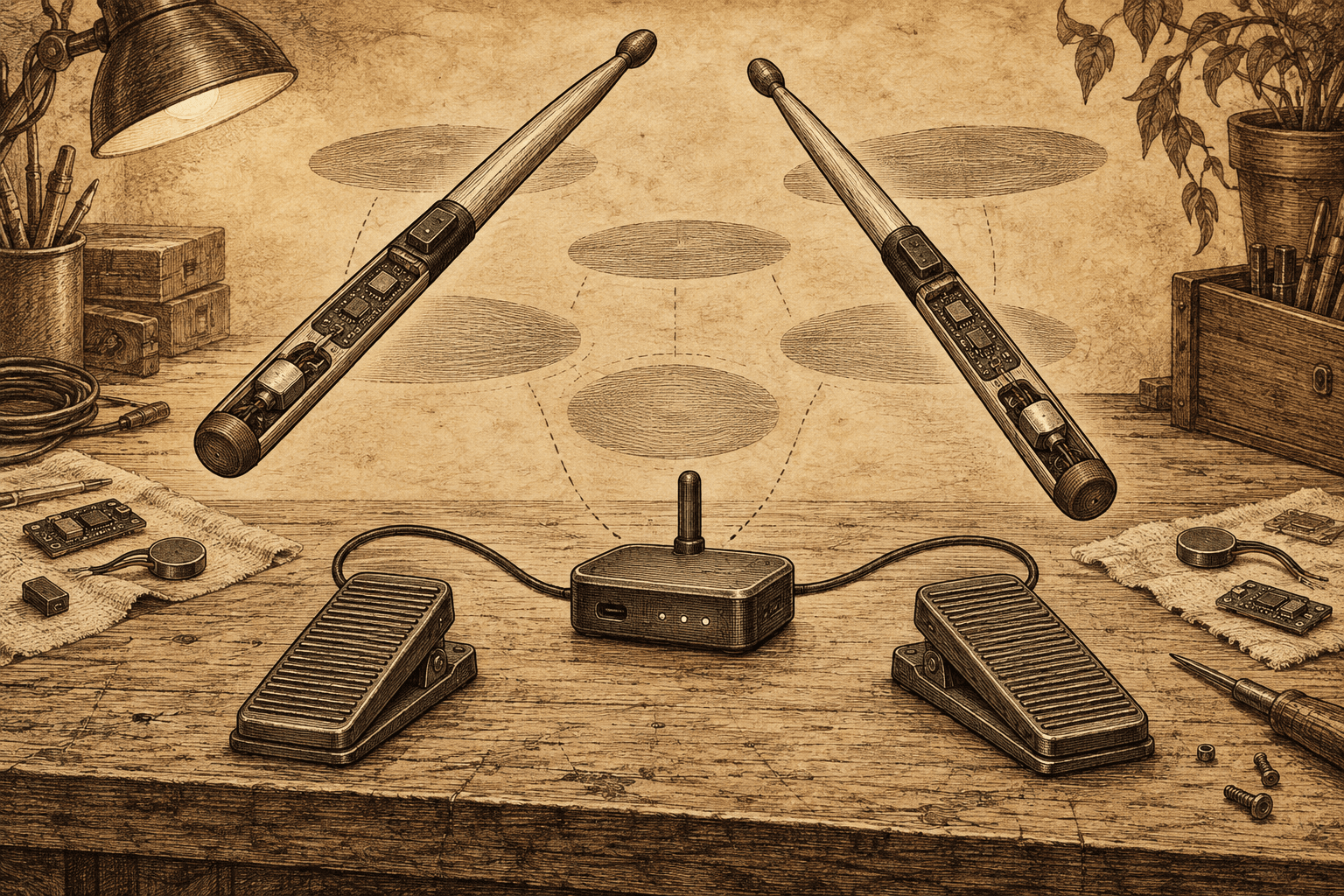
Original editorial concept art generated with built-in Codex Image Gen for The Machine Press, 2026-09-27; carried over because the October 4 handoff remains validation pending and no complete October 11 handoff exists.
Moves motion tracking onto two ESP32-S3 drumsticks, adds haptic hits and a two-pedal hub, and sends velocity-sensitive drum events to open PC or Android playback software.
Visit Space Drums 2.0Original editorial concept art generated with built-in Codex Image Gen for The Machine Press, 2026-09-27; carried over because the October 4 handoff remains validation pending and no complete October 11 handoff exists.
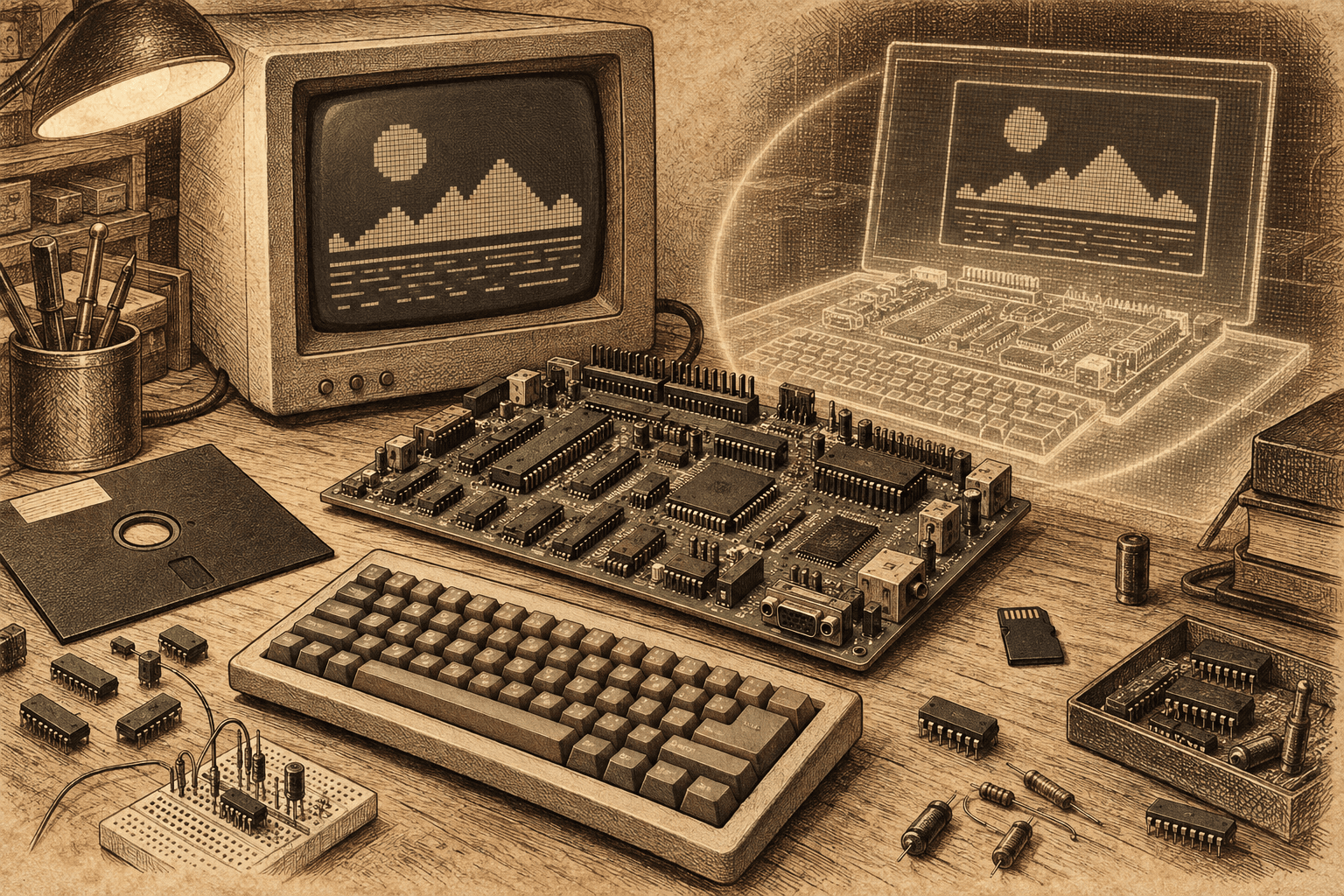
Pairs a chip-level 65C02 computer with custom hardware, video, sound, floppy, and microSD support with a cycle-honest emulator and browser assembler built around the same machine.
Visit 3RICOriginal editorial concept art generated with built-in Codex Image Gen for The Machine Press, 2026-09-27; carried over because the October 4 handoff remains validation pending and no complete October 11 handoff exists.
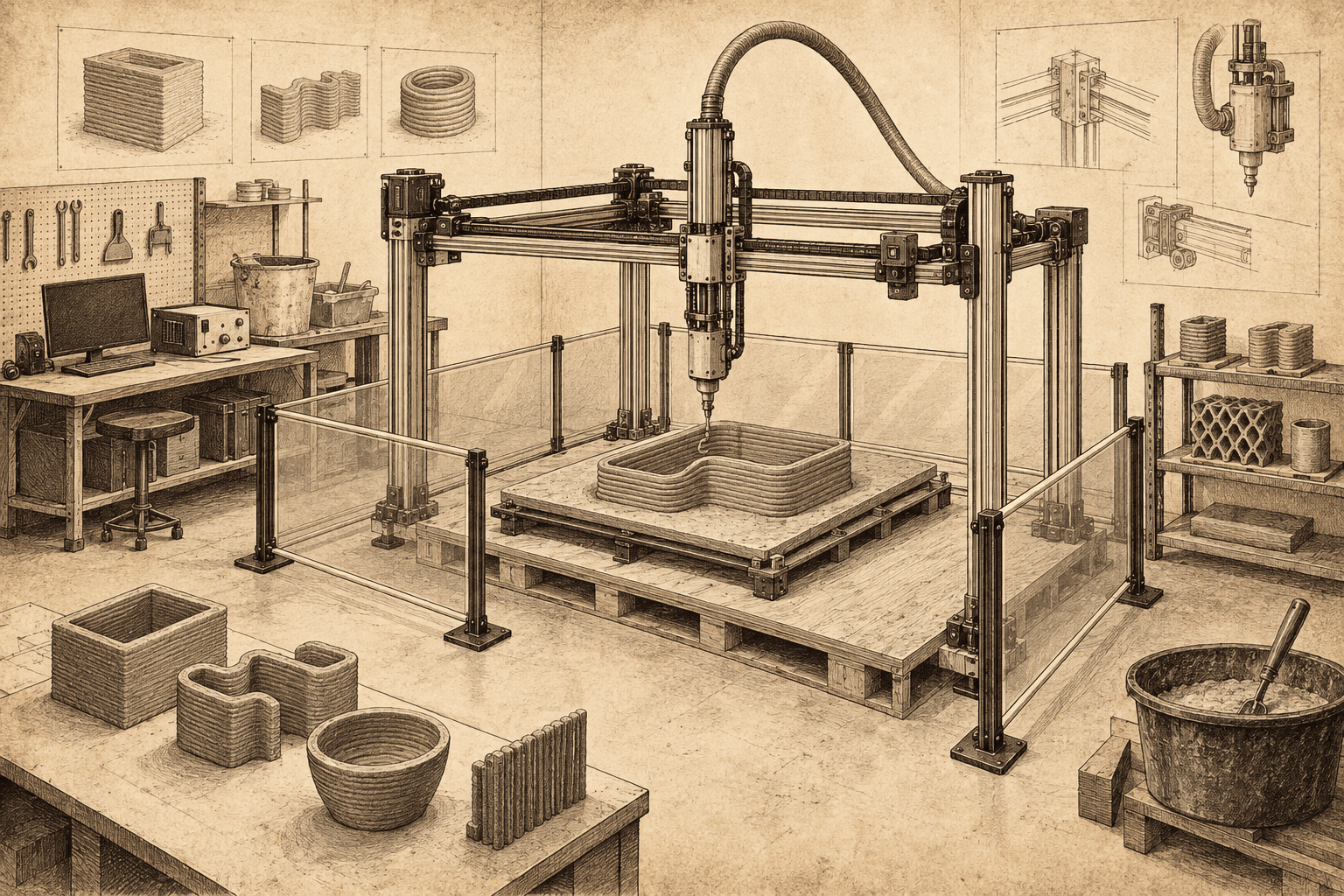
Publishes a pallet-scale cartesian motion reference, CAD, BOM, and low-voltage controls for supervised cementitious-extrusion research while explicitly excluding certified structural use.
Visit M3-CRETEOriginal editorial concept art generated with built-in Codex Image Gen for The Machine Press, 2026-09-27; carried over because the October 4 handoff remains validation pending and no complete October 11 handoff exists.
Turns a bare ESP32-S3 touchscreen into a USB-connected desk instrument for PC activity and optional room temperature, humidity, and light measurements.
Visit DeskNodeOriginal Codex Image Gen concept art from 2026-07-10; carried forward from the validated 2026-10-03 edition.
Desk Picks are selected by the newsroom. Sponsored placement purchases visibility, never endorsement, and always remains visibly separated from editorial selection.
 Editorial illustration