robotics
A Wearable Observatory Records How Work Moves
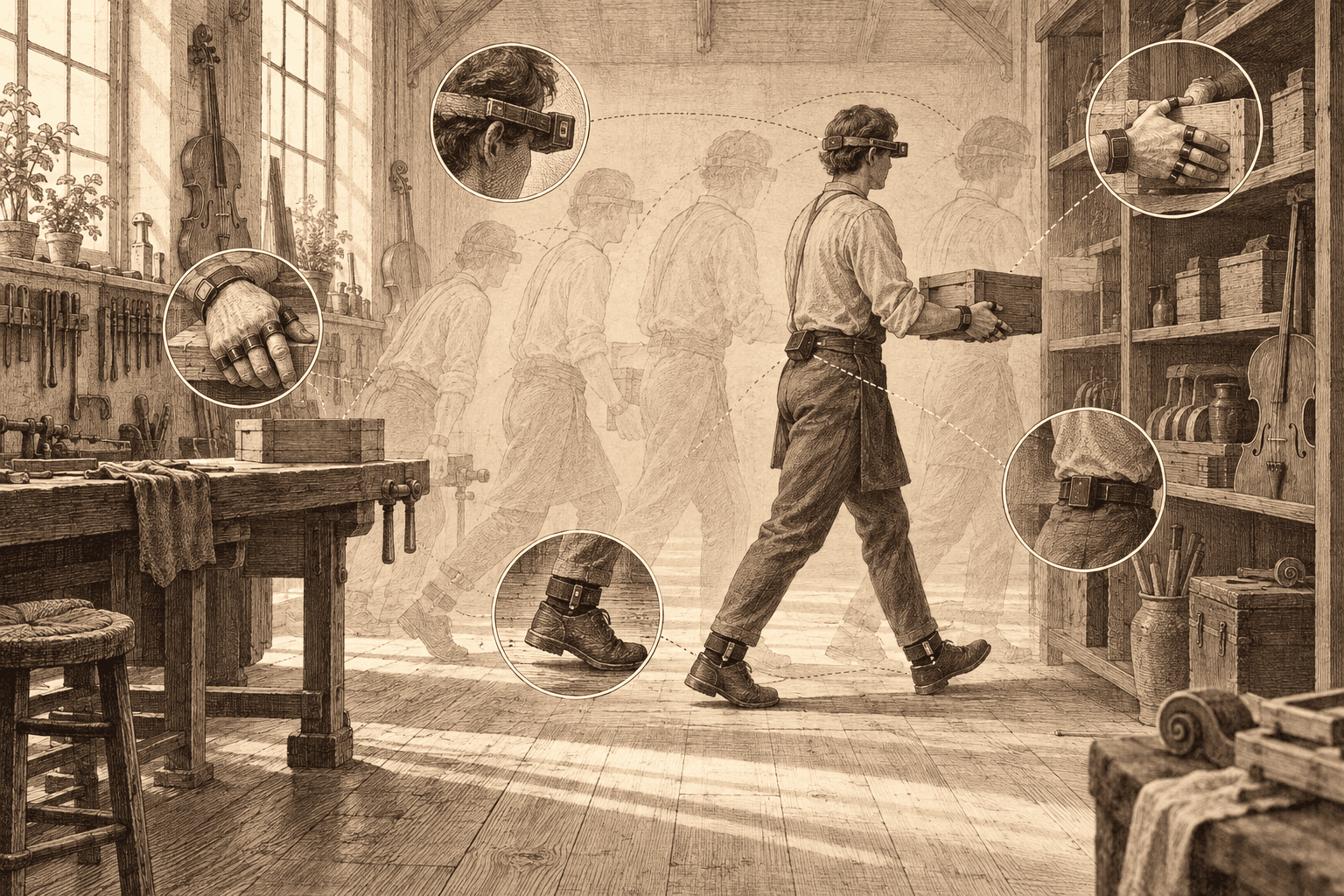
EgoExplorer aligns 100 hours of first-person video with reconstructed body motion, articulated fingers, touch observations and step-level descriptions.
Summary
EgoExplorer aligns 100 hours of first-person video with reconstructed body motion, articulated fingers, touch observations and step-level descriptions.
Robot-learning datasets often capture only part of a physical task: a camera view, body pose or hand contact. EgoExplorer's authors built a portable wearable system intended to observe those signals together during professional activities. The resulting 100-hour collection aligns egocentric video with reconstructed whole-body motion, detailed finger articulation, tactile observations and step-level descriptions. Its Calibrate-Complete-Constrain pipeline first fixes participant geometry and sensor placement, fills in unobserved joints with a temporal prior and then imposes measurement, continuity and geometry constraints. Against tracker-fitted references, the authors report a 71.9 percent reduction in body-point error relative to the strongest baseline, plus improvements in hand stability and contact estimation. Preliminary studies explore generation, conditioning and humanoid retargeting in simulation. This remains a research dataset and reconstruction method, not a guarantee that a robot can safely reproduce the recorded work.
Why it matters
EgoExplorer aligns 100 hours of first-person video with reconstructed body motion, articulated fingers, touch observations and step-level descriptions.
Limits and context
- Robot-learning datasets often capture only part of a physical task: a camera view, body pose or hand contact.
- This remains a research dataset and reconstruction method, not a guarantee that a robot can safely reproduce the recorded work.
Key claims
EgoExplorer aligns 100 hours of first-person video with reconstructed body motion, articulated fingers, touch observations and step-level descriptions.
Qualification: Robot-learning datasets often capture only part of a physical task: a camera view, body pose or hand contact.
Evidence: source-2026-10-14-002
Sources
- arXiv preprint 2610.18872, original v1arXiv / submitting research authors · primary research
Corrections
No corrections have been recorded for this story.