A cloud-accessible superconducting processor showed a distance advantage in surface-code memory, while 150-round runs exposed correlations that still resist the protection.
Editorial illustration
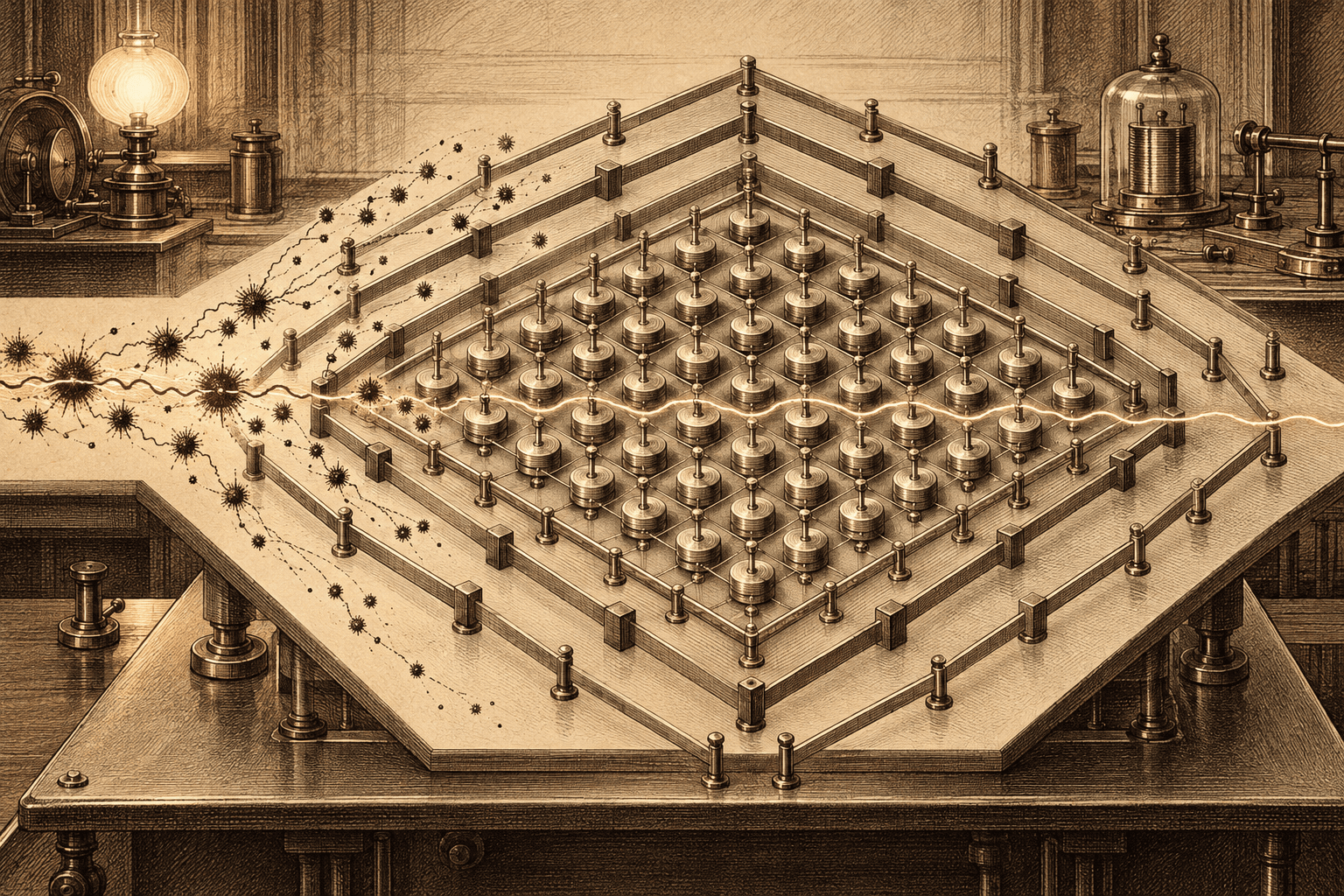
Concept illustration of surface-code error suppression and a persistent correlated error; not the IBM processor, circuit layout or experimental evidence. Original editorial illustration generated with built-in Codex Image Gen for The Machine Press, October 19, 2026 edition.
Quantum error correction earns its promise only when a larger code makes the logical memory fail less often. On an IBM Nighthawk r2 superconducting processor, researchers tested rotated surface-code memory across several placements and found that careful circuit work mattered as much as the code diagram. Short readout, fused measurement and reset, and an echo sequence reduced the median per-round logical error rate relative to a standard circuit by factors of 3.8 in the X basis and 1.4 in the Z basis. Under that optimized recipe, increasing one protected distance from three to six lowered the reported per-round error from 0.53 percent to 0.24 percent for Z memory and from 0.52 percent to 0.22 percent for X memory. The result is a hardware demonstration, not fault-tolerant computing: performance varied across processor locations, the distance advantage weakened in runs as long as 150 rounds, and long-lived correlations suggested a persistent error component. The experiment makes the engineering target clearer. Better codes, compilation, measurement and devices cannot be optimized independently when correlated noise survives the very repetition meant to suppress it.
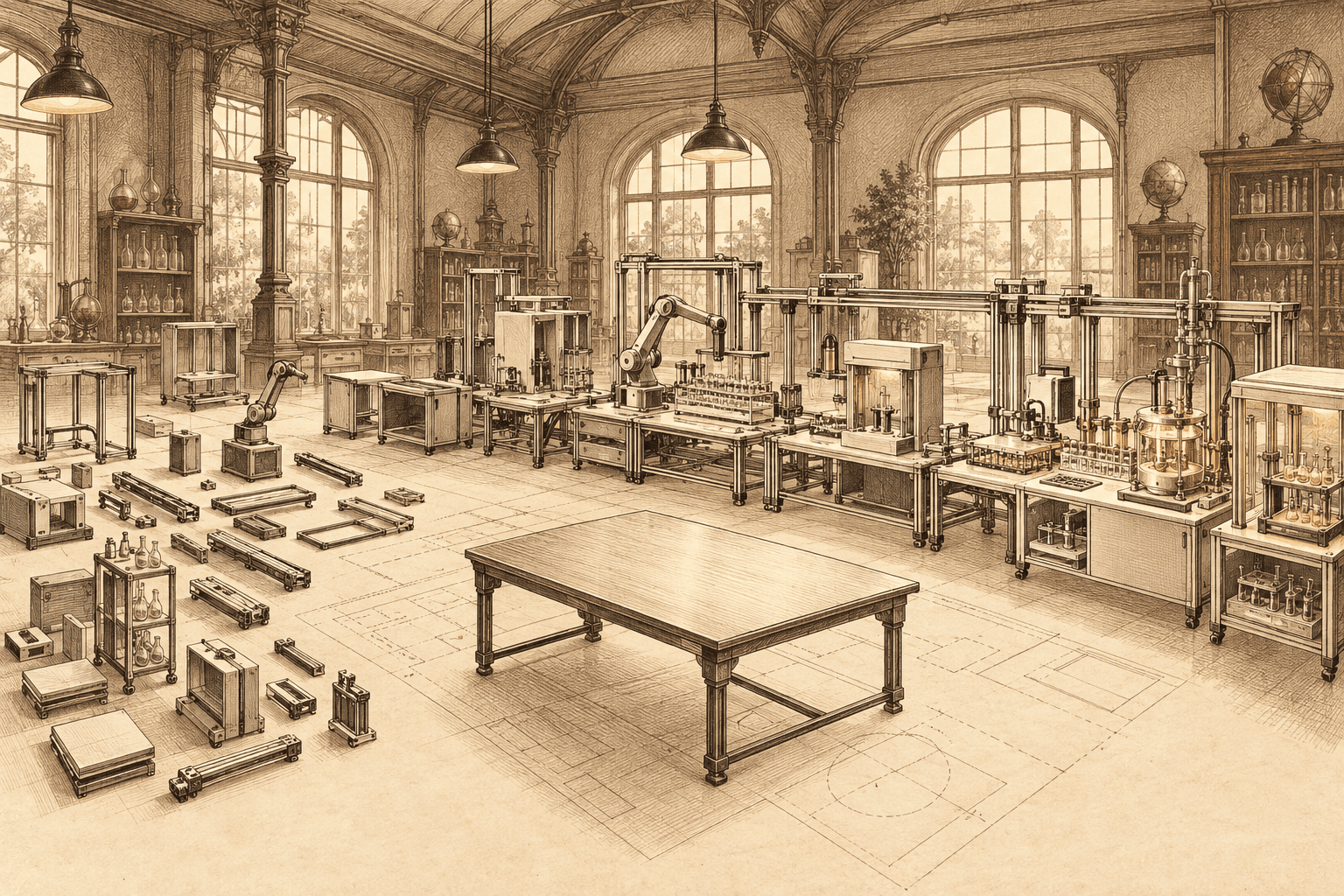
Concept illustration of a laboratory being configured around a scientific objective; not the reported SBL setup, robots or quantum-dot experiment. Original editorial illustration generated with built-in Codex Image Gen for The Machine Press, October 19, 2026 edition.
Self-Building Labs turns a scientific objective into the missing layout, digital twin, robot skills and workflows instead of assuming the automation already exists.
A self-driving laboratory can optimize experiments only after people have engineered the room, connected its instruments and taught every robot what to do. Self-Building Labs targets that earlier bottleneck. Given a high-level scientific goal and whatever equipment is already available, the proposed system designs the missing laboratory layout, creates a digital twin, develops robot skills and composes experimental workflows. The authors report demonstrations across different robots and setups, from one workstation to laboratories with several robots, and validate the end-to-end approach with a real-world quantum-dot synthesis experiment. That is a broader claim than having an agent choose the next recipe: the physical automation stack itself becomes part of the plan. The paper does not show that arbitrary laboratories can safely reconfigure themselves, and its results should not be read as eliminating human supervision, integration work or domain-specific validation. Its practical contribution is a new boundary for scientific automation. If the apparatus can be configured around the question, then changing research programs may become less like commissioning a new factory and more like compiling a new experimental capability.
A metareasoning policy changes the planner's computation budget with the state instead of fixing one delay for every maneuver.
Planning while moving creates a physical bargain: more computation may improve the plan, but the robot must continue open-loop until that answer arrives. This work casts the budget itself as a semi-Markov decision. A learned policy observes the current state, executing plan and inexpensive planner statistics, then chooses both the action commitment and time available to the solver. Across ground navigation, agile quadrotor flight and contact-rich manipulation, the authors report better performance than fixed-budget baselines and state-dependent reasoning patterns. The tested domains do not establish safe deployment in every real-time system, but they make computation time part of the control policy rather than a constant selected before the robot enters the world.
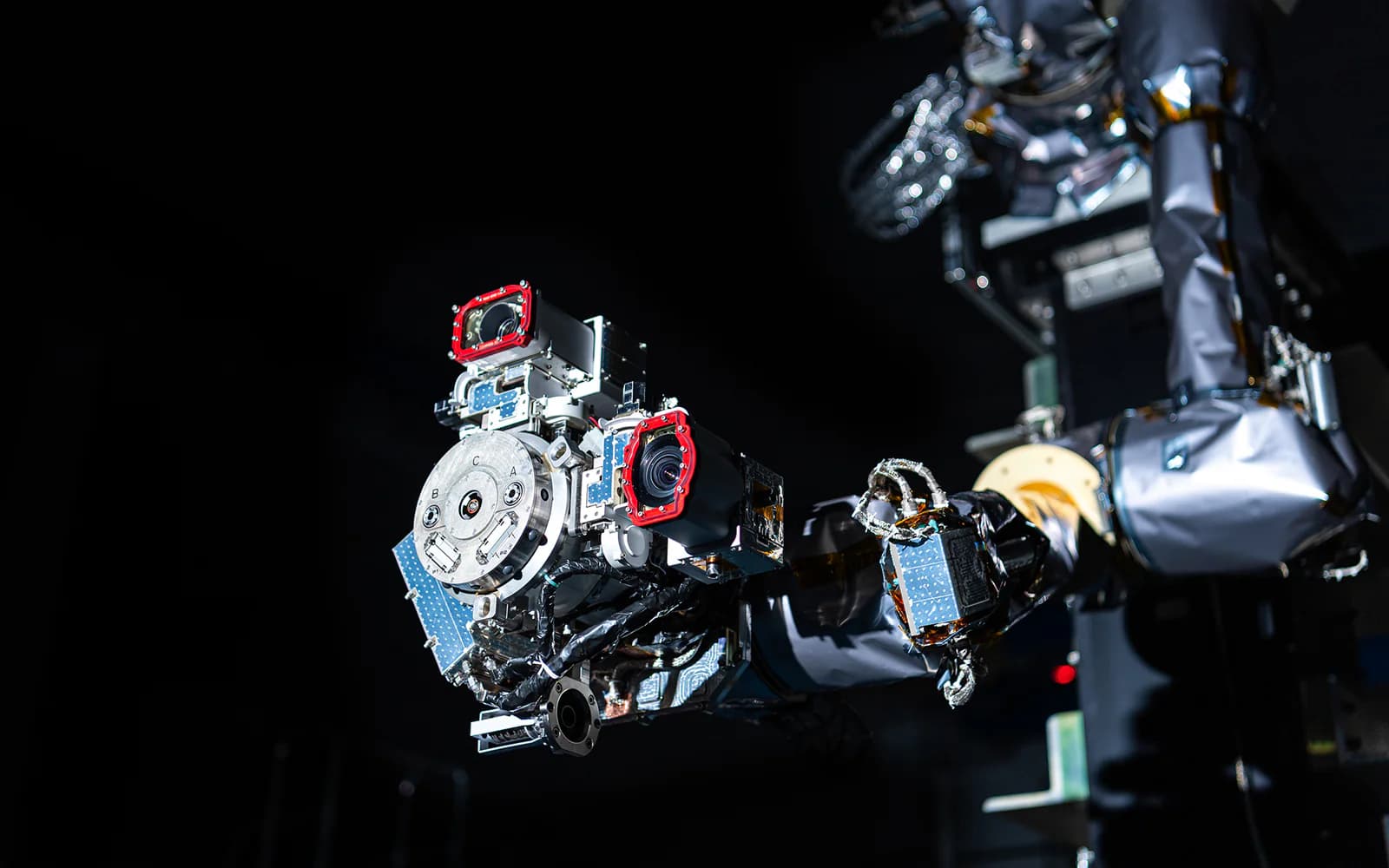
NASA OSAM-1 hardware used illustratively; it does not depict the blind assembly policy, tested robot, parts or reported trials. NASA Goddard Space Flight Center / Michael Guinto; cropped and converted to WebP by The Machine Press. Use does not imply NASA endorsement.
A proprioception-only policy learned insertion, gear meshing and threading without cameras, force sensors or tactile arrays.
Precise assembly is usually treated as a vision or force-sensing problem. These policies observe only a short history of joint positions, velocities and prior actions while the fixture, part pose and grasp are hidden. Trained entirely in simulation across randomized parts and contacts, they learned peg insertion, gear meshing and nut threading. The peg policy transferred to a real robot without additional training and inserted differently shaped pegs in 73 percent of trials. In matched simulation tests, the blind policies generalized better to unseen shapes and sizes than visual policies, though they could be slower. The result argues that a robot's own joints can provide a useful contact signal, not that external sensing is unnecessary in production assembly.
Video Geometry Corrector learns to repair warped structures and broken parallax after generation, without changing the source model.
Generated video can look plausible frame by frame while buildings bend and camera motion collapses into cuts. Video Geometry Corrector treats that as a repair problem. The team creates synthetic pairs by distorting real camera-motion clips, then trains a video-to-video model to recover the consistent target with optical flow as an auxiliary cue. Across pose-conditioned and prompt-driven tests, the authors report improved geometry for multiple source generators, with larger backbones extending the effect. Because the supervision is synthetic and the evidence is benchmark-based, the work does not establish universal correction. It does show a modular path for improving geometric consistency without retraining every generator.
StopWatch traces object-goal navigation failures to grounding: policies explore, then miss that the target is already visible or nearby.
Vision-language navigation policies often know enough to explore but still fail at the final recognition step. The StopWatch analysis identifies explicit goal grounding—detecting that the object is in view and estimating its distance—as the dominant missing capability. Adding that grounding improved results across six benchmarks and three scene collections. On corrected benchmark annotations, a policy given ground-truth grounding nearly matched the expert that generated its demonstrations, leaving much of the remaining headroom in perception rather than navigation policy learning. These are benchmark findings, but they redirect attention from ever-larger action policies toward the simpler question of whether the robot knows it has arrived.
DiscoveryRSI grows hypothesis trees, turns investigations into executable tasks and attributes later assessments back to documented contributions.
DiscoveryRSI defines a valuable hypothesis as an evidence-grounded claim about a consequential uncertainty, paired with a feasible investigation, decision criteria and alternative explanations. Its multi-agent search grows hypothesis trees, compiles selected investigations into executable tasks and reuses assessments to refine future work. Across four life-science domains, automated scores rose after two self-improvement rounds, with the largest gains in falsifiability and data resolvability; preliminary expert review also favored the system on some dimensions. The authors additionally report correspondence with a small share of research published after the model cutoff. Those evaluations are early and partly automated, so they do not establish autonomous discovery. They offer a concrete ledger for learning from the research process rather than only scoring final answers.
MOSS contracts for firm ground and expands for wet mud, sand and water, morphing in about two seconds while still moving.
A fixed wheel asks one geometry to handle soil, mud and water. MOSS uses 3D-printed origami wheels and a compact crank that changes width, diameter and fin orientation together. In tests across soil, sand, mud and water, the efficient configuration depended on terrain: contracted wheels cost less energy on firmer surfaces, while expanded wheels performed better in wetter mud, sand and water, reducing cost of transport by as much as 29 percent. Expansion also reduced slip and sand sinkage, and the platform crossed soil-mud-water transitions continuously. The compact prototype does not prove field durability at scale, but it demonstrates that mechanical morphology can be a controllable locomotion variable rather than a fixed design choice.
Generic laboratory-glassware file image used illustratively; it does not depict CocoRNA, an RNA sequence, a fold or biological validation. Rodolfo Clix / Pexels; cropped, resized, metadata stripped, and converted to WebP by The Machine Press.
CocoRNA splits inverse folding into cooperative subproblems and uses a centralized critic to coordinate the resulting design policy.
RNA inverse design asks for a sequence that will fold into a specified secondary structure. CocoRNA decomposes that search into smaller pieces handled by cooperating reinforcement-learning agents, while a centralized critic supplies global structural context during training. On the authors' Rfam experiments, the resulting policy outperformed compared methods in success rate and design speed and generalized to unseen structures without additional training. Additional sequence-design tests suggested the decomposition may transfer beyond RNA. These are computational design results rather than laboratory validation of biological function, and a predicted fold is not a therapeutic molecule. The useful idea is organizational: global structure can guide local agents without forcing one policy to search the whole combinatorial space at once.
PPMem stores generated scenes as a compact set of oriented surfaces, then renders that memory back into later video chunks.
Long generated worlds drift because the model lacks a persistent geometric record of what it already made. PPMem adds a plane-prediction head to a video diffusion transformer. Each chunk produces both RGB frames and planar geometry; merged planes become memory that later chunks receive as rendered depth. The authors report that the representation is roughly three orders of magnitude more compact than per-pixel point clouds and sustains coherence across hundreds of frames while also yielding depth, normals and exportable surfaces. Results on DL3DV and RealEstate10K beat compared 3D-grounded world models on reported video quality. Plane-heavy scenes are a favorable abstraction, so the approach is not a complete memory for every object or environment.
PRIME links similar states across trajectories and measures distance to success instead of assuming every recorded action advances the task.
A robot demonstration can contain pauses, corrections and wrong turns, yet many progress estimators treat the whole trajectory as monotonic success. PRIME builds a weighted graph across observed states, connects visually and spatially similar moments, and uses shortest paths to estimate distance to the goal. That lets the reward signal distinguish advancement, stagnation and setbacks. Across simulated and real precision-manipulation tasks, the authors report stronger robustness to suboptimal demonstrations and as much as a fivefold policy-success improvement over supervised fine-tuning baselines on charger insertion. The magnitude is task-specific, but the principle is broader: learning from a demonstration should not require pretending the demonstrator was perfect.
HaCKRS aligns more than 105,000 noisy sonar frames with overhead color video to make accessible aquatic monitoring easier to study.
Imaging sonar works where murky water defeats cameras, but research systems can be expensive and consumer sonar is difficult to annotate. The HaCKRS dataset pairs Garmin LiveScope recordings with top-down RGB video of koi carp. It contains more than 105,000 synchronized frame pairs across about 3.3 hours and four range-orientation configurations, together with geometry, timing and registration data. The release deliberately emphasizes calibrated paired observations rather than finished fish labels. It therefore does not solve detection or ecological monitoring on its own. It supplies a bridge for evaluating whether inexpensive sonar can support future counting, tracking and annotation methods under poor visibility.
ECG-SDI moves beyond coarse sleep stages, but its mortality and treatment-response signals remain observational and exploratory.
Conventional staging divides sleep into broad bins. ECG-SDI trains a two-stage model on 12,392 overnight polysomnography records to estimate a continuous depth index from a single ECG lead. The authors report strong correlation with ordered non-REM stages in internal and external data, high REM-classification AUROC, and within-stage variation that the usual labels hide. Derived phenotypes were associated with subjective sleep quality, all-cause mortality and changes after CPAP in separate analyses. Those associations do not prove that the index causes outcomes or that it is ready for clinical decisions; the wearable example is a proof of concept. The work suggests that a ubiquitous cardiac signal may carry a richer overnight profile than a sequence of categorical stages.
CC0 wafer-scale circuit rendering used illustratively; it does not depict FuTransformer, an H100, tested kernels or measured speedups. Wikideas1 / Wikimedia Commons (CC0 1.0); cropped and converted to WebP by The Machine Press.
FuTransformer uses FP8 where tokens reuse weights and INT4 where single-token decoding is limited by reading them.
Transformer prefill and decode stress hardware differently, so FuTransformer gives them different kernels and precision. On Hopper GPUs, prefill uses FP8 with fused epilogues and direct cache placement; decode uses INT4 projections and a rotated INT4 key-value cache to reduce outlier error. On one H100, the author reports prefill up to 1.48 times faster than compiled PyTorch FP8 and INT4 decode 1.3 to 2.4 times faster than the best evaluated PyTorch path across tested shapes and batches. Full Llama-3.1-8B decoding reached 2.8 milliseconds per step at batch one in the reported setup, with a perplexity cost from quantization. These are implementation-specific comparisons, not universal model-serving gains.
Blitz distills AlphaFold 3 and Boltz-2 diffusion updates, then uses physical steering and candidate selection to repair remaining geometry.
All-atom protein predictors can spend about 200 denoising steps producing a structure. Blitz uses a geometric noise schedule and multistep consistency training to compress that process to eight steps, then applies physical steering and target-free candidate selection at inference. Under one common evaluation protocol, the authors report that distilled AlphaFold 3 and Boltz-2 models retained teacher-level structural accuracy; AF3-Blitz exceeded the tested few-step baselines and its teacher on several metrics. The comparisons cover structure, interfaces, ligands and stereochemistry, but they remain computational benchmarks rather than experimental confirmation of molecular behavior. The result narrows a costly iterative stage without claiming that eight steps settle every biological question.
HardEval executes model-written remediations on live virtual machines and grades the persistent system state with hidden compliance checks.
Security hardening is not complete when a shell script looks reasonable. HardEval turns Red Hat Enterprise Linux 8 STIG controls into execution-verified tasks. A model receives the required outcome but not the implementation, writes a Bash script, and runs it on a live virtual machine; hidden OpenSCAP and OVAL checks determine whether the system actually moved from fail to pass. Across fourteen frontier and open-weight configurations, the authors found large and uneven differences among security domains. A recurring failure was convincing code that did not satisfy the exact compliance condition. The benchmark covers a specific operating system and control set, but it measures the durable state change that code-only evaluations miss.
Independent builders turning improbable ideas into real things.
Four editorial selections
$7 for seven days
Paid work is clearly labeled
Placement is never endorsement
Original editorial concept art generated with built-in Codex Image Gen for The Machine Press, 2026-09-27; carried over because the October 4 handoff remains validation pending and no complete October 11 or October 18 replacement handoff exists.
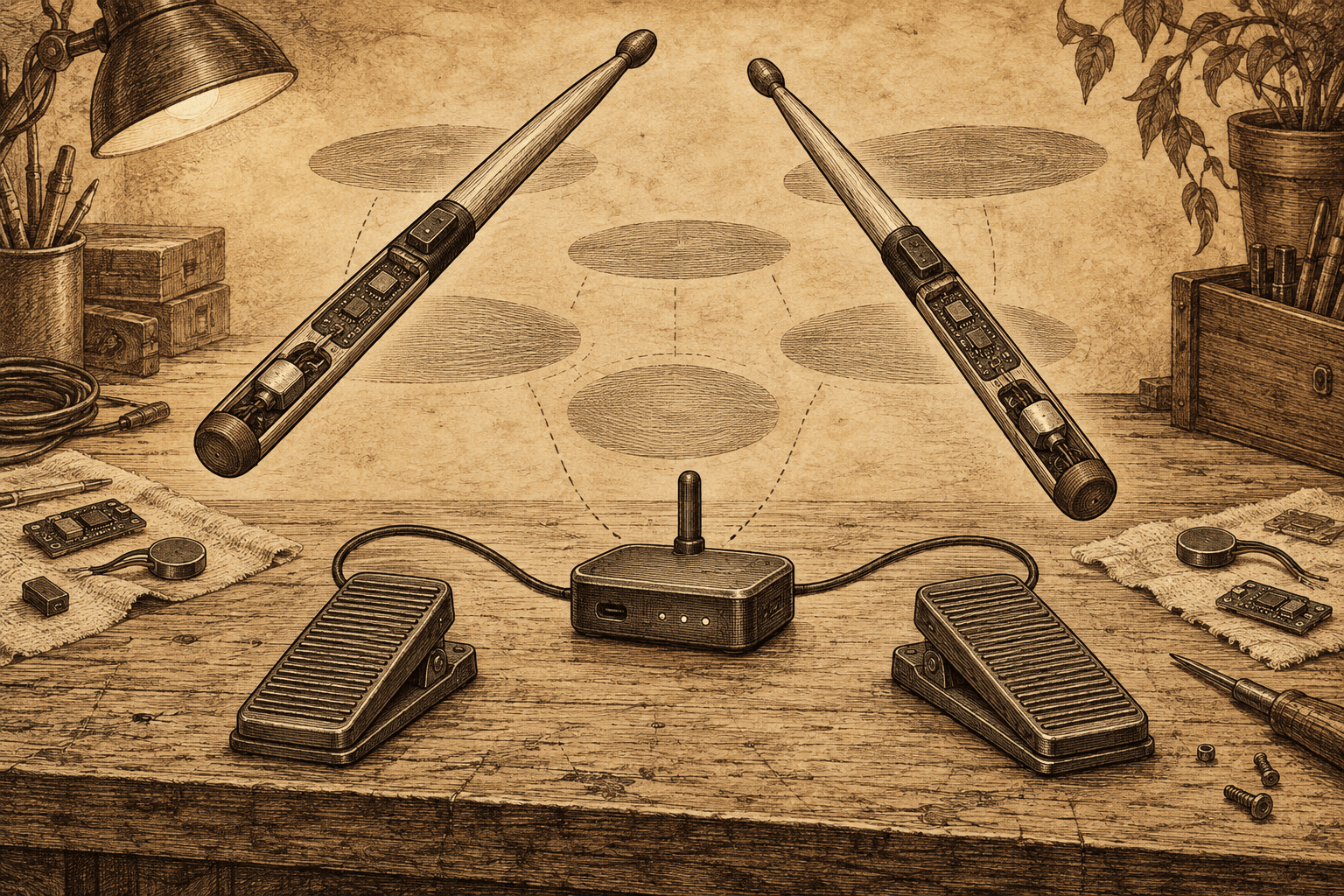
Moves motion tracking onto two ESP32-S3 drumsticks, adds haptic hits and a two-pedal hub, and sends velocity-sensitive drum events to open PC or Android playback software.
Visit Space Drums 2.0Original editorial concept art generated with built-in Codex Image Gen for The Machine Press, 2026-09-27; carried over because the October 4 handoff remains validation pending and no complete October 11 or October 18 replacement handoff exists.
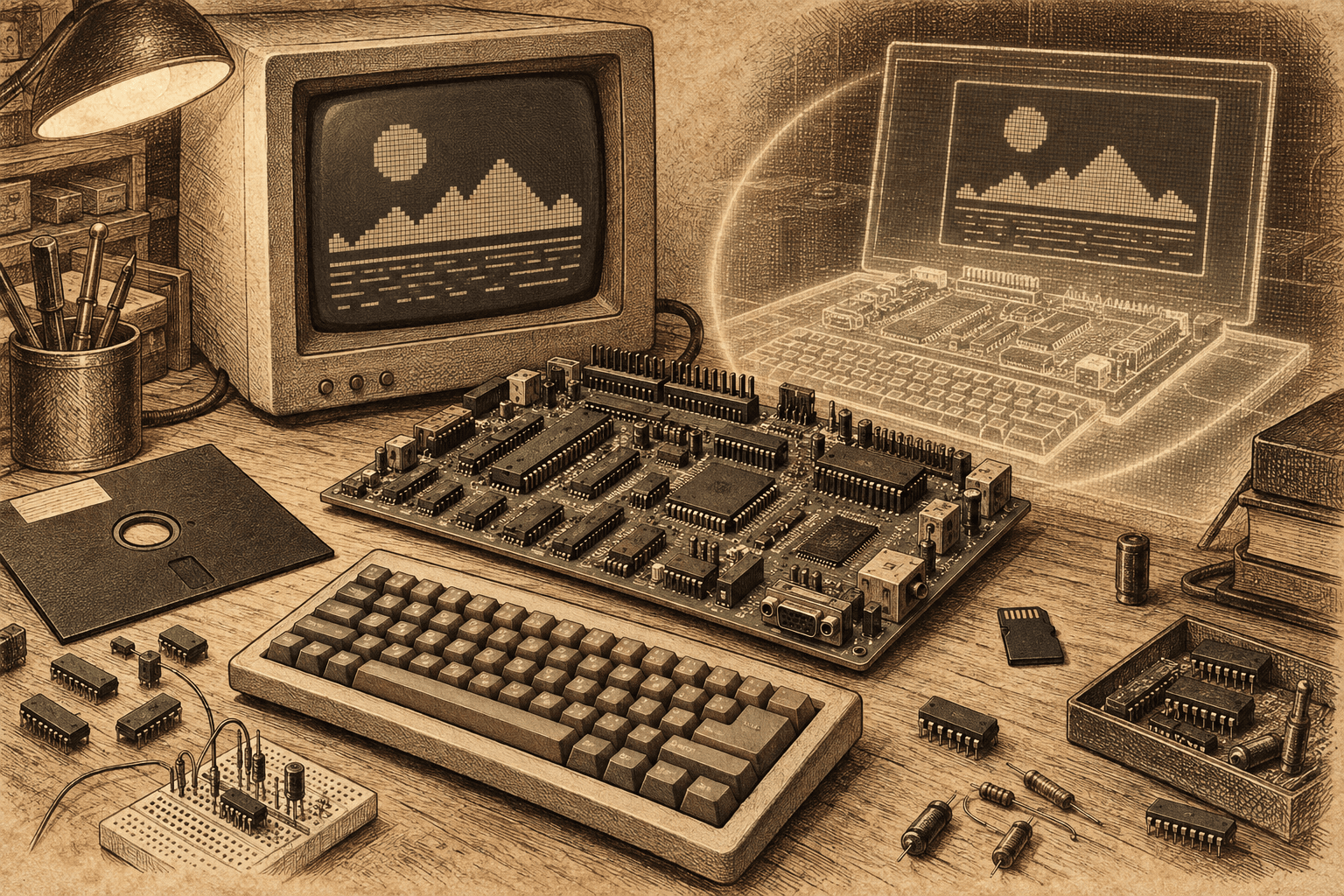
Pairs a chip-level 65C02 computer with custom hardware, video, sound, floppy, and microSD support with a cycle-honest emulator and browser assembler built around the same machine.
Visit 3RICOriginal editorial concept art generated with built-in Codex Image Gen for The Machine Press, 2026-09-27; carried over because the October 4 handoff remains validation pending and no complete October 11 or October 18 replacement handoff exists.
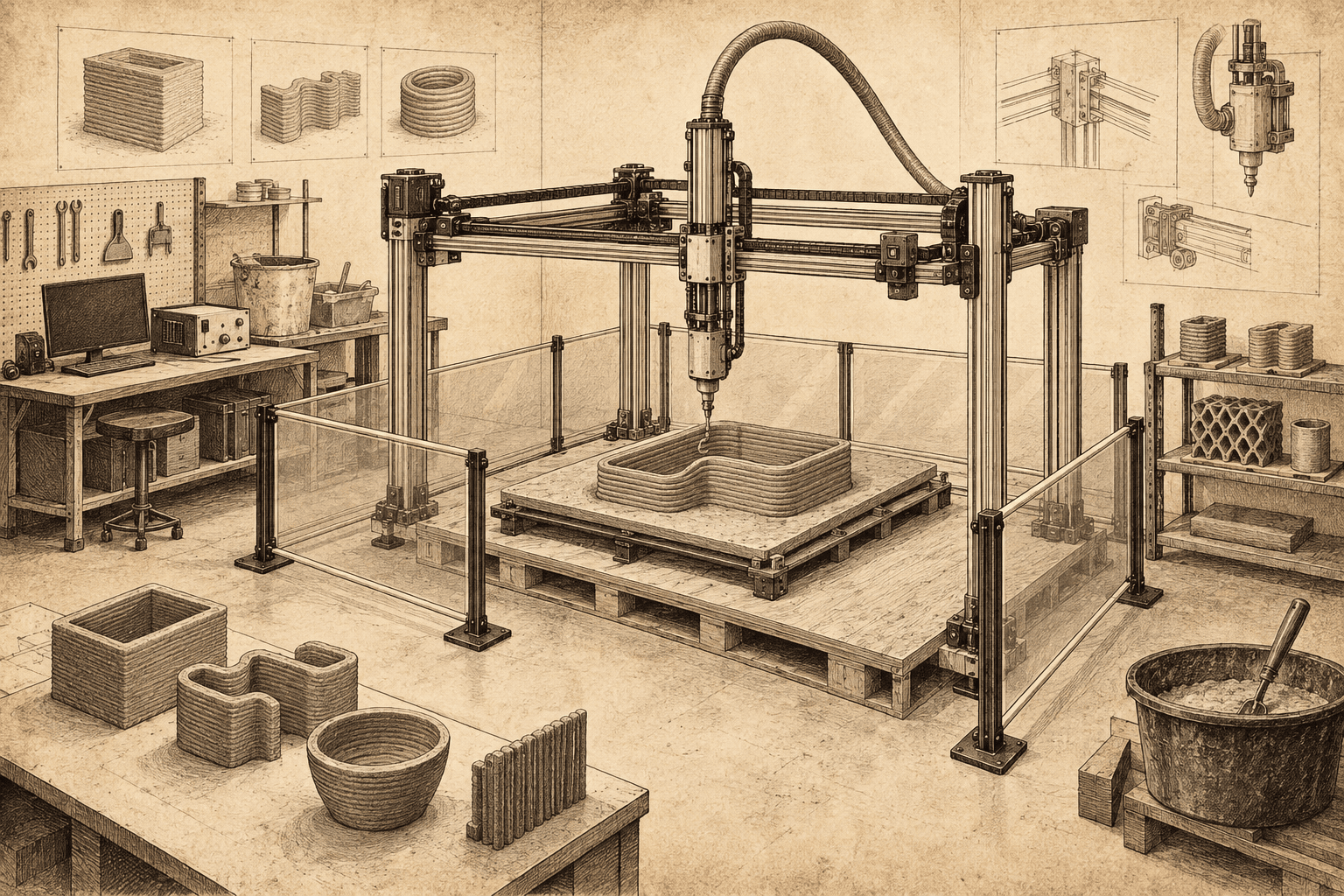
Publishes a pallet-scale cartesian motion reference, CAD, BOM, and low-voltage controls for supervised cementitious-extrusion research while explicitly excluding certified structural use.
Visit M3-CRETEOriginal editorial concept art generated with built-in Codex Image Gen for The Machine Press, 2026-09-27; carried over because the October 4 handoff remains validation pending and no complete October 11 or October 18 replacement handoff exists.
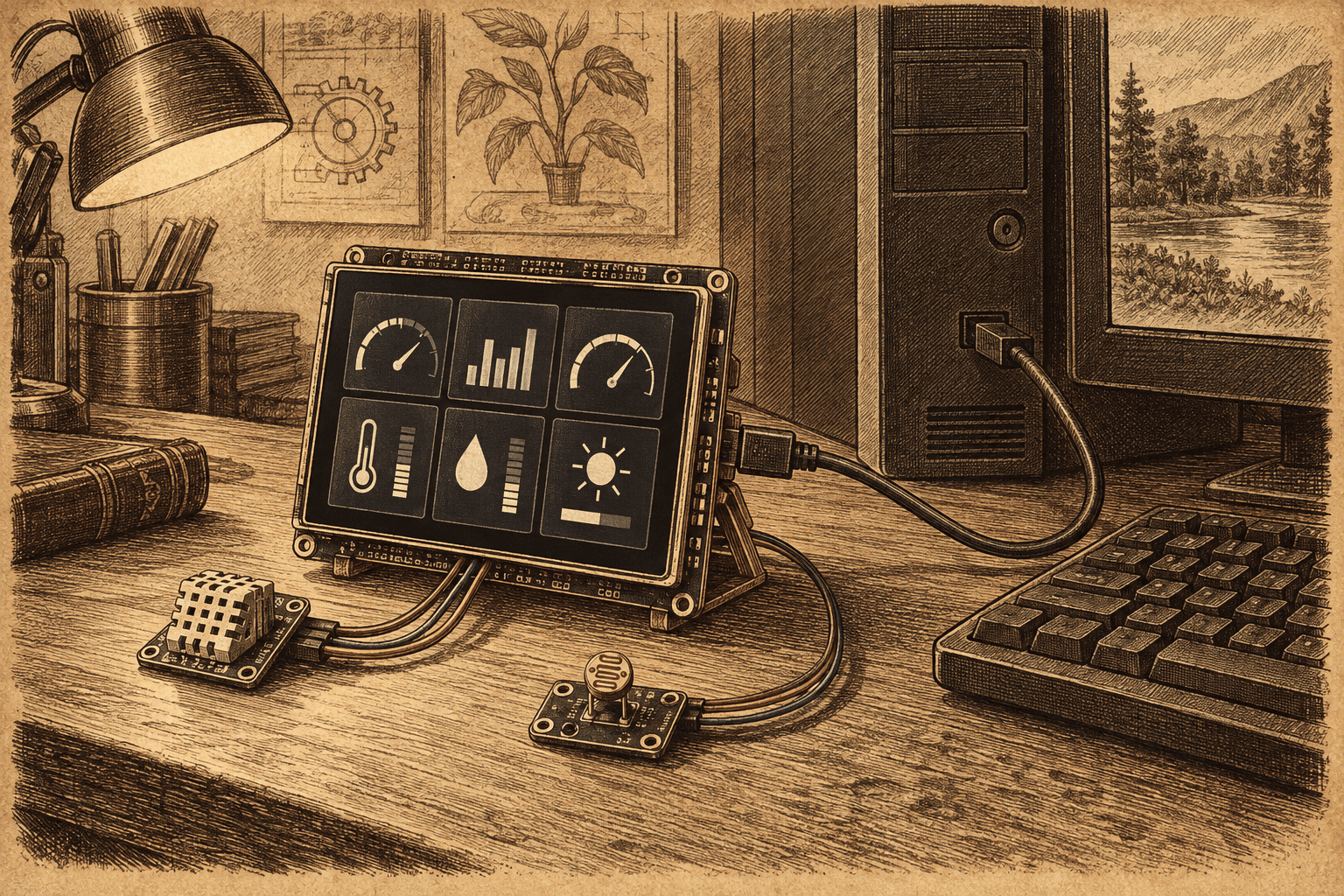
Turns a bare ESP32-S3 touchscreen into a USB-connected desk instrument for PC activity and optional room temperature, humidity, and light measurements.
Visit DeskNodeOriginal Codex Image Gen concept art from 2026-07-10; carried forward from the validated 2026-10-03 edition.
Desk Picks are selected by the newsroom. Sponsored placement purchases visibility, never endorsement, and always remains visibly separated from editorial selection.
 Editorial illustration