robotics
The Laboratory Starts Building the Laboratory
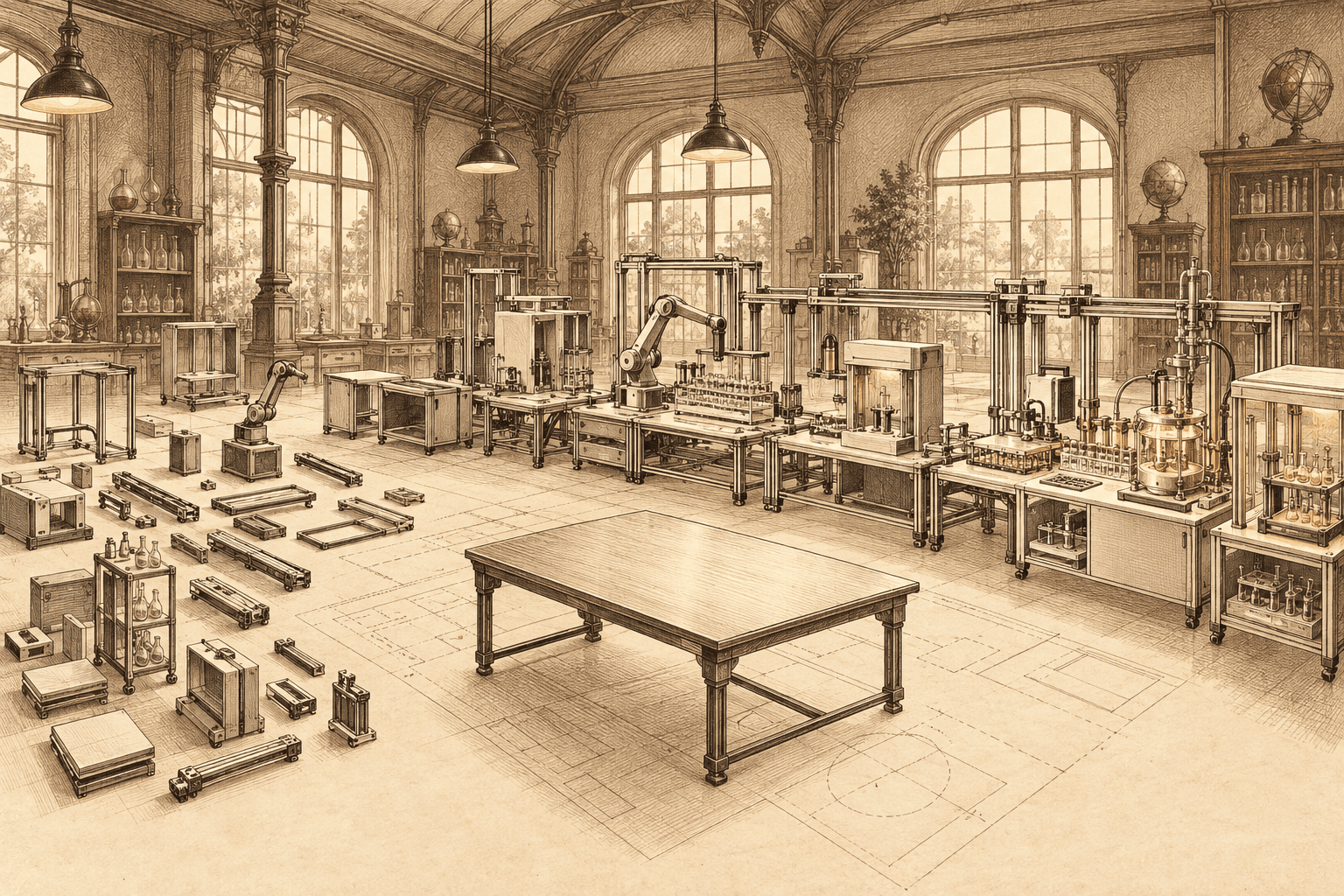
Self-Building Labs turns a scientific objective into the missing layout, digital twin, robot skills and workflows instead of assuming the automation already exists.
Summary
Self-Building Labs turns a scientific objective into the missing layout, digital twin, robot skills and workflows instead of assuming the automation already exists.
A self-driving laboratory can optimize experiments only after people have engineered the room, connected its instruments and taught every robot what to do. Self-Building Labs targets that earlier bottleneck. Given a high-level scientific goal and whatever equipment is already available, the proposed system designs the missing laboratory layout, creates a digital twin, develops robot skills and composes experimental workflows. The authors report demonstrations across different robots and setups, from one workstation to laboratories with several robots, and validate the end-to-end approach with a real-world quantum-dot synthesis experiment. That is a broader claim than having an agent choose the next recipe: the physical automation stack itself becomes part of the plan. The paper does not show that arbitrary laboratories can safely reconfigure themselves, and its results should not be read as eliminating human supervision, integration work or domain-specific validation. Its practical contribution is a new boundary for scientific automation. If the apparatus can be configured around the question, then changing research programs may become less like commissioning a new factory and more like compiling a new experimental capability.
Why it matters
Self-Building Labs turns a scientific objective into the missing layout, digital twin, robot skills and workflows instead of assuming the automation already exists.
Limits and context
- A self-driving laboratory can optimize experiments only after people have engineered the room, connected its instruments and taught every robot what to do.
- Given a high-level scientific goal and whatever equipment is already available, the proposed system designs the missing laboratory layout, creates a digital twin, develops robot skills and composes experimental workflows.
- The paper does not show that arbitrary laboratories can safely reconfigure themselves, and its results should not be read as eliminating human supervision, integration work or domain-specific validation.
Key claims
Self-Building Labs turns a scientific objective into the missing layout, digital twin, robot skills and workflows instead of assuming the automation already exists.
Qualification: A self-driving laboratory can optimize experiments only after people have engineered the room, connected its instruments and taught every robot what to do.
Evidence: source-2026-10-19-002
Sources
- arXiv preprint 2610.23826, original v1arXiv · primary research
Corrections
No corrections have been recorded for this story.