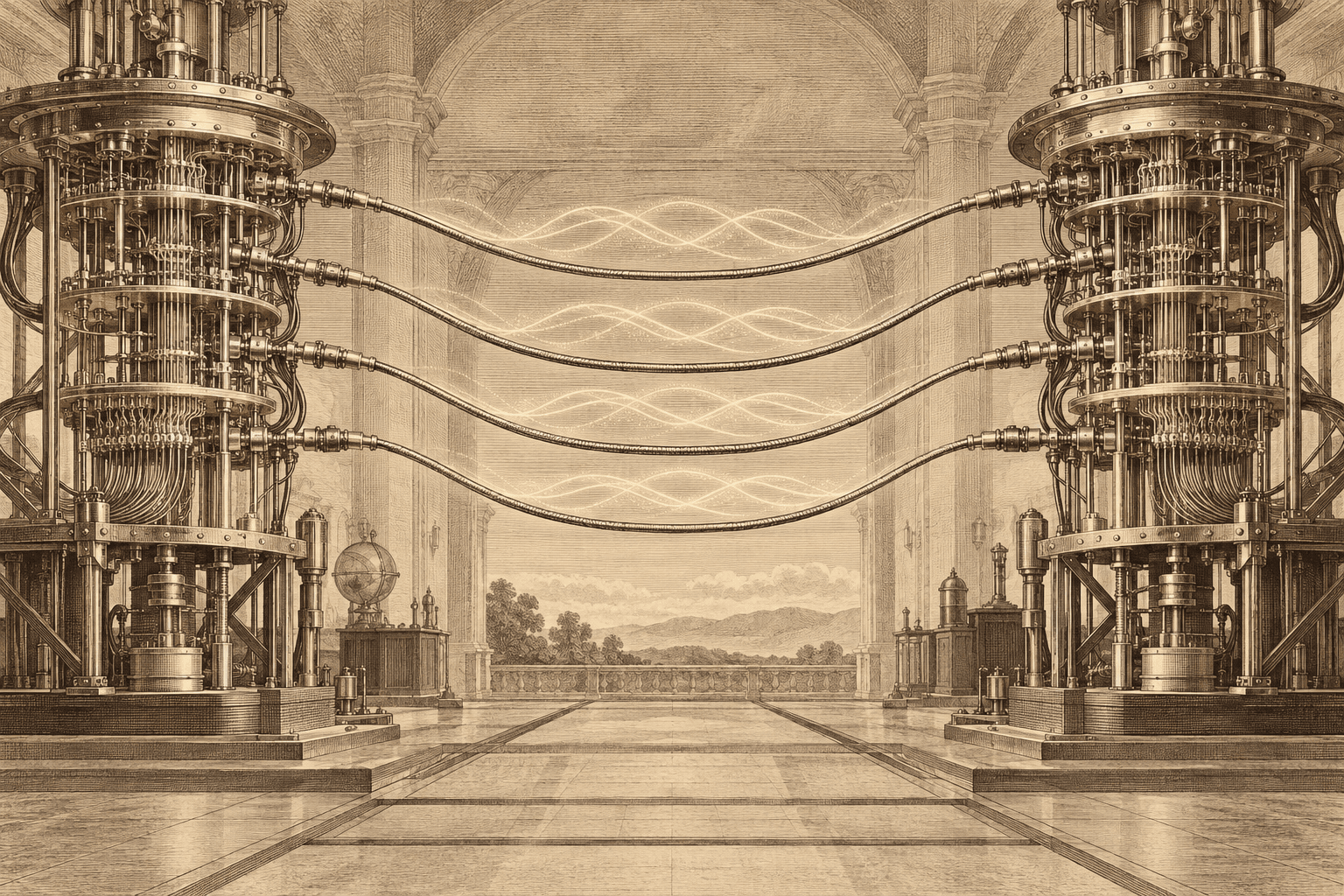
Four 80-centimeter superconducting links carried state transfer, remote two-qubit gates and simultaneous Bell pairs between separate processor modules.
Editorial illustration
Concept illustration of meter-scale links between modular quantum processors; not the reported hardware, a circuit diagram, measured data or experimental evidence. Original editorial illustration generated with built-in Codex Image Gen for The Machine Press, October 22, 2026 edition.
Modular quantum computers need links that preserve coherent operations across more than one chip. Researchers demonstrated four long-distance couplers between two 120-qubit superconducting processors. Each link used two tunable coupler qubits, RF-SQUID interfaces and 80 centimeters of aluminum coax. Relay-based state transfer averaged 99.00 percent network-benchmarking fidelity, while distant controlled-Z gates averaged 94.75 percent and reached 96.42 percent on the best link. The team also generated entangled states across the modules, including simultaneous Bell pairs on adjacent couplers. These are component-level results under the reported setup, not a fault-tolerant system, but they show a concrete route for scaling modular machines beyond a single processor package.
Concept illustration of message provenance being erased or preserved during context compaction; not an interface, exploit transcript, benchmark chart or incident record. Original editorial illustration generated with built-in Codex Image Gen for The Machine Press, October 22, 2026 edition.
Five coding-agent harnesses flattened message roles before compaction, letting forged approvals survive as memory; four role-typed harnesses resisted the same test.
Long-running coding agents summarize old context to keep working. The study identifies a trust boundary before that summary is written: several harnesses first serialize typed messages into one plain string with textual role labels. Untrusted content can then imitate a user turn, and the summarizer no longer has authoritative provenance to distinguish it. Across five open-source flattening harnesses, forged approvals survived compaction 87 to 100 percent of the time; the same attack succeeded zero percent across four harnesses that retained typed roles. In follow-on tests, laundered instructions drove sandboxed command execution and could steer reviews away from a planted backdoor. A code-level provenance check caught 77 percent of laundering while demoting 2 percent of legitimate summary content, and escaping role labels offers a simpler serializer fix. The results concern the tested harness designs, not every coding agent.
Generative systems selected a wrong holding in 38 to 86 percent of abstention cases; a decision model cut errors but did not eliminate them.
Researchers replaced the correct holding in 1,670 of 5,314 CaseHOLD items and asked models to recognize that none of the options applied. Generative language models still chose an answer in 38 to 86 percent of those cases, while the most cautious probability-based decision model did so in 30 percent. On ordinary CaseHOLD, one decision model matched the best generative system at a reported one fifty-fifth of the cost. Agreement filtering halved that model's wrong citations. The benchmark is a controlled legal-authority task, not legal advice or field validation.
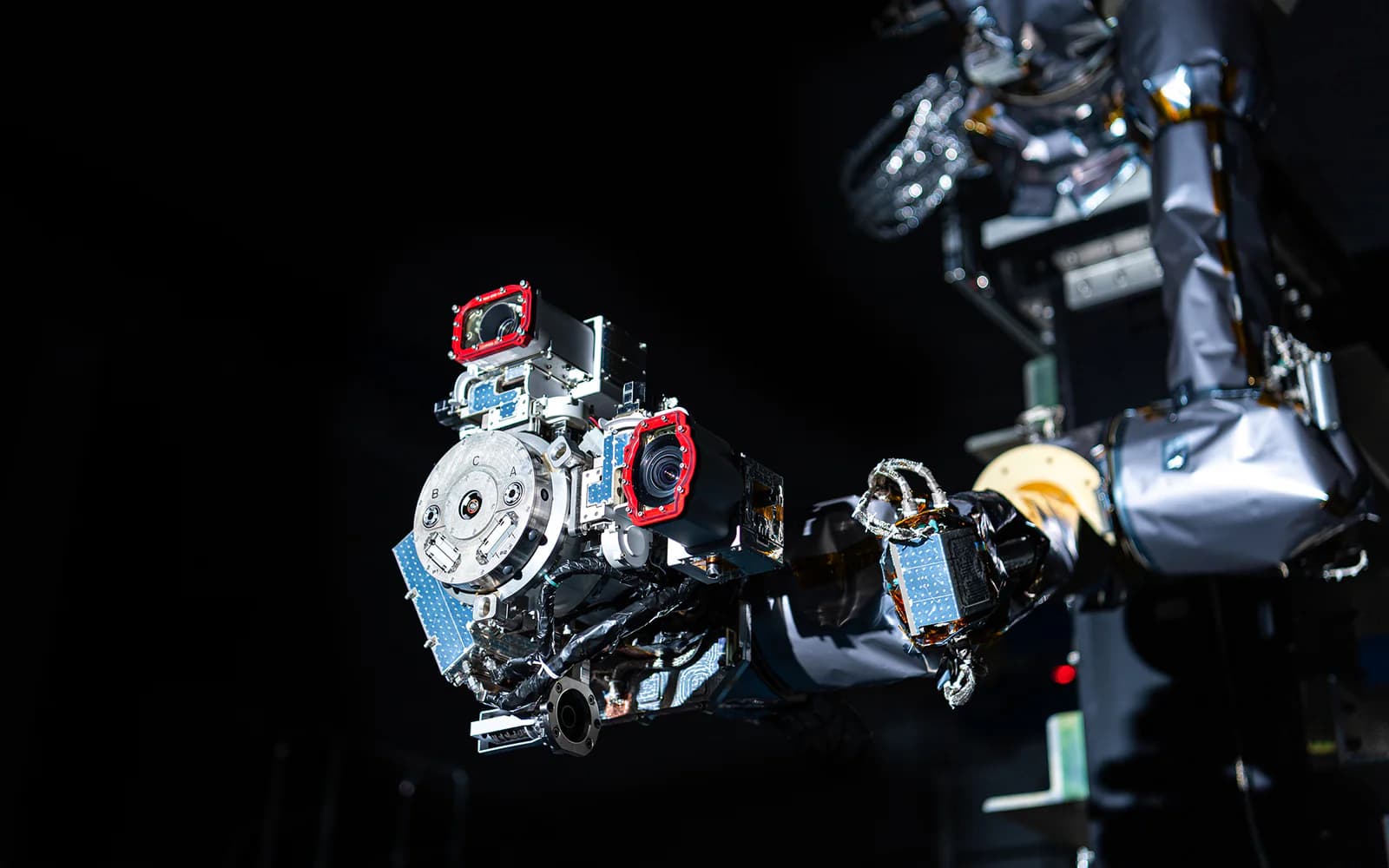
NASA OSAM-1 hardware used illustratively; it does not depict AW-0, a bimanual task, generated code, video prediction or study result. NASA Goddard Space Flight Center / Michael Guinto; cropped and converted to WebP by The Machine Press. Use does not imply NASA endorsement.
AW-0 couples code, future video and robot actions so predicted behavior can become a reusable program.
AW-0 models code, video and actions as three linked generative streams. A code expert produces parameterized routines and control logic while video and action experts predict future states and motor commands. An automated pipeline labels human and robot trajectories with programs and consolidates repeated routines into a skill library. Evaluations on RoboTwin 2.0 and physical bimanual tasks report gains over compared vision-language-action and world-action baselines. Those results are specific to the tested tasks, but they connect visual prediction with compositional execution.
CADRE tests causal video autoencoders across spatial and temporal compression instead of inheriting assumptions from offline video generation.
Interactive world models pay for every latent frame in response time. CADRE holds most components constant while varying spatial and temporal compression across manipulation and navigation settings. The study finds different optima: temporal compression costs less when a manipulation camera stays still, while spatial compression is more useful when navigation moves the camera. At high compression, a diffusion decoder was sharper than perceptual regression. The result is a latency-quality study across four environments, not a universal recipe for every simulator.
PhysiCalWorld compresses a test-scene interaction into a reusable descriptor for mass, damping and friction effects.
A short visual history may not reveal the physical properties that govern what happens next. PhysiCalWorld encodes one exploratory interaction from the test scene into a compact descriptor token, then conditions later action-driven rollouts on that token without fine-tuning or explicit physics labels. Across four environments with varied dynamics, the authors report better prediction and visual-planning success, including outside the training ranges. The learned token is an empirical latent description, not a measured physical parameter set.
CW-WAM jointly forecasts video, movement and contact wrench, then feeds force references to a faster controller.
Vision alone cannot say how hard a robot is pressing. CW-WAM predicts aligned motion and wrench chunks and keeps a fixed history of earlier forces. A 20-hertz admittance controller follows those references between slower model queries. Compared with a version without wrench input, reported insertion success rose from 25 to 70 percent for square pegs and from 40 to 95 percent for power adapters, while force-reference error also fell on tested tasks. The gains are benchmark and hardware results under the authors' setup.
On-policy student histories let a privileged teacher train exploration without the teacher needing to explore.
ASTEROID lets a partially observed student collect its own history, then asks a privileged expert for actions conditioned on that history. The student therefore learns when to gather information and when to exploit what it found. Across eleven environments, the paper reports roughly double the returns under fixed exploration budgets and about one hundredth the interactions of compared reinforcement-learning baselines. In a vision-denied robot transfer, success rose 40 percent over standard distillation. These are controlled evaluations, not proof of general exploration across open worlds.
Illustrative laboratory-glassware file image; it does not show Cell Painting, JUMP-CP, BatchBench, a biomedical image or benchmark result. Rodolfo Clix / Pexels; cropped, resized, metadata stripped, and converted to WebP by The Machine Press.
BatchBench tests whether image models survive unseen experimental batches in the large JUMP Cell Painting collection.
Biomedical images can change with laboratory, plate, instrument and acquisition conditions even when the biological question stays the same. BatchBench turns those shifts into a public robustness leaderboard built on JUMP Cell Painting. The benchmark separates familiar from unseen experimental batches and data sources so gains cannot be mistaken for ordinary in-distribution accuracy. It supplies evaluation infrastructure rather than a clinical model, and performance on Cell Painting does not establish diagnostic reliability.
AtomicRL prevents failures in one subtask from contaminating credit across the whole manipulation sequence.
Long-horizon robot policies often receive one delayed reward, obscuring which subtask failed. AtomicRL gates temporal-difference residuals at semantic task boundaries and targets exploration at the least-mastered atomic step. On LIBERO-LONG, the paper reports 3.6- and 4.0-point gains over PPO across two VLA architectures; on CALVIN ABC-D, full-task performance improved by as much as 9.5 points. A Real2Sim2Real pipeline raised average real-world task performance by 21.3 percent in the reported tests.
Simulations expose asymmetric transfer across gravity, terrain and soil—and show one randomized policy that remained broadly stable.
On a simulated Unitree G1, Earth-trained policies retained 0.64 to 0.75 survival on flat rigid lunar ground, while Moon-trained policies could not stand when moved back to Earth. A released generalist controller reached at most 0.10 survival on the Moon. Rough-terrain training helped, and one policy randomized across gravity on resistive-force terrain achieved at least 0.84 mean survival at Earth gravity and 0.96 at lunar gravity across key tests. Every lunar result depends on simulation, contact assumptions and modeled soil stiffness.
RISE steers heading, speed and path at inference time by planning future body states before executing a recovery.
The same fallen pose can support several safe ways back to standing. RISE learns a vocabulary that links intended movements to low-level actions, then uses a visual diffusion planner to predict future body states. Task costs steer that prediction toward a requested heading, rise speed or route without retraining. The authors demonstrate varied terrain recoveries in simulation and on a Unitree G1. The work controls among learned recovery behaviors; it does not guarantee recovery from arbitrary falls.
A zero-shot audit found no implantable output from three released shape-completion models across 239 cranial defects.
Researchers tested three pretrained shape-completion systems on 210 synthetic cranial defects and 29 real post-craniectomy cases. None of the zero-shot outputs both avoided intersecting remaining bone and added useful material; a task-specific volumetric model was implantable on all but one case. The authors also warn that point outputs do not encode implant thickness. The audit does not rule out future models or specialist workflows, but it shows that visually plausible completion is not enough for clinical use.
Conceptual Visualising AI artwork used illustratively; it is not a document, ingestion pipeline, formatting cue, policy requirement or study result. Tim West / Google DeepMind / Pexels; cropped, resized, metadata stripped, and converted to WebP by The Machine Press.
Mainstream converters dropped color and highlighting cues, turning singled-out policy requirements into confident misses.
Using 76 real policy documents and deterministic labels from their OOXML properties, the study asks agents to recover requirements authors visually singled out. Formatting-blind ingestion fell from 0.690 micro-F1 to 0.150 with one converter and 0.075 as plain text. Highlight and color accounted for nearly all of the measured loss, and color was preserved by none of the mainstream converters tested. The pattern replicated in PDF and across six answering models. The result concerns visual emphasis in this corpus, not every document or requirement.
Centered action likelihoods on shared trajectories locate model-and-harness combinations by what they would do.
Agent Behavior Maps compare action log-likelihoods on the same reference trajectories instead of launching each target agent in a fresh environment. Across eight cross-scored models, distances followed measured trajectory divergence in rank order. Across 100 language models and four environments, ALFWorld-derived coordinates predicted performance and exposed behavioral similarities that persisted after controlling for success rate and model size. The guarantees depend on explicit assumptions, and the map is not a substitute for deployment testing.
Biomedical agents almost always produced real PubMed identifiers in closed-book mode, but almost none were relevant to the claim.
A controlled SciFact study compared closed-book answers, single-shot PubMed retrieval, a query-writing agent and access to gold abstracts. Of 335 closed-book citations, 327 PubMed identifiers existed, yet an independent judge found only three relevant to the claim. Letting the agent write queries tripled gold-paper recall and reached 62 percent verdict accuracy; gold abstracts lifted the same models to 79 to 86 percent, pointing to retrieval as the main bottleneck. The realistic-harness accuracy differences were not statistically significant at the sample size.
Independent builders turning improbable ideas into real things.
Four editorial selections
$7 for seven days
Paid work is clearly labeled
Placement is never endorsement
Original editorial concept art generated with built-in Codex Image Gen for The Machine Press, 2026-09-27; carried over because October 4 remains validation pending and no complete October 11 or October 18 replacement handoff exists.
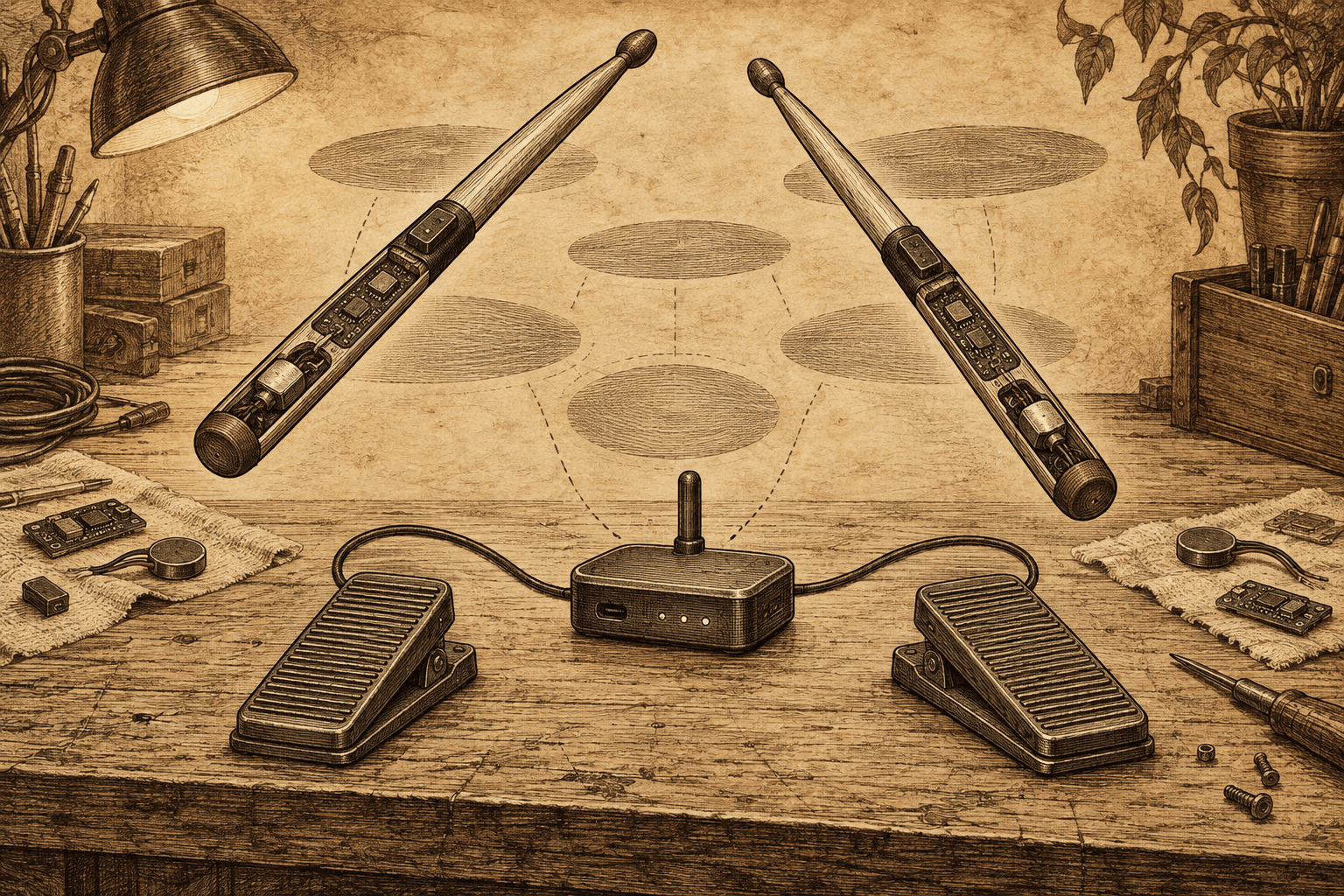
Moves motion tracking onto two ESP32-S3 drumsticks, adds haptic hits and a two-pedal hub, and sends velocity-sensitive drum events to open PC or Android playback software.
Visit Space Drums 2.0Original editorial concept art generated with built-in Codex Image Gen for The Machine Press, 2026-09-27; carried over because October 4 remains validation pending and no complete October 11 or October 18 replacement handoff exists.
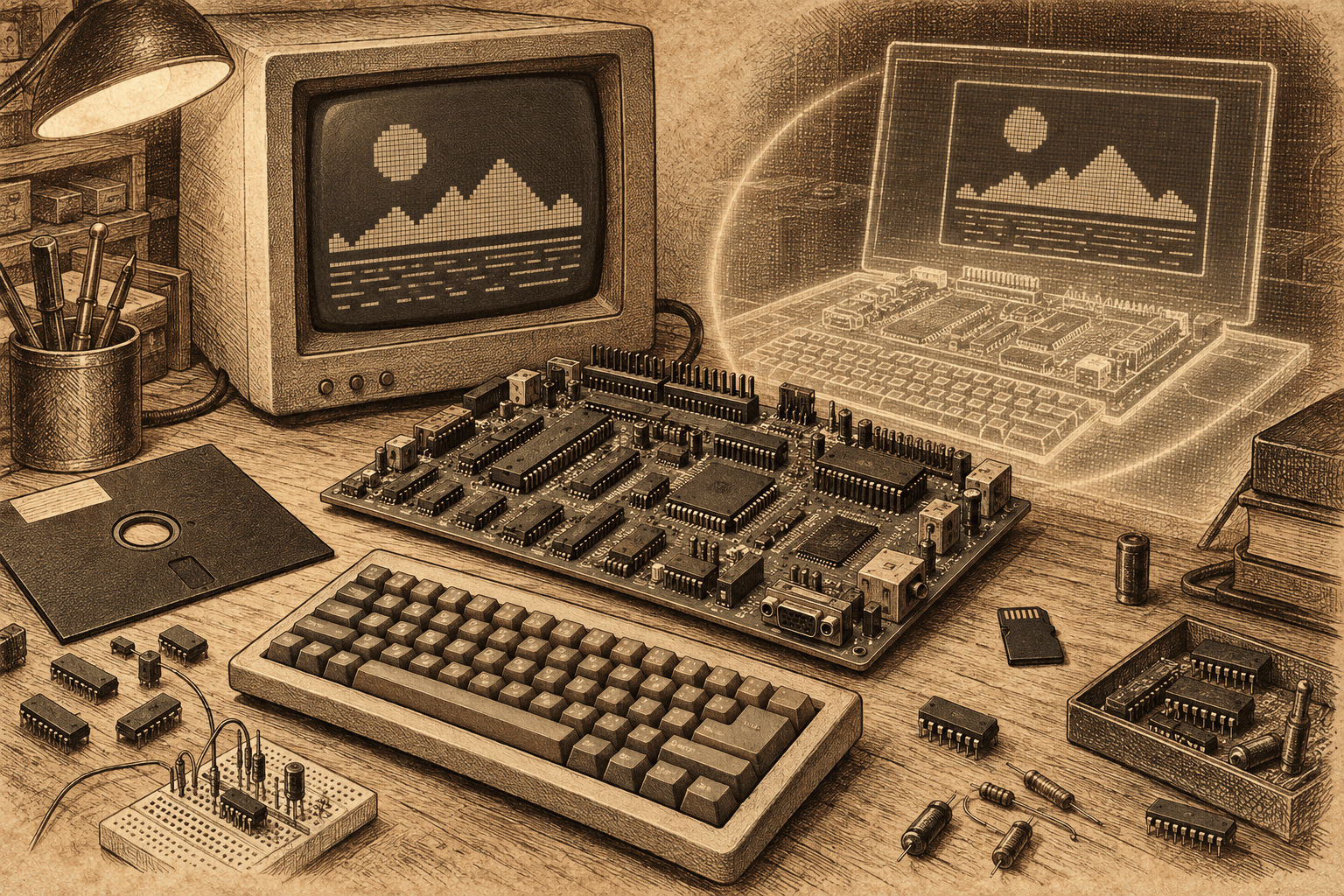
Pairs a chip-level 65C02 computer with custom hardware, video, sound, floppy, and microSD support with a cycle-honest emulator and browser assembler built around the same machine.
Visit 3RICOriginal editorial concept art generated with built-in Codex Image Gen for The Machine Press, 2026-09-27; carried over because October 4 remains validation pending and no complete October 11 or October 18 replacement handoff exists.
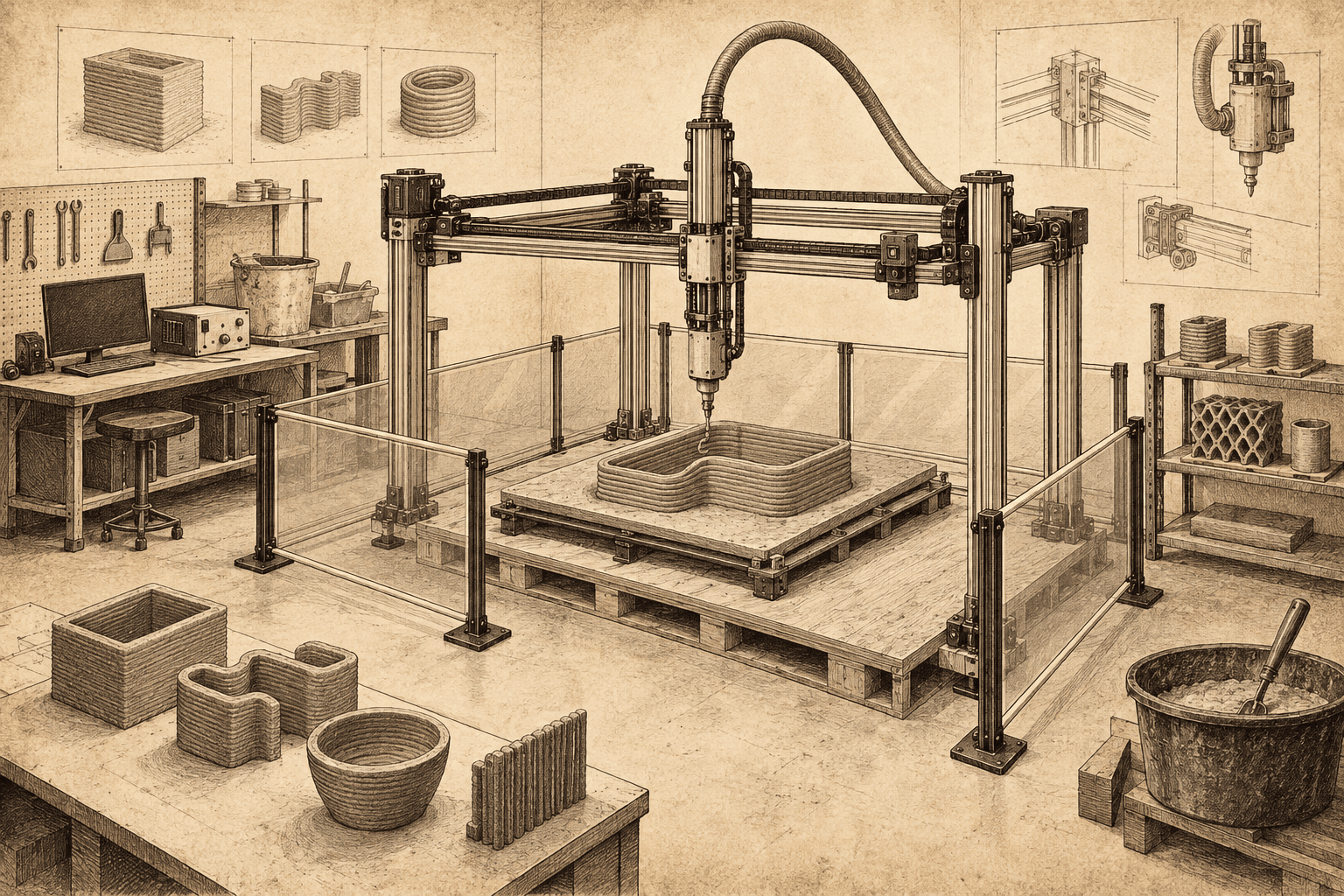
Publishes a pallet-scale cartesian motion reference, CAD, BOM, and low-voltage controls for supervised cementitious-extrusion research while explicitly excluding certified structural use.
Visit M3-CRETEOriginal editorial concept art generated with built-in Codex Image Gen for The Machine Press, 2026-09-27; carried over because October 4 remains validation pending and no complete October 11 or October 18 replacement handoff exists.
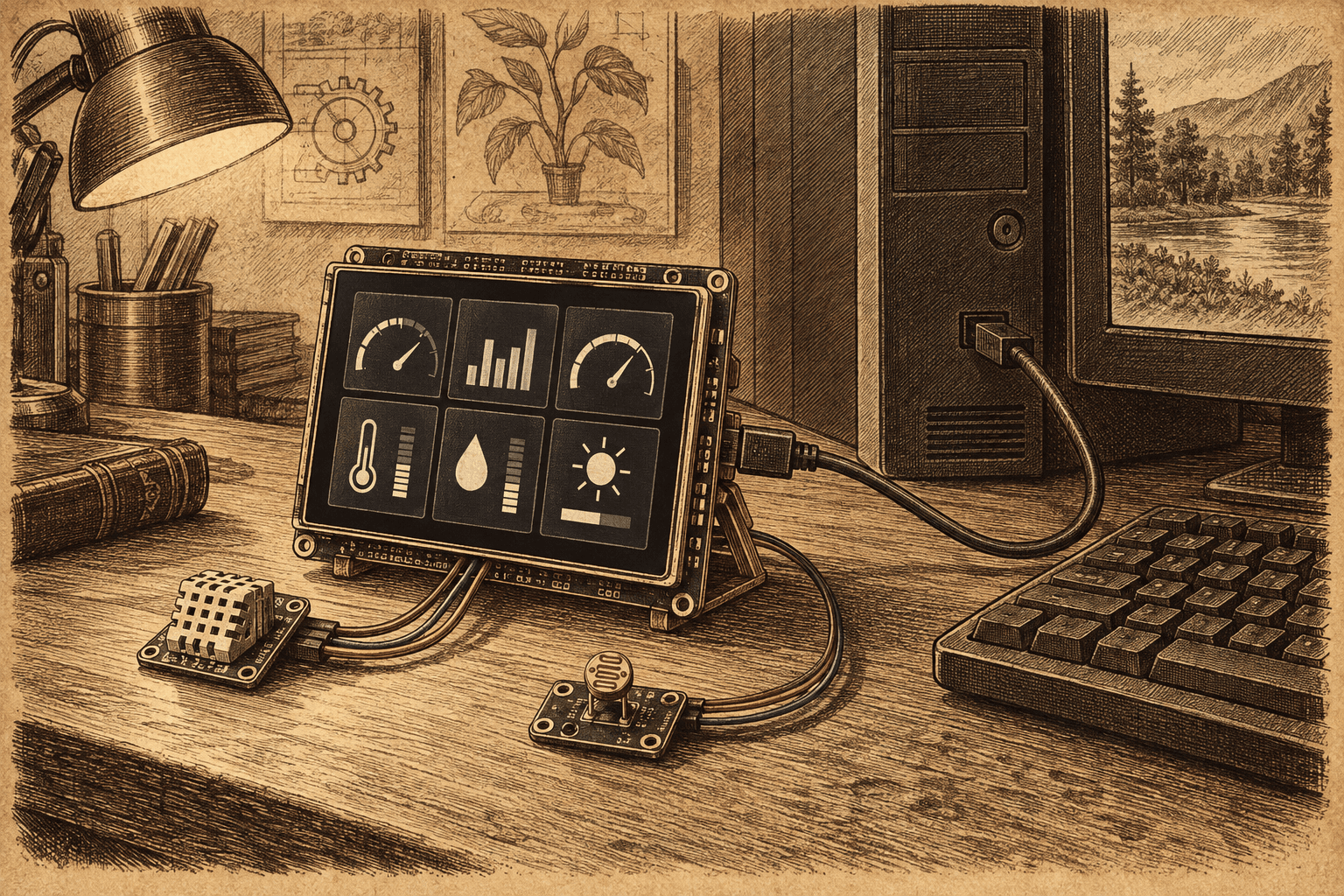
Turns a bare ESP32-S3 touchscreen into a USB-connected desk instrument for PC activity and optional room temperature, humidity, and light measurements.
Visit DeskNodeOriginal Codex Image Gen concept art from 2026-07-10; carried forward from the validated 2026-10-03 edition.
Desk Picks are selected by the newsroom. Sponsored placement purchases visibility, never endorsement, and always remains visibly separated from editorial selection.
 Editorial illustration