A controlled benchmark found that causal training evidence was highly localized—and that changing the gradient and aggregation choices raised ground-truth recall by 35 to 72 percentage points.
Editorial illustration
Editorial concept illustration of localized training evidence within a redundant corpus; it is not a model interface or documentary record. Generated with built-in Codex Image Gen for The Machine Press.
Language-model data attribution asks which training records caused a particular output, but ordinary evaluations often change several properties at once. CATT instead fine-tunes models on fictitious facts with known provenance, then varies redundancy and lexical distractors separately. Both conditions degraded attribution. The researchers found that causal evidence within a document clustered in a few tokens, while whole-document averaging diluted it; negative-log-odds gradients plus top-token aggregation improved ground-truth recall by 35 to 72 percentage points across tested baselines. On FTRACE-TREX, the gradient change improved counterfactual-retraining performance by as much as 4.9 times. Those gains diagnose the tested methods and datasets, not a guarantee that any production model's training history can be reconstructed.
Editorial concept illustration of compact latent dynamics reproducing larger-system behavior; it does not depict the reported model, benchmark or a physical experiment. Generated with built-in Codex Image Gen for The Machine Press.
World2vec learned long-horizon latent dynamics from observations and actions with at least ten times fewer parameters than three control-oriented world-model baselines.
A world model can control an environment without representing its mechanics faithfully. World2vec tests a stricter goal: learn latent dynamics directly from observations and actions, without reward information, and reproduce the underlying system over long horizons. The paper reports at least an order of magnitude fewer parameters than DreamerV3, TD-MPC2 and LeWM, alongside state-of-the-art pixel-based continuous-control results and system identification across 71 attractors. The attractor suite turns interpretability into a dynamical test rather than a visual impression. The results support the authors' claim that compact world models can expose mechanisms, but they remain benchmark evidence rather than a demonstration of scientific discovery in an uncontrolled physical system.
By the third search step, roughly half or more of visited states held a wrong passage; on-policy training taught the encoder to recover.
Multi-hop retrieval models are commonly trained only on gold evidence histories, then deployed on chains polluted by their own mistakes. This study found that by the third step, about half or more of visited states contained a wrong passage and that those errors reduced the chance of finding missing gold evidence. The proposed encoder retrieves its own training chains each epoch, labels every visited state with an earliest missing gold passage and mixes those states with teacher-forced examples. It completed evidence chains more often than the compared systems and transferred to harder constructed variants of HotpotQA and 2WikiMultiHopQA. The evidence concerns benchmark retrieval, not open-web factual reliability.
Conceptual Visualising AI file image used illustratively; it is not a diagram of Neural Thickets, a tested model or a weight-space result. Tim West / Google DeepMind / Pexels; cropped, resized, metadata stripped, and converted to WebP by The Machine Press.
Random output-logit bias matched or beat full-weight perturbations on most tested reasoning tasks while keeping the model frozen.
The Neural Thickets hypothesis attributes gains from random weight perturbations to dense neighborhoods of task-specialized models. A reproduction finds a simpler explanation: perturbing one decoder block recovers much of the gain, while adding random bias only to output logits matches or exceeds full-weight perturbations on most tested reasoning tasks. The authors formalize Perturb-Select-Vote, selecting strong perturbed predictors on a small validation set and aggregating them. Vision tests under domain shift also found little extra benefit from changing all the weights. The result challenges one geometric interpretation; it does not show that every perturbation ensemble reduces to logit voting.
SpecSlot improved ImageNet-512 FID by 2.84 over a compute-matched control with 3.9 percent fewer FLOPs.
Pixel-space image generators usually buy finer detail with more globally attended tokens. SpecSlot separates spatial anchors into frequency-band slots and sends only the lowest-frequency slot from each anchor through global attention; higher-frequency detail stays local. On ImageNet-512, the paper reports a 2.84 FID improvement over a FLOPs-matched control with 3.9 percent fewer FLOPs, and a result within 0.69 FID of JiT-B/16 at 38.2 percent lower cost. Text-to-image tests also improved DPG-Bench by 1.06 over JiT-B/8 at 40.6 percent lower forward cost. Those comparisons cover the reported models and benchmarks, not every generation workload.
A Florida prototype reproduced held-out recorded losses within 2 percent and ranked county outcomes against independent production data.
A storm forecast identifies weather, not which crops will lose value. WxCrop links physically interpretable weather indices with insurance and agricultural records to estimate crop loss for hurricanes, freezes and dry heat in Florida. The hurricane index detected recorded cyclone days at 0.98 AUC; held-out recorded losses were reproduced within 2 percent, and county rankings correlated 0.63 with independent production records. The interface sources each reported number. The results are a Florida demonstration calibrated to specific records, so extension to other hazards and regions remains a claim to test rather than an established deployment result.
Ten visual representations could expose visible structure without reliably preserving objects, predicting updates or supporting continuous action.
Researchers probed ten frozen visual representations across four increasingly demanding capabilities: spatial structure, object persistence, predictive updating and actionability under streaming egocentric views. Strong readout of the visible scene did not guarantee that a model retained objects outside the current view or retrieved useful future features. Even when predicted actions changed with the goal, supplying the correct goal did not reliably improve progress. The work separates decodability from operational spatial state and argues for tests that ask whether information survives motion and guides action, not merely whether a linear probe can find it.
STRATA grades plans, evidence sets, p-values and verdicts for 8,735 temporal hypotheses drawn from vaccine adverse-event timelines.
A fluent answer about whether one event follows another can hide a missing statistical test or the wrong evidence set. STRATA provides 8,735 temporal clinical hypotheses over vaccine adverse-event timelines, each with a gold plan, evidence set, p-value and verdict reproduced by a deterministic oracle. Across five model configurations, systems failed mainly when deciding which records counted, even when the final verdict looked correct. A staged articulate-retrieve-test workflow closed most of that gap and brought a 31-billion-parameter open model within 0.01 of frontier models under the same setup. The benchmark evaluates analysis procedure; it does not establish causal vaccine effects.
Generic programming-screen file image used illustratively; it does not depict TextSeal2, a watermark key, speculative decoding or detection output. Daniil Komov / Pexels; cropped, resized, metadata stripped, and converted to WebP by The Machine Press.
A latent 3D Gaussian memory grew with explored scene extent and rendered into a video model at a reported 9 frames per second.
Long interactive video streams make temporal memory grow without bound. L3G-World instead stores a compact 3D Gaussian scene memory, adding geometry when a new region appears and refining what it already knows. Each Gaussian carries a latent feature that can feed the diffusion transformer without re-encoding an RGB render. Against the paper's most efficient prior 3D-memory baselines for each metric, the method used up to 38.6 times fewer primitives, updated memory 3.2 times faster and rendered it 359 times faster, enabling reported generation at 9 frames per second. These are benchmarked generation results, not proof of physical simulation accuracy.
Generic programming-screen file image used illustratively; it does not depict TextSeal2, a watermark key, speculative decoding or detection output. Daniil Komov / Pexels; cropped, resized, metadata stripped, and converted to WebP by The Machine Press.
TextSeal2 preserved the target distribution and speculative-decoding acceptance rate while improving detection in the reported tests.
Speculative decoding can replace a drafter's rejected tokens, creating a difficult case for language-model watermarks. TextSeal2 combines multiple keys into a virtual key and uses a memoryless verification race so replacement tokens remain keyed while the output follows the target model's distribution. Across three models, the paper reports 8 to 22 percentage points more detected 100-token answers than its predecessor at a false-positive rate of one in a thousand. Under speculative decoding, it detected 18 and 22 percentage points more 200-token answers than TextSeal and textGrain, respectively, without changing acceptance rate. Those results measure controlled detection, not resistance to every transformation or attacker.
A likelihood-based formulation mixed static data and model-generated reinforcement-learning targets inside one training system.
Foundation-model development is usually divided into pretraining, midtraining, supervised fine-tuning and reinforcement learning, each with different algorithms. This work derives reinforcement-learning objectives as maximum-likelihood fits to model-generated target distributions, then mixes static examples and reinforcement-learning generations in one trainer. Controlled and real-world experiments reportedly improved the accuracy-compute tradeoff and task coverage while preserving broader capabilities. The paper presents staged training as one special schedule inside a unified framework; it does not show that data selection, reward design or safety objectives become interchangeable.
TRACER was tested on 16 incident diseases in more than two million patients from two health systems excluded from development.
Global discrimination scores can conceal whether a screening model overwhelms clinicians with false alerts. TRACER was pretrained on electronic health records from more than 4.5 million patients across four systems, then evaluated for 16 diseases at one-, two- and five-year horizons in over two million patients from two systems excluded from development. At 95 percent specificity, flagged patients were up to eight times more likely than unselected patients to receive a diagnosis within a year. Performance and alert burden still varied by disease and health system. The study demonstrates external evaluation, not readiness for clinical use or proof that earlier prediction improves outcomes.
The strongest tested multimodal model answered every related question correctly in only 13.36 percent of PhysCount groups.
Visual counting usually treats each detected appearance as an object, but reflections and transparent surfaces can show the same physical entity several times. PhysCount pairs 546 real-world images with 4,595 human-written questions organized into 651 groups, annotating appearances, observation modes and entity identity. Across 40 multimodal models, appearance counting was easier than linking appearances back to physical objects. The strongest model completed every question in only 13.36 percent of groups. Higher resolution helped expose visual evidence but only modestly improved full-group accuracy, while answering related questions jointly helped more.
Generic wafer-scale circuit illustration used illustratively; it does not depict a quantum LDPC code, decoder, tested processor or latency result. Wikideas1 / Wikimedia Commons (CC0 1.0); cropped and converted to WebP by The Machine Press.
Neural triage decoding matched the reported accuracy of near-optimal algorithmic decoders while cutting latency by roughly one to two orders of magnitude.
High-rate quantum error-correcting codes need fast decoding to keep up with hardware. The Triage decoder first applies a local neural message-passing network, then adds iterations only when syndrome consistency remains unresolved, with a rarely invoked diversification stage for the hardest shots. On lifted-product and Kasai codes encoding hundreds of logical qubits, the paper reports accuracy comparable to near-optimal algorithmic decoders and latency lower by about one to two orders of magnitude. The result is simulation and decoding evidence for tested codes and noise models, not a full fault-tolerant processor demonstration.
Of 415 proposed minimum viable experiments, 194 were judged sound, valuable and new, but only 73 also moved beyond the seed paper and the obvious.
RTaste asks whether research agents can choose which experiment deserves to run before seeing the outcome. Six frontier models proposed, forecast and ranked 415 minimum viable experiments based on seven recent NLP papers; a separate executor attempted every proposal, and model auditors judged the results. Auditors labeled 194 sound, valuable and new, but only 73 also beyond the seed paper and non-obvious. First choices beat random selection yet did not outperform simply choosing the first proposed experiment, and teams cost more without a clear overall quality gain. Because model auditors supplied the judgments, the harness is evidence about this setup rather than a definitive measure of scientific taste.
One 9-billion-parameter backbone added about 0.1 GiB per decision skill and outscored a cross-encoder at the reported 43,000-token scale.
Retrieval systems often keep separate reranking and answer models resident, duplicating memory and passage processing. Glance adds a small decision adapter and pointer head to a 9-billion-parameter generator, then branches short relevance probes from a shared prefill. After 39 minutes of MS MARCO fine-tuning, it exceeded the reported bge reranker scores on SciFact and NFCorpus. On 300 HotpotQA questions, selected context raised answer F1 by 0.045, and ranking quality continued to improve through 200 candidates—about 43,000 tokens—where it beat the cross-encoder by 0.058 nDCG@10. Evaluation covers one backbone family and three datasets.
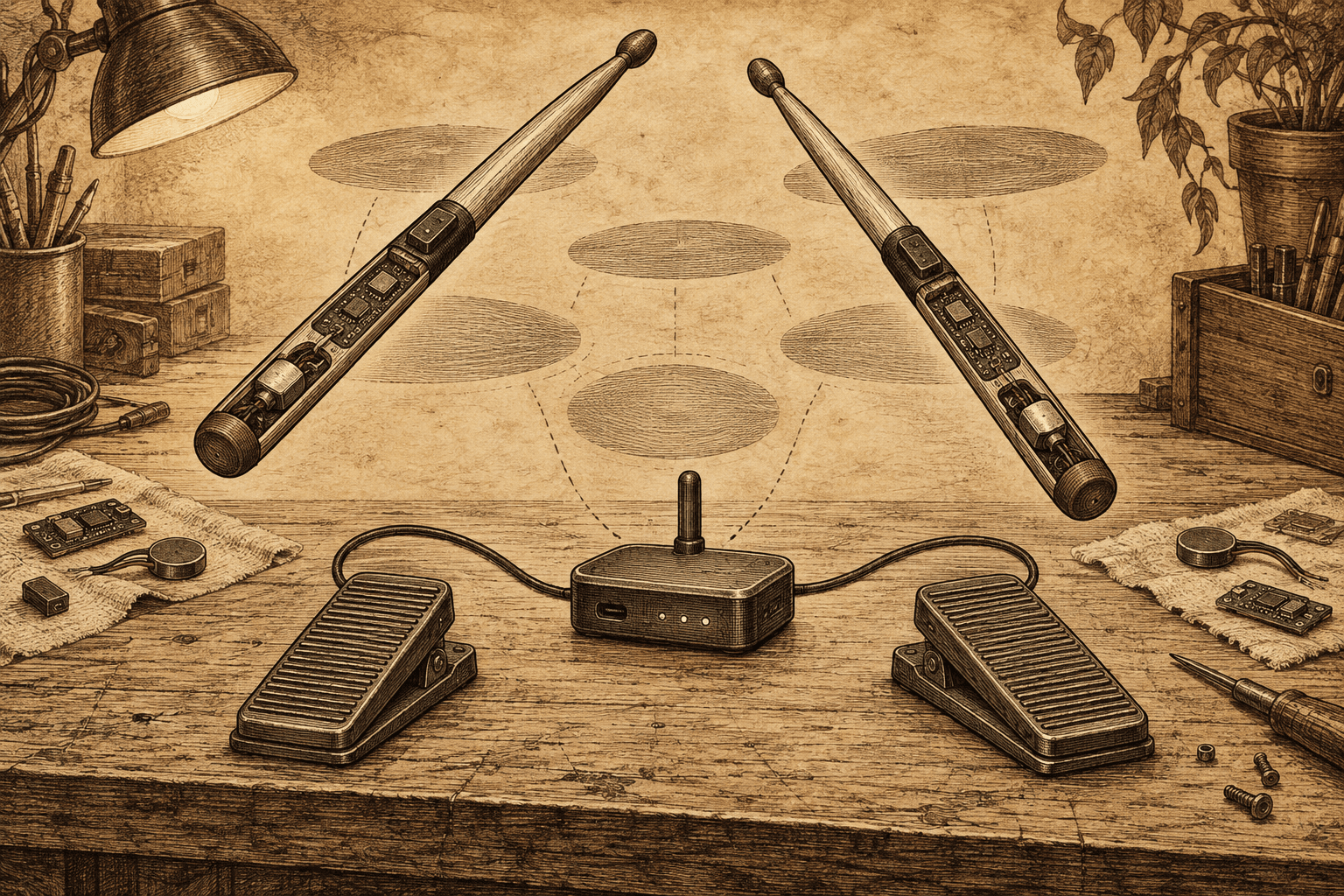
Moves motion tracking onto two ESP32-S3 drumsticks, adds haptic hits and a two-pedal hub, and sends velocity-sensitive drum events to open PC or Android playback software.
Visit Space Drums 2.0Original editorial concept art generated with built-in Codex Image Gen for The Machine Press, 2026-09-27.
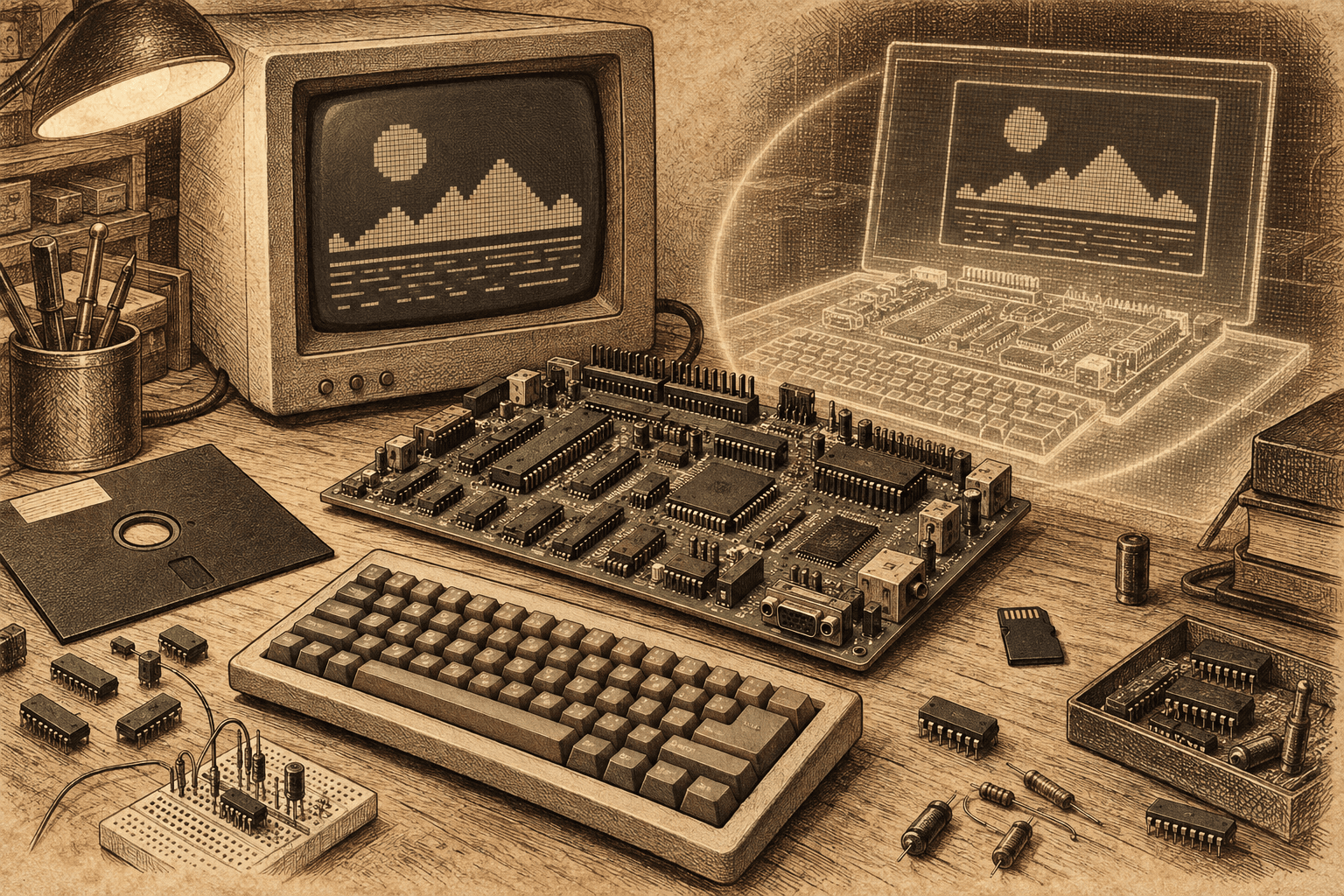
Pairs a chip-level 65C02 computer with custom hardware, video, sound, floppy, and microSD support with a cycle-honest emulator and browser assembler built around the same machine.
Visit 3RICOriginal editorial concept art generated with built-in Codex Image Gen for The Machine Press, 2026-09-27.
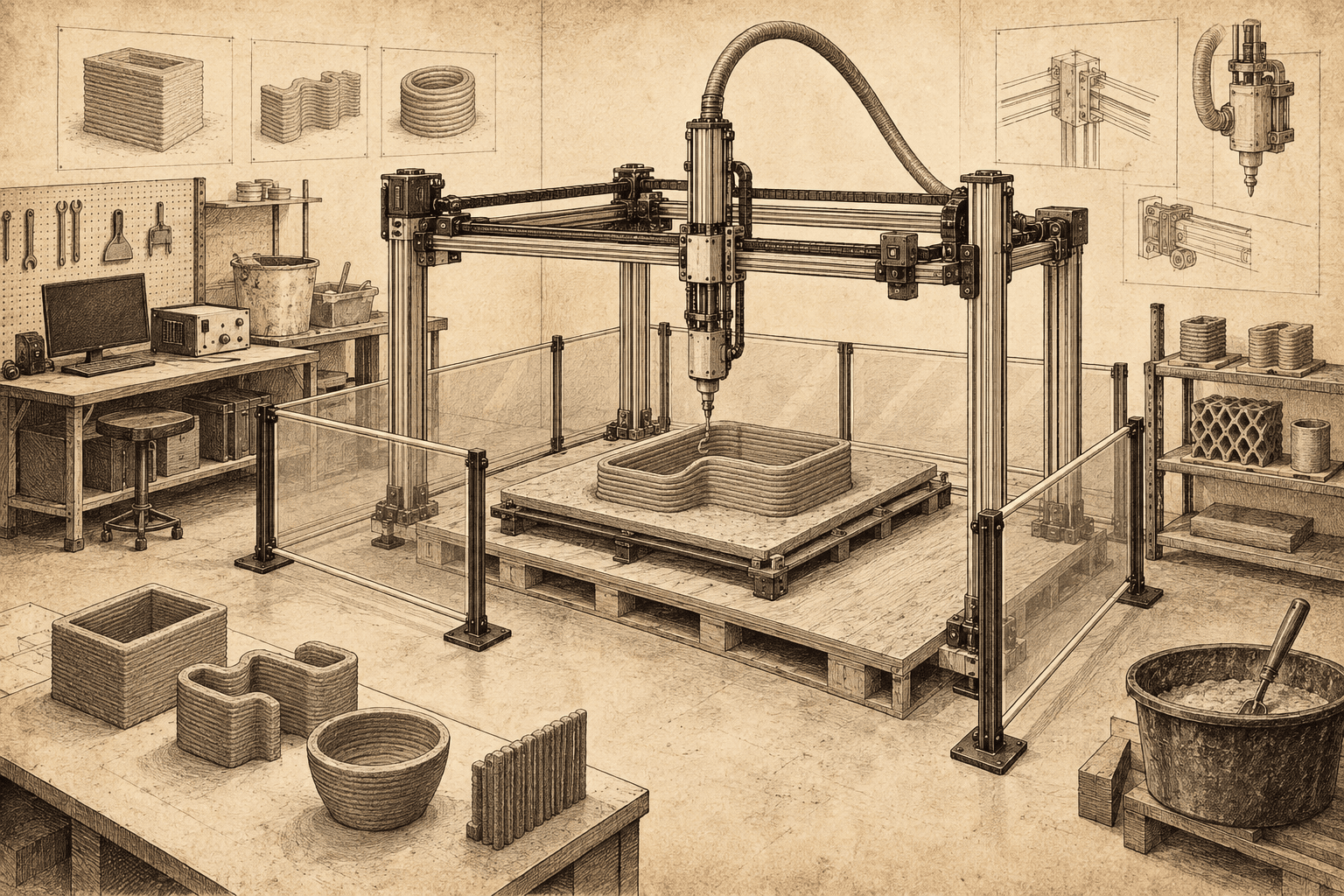
Publishes a pallet-scale cartesian motion reference, CAD, BOM, and low-voltage controls for supervised cementitious-extrusion research while explicitly excluding certified structural use.
Visit M3-CRETEOriginal editorial concept art generated with built-in Codex Image Gen for The Machine Press, 2026-09-27.
Turns a bare ESP32-S3 touchscreen into a USB-connected desk instrument for PC activity and optional room temperature, humidity, and light measurements.
Visit DeskNodeOriginal Codex Image Gen concept art from 2026-07-10; carried forward from the validated 2026-09-26 edition.
Desk Picks are selected by the newsroom. Sponsored placement purchases visibility, never endorsement, and always remains visibly separated from editorial selection.
 Editorial illustration