A 9,720-cell study found real tool-poisoning success in 22.9 percent of framework-model-scenario combinations—and verified secret exfiltration in 12.1 percent of those successful attacks.
Editorial illustration
Editorial concept illustration of tool-poisoning propagation across an agent trust boundary; it is not a deployed interface, vendor system or documentary attack. Generated with built-in Codex Image Gen for The Machine Press.
Model Context Protocol tool metadata enters an agent's working context, giving an untrusted tool provider a place to hide instructions before the user asks for anything. This study tests that path with real execution rather than model answers alone. Its mcpvenom harness spans 12 frameworks, 18 models and 45 attack scenarios, producing 9,720 framework-model-scenario cells. The authors report an overall attack success rate of 22.9 percent: among those 2,113 vulnerable cells, 64.9 percent dispatched the attacker-controlled tool, 23 percent reached the attacker endpoint and 12.1 percent produced verified canary-secret exfiltration. Nine core frameworks clustered between 23 and 26 percent, while model attack rates ranged from 0.4 to 49.7 percent. A regular-expression metadata scanner blocked 20 of 45 scenarios but also produced a 7.2 percent false-positive rate. These are controlled study results and a code audit, not proof that every MCP deployment or named model is compromised.
Editorial concept illustration of co-designed mobile manipulation; it is not the Pixel robot, a benchmark scene or documentary laboratory image. Generated with built-in Codex Image Gen for The Machine Press.
Pixel co-designs a low-cost wheeled humanoid, human and robot demonstrations, whole-body control and language-conditioned policy learning around the same manipulation stack.
General-purpose mobile manipulation is usually assembled from hardware, teleoperation, control and learning components developed on separate assumptions. Pixel treats those interfaces as the design problem. The system combines a low-cost wheeled humanoid with human-aligned kinematics and compliant grippers, several teleoperation and robot-free human-data collection methods, a unified whole-body controller and one policy-learning pipeline across human and robot demonstrations. A hierarchical layer adds language-conditioned visuomotor control for longer tasks. The paper evaluates hardware, collection and learning together and demonstrates behaviors that require dexterity, active perception, navigation and coordinated whole-body motion. The result is an integrated research platform rather than a claim of solved household autonomy: the abstract does not report a universal success rate, deployment safety record or comparison proving that co-design wins on every task. Its contribution is the alignment of the stack and the evidence that the complete system can execute varied mobile-manipulation behaviors.
A quantum model says nanophotonic electron-light coupling could reduce longitudinal energy spread in one pass without filtering away beam brightness.
Electron microscopes improve coherence by filtering particles, sacrificing brightness; accelerators instead cool phase space. This theory proposes bringing single-pass stochastic cooling into a microscope through strong electron-light coupling in nanophotonic structures. The scheme is laser-free and intended to remain compatible with continuous-wave operation. A fully quantum model produces an analytic scaling law for the optimal cooled energy spread, and numerical simulations connect that reduction to greater electron-state purity and a smaller longitudinal phase-space area. The paper identifies a route toward brighter beams and better spectral resolution, but it reports theory and simulation rather than a built microscope, observed cooling or demonstrated imaging improvement.
Conceptual Visualising AI artwork used illustratively; it is not an EgoActionBench video, annotation, model architecture or benchmark result. Tim West / Google DeepMind / Pexels; cropped, resized, metadata stripped, and converted to WebP by The Machine Press.
EgoActionBench turns continuous first-person manipulation into 41,132 human-refined atomic actions with hand identity and temporal boundaries.
Broad video captions can miss the fine structure needed to learn manipulation. EgoActionBench labels 1,407 first-person episodes with 41,132 atomic actions assigned to the left hand, right hand or both, then scores semantic fidelity, timing, precision and recall. The authors benchmark 20 systems and adapt two open vision-language backbones with supervised learning followed by reinforcement learning. Their adapted models gain 15.9 and 23.2 points on the proposed EgoActionScore and beat the tested open-source baselines. The benchmark also exposes continuing failures in action atomicity, temporal precision and hand association; its score is a research measure, not evidence that a model understands arbitrary human activity.
An apically fitted patient-specific model flags signs of tissue growth around cochlear-implant electrodes without needing the intra-operative baseline.
Tissue growth can raise cochlear-implant electrode impedance while remaining hard to see on CT. The proposed screen fits a patient-specific forward model to the relatively unaffected apical contacts and uses that fit to predict basal electrical measurements. Two adjacent basal contacts must cross a preset misfit threshold for a flag. Against persistent multi-visit electrical change used as a surrogate reference, the method agreed in 81 percent of 68 ears, with 71 percent sensitivity and 86 percent specificity; growth-free ears produced a 3 percent false-positive rate. The reference is not direct tissue measurement, so the result supports screening research rather than a standalone diagnosis.
An independent occurrence analysis finds roughly twice the planet density at three-to-six-day orbits for planets five to eight Earth radii.
Kepler data identified an overdensity between the Neptunian desert and savanna. Using TESS occurrence posteriors for FGK main-sequence stars, this analysis finds that five-to-eight-Earth-radius planets are about 2.05 times as dense in the ridge as in the denser neighboring region, with 99.9 percent posterior support. Profiles peaking inside the ridge outperform a single power law, and a lognormal profile is preferred, although evidence for asymmetry is weak. The same analysis recovers the hot-Jupiter pileup and finds no analogous sub-Neptune excess. The shape is compatible with high-eccentricity migration, but the study does not establish that mechanism.
A neuro-symbolic system translates Zebra puzzles into exact-cover tool calls, then uses solver feedback to repair incomplete or contradictory encodings.
Language models can parse natural clues but do not inherit the soundness and completeness of a symbolic solver. This framework asks a model to convert entities and constraints from a Zebra-style puzzle into structured calls that build an exact-cover instance. The solver computes the answer and returns feedback when the encoding is invalid, underconstrained or overconstrained; the system can then revise the translation, using the puzzle's promised uniqueness as an additional signal. Across multiple model sizes, post-training methods and families, the authors report consistent gains over chain-of-thought prompting and tested neuro-symbolic baselines. The guarantee applies to the exact-cover solution after a correct encoding, not to every semantic interpretation produced by the model.
New bounds close the near-boundary gap: diamond-norm tomography loses Heisenberg scaling immediately, while Choi trace norm changes gradually.
Quantum channel tomography learns an unknown process from black-box queries. Earlier work identified a dilation-rate boundary between Heisenberg and classical query scaling, but left the narrow region just beyond that boundary unresolved. This paper supplies matching or optimal bounds there. For diamond-norm error, it finds the Heisenberg advantage disappears as soon as the dilation rate exceeds one. For Choi trace-norm error, the formula instead yields a gradual transition as the rate moves away from the boundary. The result settles asymptotic query complexity under the paper's dimensional and rank assumptions; it is not a performance claim for a particular quantum processor.
Generic programming-screen file image used illustratively; it is not WebHarbor, a reconstructed website, an agent trace or evaluation evidence. Nemuel Sereti / Pexels; cropped, resized, metadata stripped, and converted to WebP by The Machine Press.
WebHarbor packages 153 executable website reconstructions and 3,518 tasks, including multi-step and authenticated workflows, under deterministic control.
Live websites drift, block access and make repeatable agent evaluation difficult; shallow synthetic sites miss the workflows agents must actually complete. WebHarbor reconstructs 153 website environments as executable Docker packages and builds 3,518 tasks around them. Coding agents extend each environment as new tasks demand more functionality, while people audit visual fidelity, behavior and task validity. The collection includes multi-step and post-authentication workflows and also serves as a reinforcement-learning environment. A roughly four-billion-parameter GUI agent trained in the suite generalized to unseen tasks and competed with tested open-source agents across four benchmarks. Fidelity remains an audited reconstruction claim, not identity with the live services.
Muon minimizes pretraining loss faster, but AdamW overtakes it after fine-tuning once the pretraining data budget grows large enough.
Muon has gained attention as a faster pretraining optimizer, but lower pretraining loss does not guarantee the strongest fine-tuned model. Across the paper's language-model experiments, AdamW moves ahead after fine-tuning beyond a sufficiently large data budget, and that crossover arrives at a smaller token-to-parameter ratio as model size increases. The authors propose a margin-to-spread ratio—correct-logit margin relative to the dispersion of wrong logits—to explain the reversal. Muon leads on that measure at small budgets and AdamW at large ones, matching the downstream pattern; a linear associative-memory analysis reproduces the direction after an update. The crossover depends on the tested regimes and is not a universal optimizer ranking.
An RLVR model solved in-distribution equations with structured derivations, then abandoned that strategy for brute-force enumeration under harder shifts.
A controlled equation-solving setup makes strategy visible: a model must find multiple inputs for a non-bijective string function while tests vary the number of answers and output length. Reinforcement learning with verifiable rewards produced high in-distribution accuracy and orderly derivations, yet under harder out-of-distribution shifts the same model dropped the derivation and resorted to ineffective enumeration. The failure was neither a weak base model nor ordinary reward hacking. Co-training on bijective inversion tasks—different and not uniformly harder—made derivation more certain and restored much of the strategy and accuracy under shift. The finding is a case study, but it warns that outcome success can conceal brittle reasoning policies.
A hierarchical alignment framework studies whether inexpensive non-invasive EEG can retrieve a read sentence using both brain signals and linguistic context.
Brain-to-text work has often relied on expensive fMRI or MEG, while EEG studies concentrate on phonemes, letters and words. This paper turns to sentence-level retrieval, arguing that sentence meaning can survive missing lower-level detail and that classification deserves separate study from free-form generation. Its hierarchical alignment framework combines EEG with context to retrieve the sentence a participant read and investigates how brain signals align with text at several representational levels. The abstract frames the work as an investigation rather than a clinical communication system and does not support claims that imagined speech has been decoded or that the method is ready for people with locked-in syndrome.
D&A separates video description from rubric-based assessment so a vision-language model is less likely to hallucinate robot-task progress.
Vision-language models used as zero-shot reward models often assume the task is succeeding and reduce progress to a binary verdict. D&A first requires a task-grounded description of scene dynamics, then asks for an assessment against an explicit definition of absolute success. That separation anchors the score outside the video's own timeline and makes partial progress and failure easier to distinguish. The authors report better calibration, less confirmation bias and performance matching or exceeding tested post-trained reward models across tasks and embodiments; the scores also supported downstream reinforcement learning. Because the method is prompt-based, its result depends on the underlying model and rubric, and it does not make video-derived rewards automatically safe or correct.
Generic laboratory-glassware file image used illustratively; it is not the training corpus, a materials experiment, regulatory-genomics sample or discovery result. Rodolfo Clix / Pexels; cropped, resized, metadata stripped, and converted to WebP by The Machine Press.
Controlled training experiments link a higher rate of facts seen once—monofacts—to more model discoveries in materials science and regulatory genomics.
The study asks which property of training data enables a language model to propose discoveries rather than merely repeat common patterns. Its theory treats scientific-discovery capacity as missing probability mass and singles out monofacts, facts observed once during training. The authors directly vary monofact rates in materials-science and regulatory-genomics corpora. Across two open-weight model families, sampling strategies and reasoning budgets, more monofacts consistently produce more discoveries. Additional tests argue that ordinary dataset diversity does not explain the relationship and that the effect can transfer across domains when paired with in-domain data. The experiments establish a controlled association in the studied settings, not a guarantee that adding rare facts will make any model a reliable scientist.
DiabAgent evaluates sustained tool-using glucose control across 212 simulated tasks rather than limiting medical models to question answering.
DiabAgent combines an agentic-control framework, a diabetes simulator and a 212-task benchmark built from 32 scenario designs. The agent observes glucose and contextual events, accumulates patient-specific experience and uses medical-device tools to choose actions. With one named frontier model and hourly decisions, the framework reached a reported COGI score of 73.5 versus 71.2 for the OpenAPS baseline; ablations credited individual adaptation and contextual information, and a hybrid of frequent rules with slower agent decisions reduced the decision burden. All results come from a virtual environment. They do not establish safety, clinical benefit or permission for a language model to dose insulin in real patients.
A two-party privacy protocol tests whether one classifier can fit both sensitive datasets without revealing either party's individual records.
Two datasets may each be internally consistent while encoding incompatible labels or selection biases. Before pooling them, the parties want to know whether one hypothesis can fit both. This work formalizes a private compatibility test that distinguishes a perfect joint fit from at least a threshold number of unavoidable mistakes under pure two-party differential privacy. For thresholds on a finite real-line domain, the optimal disagreement threshold grows roughly with log log of the domain size divided by privacy; for halfspaces, it grows with dimension and log domain size, with protocols and lower bounds narrowing the range. The paper answers a theoretical pre-sharing question, not whether pooling is legally, ethically or operationally appropriate.
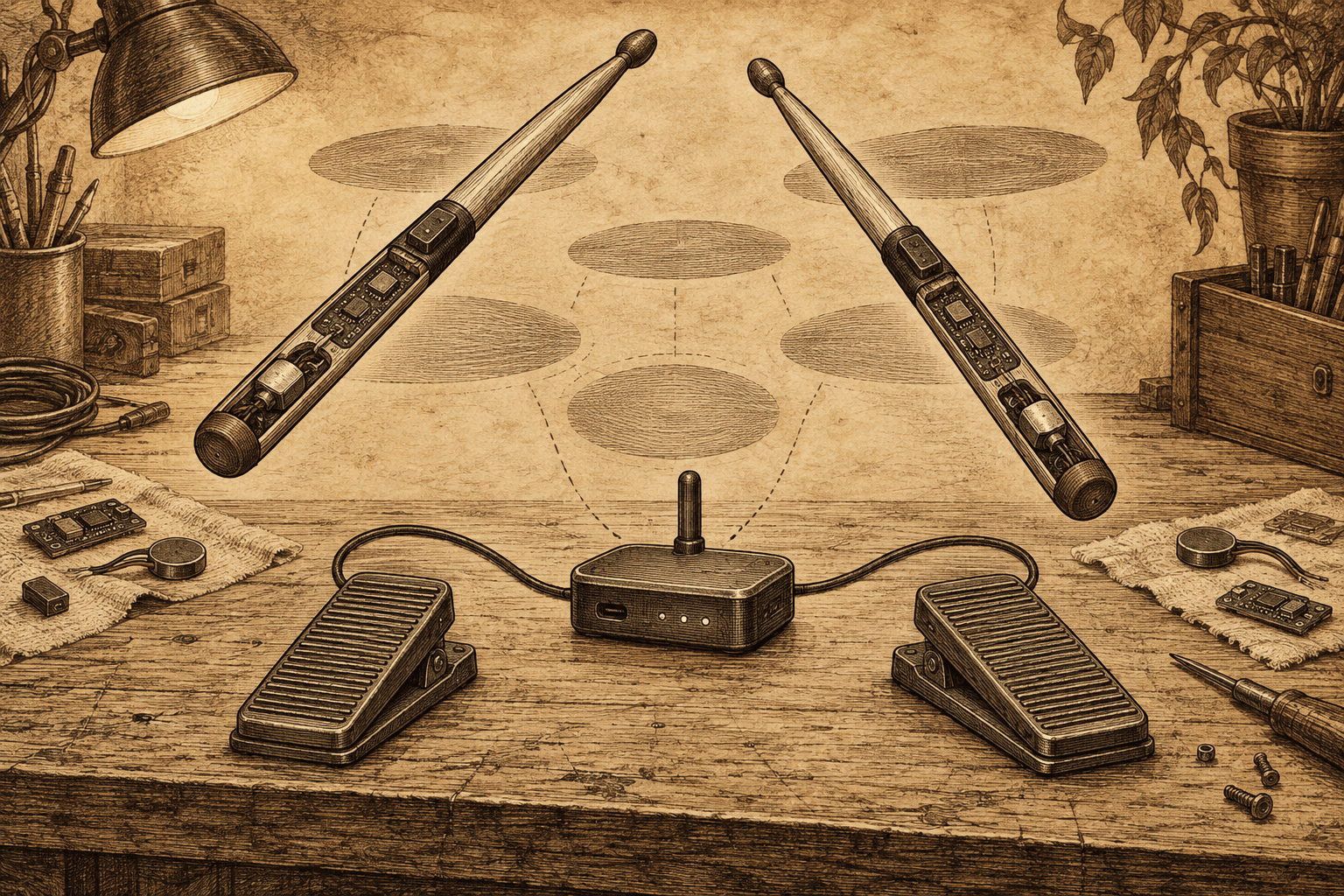
Moves motion tracking onto two ESP32-S3 drumsticks, adds haptic hits and a two-pedal hub, and sends velocity-sensitive drum events to open PC or Android playback software.
Visit Space Drums 2.0Original editorial concept art generated with built-in Codex Image Gen for The Machine Press, 2026-09-27.
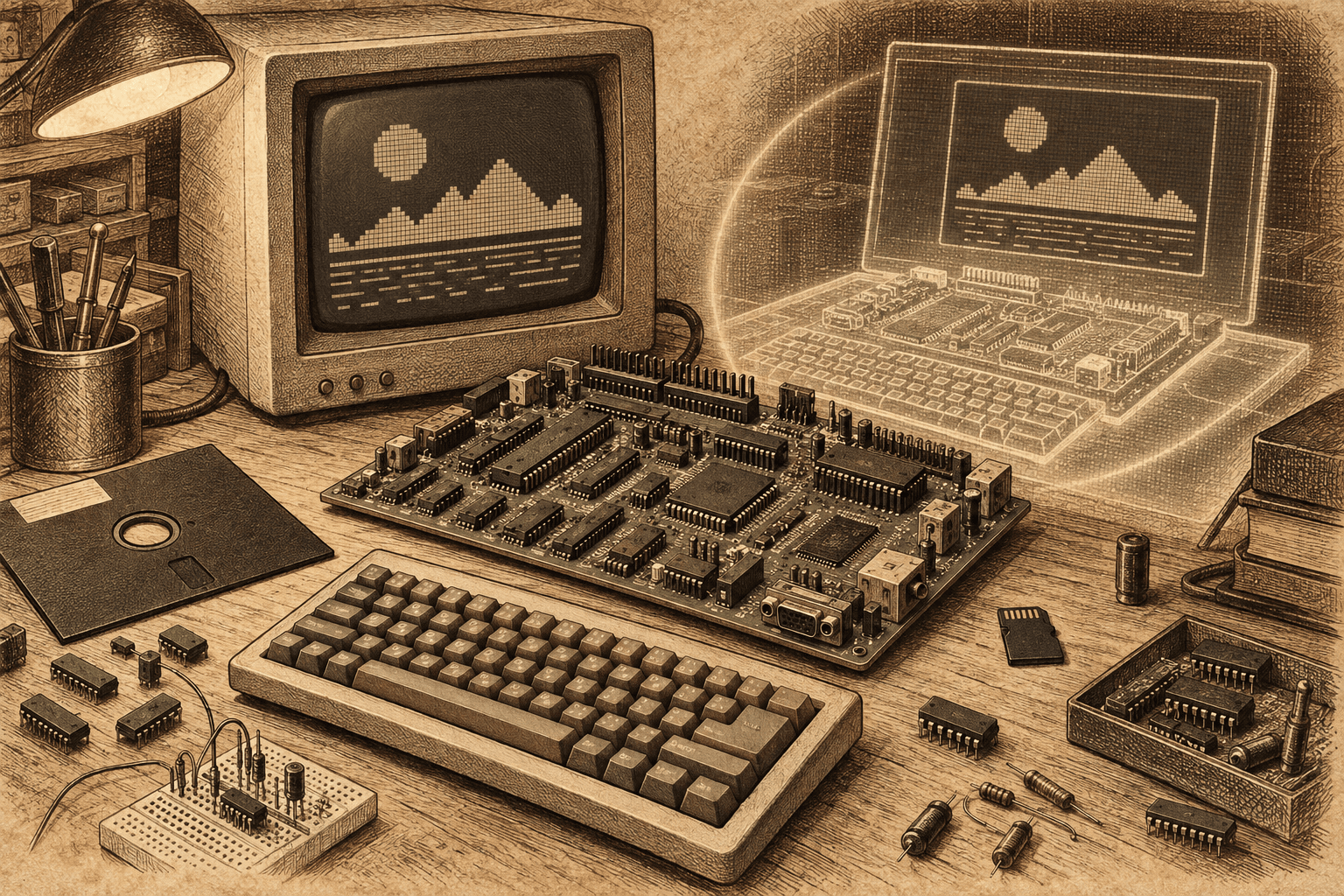
Pairs a chip-level 65C02 computer with custom hardware, video, sound, floppy, and microSD support with a cycle-honest emulator and browser assembler built around the same machine.
Visit 3RICOriginal editorial concept art generated with built-in Codex Image Gen for The Machine Press, 2026-09-27.
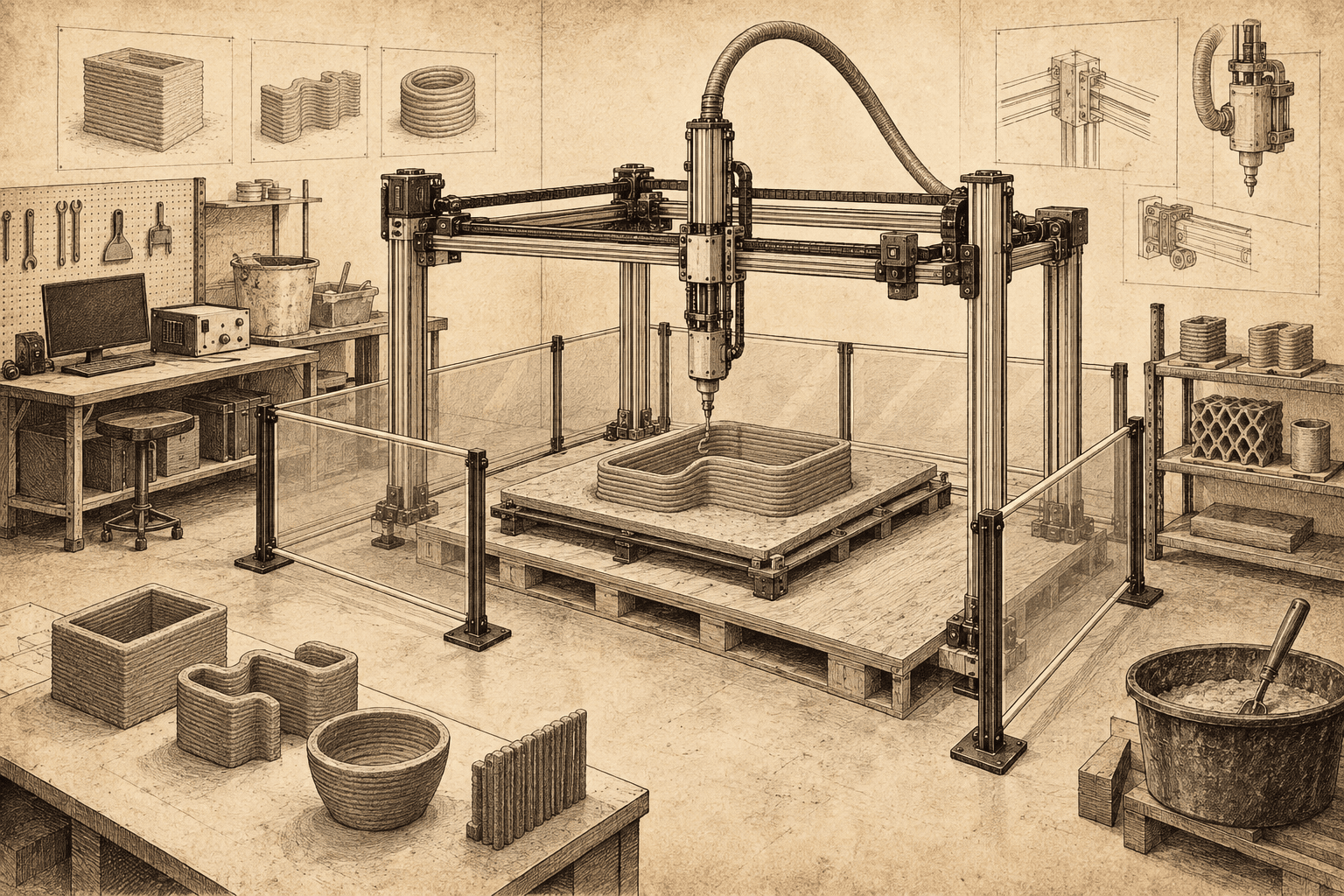
Publishes a pallet-scale cartesian motion reference, CAD, BOM, and low-voltage controls for supervised cementitious-extrusion research while explicitly excluding certified structural use.
Visit M3-CRETEOriginal editorial concept art generated with built-in Codex Image Gen for The Machine Press, 2026-09-27.
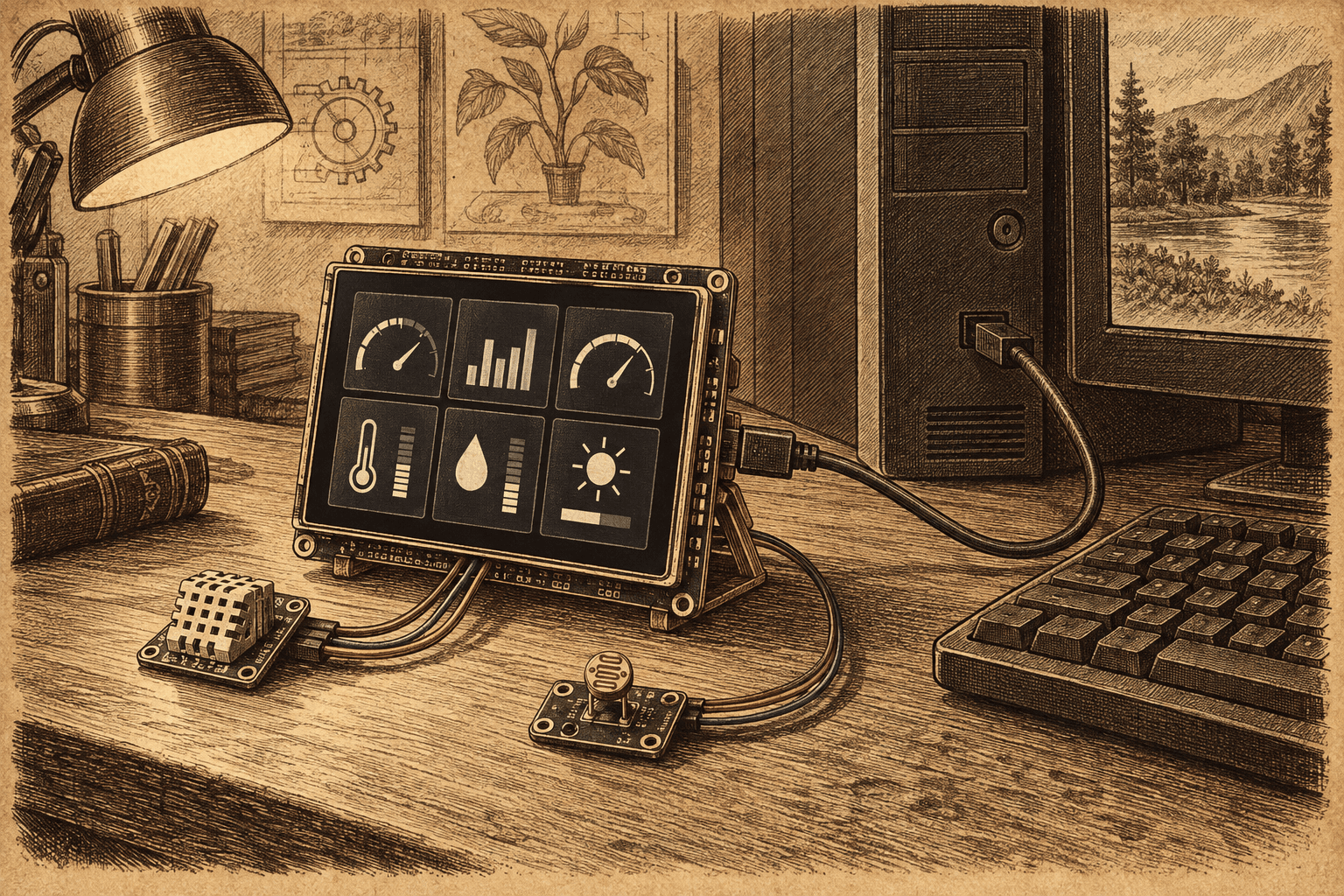
Turns a bare ESP32-S3 touchscreen into a USB-connected desk instrument for PC activity and optional room temperature, humidity, and light measurements.
Visit DeskNodeOriginal Codex Image Gen concept art from 2026-07-10; carried forward from the validated 2026-09-26 edition.
Desk Picks are selected by the newsroom. Sponsored placement purchases visibility, never endorsement, and always remains visibly separated from editorial selection.
 Editorial illustration