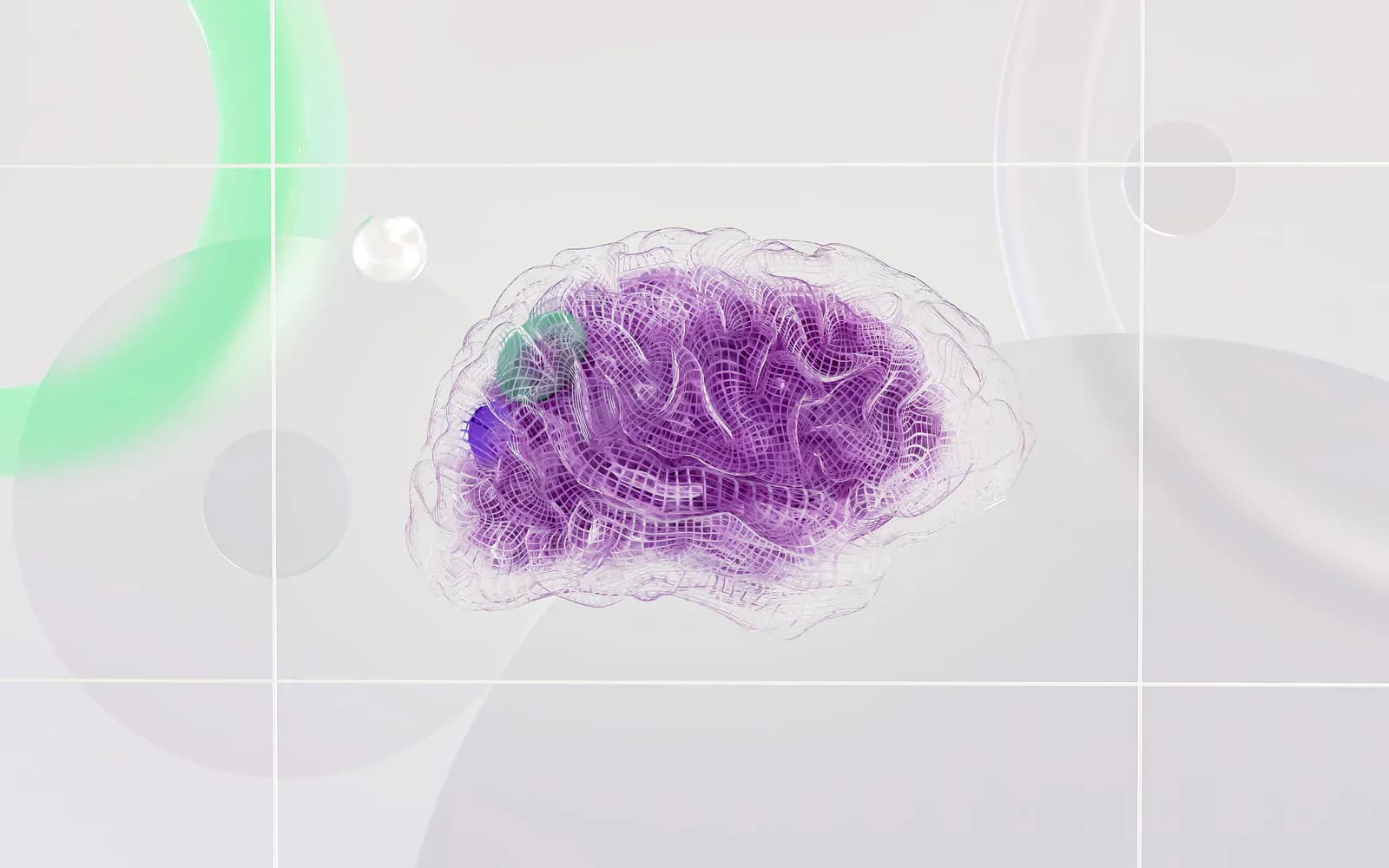
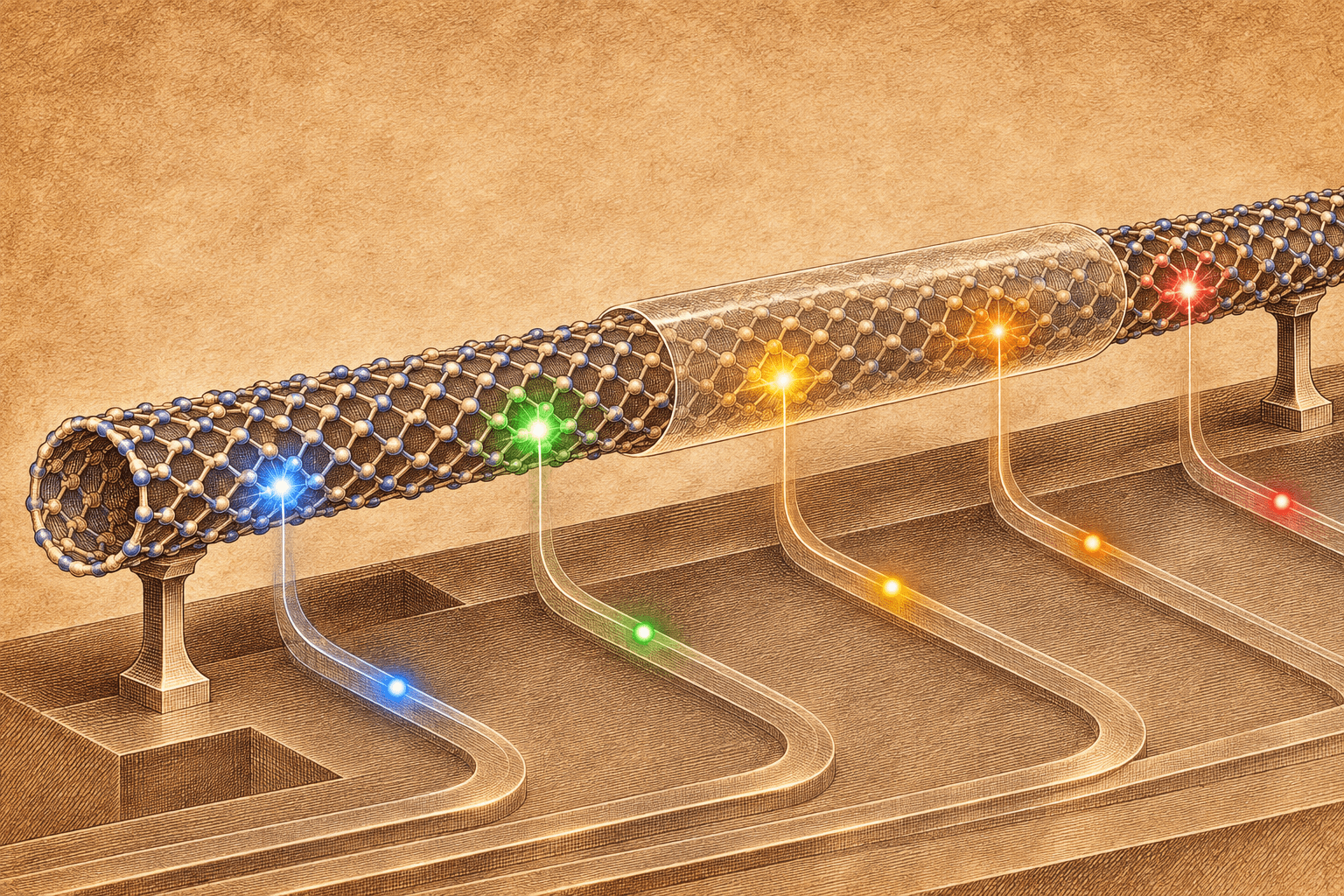
Boron nitride nanotubes host multiple room-temperature quantum emitters along one compact structure, with surface coating reducing blinking.
Editorial illustration
Editorial concept illustration of multiwavelength quantum emission along one boron nitride nanotube; it is not microscopy, a device photograph or experimental evidence. Generated with built-in Codex Image Gen for The Machine Press.
Single-photon sources must be bright, stable and small enough to integrate with photonic circuitry. The authors used confocal photoluminescence microscopy and Hanbury Brown–Twiss interferometry to study boron nitride nanotubes at room temperature. They report emitters across the visible spectrum, including regions not previously reported for flat hexagonal boron nitride, with multiple emission sites at different wavelengths along individual tubes. The fastest measured lifetime was about 0.5 nanoseconds, and surface passivation reduced blinking. The result is a laboratory characterization of candidate emitters—not a finished communications device—but a roughly 25-nanometer tube offers a compact geometry for deterministic placement in future waveguides and filters.
Editorial concept illustration of papers becoming executable research environments; it is not a Scientist World interface, agent trace or benchmark result. Generated with built-in Codex Image Gen for The Machine Press.
Scientist World converts research papers into verified executable environments, pairing reproduced baselines with agent research traces.
Scientific papers are readable records, but they rarely arrive as standardized environments in which a research agent can change a method and measure the result. Scientist World uses an autonomous pipeline to extract an open research question from each paper and reproduce the paper’s method as a baseline. The authors release the first 1,000 verified environments plus 6,400 hours of recorded research traces. On their evaluation, frontier research agents surpassed the reproduced human baseline in 74 percent of environments, while training on the traces raised a smaller model’s ideation score by 158 percent to match the frontier systems tested. Those percentages depend on the benchmark’s reproduction and scoring choices; they do not mean agents surpassed scientists generally. The release matters because it turns a claim about automated research into a large, inspectable experimental substrate.
On public coding-agent trajectories, issue difficulty and model identity explain far more than the partial run itself.
A run-independent issue-difficulty score reaches 0.92 AUROC on SWE-bench Verified trajectories, while trajectory predictors reach about 0.62. Within an issue, model identity predicts failure better than the studied predictors, and per-issue model switching provides no held-out gain. A repeated-run pilot shows that retries can rescue some failures, but current predictors cannot distinguish a bad run from a task beyond the model’s ability. The result argues for repeated-run, closed-loop evaluation rather than universal pessimism about monitoring.
Conceptual Visualising AI artwork used illustratively; it is not SwarmEvolve, a hidden-state map, agent trace or evaluation result. Novoto Studio / Google DeepMind / Pexels; cropped, resized, metadata stripped, and converted to WebP by The Machine Press.
Hundreds of low-cost agents exchange latent KV caches and select novel hidden-state directions for evolutionary program search.
SwarmEvolve organizes agents into groups that reason without decoding every intermediate step to text. A novelty filter measures distances between hidden states, while a summarizer receives combined KV caches to perform crossover. Across 21 mathematical-discovery and scientific-computing problems, the authors report the highest average score and a median 3 to 8 minutes to reach scores other frameworks needed 60 minutes to match. The comparison is limited to the tested problems, models and budgets.
XStack asks coding agents to move complete PyTorch projects on NVIDIA GPUs into JAX repositories running on Google TPUs.
Each task begins with a PyTorch repository and a clean TPU machine; a migration passes only when it reproduces authenticated criteria derived from the source project’s published result. In the released benchmark, the strongest reported agent passes 75 percent, GPT-5.6-sol passes 45 percent and every other tested agent reaches at most 40 percent. The scores describe this benchmark’s repositories, infrastructure and grading—not all framework migration work.
OopsieRecover infers semantic intent from corrective demonstrations, then steers robot policies with spatial costs across new scenes.
Instead of binding a correction to the exact observation in which it appeared, the framework uses abduction to infer why the original behavior was undesirable. It encodes that knowledge as dense spatial representations and conditional costs. Across six manipulation tasks and variations in objects, poses, scenes and related tasks, the authors report that a handful of demonstrations can transfer corrections without fresh data for every variation. The result remains confined to the paper’s tasks and vision-language-action models.
VFlash predicts complete points, boxes or trajectories in one forward pass instead of emitting their coordinates token by token.
A lightweight drafter exploits the known structure of each visual primitive and adapts to its type, dimensionality and length. Across the evaluated 2D and 3D robot-trajectory tasks, the method reduces prediction error relative to autoregressive decoding. Preliminary single-rollout measurements show roughly 25-times faster 3D point-motion generation, while a conditioned world-action model reaches 70.2 percent average success across four MolmoSpaces suites versus 62.6 percent for the baseline.
A common simulation framework places noisy boson and fermion sampling in polynomial time under fixed nonzero overall loss.
The result covers Fock-state boson sampling, fixed-squeezing Gaussian boson sampling and fermion sampling with magic inputs, at inverse-polynomial total-variation error and with high probability over Haar-random interferometers. Under a weaker flatness assumption, the authors obtain quasipolynomial simulation without Haar randomness and polynomial simulation at logarithmic depth with constant loss per layer. These are asymptotic theoretical conditions, not a demonstration that every noisy quantum experiment is classically easy.
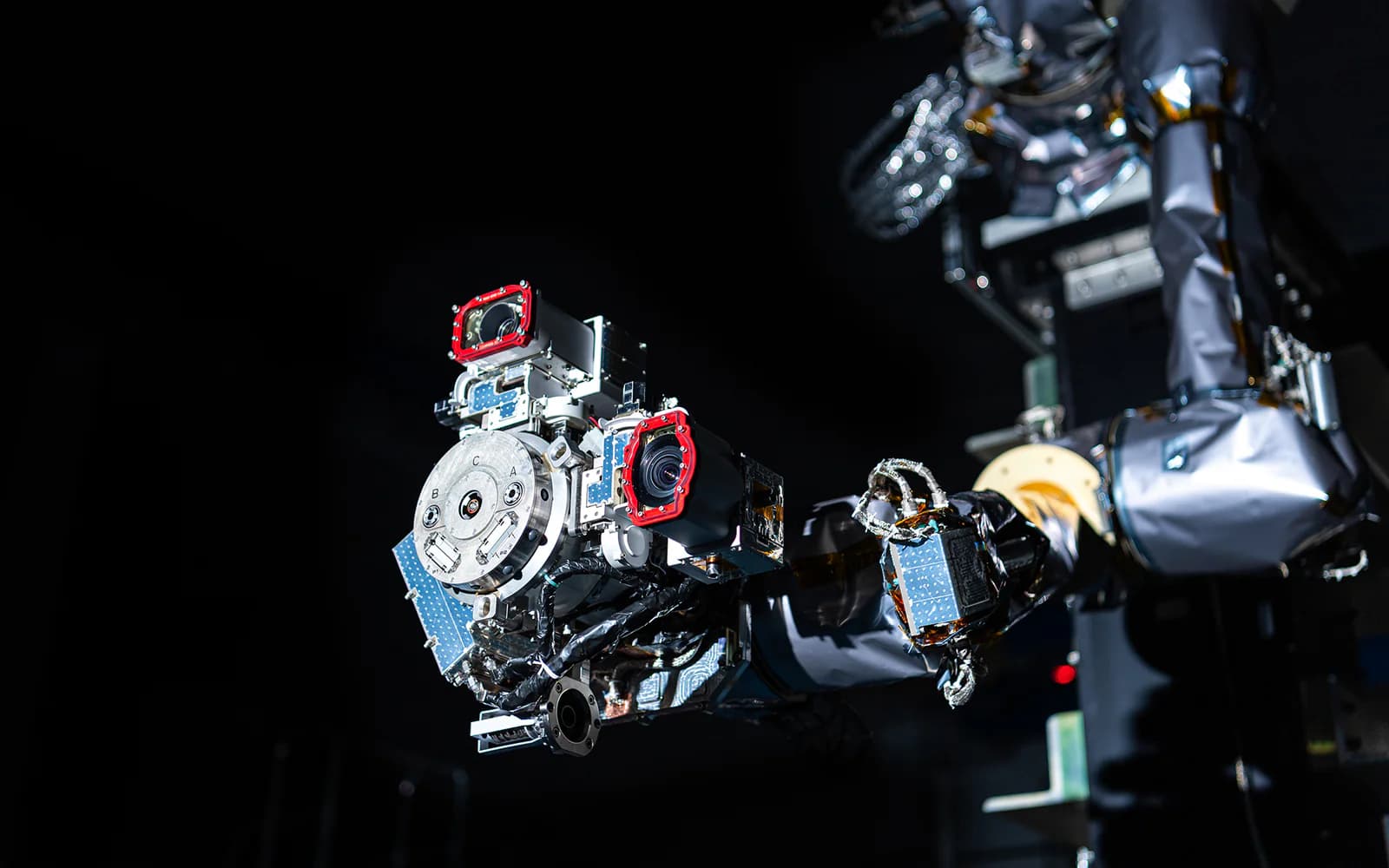
NASA OSAM-1 hardware used illustratively; it is not a VLA-Tug robot, manipulation episode, failure monitor or safety result. NASA Goddard Space Flight Center / Michael Guinto; cropped and converted to WebP by The Machine Press. Use does not imply NASA endorsement.
VLA-Tug probes latent layers for calibrated early failure detection and classifies the likely failure mode with little overhead.
Training on the pre-failure segment improves early detection by as much as 30 percent at matched false-positive rates over the strongest learned baseline. Under unseen-task shift, missed-detection and false-alarm bounds remain valid in up to 86 percent of runs, versus at most 21 percent for baselines. Top-three failure-mode accuracy rises by up to 44 percent over a majority baseline, and the authors release 3,180 annotated manipulation episodes. These are benchmarked monitoring results, not a safety certification.
A continuous-validation audit turns Terminal-Bench 2.0 into 2.1 and shows that task defects and time budgets both move results.
The workflow combines community reports, task artifacts, traces, automated oracle checks and human-gated repairs. The audit finds issues in roughly 30 percent of Terminal-Bench 2.0; repairs raise accuracy by more than 10 percentage points and move leaderboard positions by up to three ranks, though rank correlation remains high. Extending wall-clock limits also closes large harness gaps for two tested models, showing that resource budgets belong in the benchmark specification.
A hierarchical controller conditions whole-body robot motion on a human partner and anticipates motion through temporary occlusion.
Social Humanoid uses a shared tokenized representation for human and robot movement, then a low-level controller executes the generated motion on a 29-degree-of-freedom Unitree G1. Adaptive retargeting across five motion-capture datasets yields a 260-hour interaction benchmark. The authors report coordinated behavior across varied interaction types in simulation and real-world demonstrations. The evidence concerns the released system and scenarios, not open-ended social understanding.
StepBack localizes a likely first mistake, then resamples only that step and the suffix rather than whole reasoning traces.
The method begins with a small set of draft trajectories, uses lightweight signals to find likely first-error positions and votes across corrected suffixes. Across seven math-reasoning and multi-hop question-answering benchmarks, the authors report average accuracy matching self-consistency while using up to 41.26 percent fewer tokens. It can also be combined with adaptive-consistency methods. The savings depend on the tested tasks and localization signals.
A particle-jamming and water-transfer prototype independently modulates stiffness and temperature for tactile displays.
Mechanical tests show a controllable 300 percent stiffness increase. Thermal characterization spans 10 to 50 degrees Celsius, with closed-loop control maintaining a 0.2-degree error from its setpoint. The prototype is a research display for perceptual work, medical simulation and affective haptics; the paper does not establish durability, wearability or clinical performance.
Generic fiber-network infrastructure used illustratively; it is not a SCALE deployment, latent message, bandwidth trace or robot network. Brett Sayles / Pexels; cropped, resized, metadata stripped, and converted to WebP by The Machine Press.
SCALE reuses similar tokens across time and schedules semantic gain against bandwidth and real-time deadlines.
The method matches tokens between consecutive latent messages, profiles the gain and cost of sending different amounts of representation, and schedules pending transmissions under bandwidth and deadline limits. Across three cyber-physical benchmarks and a physical spider-robot case study, the authors report higher task performance and on-time delivery in constrained networks. The results do not establish general network efficiency outside the tested models and conditions.
SensorGuard-RV authenticates samples in fixed-function hardware and decrypts them directly into a RISC-V register.
A write-once ownership switch hands the sensor to a controller whose key is inaccessible to software. A new instruction verifies tags and rejects replays, including across resets, before placing data in a CPU register. On an FPGA implementation with an accelerometer, a protected sample arrives in 51.9 microseconds and the loop sustains 19,015 transactions per second, 5.3 percent above the software-driven SPI baseline. Added logic and estimated power remain material tradeoffs.
A two-year NIRCam baseline places JADES-GS-BD-5 about 64 parsecs away, roughly three times farther than prior parallax-measured Y dwarfs.
The team measures 49.8 milliarcseconds per year of proper motion and a parallax of 15.7 milliarcseconds, yielding a geometric distance of 64 parsecs with stated uncertainty of plus six and minus five. Its inferred motion fits the Galactic thin disk, while its faint luminosity and near-infrared spectrum place it beyond Y1 and among the coldest dwarfs known. Evolution models put it in the planetary-mass regime, though current atmosphere models do not reproduce the full spectral-energy distribution.
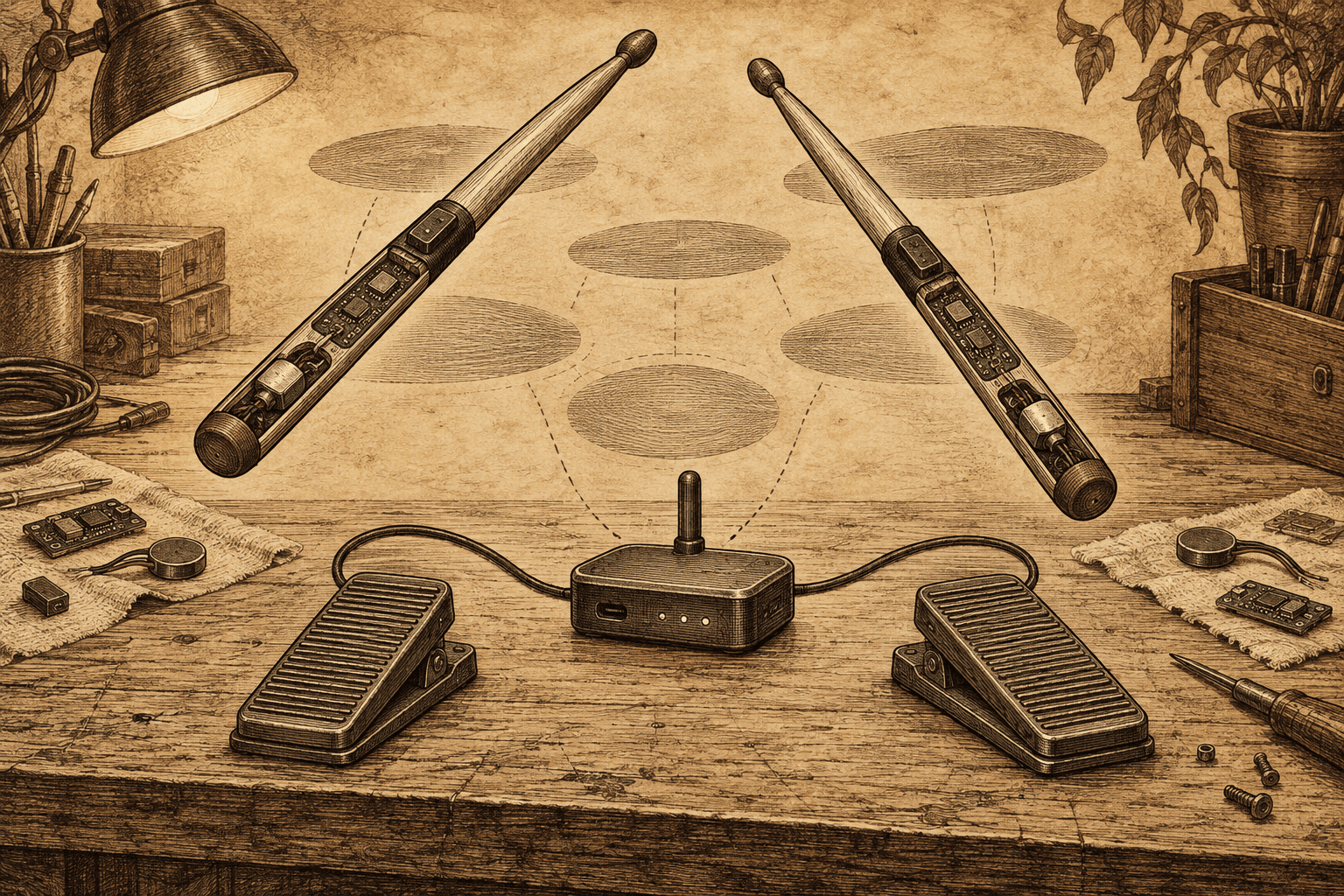
Moves motion tracking onto two ESP32-S3 drumsticks, adds haptic hits and a two-pedal hub, and sends velocity-sensitive drum events to open PC or Android playback software.
Visit Space Drums 2.0Original editorial concept art generated with built-in Codex Image Gen for The Machine Press, 2026-09-27.
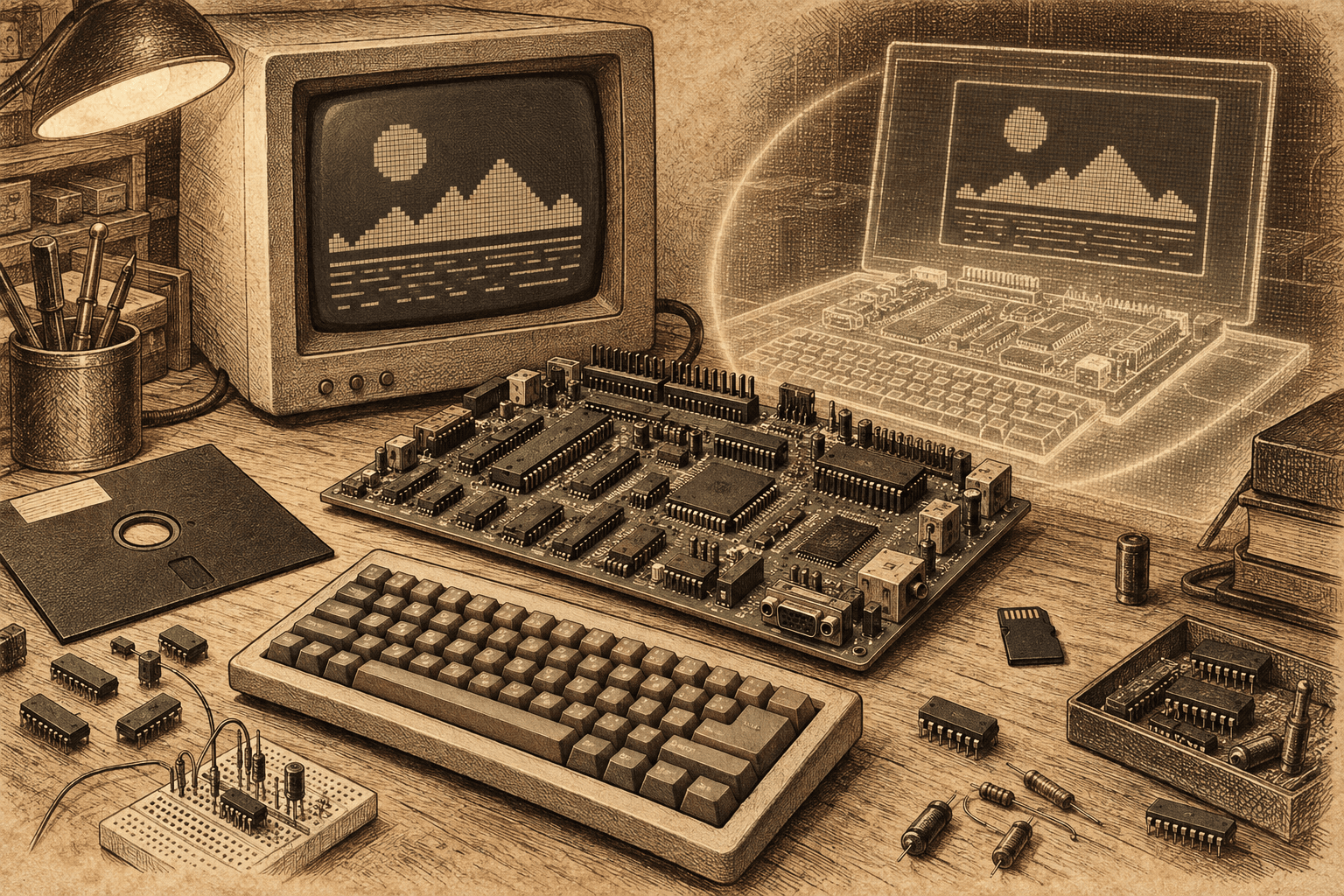
Pairs a chip-level 65C02 computer with custom hardware, video, sound, floppy, and microSD support with a cycle-honest emulator and browser assembler built around the same machine.
Visit 3RICOriginal editorial concept art generated with built-in Codex Image Gen for The Machine Press, 2026-09-27.
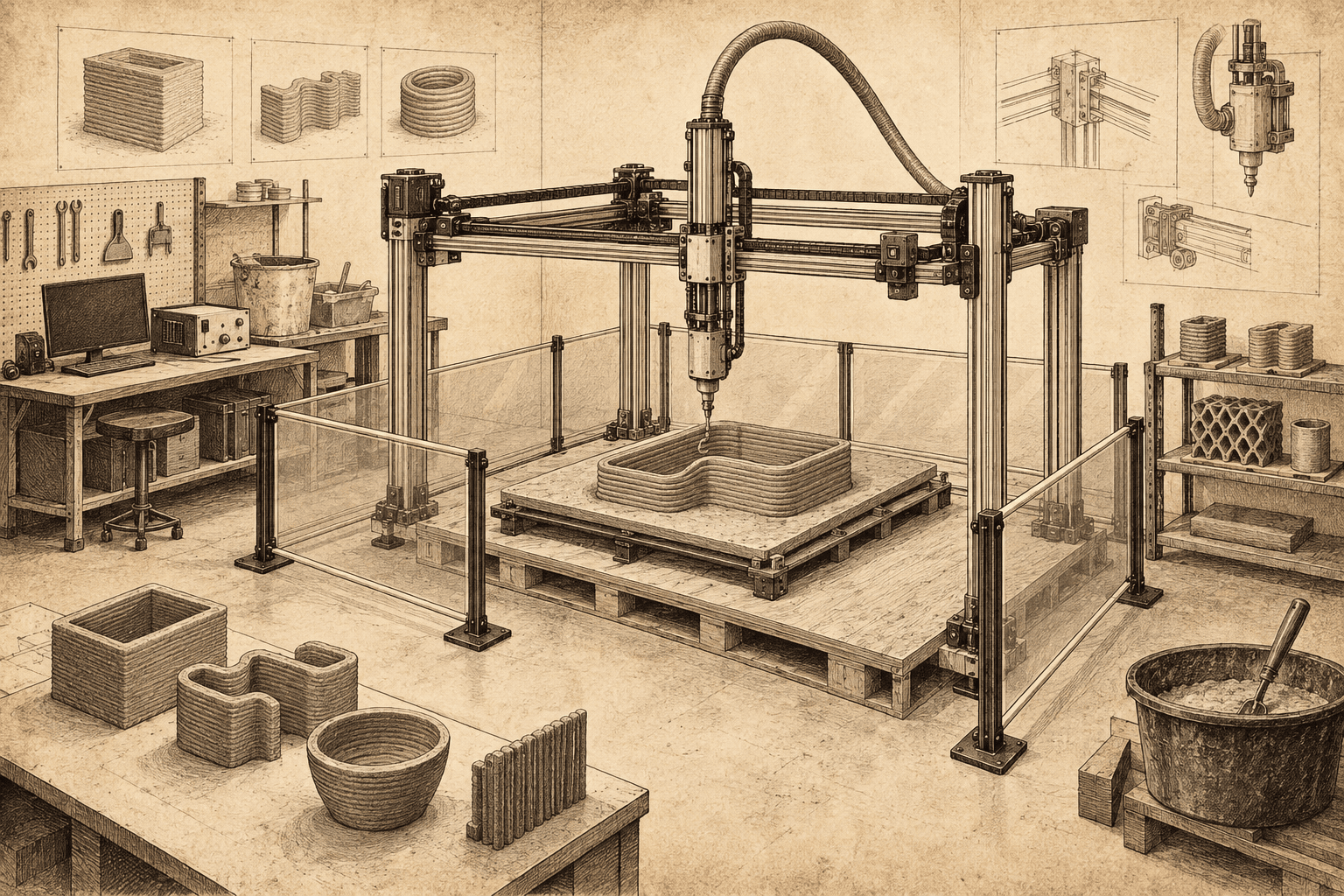
Publishes a pallet-scale cartesian motion reference, CAD, BOM, and low-voltage controls for supervised cementitious-extrusion research while explicitly excluding certified structural use.
Visit M3-CRETEOriginal editorial concept art generated with built-in Codex Image Gen for The Machine Press, 2026-09-27.
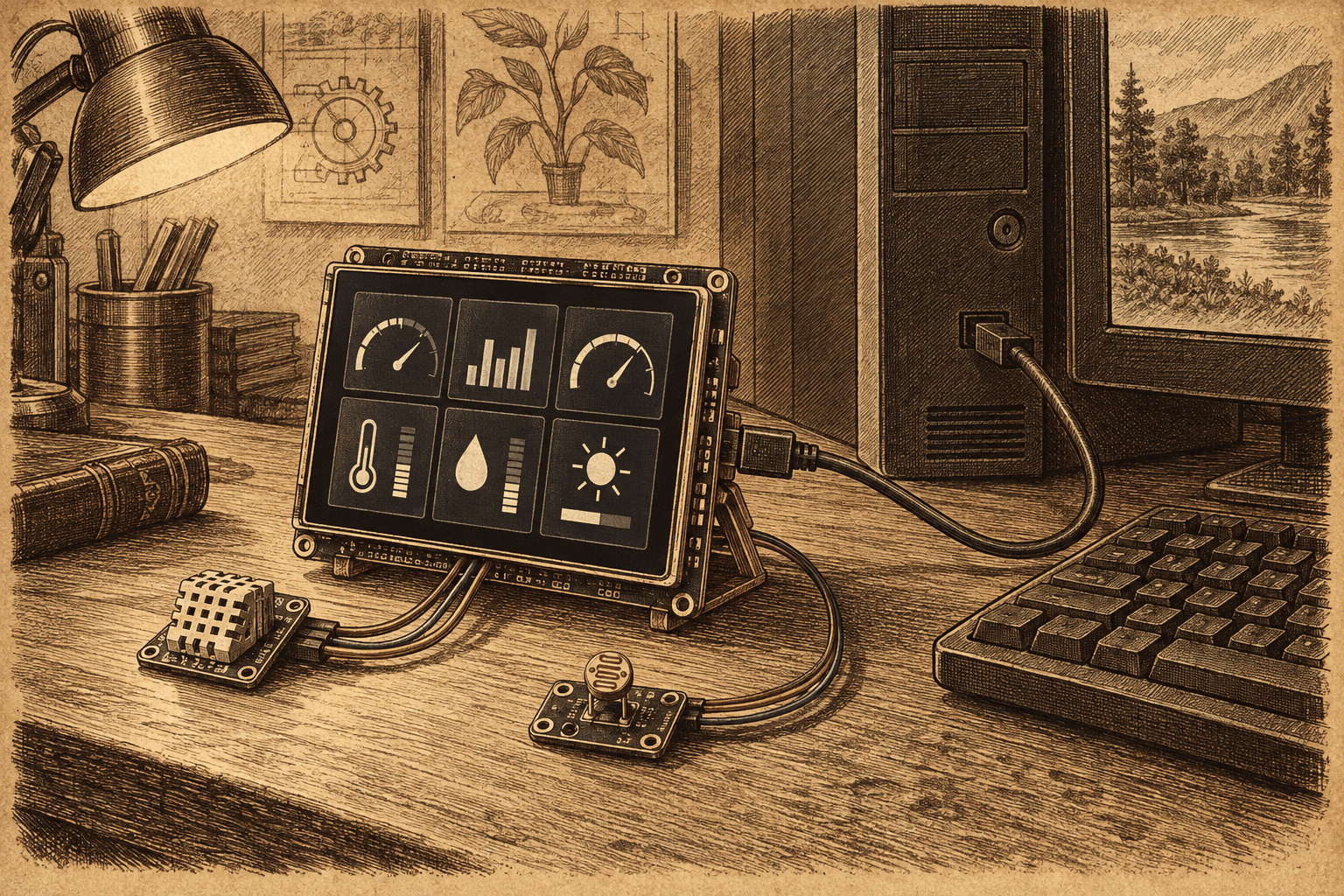
Turns a bare ESP32-S3 touchscreen into a USB-connected desk instrument for PC activity and optional room temperature, humidity, and light measurements.
Visit DeskNodeOriginal Codex Image Gen concept art from 2026-07-10; carried forward from the validated 2026-09-26 edition.
Desk Picks are selected by the newsroom. Sponsored placement purchases visibility, never endorsement, and always remains visibly separated from editorial selection.
 Editorial illustration