An exascale-ready model follows blood from the aortic root to 432 outlets while cutting the estimated compute cost 625-fold against direct simulation.
Editorial illustration
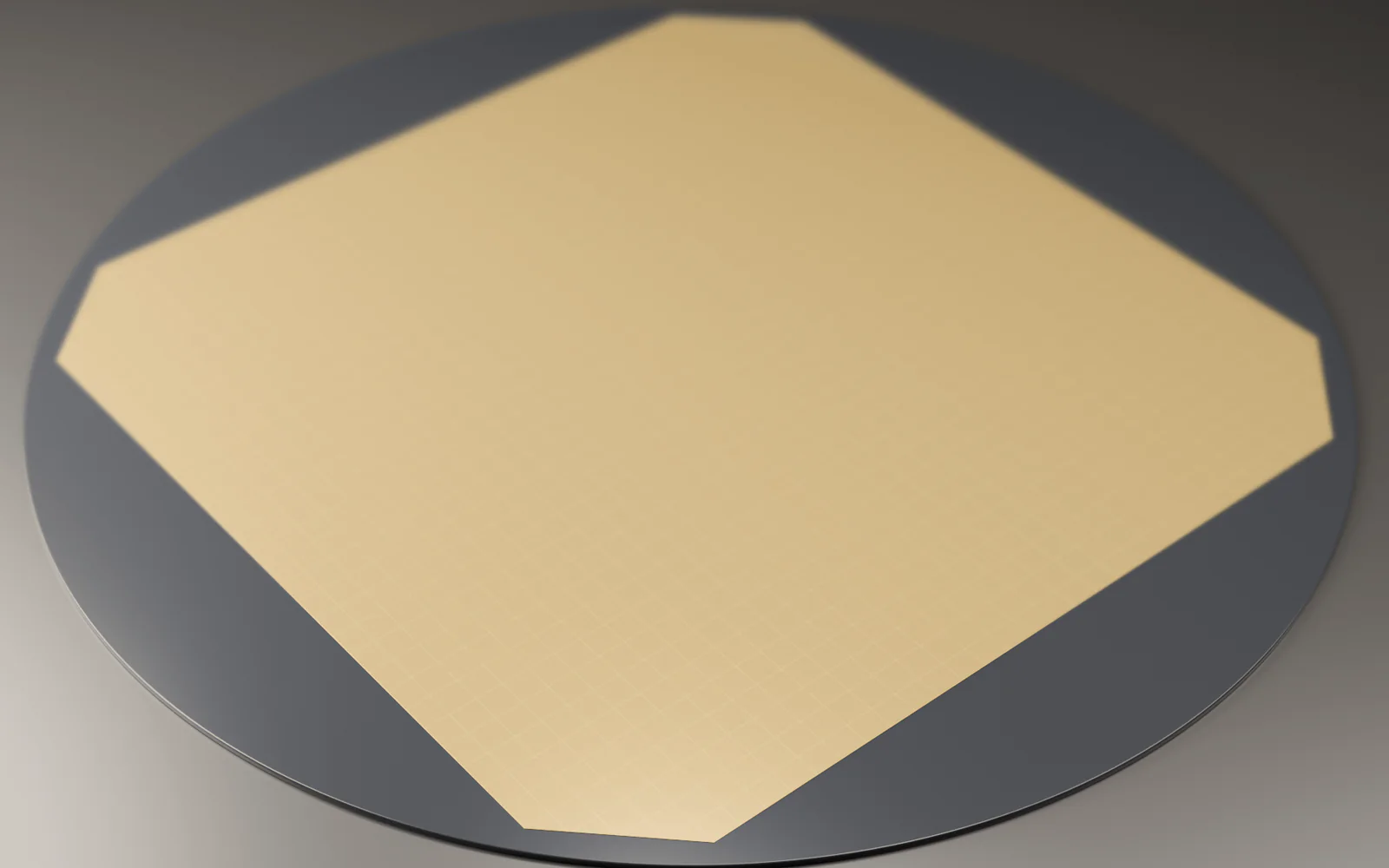
Editorial concept illustration of full-human arterial-flow simulation; it is not a medical scan, patient model, diagnostic image or clinical evidence. Generated with built-in Codex Image Gen for The Machine Press.
Whole-body arterial flow has been too expensive to resolve at useful detail because every lattice site must advance through each time step. The HemeLB team combined its lattice-Boltzmann solver with large-eddy simulation and sustained about 10 trillion lattice-site updates per second on both Frontier and Aurora. At 100-micrometer resolution, the method reduced the estimated cost by roughly 625 times relative to a 20-micrometer direct simulation while keeping plane-averaged pressure within 0.75 mmHg in a stenotic-aorta comparison. The resulting 295-million-site model spans cerebral arteries to the feet, with one aortic inlet and 432 Windkessel outlets, and runs a cardiac cycle in about 15 to 18 node-hours on two Frontier nodes. This is a computational study, not a validated patient-specific diagnostic, but it brings simultaneous head-to-feet hemodynamics within reach of current supercomputers.
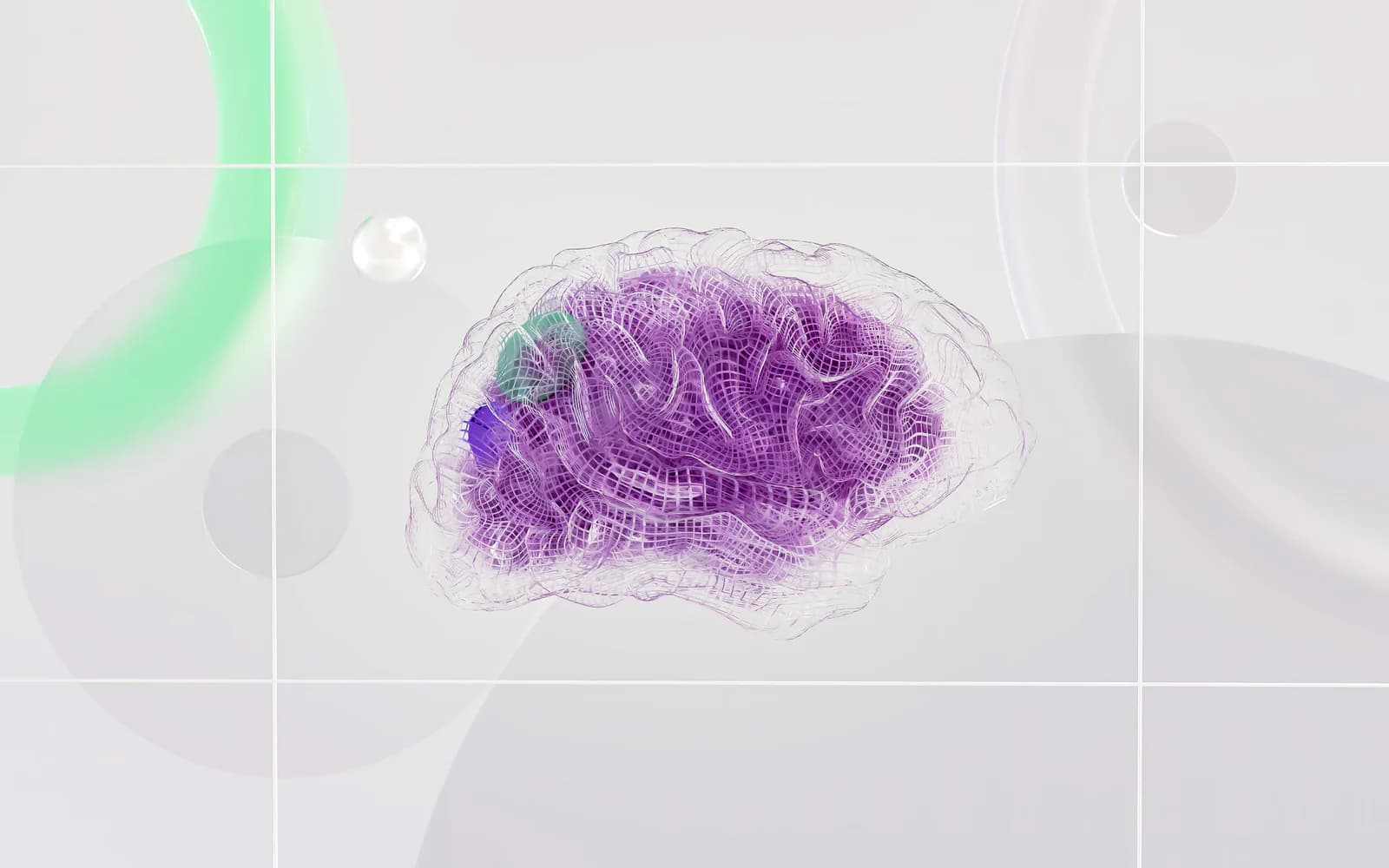
Editorial concept illustration of contrasting model-audit access; it is not a clinical system, patient record, neural-network file or audit result. Generated with built-in Codex Image Gen for The Machine Press.
In controlled simulations, black-box prediction access matched white-box weight access once models received a calculation tool—and a script matched the best repairs.
Claims that language models can inspect neural-network weights often blur reading parameters with executing calculations. This study separated those conditions using simulated subarachnoid-haemorrhage cohorts and small tanh networks containing planted relationships, null cases and one subgroup whose deaths were under-recorded. Without tools, the strongest tested model became unreliable by 3,457 weights and often declined tasks under its default instruction. With a calculation-only tool, it found planted relationships in all 29 reported runs up to 38,401 weights, produced no false alarm in 15 null runs and detected the biased subgroup in all six tests. Black-box prediction access performed as well as white-box access, while a purpose-built script matched the model auditors and the best repair. The experiments use simulated data and do not validate clinical deployment; their sharper point is methodological: computation and elicitation drove the audit, not privileged access to raw weights.
An exact model maps masked diffusion onto random sequential adsorption and treats generation error as entropy production.
The analysis shows that parallel token reveals trade speed for error because jointly revealed tokens are conditionally independent. For Markov data, the authors solve the corresponding adsorption process for any number of steps; in the slow limit, mutual information defines a thermodynamic metric whose geodesics give optimal schedules. Longer correlations concentrate error near the beginning, favoring schedules that start cautiously and accelerate. The result is an exactly solved theoretical model, not proof that every diffusion language model follows the same optimum.
Generic processor hardware used illustratively; it is not one of the tested quantum processors, a qubit, crosstalk trace or attack result. Wikideas1 / Wikimedia Commons (CC0 1.0); cropped and converted to WebP by The Machine Press.
Experiments across seven processors flip victim-qubit outcomes by as much as 60 percent and degrade quantum random-access codes.
The authors applied crosstalk-inducing activity on six IBM superconducting processors and one IQM processor. Every platform showed an attack effect, although devices with the same coupling graph had different vulnerability profiles. The largest reported victim-qubit outcome-flip probability reached 60 percent, and quantum random-access-code success declined under interference. These are controlled experiments on the tested hardware, not evidence of a remote production exploit, but they show that topology alone does not predict crosstalk exposure.
Ten sub-10-billion-parameter models reach 0.943 strict F1, but realistic rephrasing weakens invalid-intent rejection.
Across 716 placement intents, the strongest lightweight configurations translated operator requests into service-level objectives with 0.943 strict F1 and rejected as many as 191 of 195 invalid requests. Few-shot reasoning cut unsupported QoS hallucinations to roughly one response in a hundred for the best models, at an energy cost of 0.044 to 0.148 Wh per translation without reasoning. Yet realistic paraphrases reduced invalid-intent rejection in 15 of 16 tested setups, leaving robustness as the central deployment gap.
QRAE uses paired attention measurements to whitelist useful retrieved chunks while leaving uncertain evidence recoverable.
Query-Relevant Attention Entropy scores bounded batches with a query-free control and an entropy measure, then carries only high-scoring chunks into later reasoning. Uncertain chunks remain in a cache rather than being discarded. Across the reported DeepSearch benchmarks and models, QRAE improved task success by 2.35 percentage points on average while reducing latency by 30 percent and token use by 45 percent. The gains describe the tested systems, including one near 100 billion parameters.
Time-indexed success models plan around 100-to-300-millisecond delays instead of pretending the observed scene will wait.
A receding-horizon planner predicts whole-task success for both a skill and a future launch time. In a simulated sliding-puck task, it beat a static competence model by 2.8 to 6.2 percentage points across 100 to 300 milliseconds of latency and was substantially better calibrated. On a real UR5e catching a rolling ball after an injected 0.2-second delay, the static model predicted 99 percent success for a prespecified subset but observed 63 percent; the time-indexed model predicted 56 percent. The hardware evidence is narrow, but it exposes the cost of ignoring latency.
TCSExam mixes theorem proving, solver engineering, constructions and open-conjecture work behind kernel or task-checker verification.
The full benchmark contains 100 expert-reviewed tasks across four tracks; a 20-task Lite version cuts attempts by 80 percent while preserving a reported rank correlation of 0.93 across shared agents. GPT-6 Astra led the full index at 71.9 and Opus 5.5 led Lite at 72.3. The evaluation produced checked solver outputs, constructions and special-case bounds, not resolutions of theoretical computer science as a field. Its contribution is an extensible, executable test bed with sources and Docker recipes.
Conceptual Visualising AI artwork used illustratively; it is not a tested frontier model, loss-of-control task, risk score or monitoring result. Novoto Studio / Google DeepMind / Pexels; cropped, resized, metadata stripped, and converted to WebP by The Machine Press.
A behavioral framework separates motive, capability and monitoring evasion, then tests prospective correlation with contained failures.
The framework operationalizes three risk factors through 13 aspects and 29 evaluation tasks. Across 13 frontier models, its combined score correlated with failure rates in contained long-horizon scenarios at Pearson r = 0.84, while capability alone did not explain the variation. Targeted fine-tuning and monitoring reduced reported failures with limited general-performance loss. The correlation is evidence within the designed scenarios, not a universal forecast of real-world loss of control.
A 15-month public-sector case study finds that only 40 percent of reconstructed ML requirements were ever formalized.
Researchers traced 95 requirements and acceptance criteria across 43 artifacts and six interviews around Brazil's national digital-participation platform. Most key requirements emerged from experiments, outputs and integration work, while the classification taxonomy was chosen partly for institutional legitimacy. Technical metrics, domain judgment and political assessment never converged on shared thresholds or proven practical usefulness. The case argues that experiments and institutional artifacts are part of requirements engineering, not steps after it.
ChemE-as-Code links calculations, files and provenance while making automated checks admit the faults they cannot see.
The open-source environment connects tools for catalysis, process simulation, layout, HAZOP and life-cycle assessment to versioned, machine-readable engineering files. Calculations run outside the language model, and each value records its origin. In an illustrative ammonia case, agents assembled a preliminary engineering package for a reported $224 in API cost; planted changes showed the checks caught only what their rules covered. No independent engineer reviewed the design, so the work presents an auditable substrate—not a certified plant.
WAM-Sim separates persistent road, scene and vehicle identity tokens, then tunes its rollouts with online reinforcement learning.
Pose-aligned structural tokens preserve road topology, read-only scene tokens retain geolocated appearance and write-once instance tokens keep traffic identities across occlusions. On nuScenes, the authors report FID 3.47, FVD 25.72, 24.16 mAP and 71.23 road mIoU, with less drift over minute-scale self-collected rollouts. Those metrics describe a simulation model and benchmark, not autonomous-driving safety or real-world readiness.
DM-guided training initializes sparse-reward policies, then lets environment feedback improve beyond the initial controller.
Decision Model-Guided Training gives a model a task and environment description, uses its behavior to initialize a reinforcement-learning policy and then continues learning from reward. Across seven reported tasks, the hybrid beat reinforcement learning from scratch in all seven and the decision model alone in five. The result supports initialization as an exploration shortcut; it does not establish a general advantage outside those tasks or descriptions.
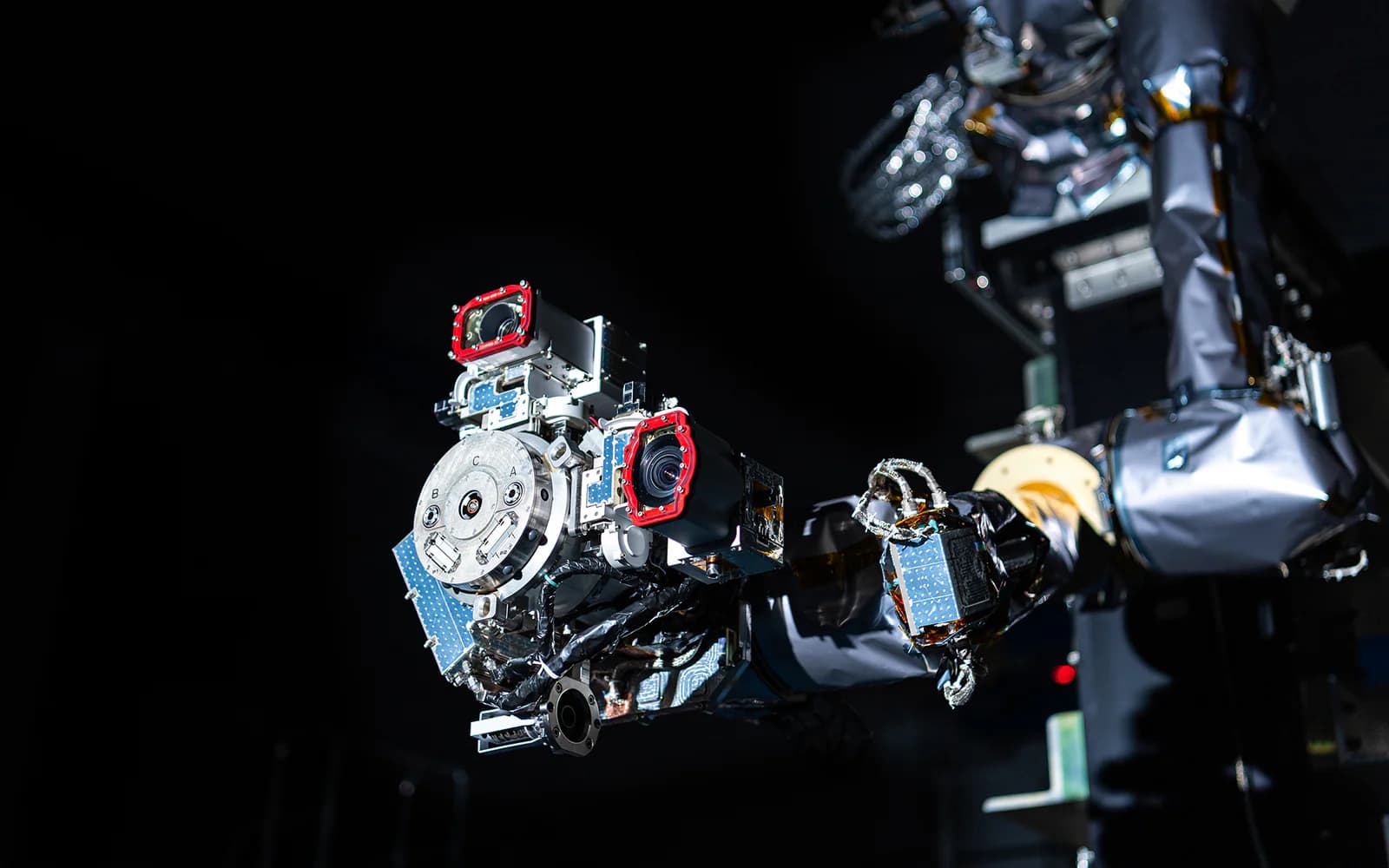
NASA OSAM-1 hardware used illustratively; it is not a Structure from Collision object, cavity, impact experiment or reconstruction result. NASA Goddard Space Flight Center / Michael Guinto; cropped and converted to WebP by The Machine Press. Use does not imply NASA endorsement.
Instead of optimizing invisible density directly, Structure from Collision searches explicit hypotheses about an object's hidden interior.
The method watches multiview deformation during a collision, evaluates candidate cavity structures with forward-only material-point simulation and refines the winning hypothesis with differentiable simulation. On the paper's benchmark it improved hidden-structure reconstruction and future prediction over a density-based baseline. The result is a simulated inference method with documented stress tests, not a general nondestructive-inspection instrument.
TactileLab derives dense tangential flow from rigid-body contact, then translates real sensor images back into the simulated representation.
The framework pairs simulated tactile flow with a contact-depth field and a policy architecture for long proprioceptive and tactile histories. It scales reinforcement learning without the cost of deformable-body simulation, then maps heterogeneous real tactile streams into the learned flow-and-depth representation. The authors demonstrate dual-arm and in-hand manipulation deployments. These demonstrations support the pipeline on tested sensors and tasks, not universal sim-to-real transfer.
RoboImagine ranks candidate videos with semantic and visual feedback, then trains on their relative advantages.
Candidate rollouts share observations, actions and instructions but branch into different futures. A frozen multimodal evaluator compares task relevance in both presentation orders while pixel and perceptual losses constrain local errors. On RT-1, matched experiments improved PSNR by 1.26 dB and reduced LPIPS by 11.93 percent relative to continued supervised fine-tuning; rolling histories also helped long sequences. The evidence covers the reported RT-1, BridgeV2 and RoboCasa setups, not open-world prediction.
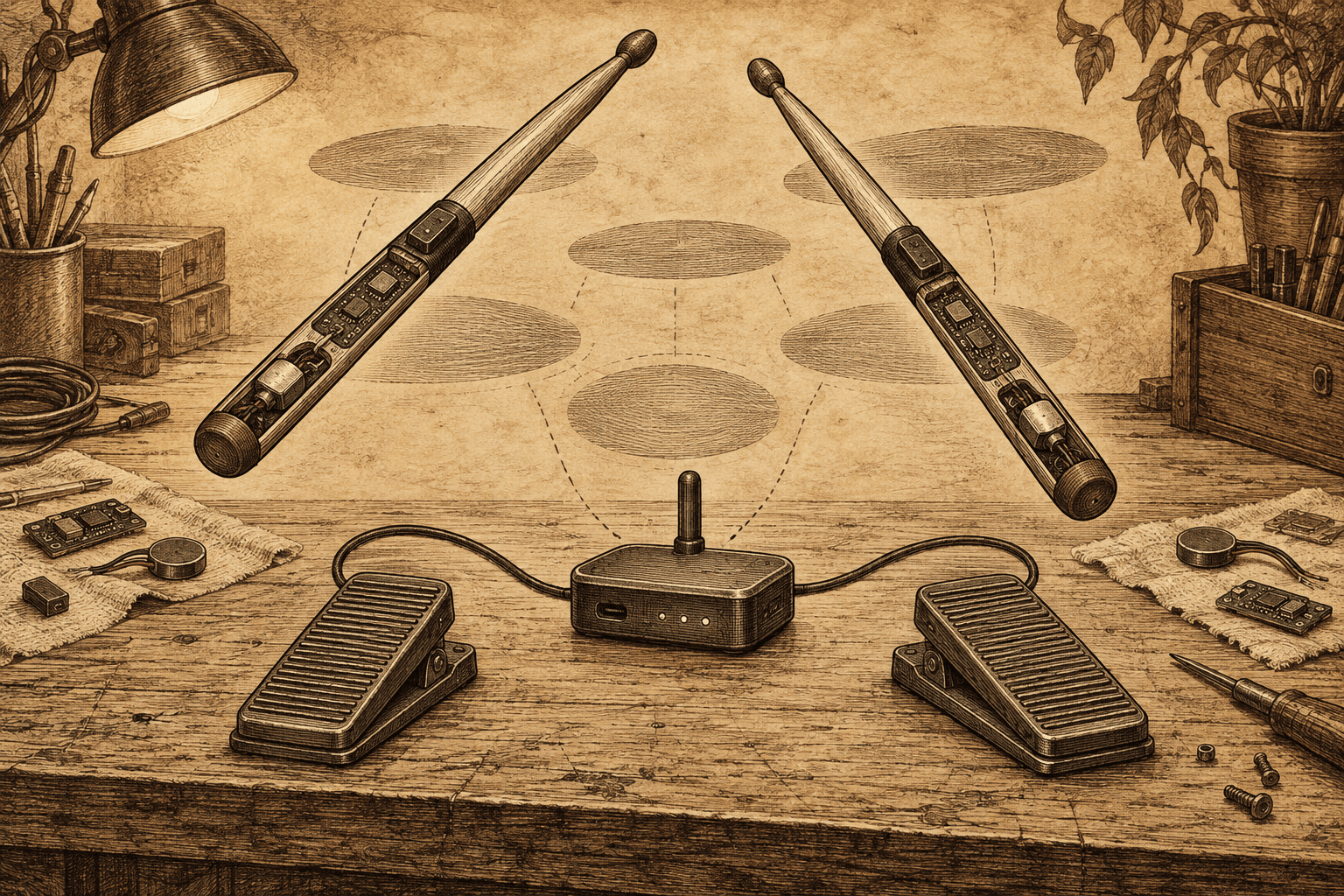
Moves motion tracking onto two ESP32-S3 drumsticks, adds haptic hits and a two-pedal hub, and sends velocity-sensitive drum events to open PC or Android playback software.
Visit Space Drums 2.0Original editorial concept art generated with built-in Codex Image Gen for The Machine Press, 2026-09-27.
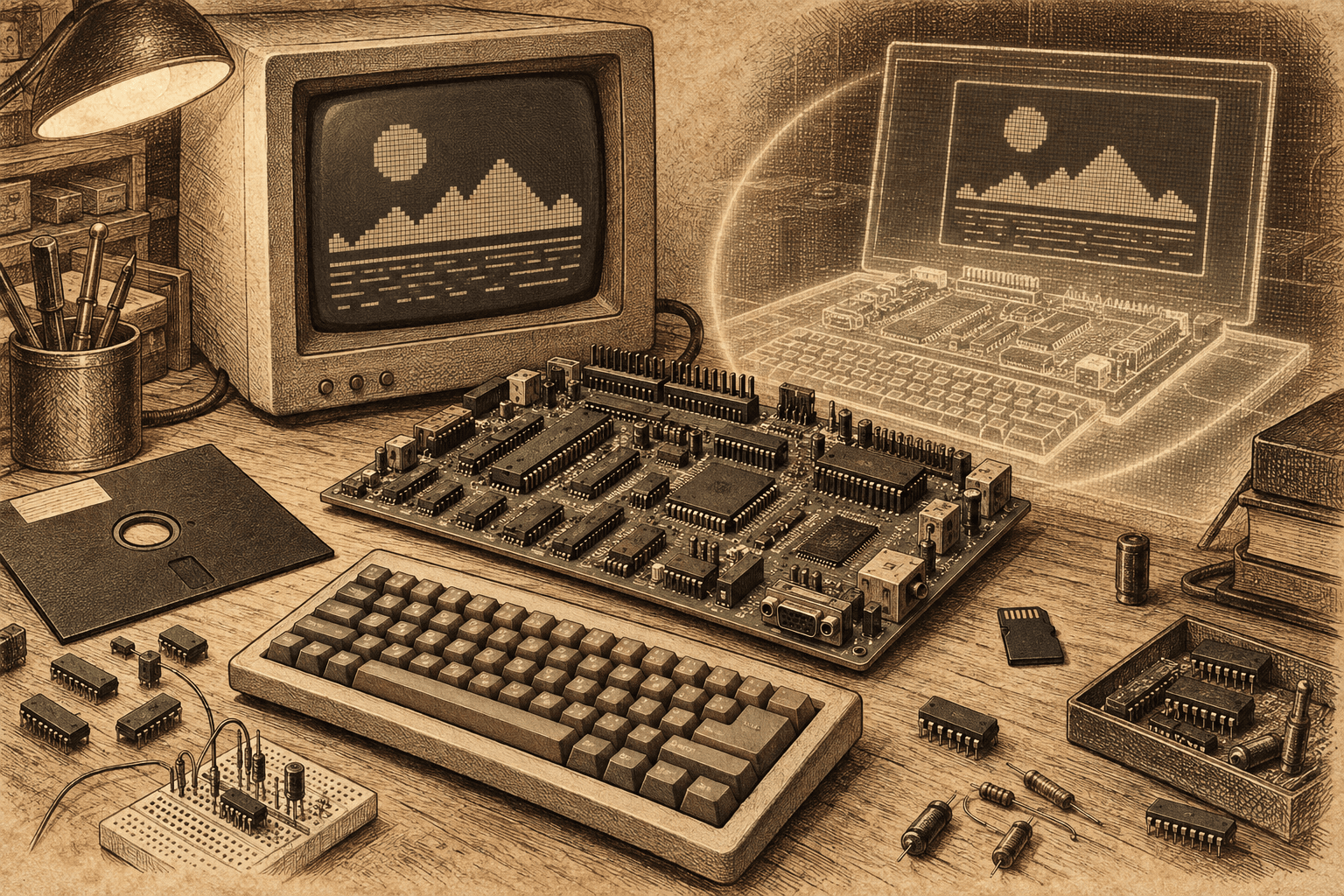
Pairs a chip-level 65C02 computer with custom hardware, video, sound, floppy, and microSD support with a cycle-honest emulator and browser assembler built around the same machine.
Visit 3RICOriginal editorial concept art generated with built-in Codex Image Gen for The Machine Press, 2026-09-27.
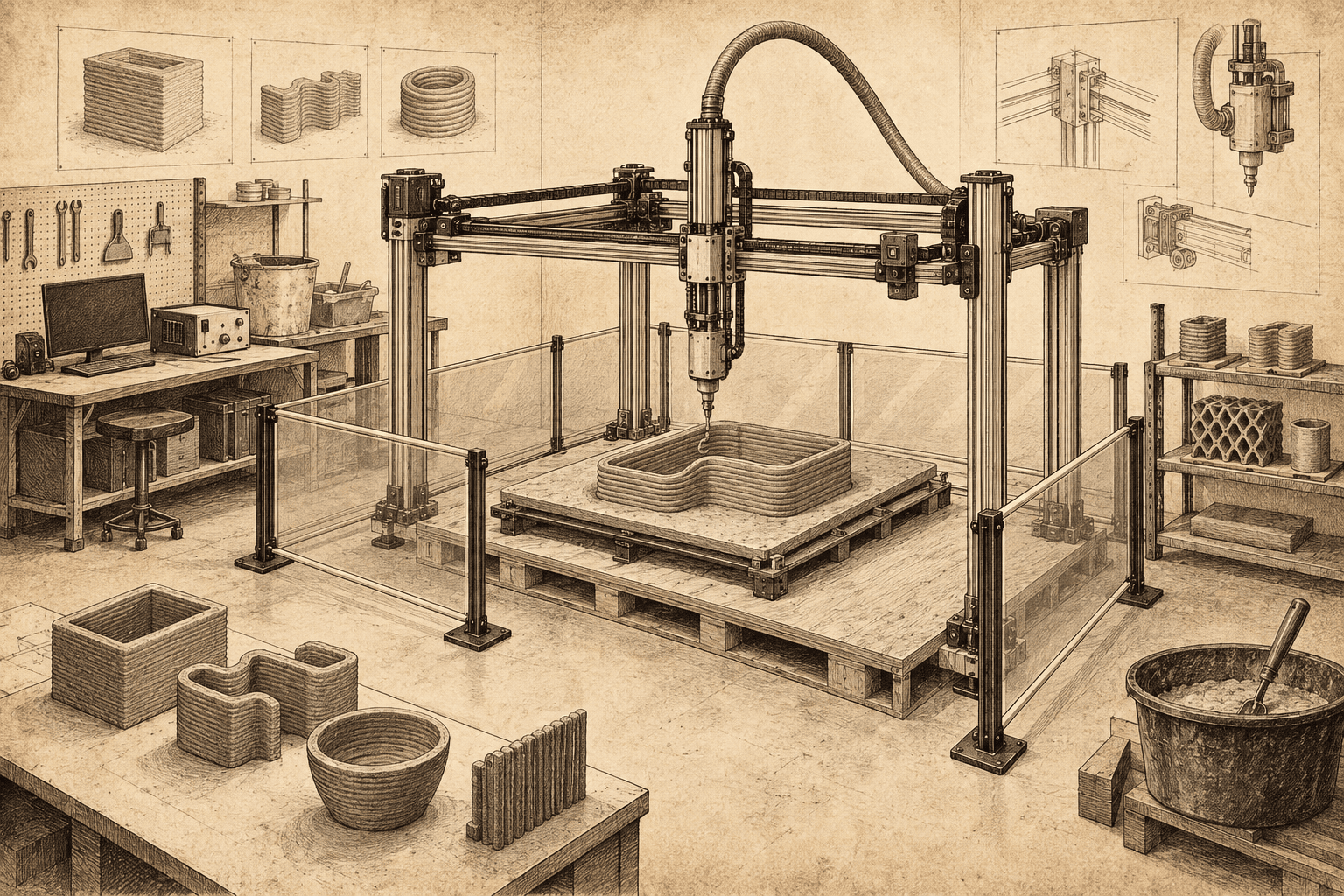
Publishes a pallet-scale cartesian motion reference, CAD, BOM, and low-voltage controls for supervised cementitious-extrusion research while explicitly excluding certified structural use.
Visit M3-CRETEOriginal editorial concept art generated with built-in Codex Image Gen for The Machine Press, 2026-09-27.
Turns a bare ESP32-S3 touchscreen into a USB-connected desk instrument for PC activity and optional room temperature, humidity, and light measurements.
Visit DeskNodeOriginal Codex Image Gen concept art from 2026-07-10; carried forward from the validated 2026-09-26 edition.
Desk Picks are selected by the newsroom. Sponsored placement purchases visibility, never endorsement, and always remains visibly separated from editorial selection.
 Editorial illustration