research
The Whole Arterial Tree Enters One Simulation
An exascale-ready model follows blood from the aortic root to 432 outlets while cutting the estimated compute cost 625-fold against direct simulation.
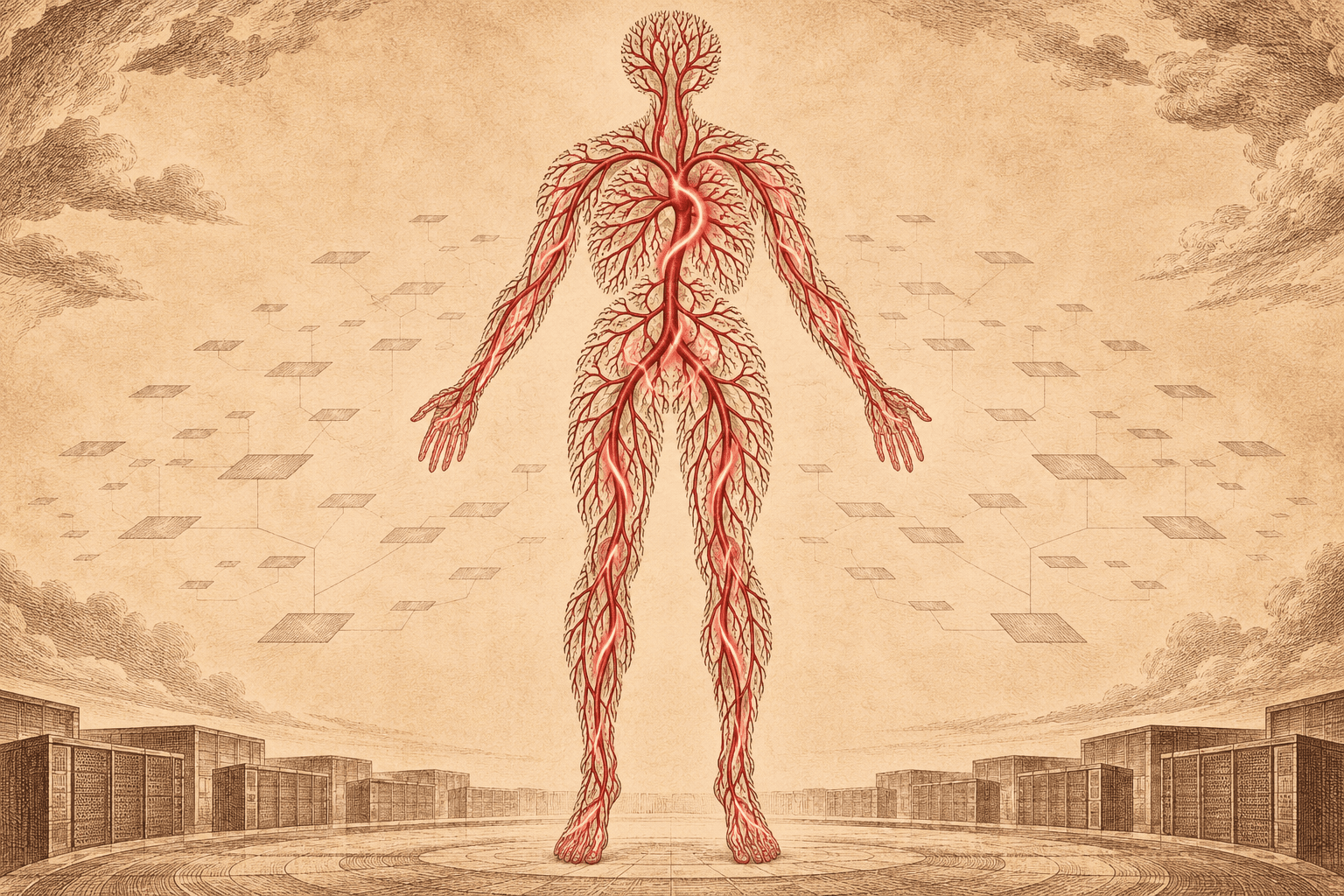
Summary
An exascale-ready model follows blood from the aortic root to 432 outlets while cutting the estimated compute cost 625-fold against direct simulation.
Whole-body arterial flow has been too expensive to resolve at useful detail because every lattice site must advance through each time step. The HemeLB team combined its lattice-Boltzmann solver with large-eddy simulation and sustained about 10 trillion lattice-site updates per second on both Frontier and Aurora. At 100-micrometer resolution, the method reduced the estimated cost by roughly 625 times relative to a 20-micrometer direct simulation while keeping plane-averaged pressure within 0.75 mmHg in a stenotic-aorta comparison. The resulting 295-million-site model spans cerebral arteries to the feet, with one aortic inlet and 432 Windkessel outlets, and runs a cardiac cycle in about 15 to 18 node-hours on two Frontier nodes. This is a computational study, not a validated patient-specific diagnostic, but it brings simultaneous head-to-feet hemodynamics within reach of current supercomputers.
Why it matters
An exascale-ready model follows blood from the aortic root to 432 outlets while cutting the estimated compute cost 625-fold against direct simulation.
Limits and context
- This is a computational study, not a validated patient-specific diagnostic, but it brings simultaneous head-to-feet hemodynamics within reach of current supercomputers.
Key claims
An exascale-ready model follows blood from the aortic root to 432 outlets while cutting the estimated compute cost 625-fold against direct simulation.
Qualification: This is a computational study, not a validated patient-specific diagnostic, but it brings simultaneous head-to-feet hemodynamics within reach of current supercomputers.
Evidence: source-2026-11-07-001
Sources
- arXiv preprint 2611.07840, original v1arXiv · primary research
Corrections
: Publication note: This November 7 edition was assembled before its scheduled 9:00 AM America/Detroit reveal but is being published late after recovery from a local build interruption. Its original reporting, image-generation times and scheduled publishAt are preserved.