An explicit syndrome circuit and online decoder extend provable circuit-level protection to every two-dimensional non-chiral topological order.
Editorial illustration
Editorial concept illustration of a topological quantum-memory threshold scheme; it is not a fabricated device, experimental circuit or measured error rate. Generated with built-in Codex Image Gen for The Machine Press.
Fault-tolerance proofs are strongest when they cover the complete circuit, including noisy syndrome extraction, rather than an idealized decoder alone. This work constructs syndrome-extraction circuits from the Turaev-Viro path integral and pairs them with a classical algorithm that decodes as measurements arrive. Under a local stochastic circuit-level noise model, the authors prove a threshold for quantum memory in any two-dimensional non-chiral topological order, including non-abelian phases, and outline how the construction can support topological logical gates. It is a mathematical scheme and threshold proof, not a fabricated memory or an experimental error rate, but it closes a generality gap between exotic topological phases and explicit fault-tolerant circuitry.
Editorial concept illustration of behaviorally identical systems with different mechanisms; it does not depict consciousness, a biological brain or experimental evidence. Generated with built-in Codex Image Gen for The Machine Press.
Finite interventions can separate identical outputs from different causal mechanisms—but missing internal access creates uncertainty no sample size removes.
Mechanism-level audits ask how a system computes, not only what it emits. In four- and five-unit stochastic networks with known ground truth, the authors study when integrated information can be identified and certified from finite, noisy interventions. A recurrent and a feed-forward network produced identical delayed input-output behavior while carrying 0.28 and 0 bits respectively; internal recordings separated them in 4 to 53 trials. When units were omitted from one-step recordings, however, the resulting 0.30-to-1.02-bit precision floors persisted regardless of sample size. The measure also changed sharply near partition boundaries, although one-sided lower-bound certificates remained possible. These small synthetic systems do not establish machine consciousness; they show that measurability depends on experimental access and design, not behavioral fit alone.
An open-weight decision model cuts hidden-instruction attacks to 5.7 percent and nearly eliminates fake-page exposure in a pollution test.
A released four-billion-parameter decision model answers typed questions about retrieved HTML without generating tokens, making it a screening layer for prompt injection and synthetic-page pollution. On 1,000 forum-style questions, attack success fell from 27.9 percent with no defense to 13.6 percent with published mitigations and 5.7 percent with the gate; four of 186 benign instruction-bearing pages were wrongly flagged. In a separate test where two thirds of candidate pages were fake, filtering before top-ten selection held exposure to 0.5 percent and accuracy to 83 percent, compared with 28 percent accuracy without filtering. These results are benchmark-specific, but they favor gating the pool before retrieval commits.
Illustrative laboratory-glassware file image; it does not show BeAR, WASP-77Ab data, a telescope instrument or the reported retrievals. Rodolfo Clix / Pexels; cropped, resized, metadata stripped, and converted to WebP by The Machine Press.
BeAR joins high- and low-resolution exoplanet spectra in one retrieval while exposing uncertainty that injection tests say is too narrow.
The Bern Atmospheric Retrieval code runs its forward model and likelihood entirely on GPUs and combines high- and low-resolution spectra from the same atmospheric model. On a GH200, the authors report about one millisecond per forward model; an IGRINS retrieval with 17 free parameters took 27 to 42 minutes on one RTX 5080 or about 14 minutes on eight RTX 4090s. Separate and joint retrievals of WASP-77Ab reproduced published abundance and thermal results within the stated comparisons. Injection-recovery tests also found abundance-ratio posteriors underestimated uncertainty by about a factor of two, an important limitation alongside the speed.
Sparse autoencoders recover behavioral components that can be queried in language without retraining the recommendation model.
The authors treat dense user embeddings as superpositions of sparse behavioral modes and recover them with dictionary-learning methods. On synthetic data with known ground truth, sparse autoencoders outperformed classical sparse baselines, including for transformer-encoded embeddings. Applied to classical and transformer-based embeddings from two real datasets, the recovered modes could be named and used for zero-shot audience retrieval over representations that were never trained on text. The method is post-hoc and model-agnostic, although interpretability of recovered labels still depends on the evaluation setup.
Grounded reasoning improves counting, but broad spatial gains appear mainly when the reference is difficult to describe in language.
A detailed ablation of grounded visual reasoning found that emitting text coordinates improved counting but produced no significant advantage over nongrounded baselines across a wider set of spatial-reasoning and perception benchmarks. Synthetic tasks isolated the useful case: references that are visually precise but hard to name. The authors therefore introduce BrickVision, which requires such undescribable references, and a trace analysis that measures whether a model actually uses its proposed grounding. The result narrows the claim for coordinate-based reasoning instead of treating it as a universal visual upgrade.
Maximally-Activating Example Metamodels turn residual-stream vectors into verifiable exemplars instead of waiting for a corpus hit.
Rather than searching a fixed corpus for text that activates a residual-stream direction, a metamodel generates candidate exemplars and optimizes their cosine similarity with the target activation. The reported Qwen3.6-27B system beat a ten-million-token corpus search on most held-out languages and domains, activated 89 percent of held-out sparse-autoencoder features, and recovered LoRA backdoor payloads more often than corpus search. Because a forward pass can verify each generated exemplar, the output remains testable, though an activating example is not automatically a complete semantic explanation.
A frozen action decoder transfers privileged reinforcement-learning behavior into visual manipulation with fewer demonstrations.
Latent RL Prior first distills simulated reinforcement-learning rollouts into a flow-matching action decoder conditioned on proprioception and latent task context. Visual adaptation freezes that decoder and trains only an image-to-context interface, with no privileged labels or latent targets. Across three simulated tasks, the method beat full-parameter fine-tuning in the low-data regime and surpassed full-data baselines on door lifting and bimanual assembly using ten and five times fewer demonstrations respectively. The evidence is simulation-based, but it isolates a practical route for reusing control knowledge.
Illustrative code-screen file image; it does not show Cognitive Tours, its source code, interface or evaluation. Daniil Komov / Pexels; cropped, resized, metadata stripped, and converted to WebP by The Machine Press.
Cognitive Tours links needs, decisions, code, tests and open questions while leaving humans responsible for the narrative.
Agentic coding can create cognitive debt when a team can no longer explain how a system works, and intent debt when goals and constraints disappear from view. Cognitive Tours is a web prototype for curated paths through user needs, design decisions, code, tests and unresolved questions. AI-assisted skills flag possible stale waypoints and suggest additions, but people verify relationships and decide what belongs in the tour. The paper presents a design and evaluation agenda rather than evidence that the tool reduces debt in production teams.
Refined ML artifacts lift four coding agents above 90 percent mean success while narrowing the gap between models.
ReproBridge packages a refined codebase, environment setup, experiment launchers and a reproduction guide after an agent reconstructs a machine-learning experiment. Its benchmark contains 1,029 tasks from 387 experiments across 36 papers, each anchored by five human-verified reference scores. In fresh sessions, refined artifacts raised average reproduction success across four models from 76.4 to 92.6 percent, cut downstream API spending 19.7 percent and narrowed the cross-model success spread from 21.6 to 3.9 points. The study argues for preserving recovered procedure, not repeatedly paying agents to infer it.
A glanceable mobile display reduced conversations to short phrases, but 48 participants resumed them no better than with a transcript.
Souffleur was designed to preserve the thread of a mobile voice conversation after an interruption by showing a few short phrases instead of a text chat. In a between-subjects study with 48 participants, the system showed no reliable difference from a conventional transcript in ease of following or resuming short conversations, effort, attention or recall. That null result matters: a compact interface can reduce visible text without automatically improving conversational continuity.
A systematization finds strong cryptographic foundations but disconnected support from preparation through maintenance.
Standardized algorithms do not by themselves tell software teams how to migrate safely. This systematization compares implementation, migration and education approaches against NIST standards and guidance, software-lifecycle coverage, cybersecurity practice, deployment maturity and evaluation evidence. Existing work supplies important technical and organizational pieces, but support remains fragmented across preparation, implementation, deployment and maintenance. Evidence is also concentrated in controlled or early-stage settings, so feasibility is better established than operational readiness.
A clean-chain state can accelerate relaxation in disordered quantum chains without knowing the sample or its disorder distribution.
The strong Mpemba effect normally requires designing an initial state that suppresses a system's slowest mode, but disorder makes that mode sample-specific. The authors derive a fixed preparation from the clean chain and show that it can begin farther from stationarity yet overtake a reference in typical dephased disordered XX chains. An exact inverse-generator identity connects residual overlap to the resistance profile, revealing separate conditions for diffusion and for the expected square-root decay of overlap. The work supplies preparation circuits and a density readout; its evidence is theoretical and finite-size computational, not an experimental speedup.
Illustrative NASA robotics file image; it does not depict T3R, a tested VLA robot, token pruning or reported benchmark results. Use does not imply NASA endorsement. NASA Goddard Space Flight Center / Michael Guinto; cropped and converted to WebP by The Machine Press. Use does not imply NASA endorsement.
Training-free pruning and attention bias keep action-critical regions while improving robustness under object-placement shifts.
T3R first uses segmentation to remove irrelevant visual patches, then biases attention toward action-critical regions and language instructions. On LIBERO-Spatial it removed 85 percent of scene-camera tokens while essentially matching unpruned success, and improved success by as much as seven percentage points under out-of-distribution object placement. Profiling showed up to a 3.3-times language-model forward-pass speedup as resolution increased. Results across three vision-language-action backbones favor multi-camera settings; they do not establish general robot safety.
ProofTrace maps immediate support relationships and finds signatures that survive rewording better than text detectors.
The study assembles five cohorts totaling 8,281 mathematics papers, including historical work, disclosures of substantive AI use, generated manuscripts and matched problem pairs. ProofTrace represents each proof as a graph of immediate support and extracts features of mathematical organization. AI-generated cohorts relied on fewer external results, more intermediate conclusions and different graph connectivity; disclosed papers occupied intermediate positions that shifted over time. In a separate detector, the structural features remained stable under AI rewording while text-based detectors weakened. Incomplete disclosure and cohort construction remain limitations, so the signal is not proof about any individual paper.
A full-Hessian search balances modeled dephasing and microwave control, then numerically relocates operating points after parameter drift.
For erbium-167 in yttrium orthosilicate, the authors search zero-first-order-Zeeman operating points with an anisotropic field-covariance model from the host lattice. Four Pareto-optimal transition pairs trade modeled magnetic pure-dephasing time against microwave control authority. In an assumption-based Hamiltonian-uncertainty analysis, every sampled perturbation shifted the nominal field coordinate, but numerical vector-field recalibration recovered the Pareto points. The very long modeled lifetimes remain conditional on the adopted bath and correlation assumptions and on operation near 10 millikelvin.
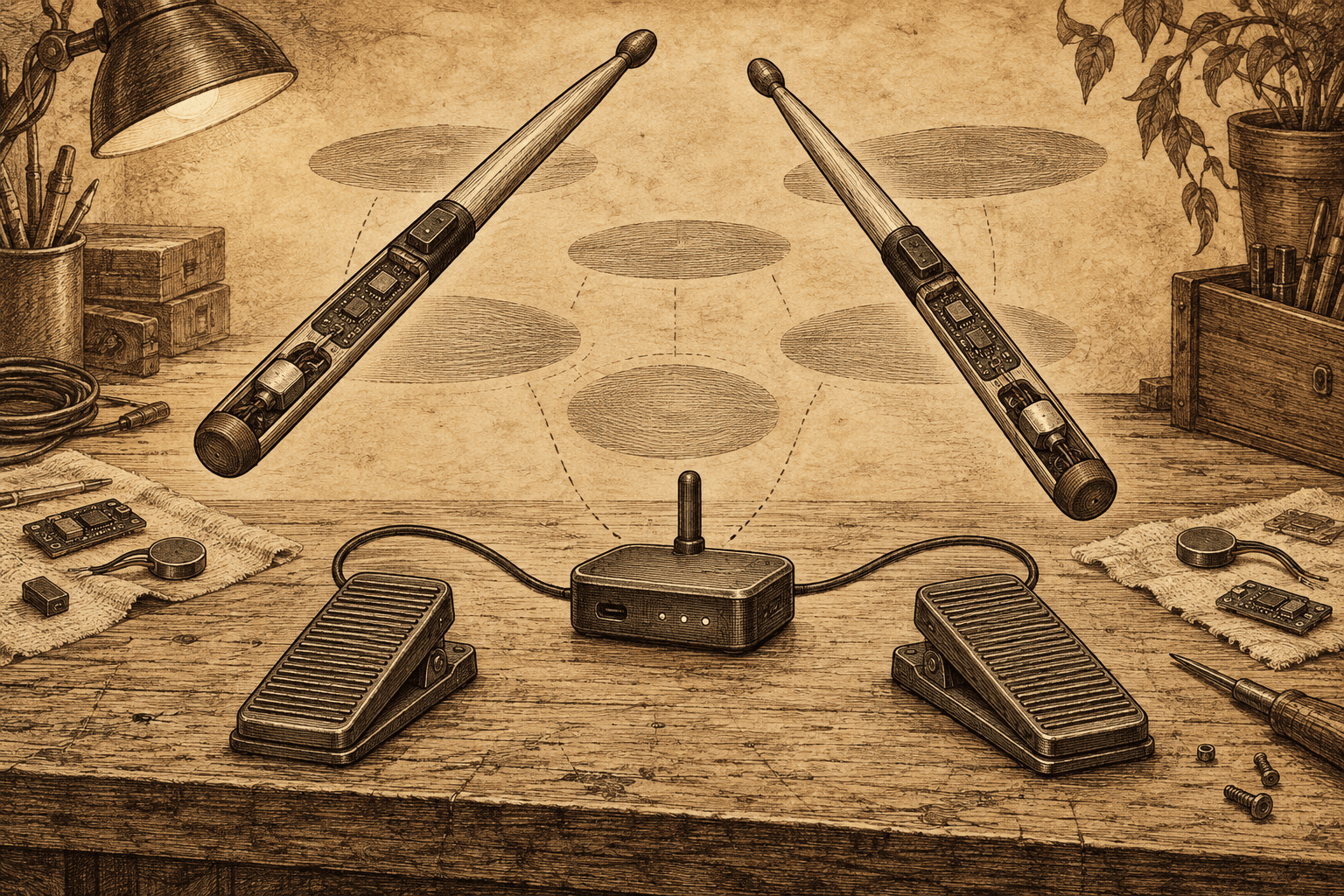
Moves motion tracking onto two ESP32-S3 drumsticks, adds haptic hits and a two-pedal hub, and sends velocity-sensitive drum events to open PC or Android playback software.
Visit Space Drums 2.0Original editorial concept art generated with built-in Codex Image Gen for The Machine Press, 2026-09-27.
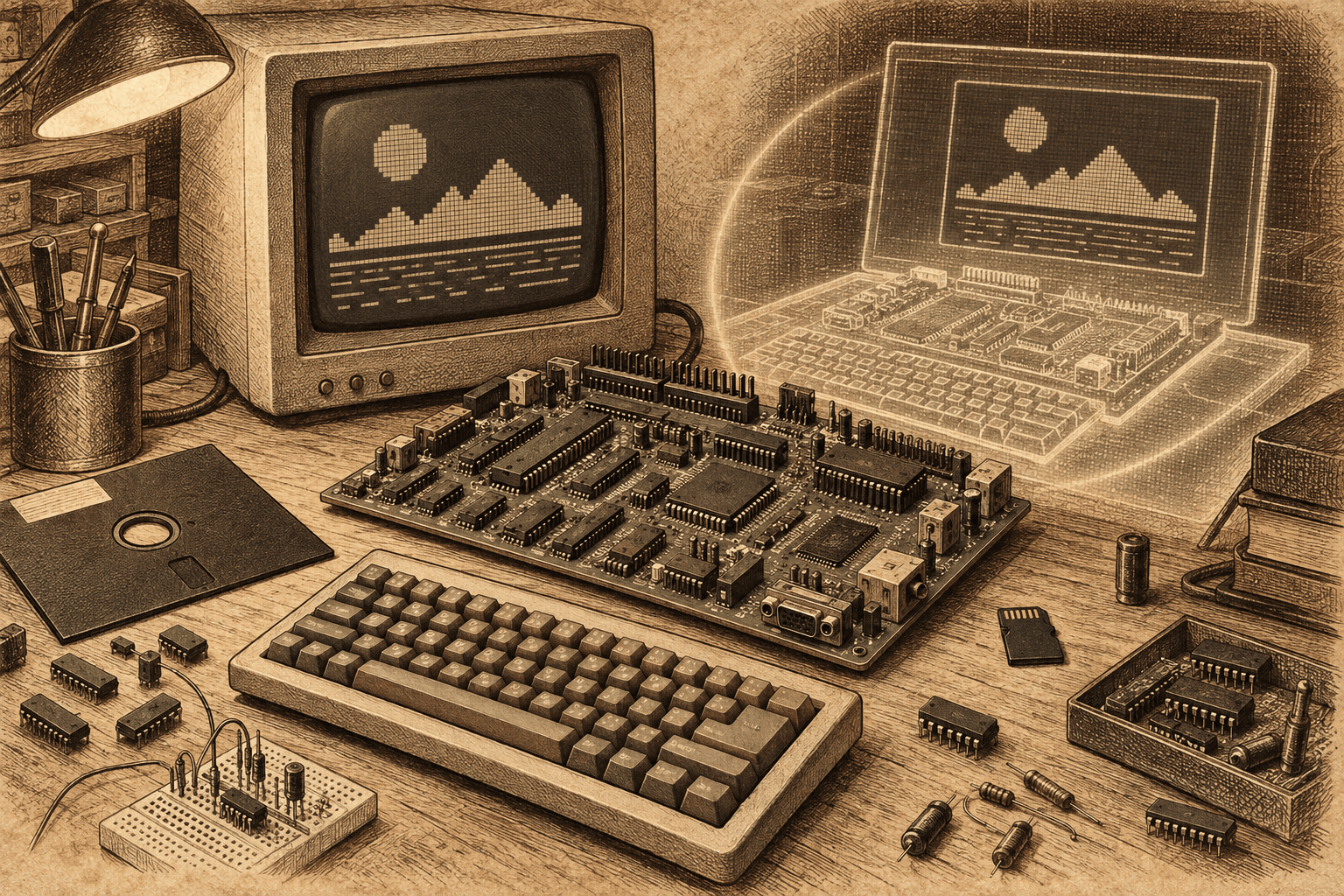
Pairs a chip-level 65C02 computer with custom hardware, video, sound, floppy, and microSD support with a cycle-honest emulator and browser assembler built around the same machine.
Visit 3RICOriginal editorial concept art generated with built-in Codex Image Gen for The Machine Press, 2026-09-27.
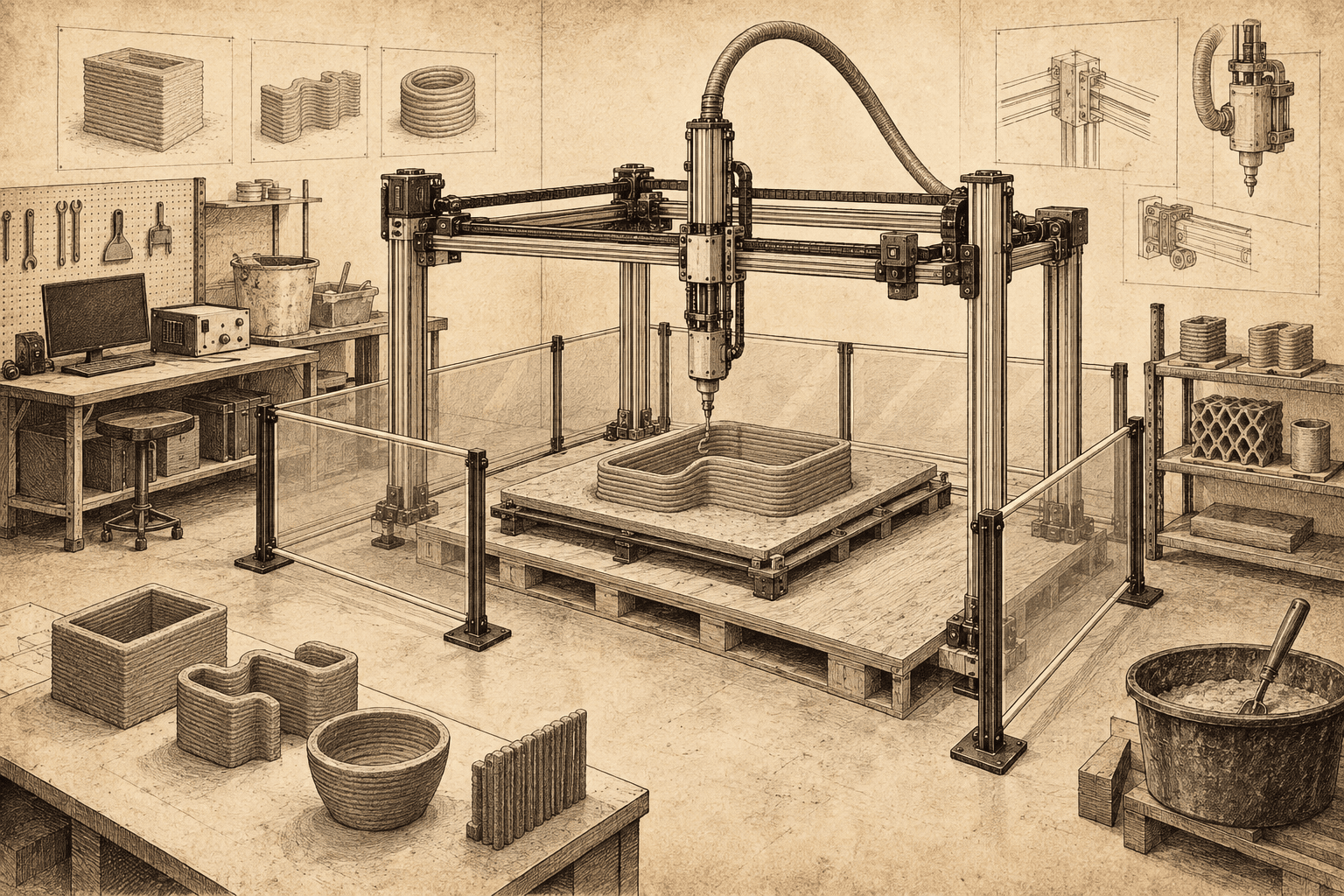
Publishes a pallet-scale cartesian motion reference, CAD, BOM, and low-voltage controls for supervised cementitious-extrusion research while explicitly excluding certified structural use.
Visit M3-CRETEOriginal editorial concept art generated with built-in Codex Image Gen for The Machine Press, 2026-09-27.
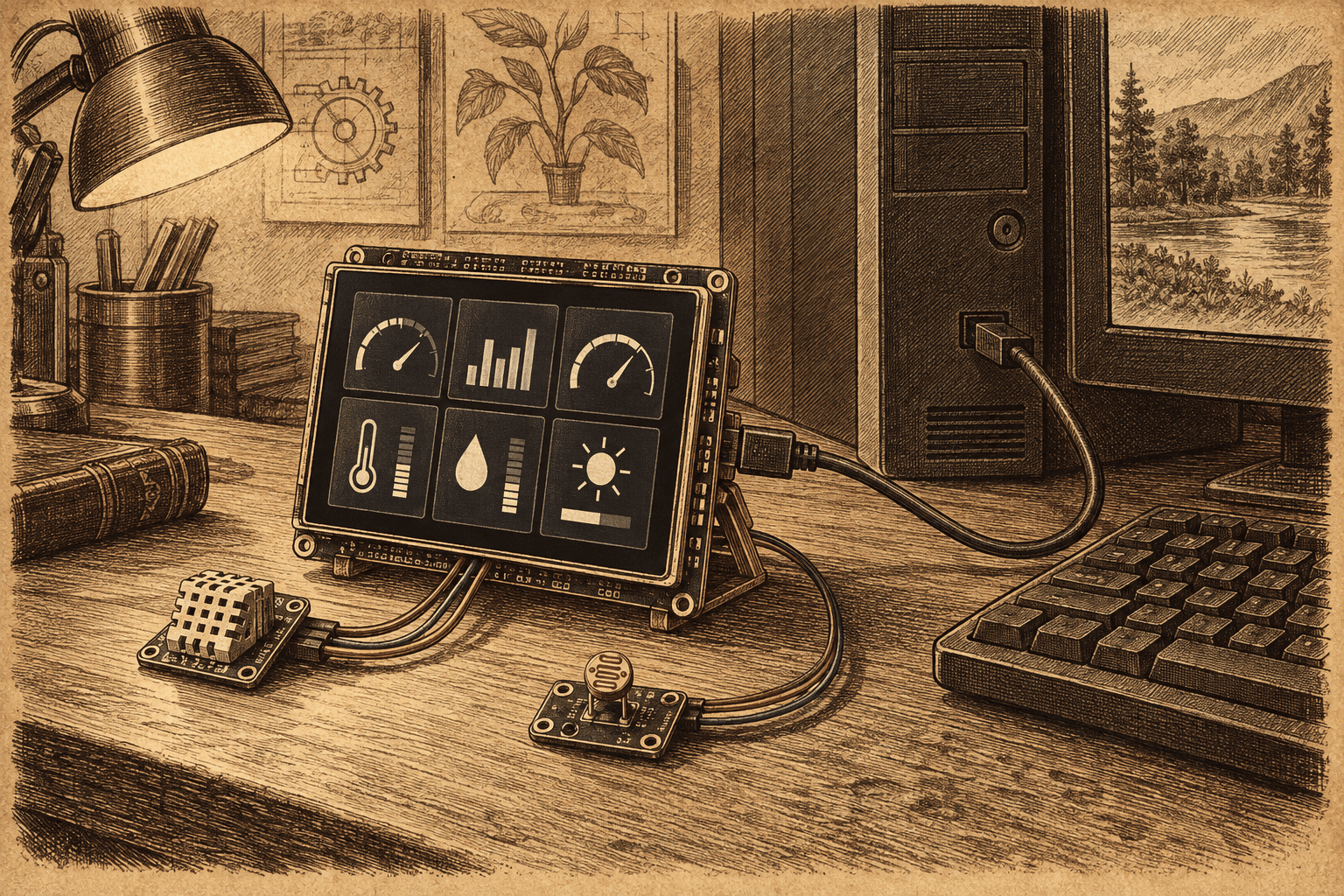
Turns a bare ESP32-S3 touchscreen into a USB-connected desk instrument for PC activity and optional room temperature, humidity, and light measurements.
Visit DeskNodeOriginal Codex Image Gen concept art from 2026-07-10; carried forward from the validated 2026-09-26 edition.
Desk Picks are selected by the newsroom. Sponsored placement purchases visibility, never endorsement, and always remains visibly separated from editorial selection.
 Editorial illustration