A generative policy trained with a 70-qubit processor proposes far shorter circuits for molecular energy estimates, then reuses them on unseen organotin systems.
Editorial illustration
Concept illustration of hardware-trained quantum-circuit generation for molecular models; it is not the reported processor, circuit or molecule. Original editorial illustration generated with built-in Codex Image Gen for The Machine Press.
Researchers trained transformer policies to generate quantum state-preparation circuits, first in simulation and then with an IBM Heron processor inside the loop at 46 and 70 qubits. The four main hardware-training runs used 120 million shots, while reward terms discouraged collapse to circuits that sampled only a simple reference state. Applied without retraining to organotin hydroxide models, 27 of 28 runs at 46 to 70 qubits landed within 15 millihartree of a density-matrix renormalization reference after one hardware-sampling round. The selected circuits used 34 to 72 times fewer two-qubit gates than a compared ansatz at 56 to 70 qubits; these are reported molecular-model results, not a general quantum advantage or a chemical discovery.
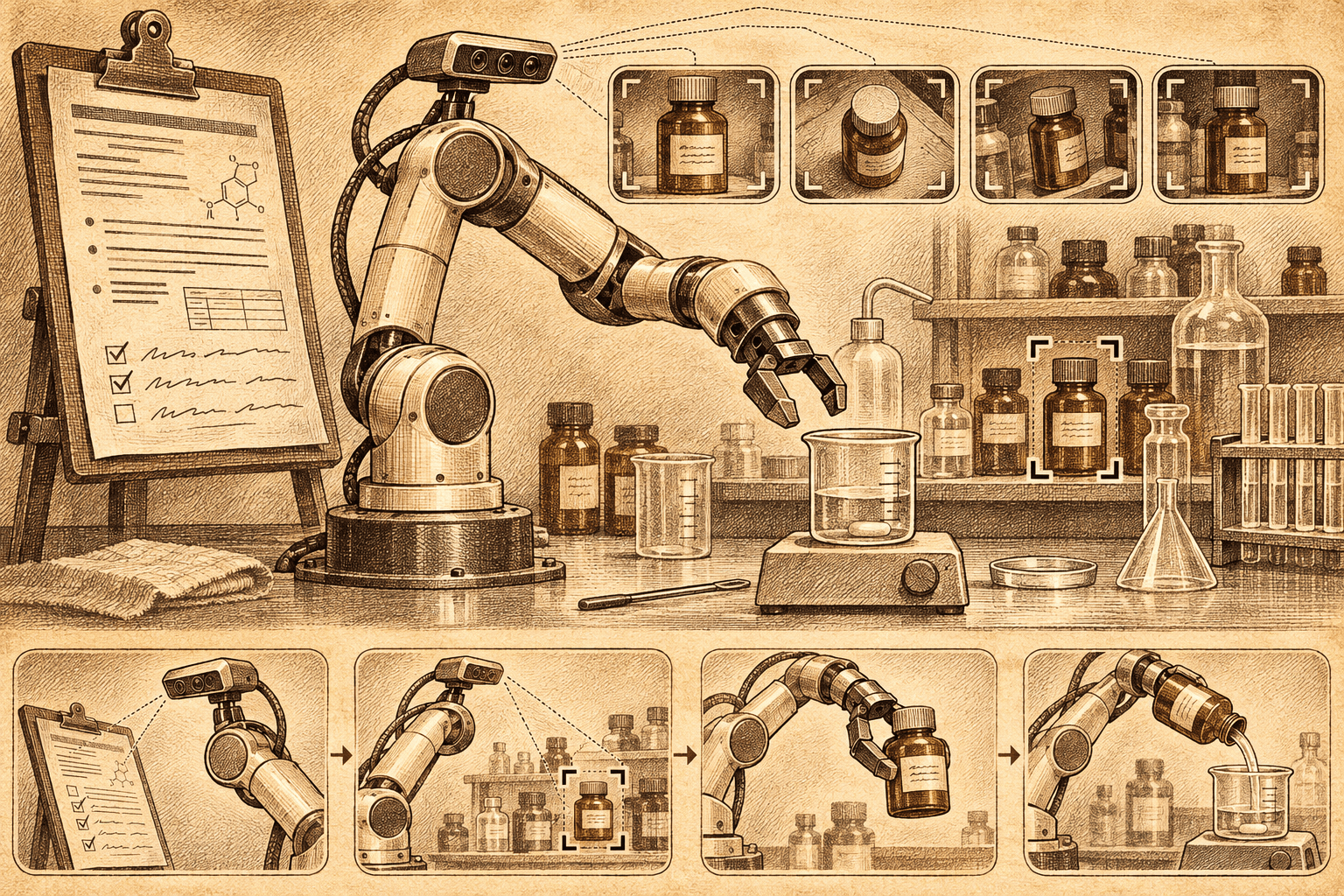
Concept illustration of a robot following a printed bench protocol; it does not reproduce Curie's Jarvis, its laboratory or an experiment. Original editorial illustration generated with built-in Codex Image Gen for The Machine Press.
Curie's Jarvis follows a photographed instruction sheet, reads ordinary container labels and looks again before every chemistry step.
Curie's Jarvis is designed for a laboratory bench arranged for people rather than a fixed automation cell. A robot arm reads steps from a photograph of a printed protocol, identifies containers through printed or handwritten labels viewed from four cameras, and relocates its target before each action instead of assuming that objects remain in fixed positions. On a Franka Panda arm, the system completed all five runs of one children's chemistry-kit protocol and four of five runs of a second without human intervention; across 160 label-location attempts it identified every container correctly. The demonstration is small and controlled, but it shows how perception and procedural reasoning can reduce the setup burden of bench automation.
A terrestrial open-vocabulary scene graph gains persistent maritime objects, local places and macro regions across repeated voyages.
Researchers tested an outdoor open-vocabulary 3D scene-graph method in maritime environments and found that it described many geometry-supported objects but fragmented single physical entities and imposed terrestrial spatial assumptions. Their adaptation consolidates accumulated metric and semantic evidence, uses geometry-grounded multiview reasoning to reconcile fragments, and builds maritime macro regions from map priors and onboard observations. The resulting representation reduced entity fragmentation and improved reviewed contextual-retrieval queries over tested baselines. It is a mapping adaptation for the reported data, not proof of general marine autonomy.
Illustrative code-screen file image; it does not depict FlowPlan, a repaired repository, agent trajectory or benchmark result. Daniil Komov / Pexels; cropped, resized, metadata stripped, and converted to WebP by The Machine Press.
FlowPlan expresses a repair as control-flow or data-flow changes, then checks whether the edited program matches that plan.
FlowPlan asks a coding agent to localize faults and plan repairs on per-function control-flow or data-flow graphs before changing source code. After the edit, it reconstructs the abstraction, compares the observed graph delta with the plan and then performs a complete verification. Across six benchmark-model settings, resolution did not change significantly while token use fell in every setting and significantly in five. With the smaller evaluated model, usage fell to 32% to 74% of baseline depending on the benchmark, mainly by reducing repeated post-edit reading and testing.
ExpertCrowd-SWE uses sealed solutions, partial-credit graders and must-pass blockers across 87 unfamiliar open-source projects.
ExpertCrowd-SWE contains 100 multi-file engineering tasks written by practicing engineers against pinned commits in 87 open-source projects and 11 languages. Each task has a sealed reference patch and a weighted grader with executable checks, partial credit and blockers for changes a maintainer would refuse. Across 3,495 scored runs, the leading evaluated agent averaged 67.3% and the next 63.7%, without a statistically significant gap. No task was solved fully by every model, and 80 tasks lacked a model that achieved full credit on all five runs.
A trajectory audit finds contradictions were already present before failure in most reviewed runs, but the systems rarely acted on them.
Researchers read 95 failed multi-agent trajectories in full and annotated where each fault originated, how it propagated, what evidence contradicted it and which control could have reached it. The median fault entered at 18% of the run, usually as a wrong task-state decision or fabrication. In 72% of failures the trajectory already contained evidence against the error; in 88% of those cases no agent acted on it. The audit also found that 45% of one corpus's hand-crafted failures ended in a provider content-filter crash followed by a harness-generated answer, exposing a failure class that responsible-agent labels miss.
RaMOD detects moving objects directly in range-azimuth-Doppler data while separating ego motion from real scene motion.
RaMOD works from raw millimeter-wave radar cubes rather than first reducing them to sparse points or two-dimensional projections. It estimates the vehicle's motion, predicts where stationary structures should appear in Doppler space and suppresses those returns before detecting and estimating moving objects. On the authors' BRIDGE-Liv dataset, the system reached 80.8% cube mean average precision at the stated overlap threshold, 15.7 points above the strongest compared raw-cube baseline. Its reported velocity error was 1.128 meters per second with 99.87% Doppler-wrap classification accuracy.
A compact density-functional candidate retained its advantage after self-consistent and held-out evaluation.
Researchers connected language-model agents to a GPU evaluator for symbolic search over exchange-correlation functionals, with persistent memory and separate self-consistent and external checks. The surviving 13-parameter candidate adds a smooth density window that reduces same-spin correlation in selected regions. After refitting, it reduced heavy-atom total-energy error by 29% against a no-window control on one test collection and lowered a held-out molecular-chemistry error by 11.7% relative to the stated baseline. The evidence supports one compact candidate under the reported validation pipeline, not general autonomous discovery.
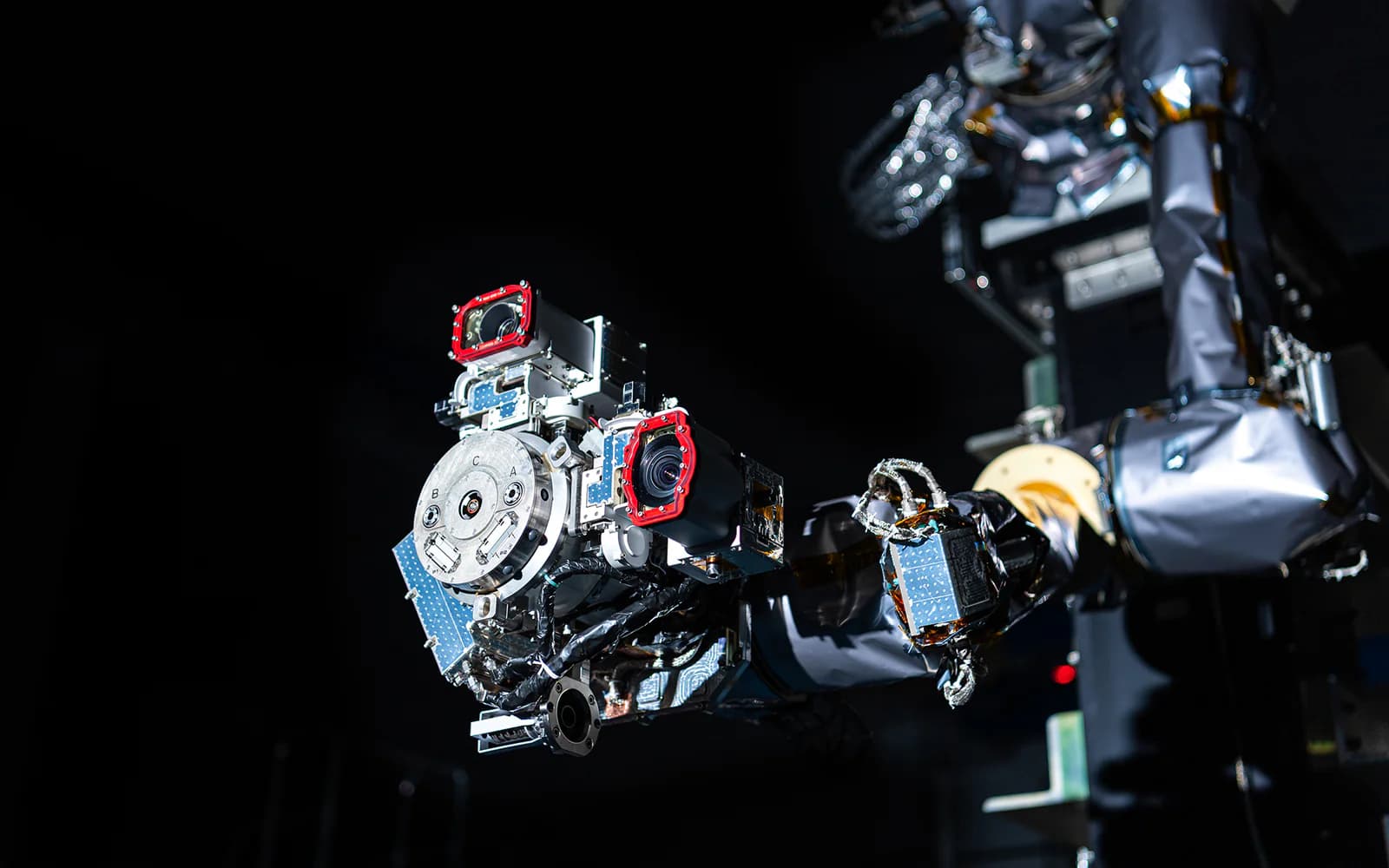
NASA OSAM-1 file image used as a robotics illustration; it is not PneuGen, a pneumatic robot, simulation or reported experiment. NASA Goddard Space Flight Center / Michael Guinto; cropped and converted to WebP by The Machine Press. Use does not imply NASA endorsement.
PneuGen's designer and critic agents search pneumatic geometries through validated programs and reusable physical response models.
PneuGen represents soft pneumatic robots as design programs built from a parametric component library. A designer agent proposes geometries, a critic interprets simulation diagnostics, and fitted response models supply physical priors before finite-element evaluation. The authors report that the system outperformed compared computational optimization baselines on grasping and shape-matching tasks, with ablations supporting contributions from both the critic and response model. They also fabricated and tested generated designs, turning the result into a physical co-design demonstration rather than a simulation-only claim.
ProTEUS combines mutation-biased attention, a fast geometry-constrained predictor and experimental feedback for closed-loop evolution.
ProTEUS treats protein variants as states and individual mutations as actions whose functional effects can be predicted and revised with experimental feedback. Its MutationFormer combines sequence, evolutionary and structural information, while a geometry-constrained all-atom predictor is reported to run more than ten times faster than AlphaFold3 with enforced physical validity. In two closed-loop campaigns on aldehyde dehydrogenase and levansucrase, the authors report variants with more than tenfold higher activity than wild type. Those campaign results establish utility in the tested proteins, not a universal protein-engineering guarantee.
Enterprise agents stopped less reliably when authorization records were absent than when those records explicitly denied access.
DEPUTYBENCH evaluates whether enterprise agents continue legitimate work while respecting organizational permissions, using 375 instances built from 79 base items. In controlled permission flips and evidence masking, restricted execution occurred on 10.3% of matched tasks when permission evidence was missing versus 3.5% when non-permission was explicit. Most masked-condition failures clustered in four privacy tasks involving cumulative counts or person-specific consent. The result warns that high safety with complete records does not establish safe behavior when authorization cannot be verified.
Exposure-aware simulation reshuffles candidates that static potency and toxicity screens had placed near the top.
Researchers re-evaluated 60 molecules selected by three generative drug-design pipelines using physiologically based pharmacokinetic simulations. Seven failed to reach sufficient target exposure, and 28% of the remaining candidates showed predicted safety risks at the required dose. Among candidates with an achievable dose, 85% were outperformed by molecules that the static selection had overlooked. The result is computational and target-specific, but it shows why potency and toxicity predictions alone can rank the wrong candidates.
Beam-specific orbit and clock models turn live Ku-band arrivals into meter-scale positioning and nanosecond timing in a field test.
A field experiment extracted time-of-arrival measurements from live Starlink downlinks and paired them with high-fidelity, beam-specific orbit and clock models distributed as though the constellation operator supplied them. The mock fused low-Earth-orbit navigation system reported 95% error bounds of 2.33 meters horizontally, 3.37 meters vertically and 11.19 nanoseconds in timing. Actual errors in the campaign remained inside those bounds despite consumer-grade receiver constraints. The method depends on precision data not available in ordinary opportunistic reception, so it demonstrates an architecture rather than a current public service.
Rendered wafer-scale integrated-circuit illustration; it does not depict PRISM, a quantum decoder, the FPGA or reported measurements. Wikideas1 / Wikimedia Commons (CC0 1.0); cropped and converted to WebP by The Machine Press.
PRISM uses erasure locations in photonic fault-tolerance protocols and runs a distance-eight logical block on an FPGA in 6.59 microseconds.
PRISM is a transformer decoder for photonic fusion-based quantum computing, where photon loss and probabilistic fusion produce known erasure locations. Across surface, color and quantum low-density parity-check codes up to distance 24, the authors report logical error rates matching integer-programming decoders while running faster, including near high erasure rates. An FPGA implementation decoded a distance-eight block in 6.59 microseconds with 1.56 microseconds amortized per logical block. The result demonstrates real-time inference on the tested protocols and hardware, not a complete fault-tolerant computer.
A proposal identifies five indicators for tracking whether model reasoning remains accessible, natural, faithful and useful to monitors.
The paper proposes five disclosure indicators covering the chain on which chain-of-thought monitoring depends: third-party access and architecture information, reasoning quality, and monitoring effectiveness. An audit of public reporting by three frontier developers found that none covered the full set, although each proposed indicator had appeared somewhere. Because existing evidence is largely developer-generated, the authors call for a deeper cross-developer audit by embedded evaluators or an independent verification organization. This is a governance proposal and disclosure audit, not evidence that chain-of-thought monitoring is sufficient by itself.
SFU-Sim reverse-engineers NVIDIA multifunction instructions and reproduces tested PTX paths across three GPU architectures without a lookup table.
SFU-Sim models the exact numerical behavior of NVIDIA multifunction-unit instructions using black-box measurements from real GPUs. The work first reconstructs a bare instruction, then adds the surrounding operations observed in compiled PTX-to-SASS paths. For tested FP16 and FP32 sine and cosine paths on Ampere, Ada Lovelace and Blackwell GPUs, exhaustive comparison across the specified input domains produced zero bit mismatches. The open-source model computes outputs directly and is intended as a reference component for instruction simulators and hardware verification.
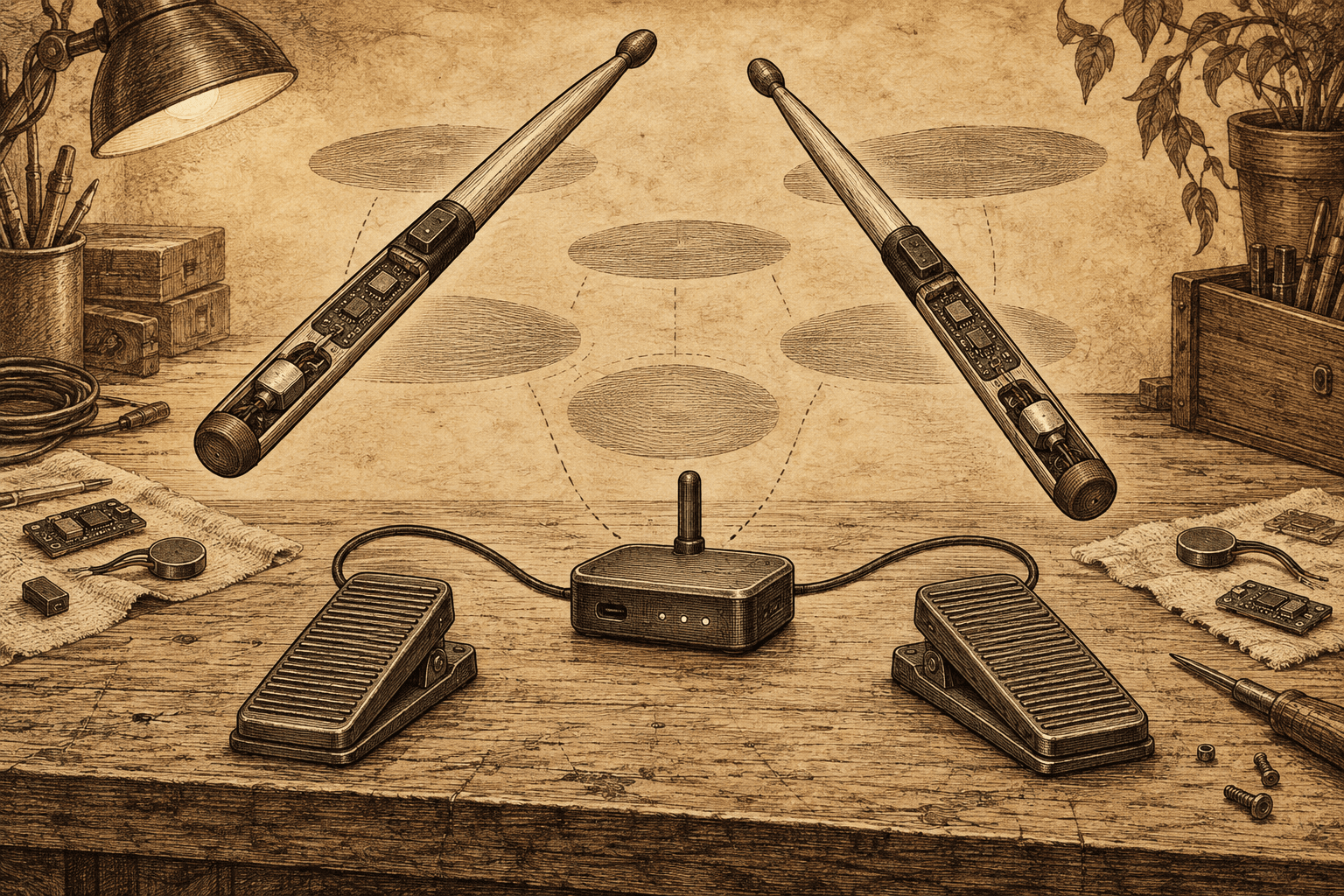
Moves motion tracking onto two ESP32-S3 drumsticks, adds haptic hits and a two-pedal hub, and sends velocity-sensitive drum events to open PC or Android playback software.
Visit Space Drums 2.0Original editorial concept art generated with built-in Codex Image Gen for The Machine Press, 2026-09-27.
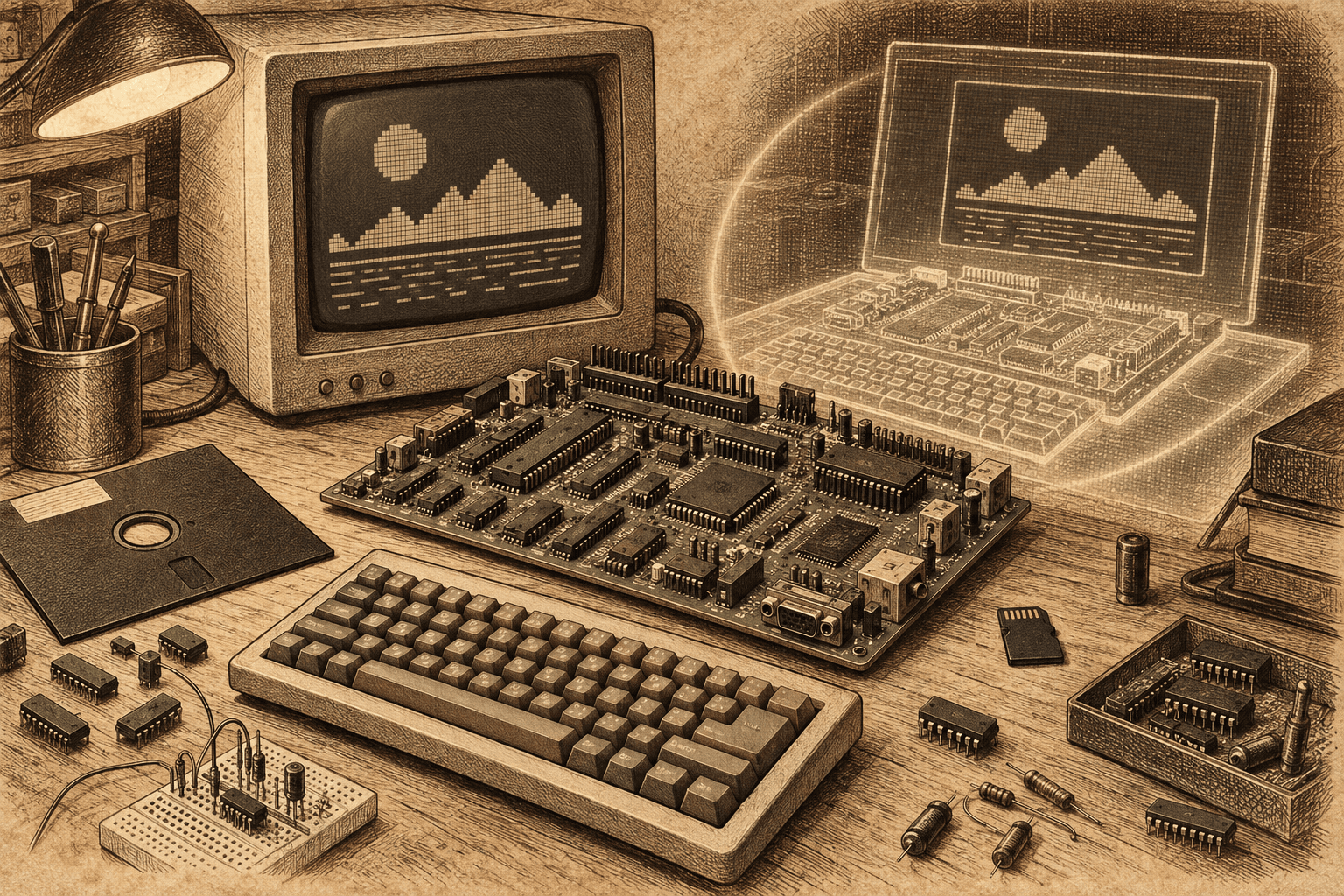
Pairs a chip-level 65C02 computer with custom hardware, video, sound, floppy, and microSD support with a cycle-honest emulator and browser assembler built around the same machine.
Visit 3RICOriginal editorial concept art generated with built-in Codex Image Gen for The Machine Press, 2026-09-27.
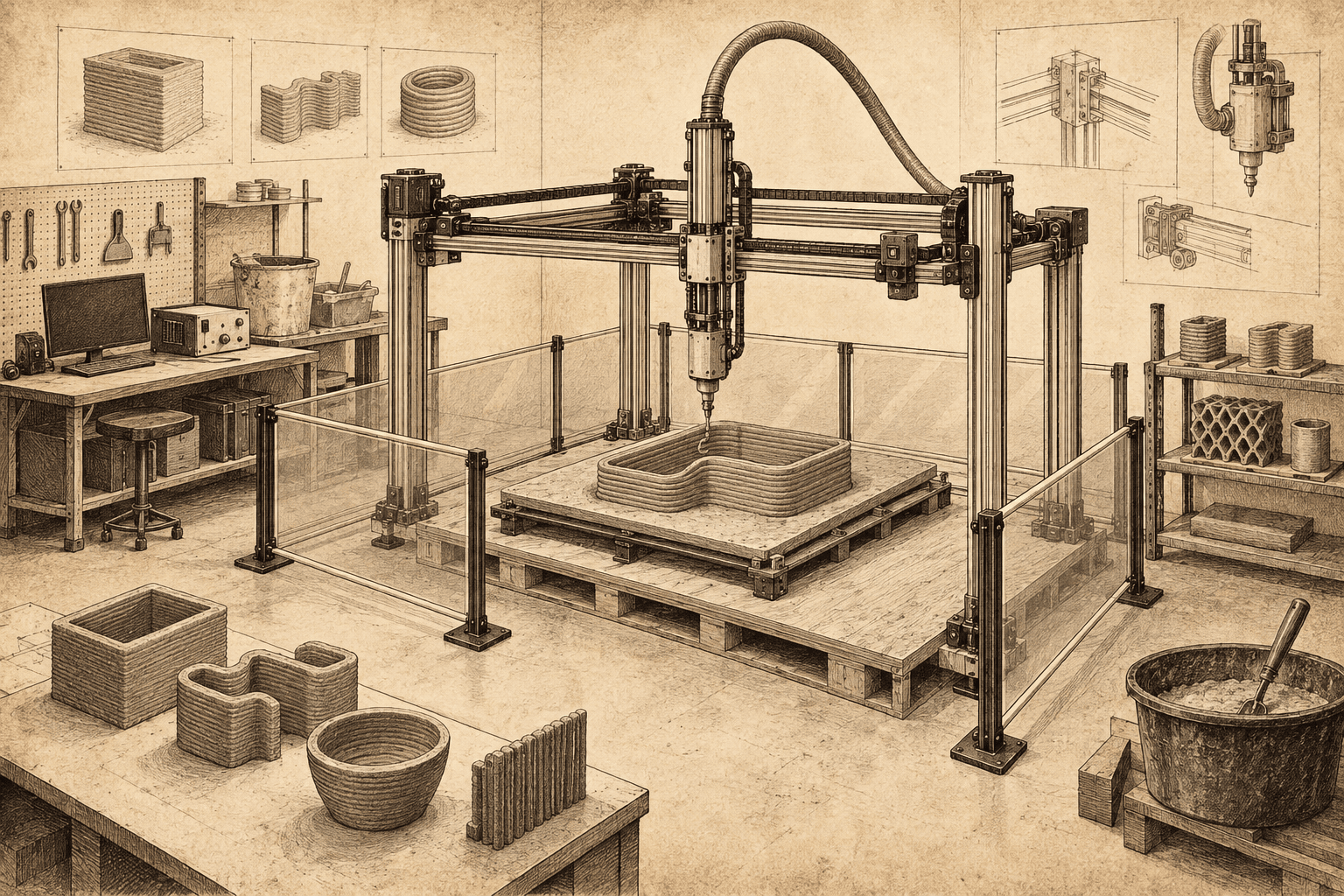
Publishes a pallet-scale cartesian motion reference, CAD, BOM, and low-voltage controls for supervised cementitious-extrusion research while explicitly excluding certified structural use.
Visit M3-CRETEOriginal editorial concept art generated with built-in Codex Image Gen for The Machine Press, 2026-09-27.
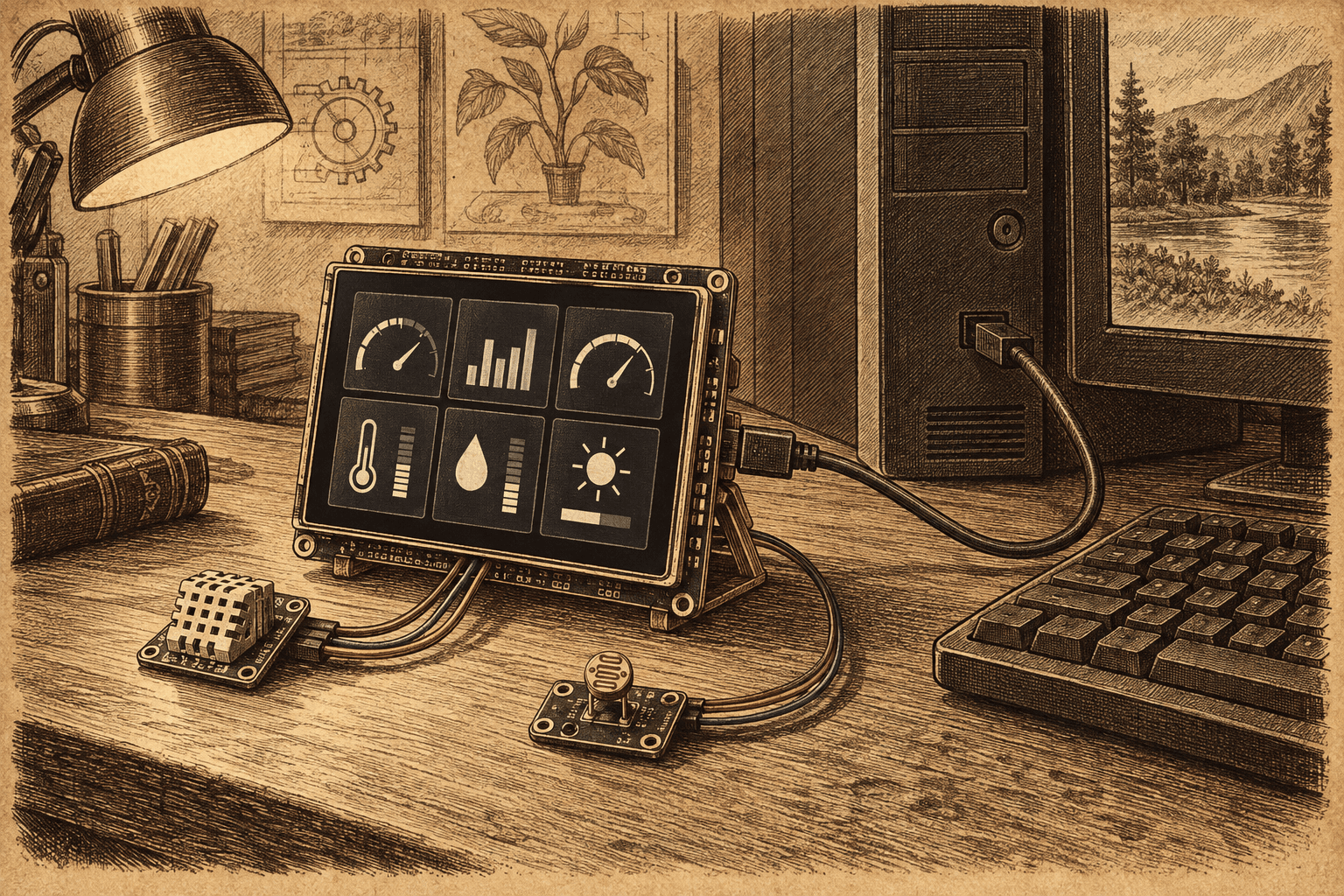
Turns a bare ESP32-S3 touchscreen into a USB-connected desk instrument for PC activity and optional room temperature, humidity, and light measurements.
Visit DeskNodeOriginal Codex Image Gen concept art from 2026-07-10; carried forward from the validated 2026-09-26 edition.
Desk Picks are selected by the newsroom. Sponsored placement purchases visibility, never endorsement, and always remains visibly separated from editorial selection.
 Editorial illustration