robotics
The Robot Reads the Protocol on the Bench
Curie's Jarvis follows a photographed instruction sheet, reads ordinary container labels and looks again before every chemistry step.
Summary
Curie's Jarvis follows a photographed instruction sheet, reads ordinary container labels and looks again before every chemistry step.
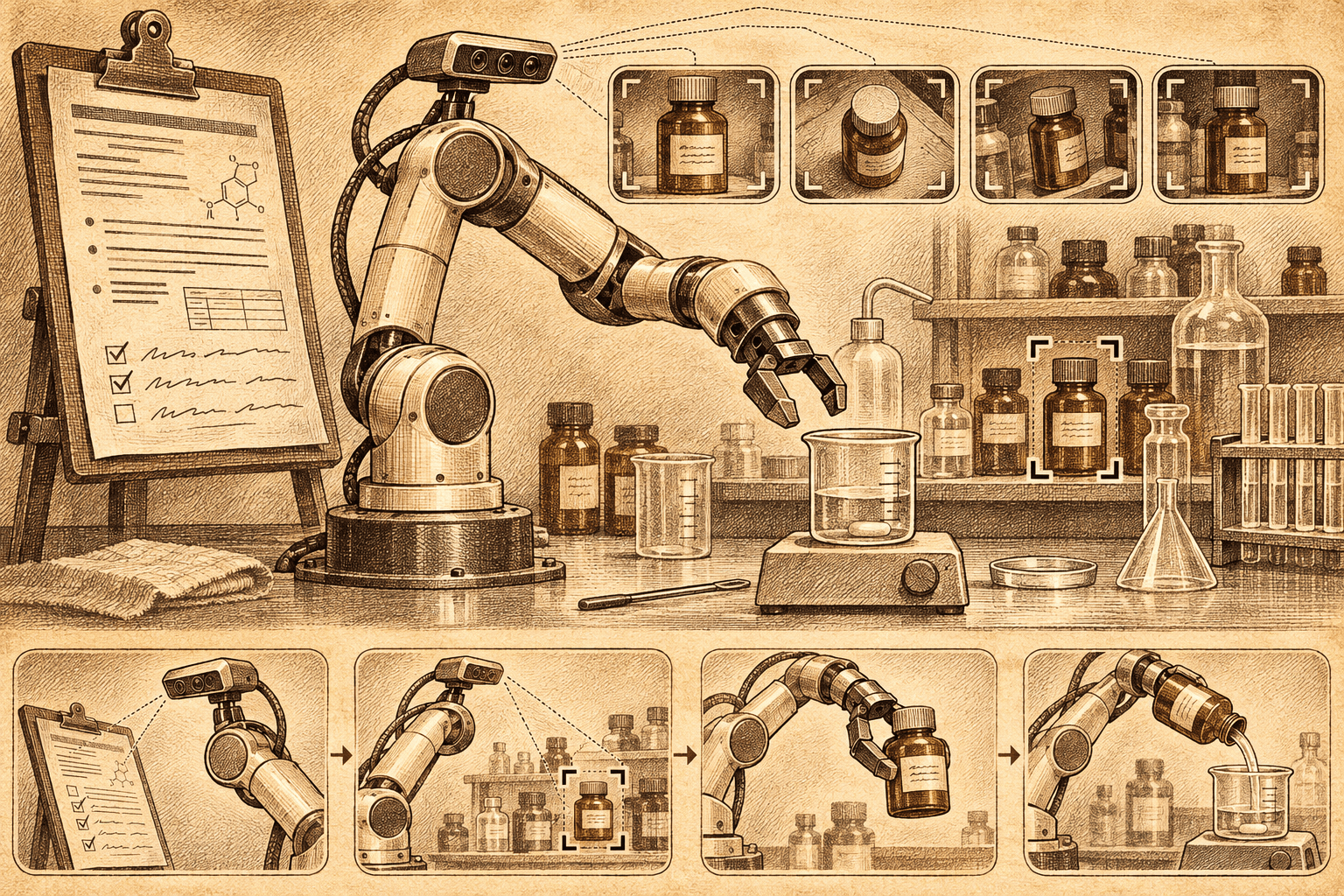
Curie's Jarvis is designed for a laboratory bench arranged for people rather than a fixed automation cell. A robot arm reads steps from a photograph of a printed protocol, identifies containers through printed or handwritten labels viewed from four cameras, and relocates its target before each action instead of assuming that objects remain in fixed positions. On a Franka Panda arm, the system completed all five runs of one children's chemistry-kit protocol and four of five runs of a second without human intervention; across 160 label-location attempts it identified every container correctly. The demonstration is small and controlled, but it shows how perception and procedural reasoning can reduce the setup burden of bench automation.
Why it matters
Curie's Jarvis follows a photographed instruction sheet, reads ordinary container labels and looks again before every chemistry step.
Limits and context
- Curie's Jarvis is designed for a laboratory bench arranged for people rather than a fixed automation cell.
- A robot arm reads steps from a photograph of a printed protocol, identifies containers through printed or handwritten labels viewed from four cameras, and relocates its target before each action instead of assuming that objects remain in fixed positions.
Key claims
Curie's Jarvis follows a photographed instruction sheet, reads ordinary container labels and looks again before every chemistry step.
Qualification: Curie's Jarvis is designed for a laboratory bench arranged for people rather than a fixed automation cell.
Evidence: source-2026-11-12-002
Sources
- arXiv:2611.13251v1arXiv / Cornell University · primary research
Corrections
No corrections have been recorded for this story.