research
A Black Hole Effect, Without the Black Hole
A stationary ring of tuned resonators reproduced the wave amplification expected near an ultrafast rotating body, moving a half-century-old idea onto a laboratory bench.
Summary
A stationary ring of tuned resonators reproduced the wave amplification expected near an ultrafast rotating body, moving a half-century-old idea onto a laboratory bench.
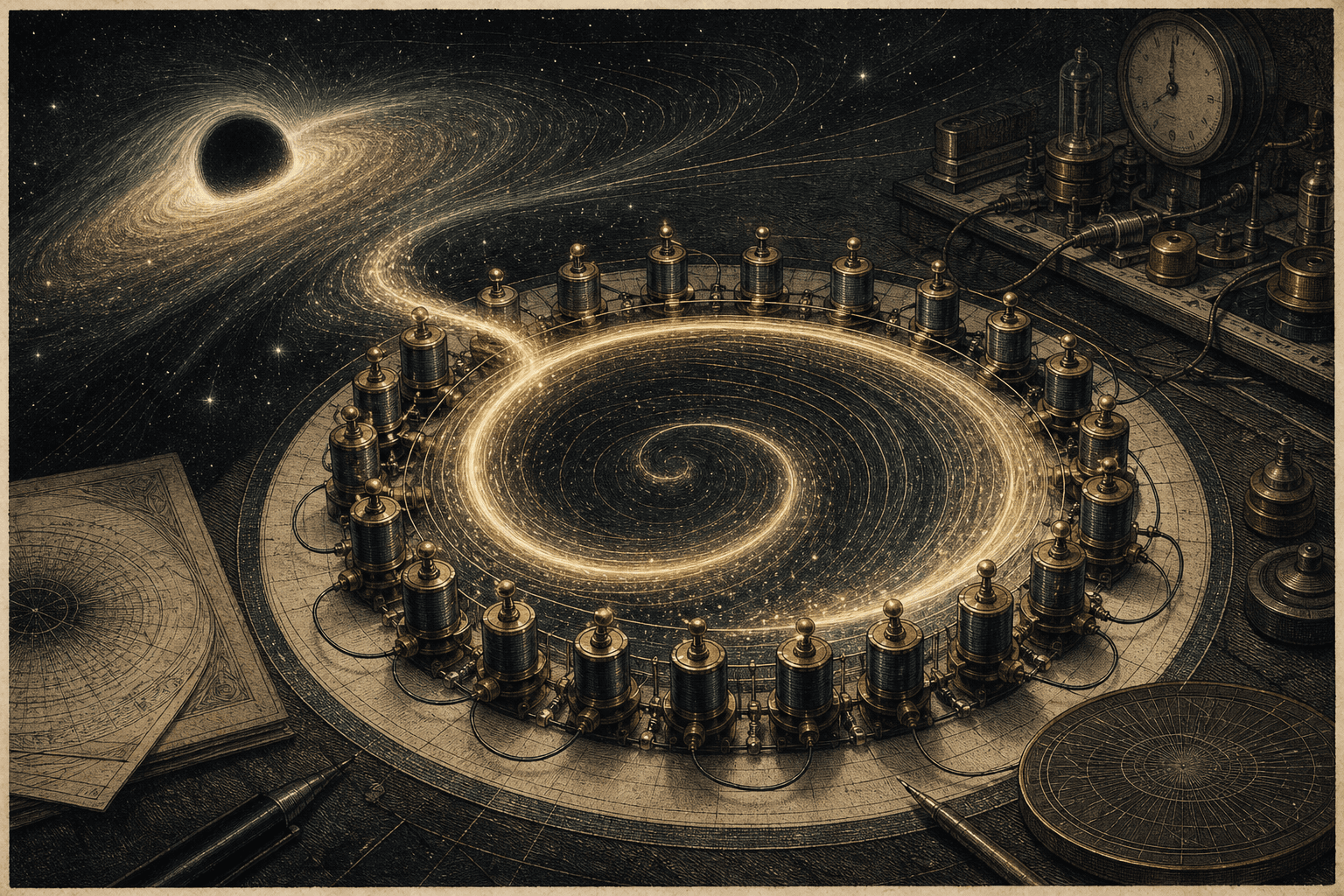
Researchers led by the CUNY Advanced Science Research Center report a laboratory realization of the Penrose-Zel'dovich wave-amplification process. Instead of spinning matter at otherwise impractical speed, the team arranged electronic resonators in a ring and varied them in space and time so electromagnetic waves experienced an effectively rotating boundary. Waves with the right angular character emerged with more energy. The result does not extract energy from an actual black hole; it recreates the governing amplification mechanism in a controllable device. Published in Nature, the work gives physicists a platform for studying extreme rotational dynamics and may inform future photonic and quantum systems.
Why it matters
A stationary ring of tuned resonators reproduced the wave amplification expected near an ultrafast rotating body, moving a half-century-old idea onto a laboratory bench.
Limits and context
- Researchers led by the CUNY Advanced Science Research Center report a laboratory realization of the Penrose-Zel'dovich wave-amplification process.
- The result does not extract energy from an actual black hole; it recreates the governing amplification mechanism in a controllable device.
Key claims
A stationary ring of tuned resonators reproduced the wave amplification expected near an ultrafast rotating body, moving a half-century-old idea onto a laboratory bench.
Qualification: Researchers led by the CUNY Advanced Science Research Center report a laboratory realization of the Penrose-Zel'dovich wave-amplification process.
Evidence: source-2026-07-12-001
Sources
- Nature: Wave amplification from a synthetic rotating mediumwww.nature.com · primary research
Corrections
No corrections have been recorded for this story.