research
The Black Hole Was Not Where the Galaxy Put It
A star-shredding flare exposed a million-solar-mass black hole more than 30,000 light-years from its host galaxy's center.
Summary
A star-shredding flare exposed a million-solar-mass black hole more than 30,000 light-years from its host galaxy's center.
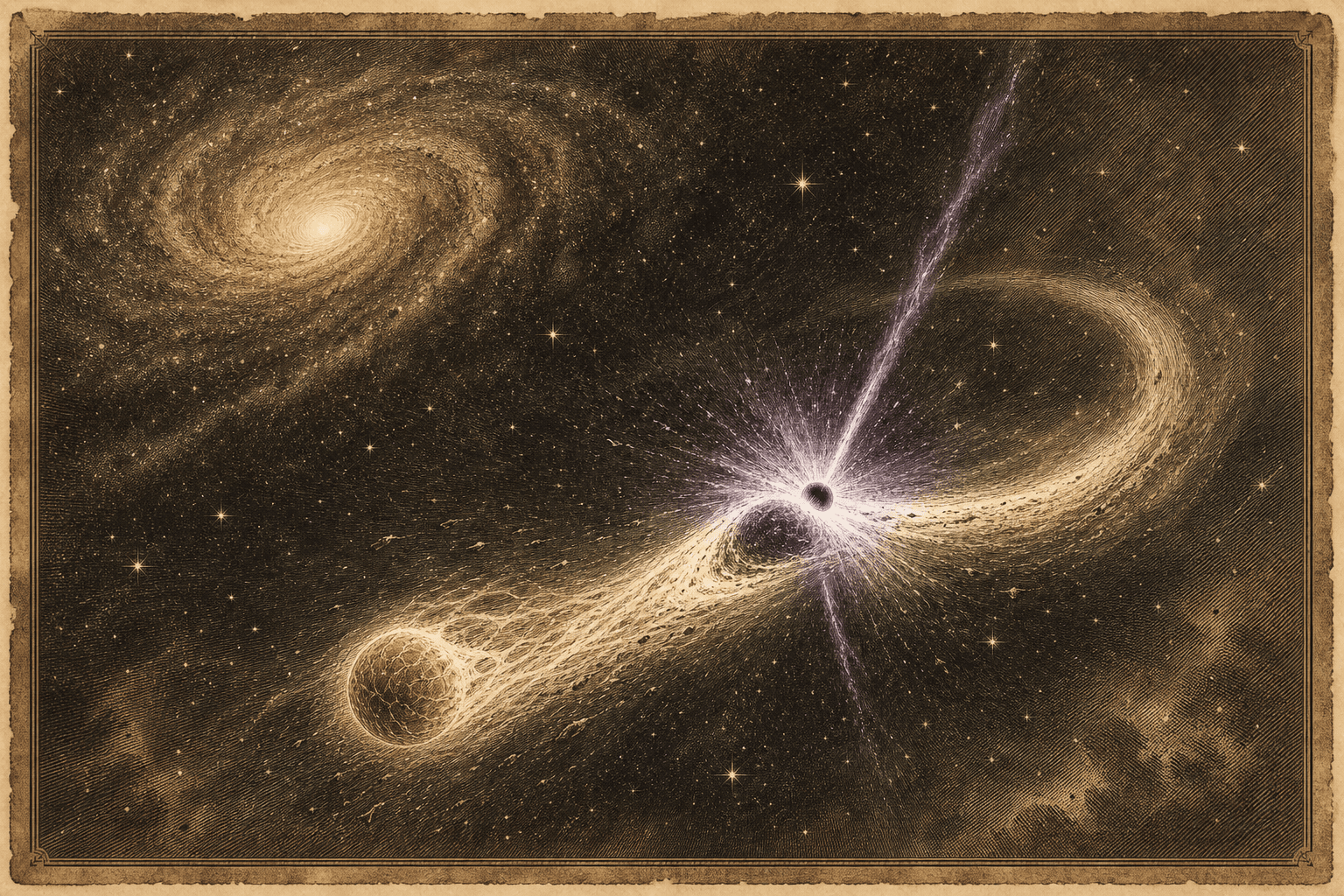
Astronomers using NASA's Swift observatory and other facilities followed the tidal disruption event AT2025osq after the Zwicky Transient Facility found its flare in November 2025. The source briefly outshone its host galaxy in ultraviolet light, and the team placed the roughly million-solar-mass black hole more than 30,000 light-years from the galactic center. The July 27 Astrophysical Journal Letters report validates tidal disruptions as a way to find otherwise hidden wandering black holes, but one detection does not establish how common they are.
Why it matters
A star-shredding flare exposed a million-solar-mass black hole more than 30,000 light-years from its host galaxy's center.
Limits and context
- The July 27 Astrophysical Journal Letters report validates tidal disruptions as a way to find otherwise hidden wandering black holes, but one detection does not establish how common they are.
Key claims
A star-shredding flare exposed a million-solar-mass black hole more than 30,000 light-years from its host galaxy's center.
Qualification: The July 27 Astrophysical Journal Letters report validates tidal disruptions as a way to find otherwise hidden wandering black holes, but one detection does not establish how common they are.
Evidence: source-2026-07-28-001
Sources
- NASA Goddard via ScienceDaily: Off-center tidal disruption event AT2025osqNASA Goddard via ScienceDaily · secondary reporting
Corrections
No corrections have been recorded for this story.