research
Ice May Have Its Own Echo
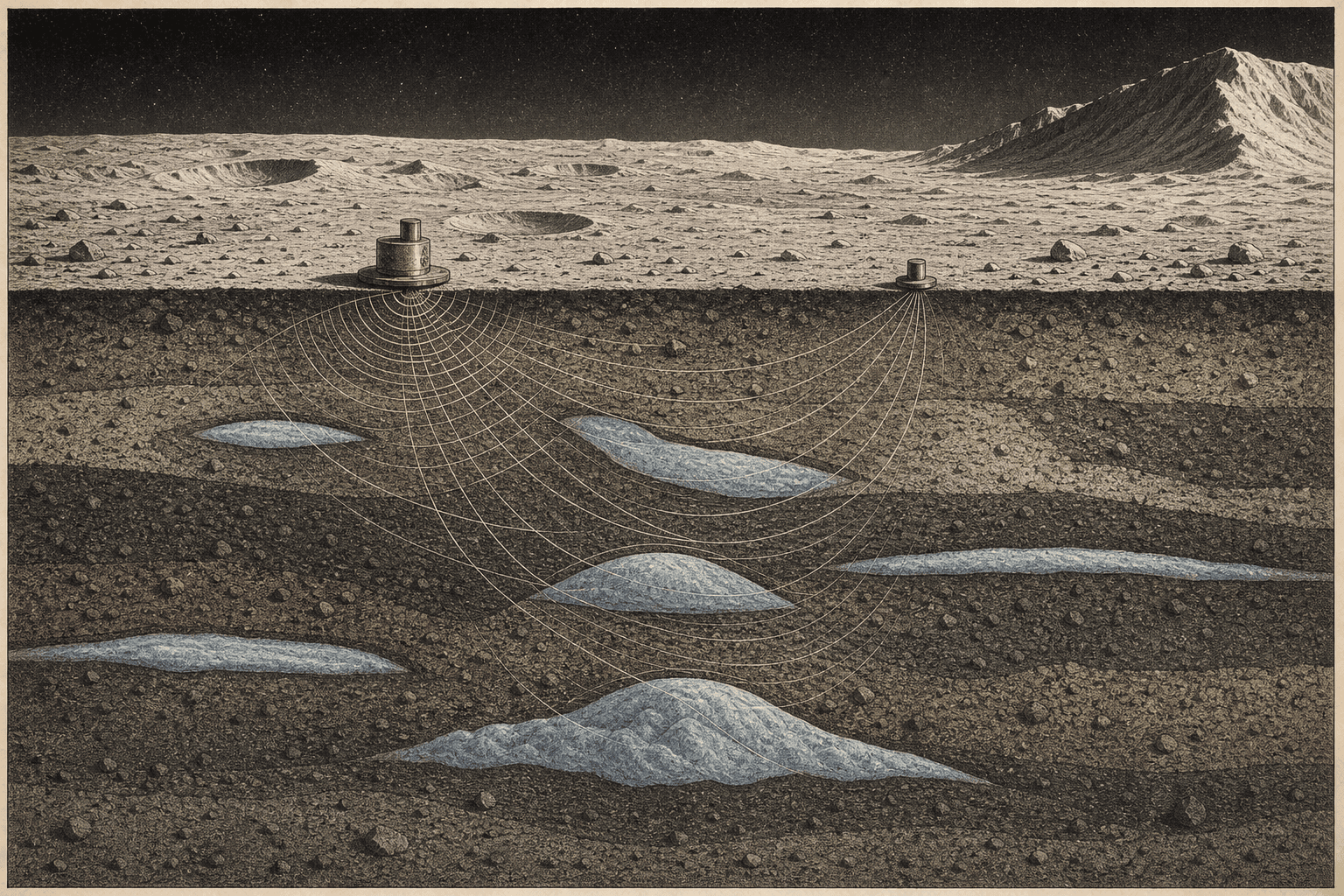
Laboratory measurements and models suggest that lunar ice geometries could leave distinct seismic signatures, offering a possible way to search below the surface.
Summary
Laboratory measurements and models suggest that lunar ice geometries could leave distinct seismic signatures, offering a possible way to search below the surface.
Researchers from UC Berkeley, the University of Maryland and the University of Hawaii used a 15-inch cryogenic vacuum chamber, simulated lunar soil and microtomography to study how ice changes seismic behavior. Their model predicts that different deposits could produce distinguishable signatures down to roughly 800 meters. The work proposes a method for future instruments; it has not yet detected an ice deposit on the Moon and still needs field validation.
Why it matters
Laboratory measurements and models suggest that lunar ice geometries could leave distinct seismic signatures, offering a possible way to search below the surface.
Limits and context
- The work proposes a method for future instruments; it has not yet detected an ice deposit on the Moon and still needs field validation.
Key claims
Laboratory measurements and models suggest that lunar ice geometries could leave distinct seismic signatures, offering a possible way to search below the surface.
Qualification: The work proposes a method for future instruments; it has not yet detected an ice deposit on the Moon and still needs field validation.
Evidence: source-2026-08-01-002
Sources
- UC Berkeley via Newswise: Seismic search for lunar iceUniversity of California, Berkeley via Newswise · official announcement
Corrections
No corrections have been recorded for this story.