chips infrastructure
The Hardest Part Came With a Receipt
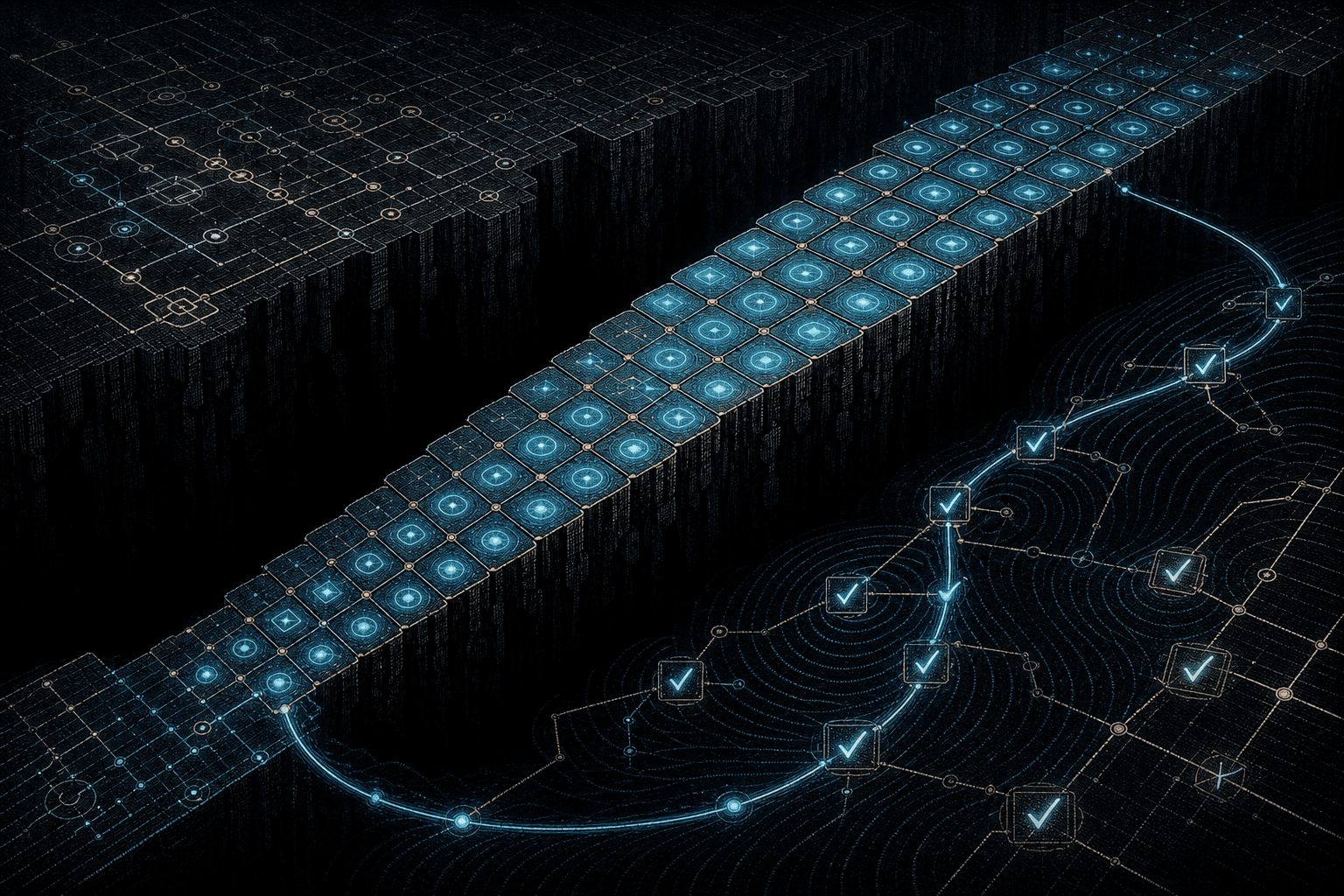
A 70-logical-qubit experiment paired computational difficulty with statistical evidence that the noisy machine had executed the circuit faithfully.
Summary
A 70-logical-qubit experiment paired computational difficulty with statistical evidence that the noisy machine had executed the circuit faithfully.
IBM and University of Chicago researchers report a structured sampling experiment designed to address quantum advantage's verification problem. The machine executed 70 logical qubits, 2,415 logical two-qubit operations and 468 logical T gates in about 15 minutes. The circuit construction retained the hardness associated with random-circuit sampling while enabling error evidence inside the same computation. The result is an arXiv preprint and the claim of practical classical inaccessibility depends on the simulation methods tested; it is not a general proof that every useful task now favors quantum hardware.
Why it matters
A 70-logical-qubit experiment paired computational difficulty with statistical evidence that the noisy machine had executed the circuit faithfully.
Limits and context
- The result is an arXiv preprint and the claim of practical classical inaccessibility depends on the simulation methods tested; it is not a general proof that every useful task now favors quantum hardware.
Key claims
A 70-logical-qubit experiment paired computational difficulty with statistical evidence that the noisy machine had executed the circuit faithfully.
Qualification: The result is an arXiv preprint and the claim of practical classical inaccessibility depends on the simulation methods tested; it is not a general proof that every useful task now favors quantum hardware.
Evidence: source-2026-08-02-001
Sources
- IBM and University of Chicago: verifiably high-fidelity hard-circuit samplingIBM and University of Chicago · official announcement
Corrections
No corrections have been recorded for this story.