research
The Planet Was Feeding the Star That Stripped It
Radiation-hydrodynamic simulations support a gas-rich planet as the source of the volatile disk around white dwarf WDJ0914+1914.
Summary
Radiation-hydrodynamic simulations support a gas-rich planet as the source of the volatile disk around white dwarf WDJ0914+1914.
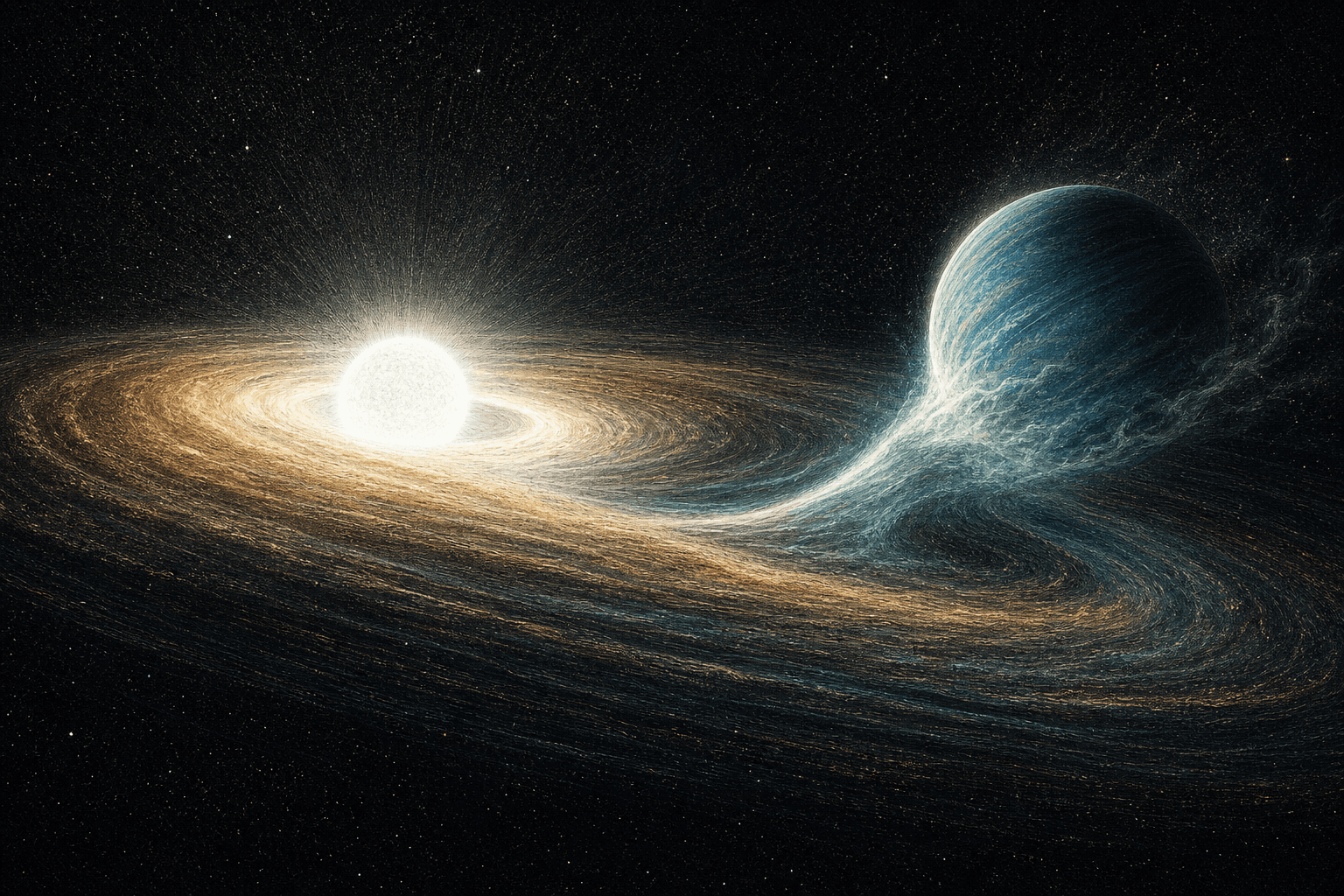
A model of WDJ0914+1914 couples three-dimensional atmospheric escape from a close Neptune-like or super-puff planet to the one-dimensional evolution of the resulting circumstellar disk. Across the cases tested, gas escaped at roughly 1.8 to 4.0 trillion grams per second; the fed disk stabilized within about 100,000 years and delivered several billion to ten billion grams per second onto the white dwarf, consistent with earlier observational estimates. The simulated disk extends farther than inferred observations, and the planet itself has not been directly imaged, so the work strengthens a physical explanation rather than closing the case.
Why it matters
Radiation-hydrodynamic simulations support a gas-rich planet as the source of the volatile disk around white dwarf WDJ0914+1914.
Limits and context
- The simulated disk extends farther than inferred observations, and the planet itself has not been directly imaged, so the work strengthens a physical explanation rather than closing the case.
Key claims
Radiation-hydrodynamic simulations support a gas-rich planet as the source of the volatile disk around white dwarf WDJ0914+1914.
Qualification: The simulated disk extends farther than inferred observations, and the planet itself has not been directly imaged, so the work strengthens a physical explanation rather than closing the case.
Evidence: source-2026-08-03-002
Sources
- Astronomy & Astrophysics: planetary atmospheric escape around WDJ0914+1914EDP Sciences · secondary reporting
Corrections
No corrections have been recorded for this story.