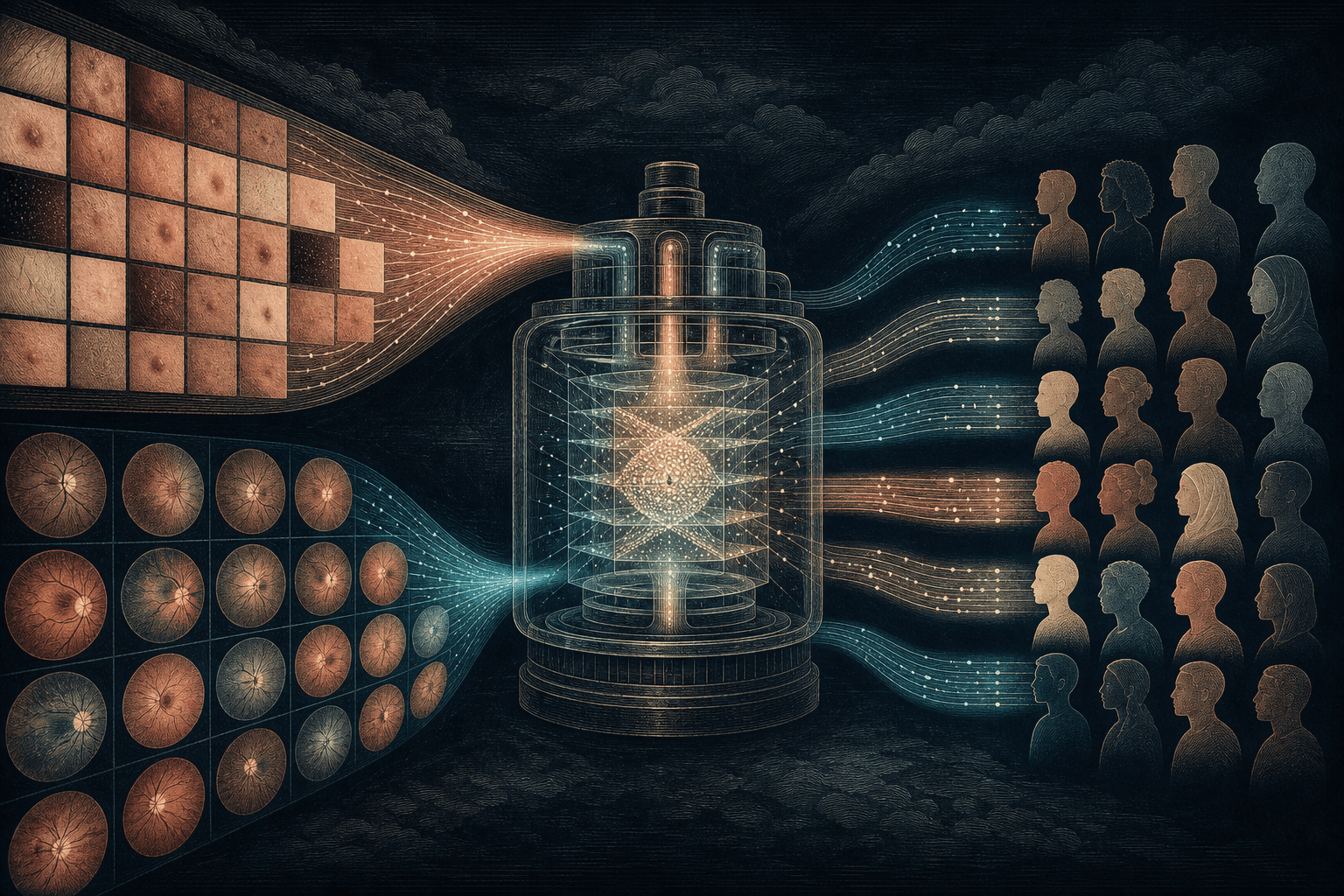
A cross-modal alignment method narrowed intersectional performance gaps in skin-lesion and glaucoma classification while improving or preserving overall accuracy.
Editorial illustration
Original conceptual illustration of cross-modal fairness training; it is not a clinical interface, patient image, diagnostic output or figure from the study. Original editorial illustration generated with built-in Codex Image Gen for The Machine Press, 2026-08-03.
Researchers evaluated a training framework called CMAC-MMD on 10,015 HAM10000 skin-lesion images, an external set of 12,000 BCN20000 images and 10,000 fundus images. Compared with standard training, the reported dermatology true-positive-rate gap across intersecting age, gender and race groups fell from 0.50 to 0.26 while AUC rose from 0.94 to 0.97; the glaucoma gap fell from 0.41 to 0.31 while AUC moved from 0.71 to 0.72. The method does not require sensitive demographics at inference, but these are retrospective dataset results, not evidence of clinical deployment or the elimination of bias.
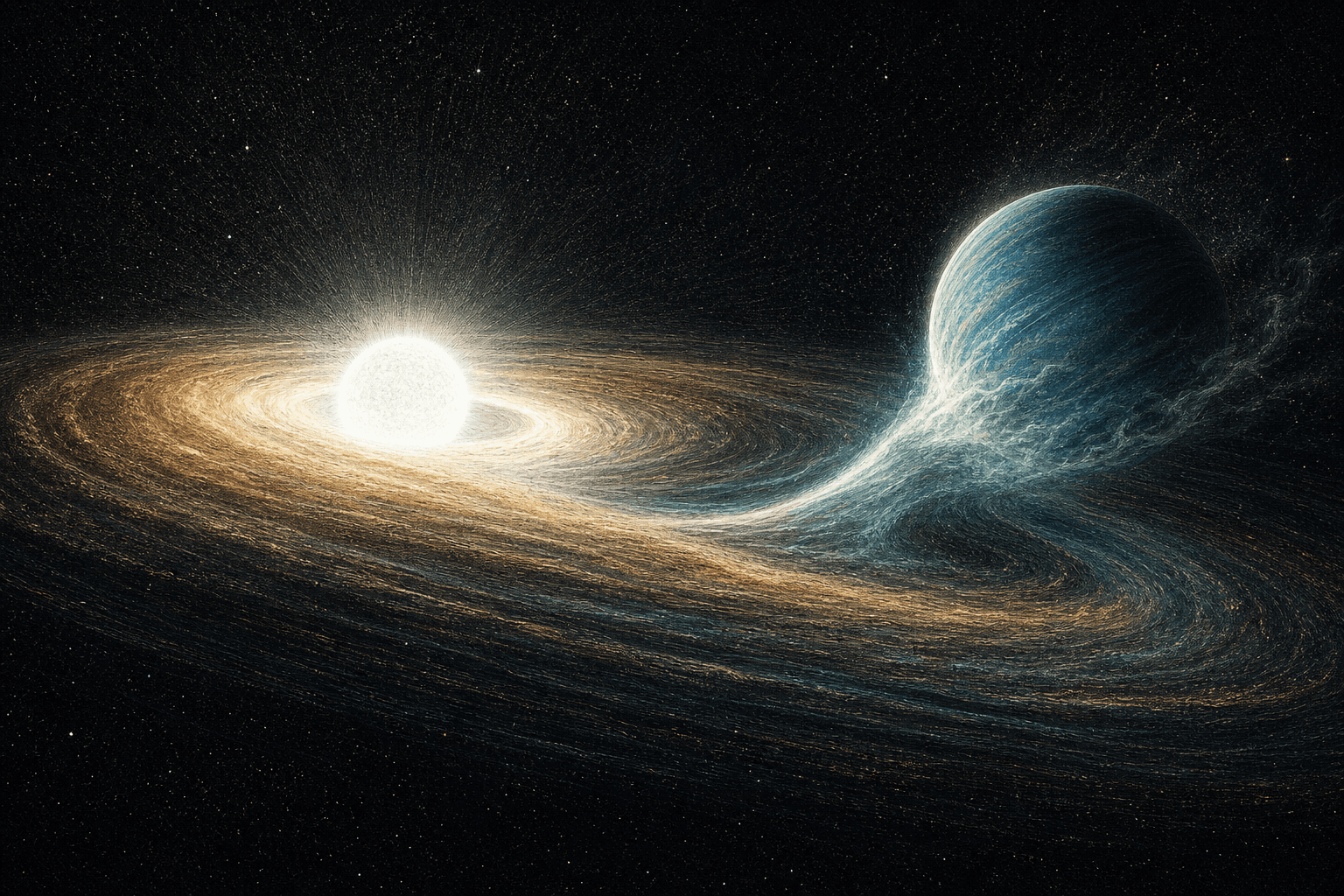
Original conceptual illustration of modeled atmospheric escape and disk feeding around WDJ0914+1914; the planet has not been directly imaged. Original editorial illustration generated with built-in Codex Image Gen for The Machine Press, 2026-08-03.
Radiation-hydrodynamic simulations support a gas-rich planet as the source of the volatile disk around white dwarf WDJ0914+1914.
A model of WDJ0914+1914 couples three-dimensional atmospheric escape from a close Neptune-like or super-puff planet to the one-dimensional evolution of the resulting circumstellar disk. Across the cases tested, gas escaped at roughly 1.8 to 4.0 trillion grams per second; the fed disk stabilized within about 100,000 years and delivered several billion to ten billion grams per second onto the white dwarf, consistent with earlier observational estimates. The simulated disk extends farther than inferred observations, and the planet itself has not been directly imaged, so the work strengthens a physical explanation rather than closing the case.
A year of in-network sampling found microbial succession and warmer-month disinfection by-products in Valencia.
Sampling devices placed inside an operational chlorinated network tracked biofilms without interrupting service. No fecal indicators or pathogens appeared in water samples, but biofilm DNA contained sequences related to opportunistic groups, especially after six and nine months. Disinfection by-products rose in warmer months with higher chlorine doses, while biofilm regrowth itself was seasonally independent, supporting age-aware monitoring rather than a temperature-only rule.
Conceptual Visualising AI file image; it does not depict the participants, cartoon stimulus, reported hues or experimental result. Novoto Studio / Google DeepMind / Pexels; cropped, resized, metadata stripped, and converted to WebP by The Machine Press.
Serial dependence biased judgments of a slowly changing object toward its earlier hue.
Observers watched a cartoon object change color gradually and then reported the hue they perceived. Across a one-shot study and three follow-up experiments, reports were pulled toward earlier states, with the bias growing as more of the change unfolded. The experiments support serial dependence as an active mechanism behind slow change blindness rather than simple inattention alone.
Silica fume and a superplasticizer cut capillary porosity and prevented Aspergillus colonization in a 28-day test.
Concrete made with 15 percent silica-fume replacement and a polycarboxylate superplasticizer reduced capillary porosity by 40.6 percent, to 4.39 percent, while improving mechanical properties. Control specimens developed Aspergillus biofilms after inoculation; the modified specimens remained free of colonization through 28 days. The result is a controlled materials experiment, not proof of indefinite resistance in field infrastructure.
Four more years of radial-velocity monitoring sharpened one of the strangest known architectures around an ultra-short-period planet.
A joint analysis of 237 HARPS-N spectra with K2 and TESS photometry refined the outer planet K2-312 c to an 871.32-day orbit, a minimum mass near five Jupiters and eccentricity near 0.85. Simulations show that scattering between two giants could eject one planet, leave the survivor highly eccentric and spare the inner rocky planet. That formation history is plausible, not directly observed.
A W43-MM1 case study found that simplified virial estimates can overstate turbulent and magnetic support.
ALMA molecular-line and dust-polarization observations were used to estimate kinetic and magnetic support in dense W43-MM1 cores. Simplified calculations classified roughly 85 percent of the measured subset as supported against collapseâ€â€an implausible answer for many protostellar cores. The authors trace the mismatch to scale extrapolation and omitted surface terms, warning that convenient virial summaries can introduce large biases.
A revised WaveDiff recovered wide-field wavefront error to about three percent using only noisy in-focus observations.
WaveDiff combines a differentiable optical model with learned wavefront features to infer telescope aberrations from stellar images. A projection step linking its parametric and learned components reduced simulated wavefront-recovery error from about 30 percent to about three percent while slightly improving pixel-space modeling. The result was demonstrated on noisy, undersampled observations in simulation and still needs instrument-specific validation.
NASA OSAM-1 robotics file image; it does not depict the medical robot, ultrasound probe, participants or reported experiment, and use implies no NASA endorsement. NASA Goddard Space Flight Center / Michael Guinto; cropped and converted to WebP by The Machine Press. Use does not imply NASA endorsement.
A three-step probe motion estimated the acoustic window for an apical four-chamber echocardiogram in five subjects.
The proposed workflow begins at the parasternal long-axis view, sweeps while keeping the mitral valve centered, then rotates and angles the probe to align both valves and the septum before final tilting. In proof-of-concept tests across five subjects, predefined image-quality scoring averaged 68.0 percent. The small study establishes feasibility for algorithm-assisted guidance, not autonomous clinical scanning.
The first continuous J- and H-band sequence from polar day into polar night measured background changes at Dome A.
A binocular infrared telescope recorded fixed-pointing observations from February through May 2024 at Dome A. The analysis places twilight-to-night boundaries at solar elevations near minus 9.3 degrees in J and minus 7.4 degrees in H, and finds polar-night background darker than comparable elevations during ordinary day-night alternation. H-band brightness also tracked sunspot number more clearly, so longer monitoring across the solar cycle remains important.
External validation preserved average error but exposed systematic underprediction for severe upper-limb impairment.
A stroke-recovery model trained in a Dutch cohort was tested in an independent Danish prospective cohort of 80 patients about two weeks after stroke. Median absolute error was statistically comparable to development results, and calibration was close to ideal above predicted Action Research Arm Test scores of 40. Lower ranges were systematically underpredicted, showing that additional predictors are needed before clinical implementation for severely impaired patients.
Across 376 roadside encounters in Uganda, pedestrians and cyclists showed more caution than motorists.
Researchers analyzed opportunistically recorded interactions around wild chimpanzee crossings in Bulindi over 38 months. Caution rose when animals actively crossed and when local field assistants were present, but fell around larger chimpanzee groups; seven near misses were linked mainly to poor visibility and reckless motorcycling. No collision occurred, yet the pattern supports speed controls, visibility improvements and locally trusted safety staff.
Patient-specific digital twins linked through-wall fibrosis patterns to endocardial and epicardial electrical separation.
MRI-derived bi-atrial digital twins from 21 people with persistent atrial fibrillation produced 91 reentry-sustaining regions for comparison with 73 controls. Reentry regions showed substantially greater voltage and activation-time differences between inner and outer atrial surfaces, while fibrosis percentage and through-wall dissimilarity independently tracked reentry. The work is mechanistic simulation evidence, not a tested ablation protocol.
Illustrative fiber-optic macro file image; it does not depict ALMA, VAPOLA, active galaxies, Sgr A* or any repository data product. Atlantic Ambience / Pexels; cropped, resized, metadata stripped, and converted to WebP by The Machine Press.
VAPOLA turns specialized phased-array observations of active galaxies and the Galactic center into science-ready products.
The VAPOLA repository uses an automated pipeline to create calibrated visibilities, full-Stokes images, polarization and spectral-index maps, fitted parameters and calibration metadata from ALMA observations made during global very-long-baseline campaigns. The first release lowers the expertise barrier for work on jets, accretion flows and Sgr A*. Its value is reusable infrastructure; scientific conclusions still depend on each analysis.
First-principles calculations predict PbGeH and PbSnH monolayers that combine room-temperature-scale bandgaps with piezoelectricity.
Calculations predict quantum-spin-Hall gaps up to 0.314 electron volts and in-plane piezoelectric coefficients of 6.676 and 5.370 picometers per volt for two hydrogenated lead monolayers. A Janus variant also produced an out-of-plane response and a large modeled Rashba parameter while retaining edge states under plus or minus six percent strain. These are theoretical materials predictions, not fabricated devices.
A conductive NiCoFe alloy core supported reversible active phases during oxygen and urea oxidation.
In situ X-ray absorption measurements and density-functional calculations compared a layered hydroxide with a surface-reconstructed NiCoFe alloy. At higher current density and after cycling, the reconstructed catalyst required less potential and retained better turnover performance, including intermittent operation. The study attributes durability to a conductive core and more reversible surface phases; practical electrolyzer economics were not tested.
Packs a Raspberry Pi Zero 2W, square display, thumb keyboard, three USB ports, swappable batteries, and accessible storage into a palm-size Linux terminal.
Visit Hackberry Pi ZeroOriginal editorial concept art generated with built-in Codex Image Gen for The Machine Press, 2026-08-02; carried into the 2026-08-03 edition.
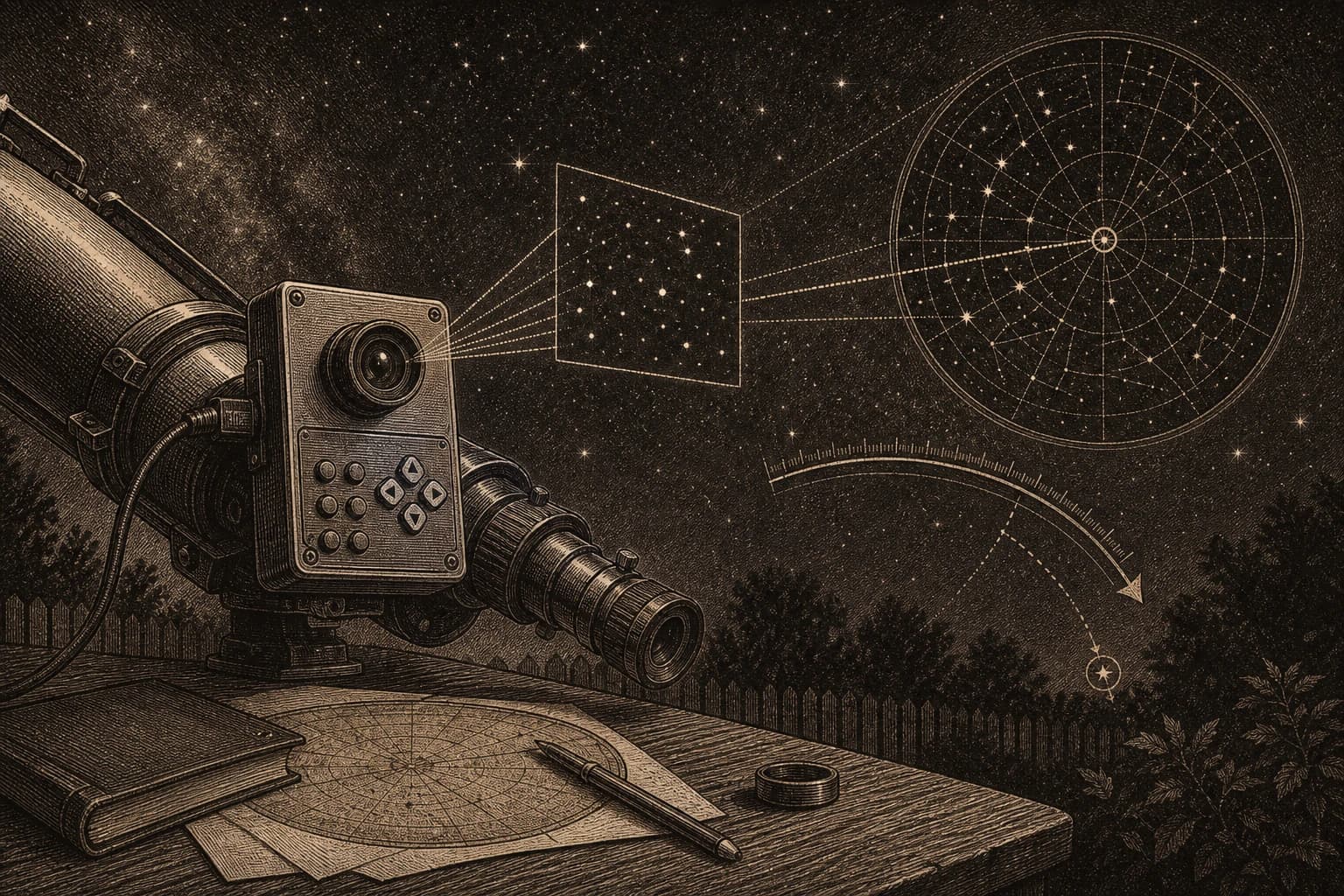
Mounts a Raspberry Pi camera beside a telescope, plate-solves the star field, and combines GPS and inertial sensing to guide push-to observing without a separate alignment routine.
Visit PiFinderOriginal editorial concept art generated with built-in Codex Image Gen for The Machine Press, 2026-08-02; carried into the 2026-08-03 edition.
Routes tendons through a modular five-finger, 16-joint hand with seven controlled degrees of freedom, printable parts, firmware, an SDK, ROS 2 tools, and simulation assets.
Visit Aero Hand OpenOriginal editorial concept art generated with built-in Codex Image Gen for The Machine Press, 2026-08-02; carried into the 2026-08-03 edition.
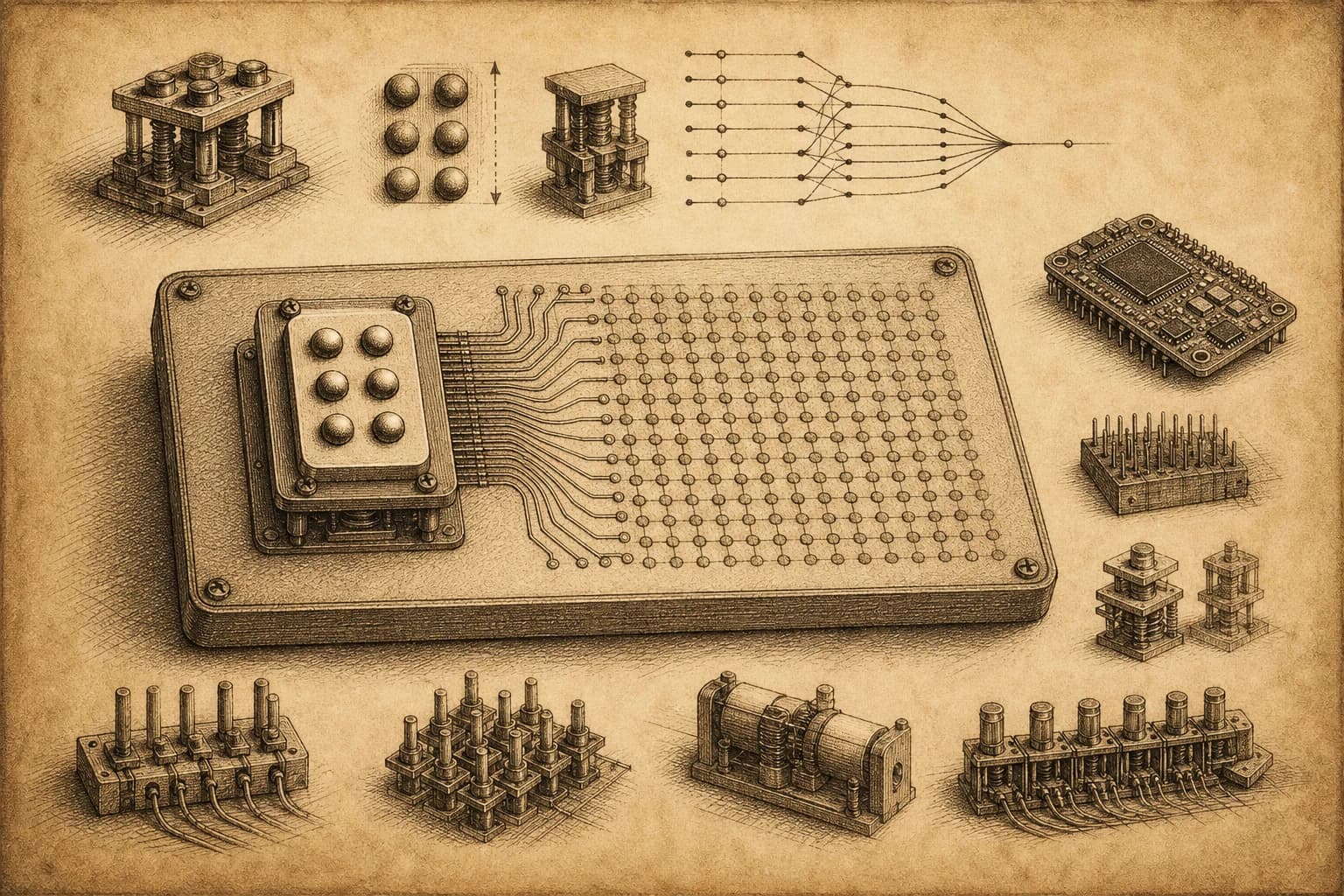
Explores pairing one physical refreshable Braille cell with a tactile sensor matrix representing virtual character positions, reducing the amount of moving hardware under study.
Visit BrailleTouchOriginal Codex Image Gen concept art from 2026-07-10; carried forward from the validated 2026-08-01 edition.
Desk Picks are selected by the newsroom. Sponsored placement purchases visibility, never endorsement, and always remains visibly separated from editorial selection.
 Editorial illustration