research
The Sound Field Became a Map of Possible Firing
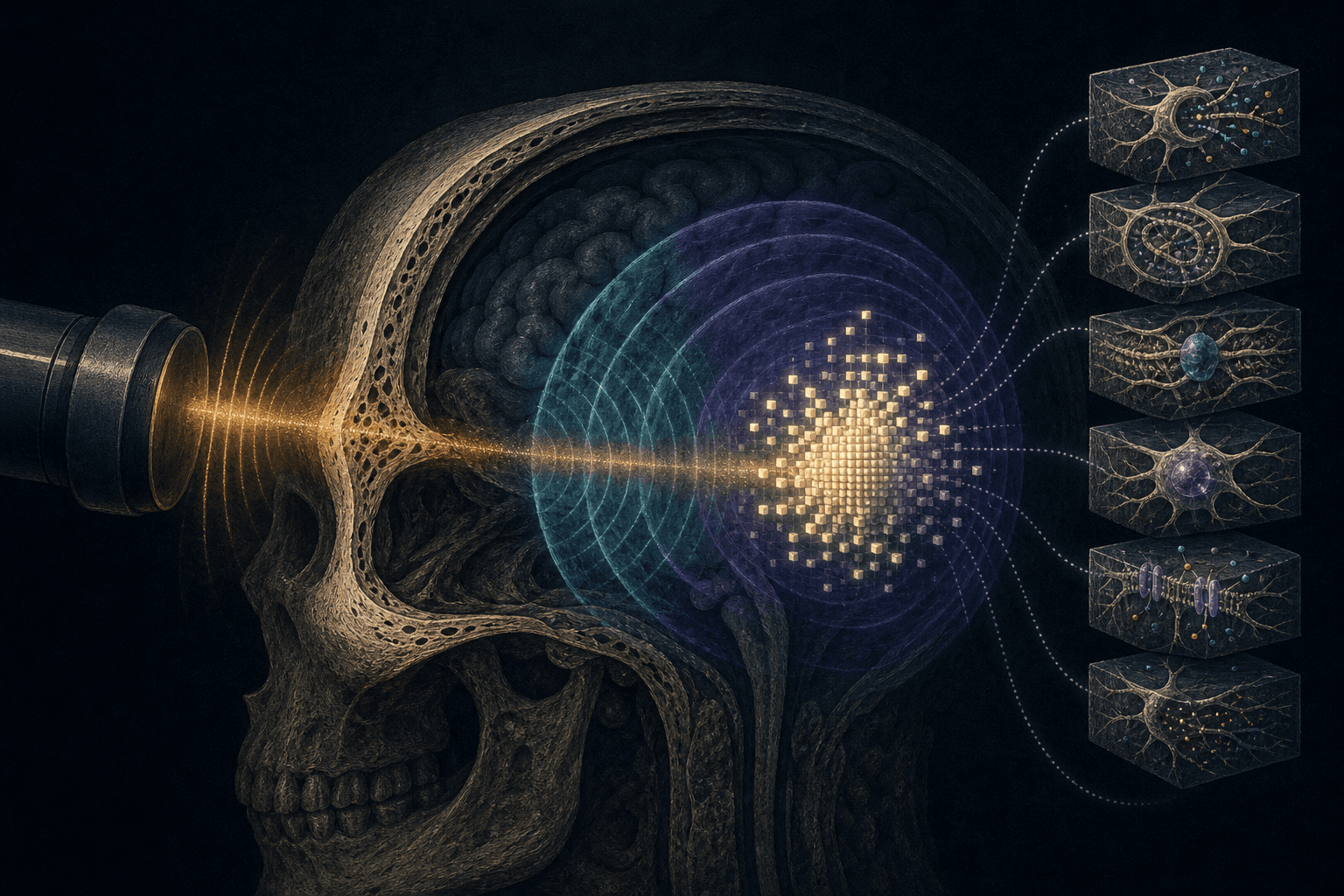
An open framework couples skull acoustics, tissue mechanics, heat and six candidate neural pathways into voxel-resolved predictions.
Summary
An open framework couples skull acoustics, tissue mechanics, heat and six candidate neural pathways into voxel-resolved predictions.
A new computational framework maps a transcranial focused-ultrasound field to predicted neural firing volumes registered to anatomy. It couples nonlinear acoustic propagation, viscoelastic shear waves, bioheat diffusion, a strain-to-membrane-tension model and a multi-compartment Hodgkin-Huxley neuron with six interchangeable candidate mechanisms. In a demonstration through a micro-CT human-skull specimen toward the left dorsal anterior cingulate cortex, the model predicted a focal firing volume of about 8,500 cubic millimeters while its calculated thermal rise stayed within cited consensus safety envelopes. This is a preprint modeling framework designed to produce falsifiable predictions; it does not resolve the biological mechanism, demonstrate treatment in living patients or establish clinical safety.
Why it matters
An open framework couples skull acoustics, tissue mechanics, heat and six candidate neural pathways into voxel-resolved predictions.
Limits and context
- This is a preprint modeling framework designed to produce falsifiable predictions; it does not resolve the biological mechanism, demonstrate treatment in living patients or establish clinical safety.
Key claims
An open framework couples skull acoustics, tissue mechanics, heat and six candidate neural pathways into voxel-resolved predictions.
Qualification: This is a preprint modeling framework designed to produce falsifiable predictions; it does not resolve the biological mechanism, demonstrate treatment in living patients or establish clinical safety.
Evidence: source-2026-08-07-002
Sources
- arXiv preprint 2608.06321arXiv · primary research
Corrections
No corrections have been recorded for this story.