A controlled benchmark separated event frequency from visual complexity and found video-language models failing first on brief events, then on faithful timelines.
Editorial illustration
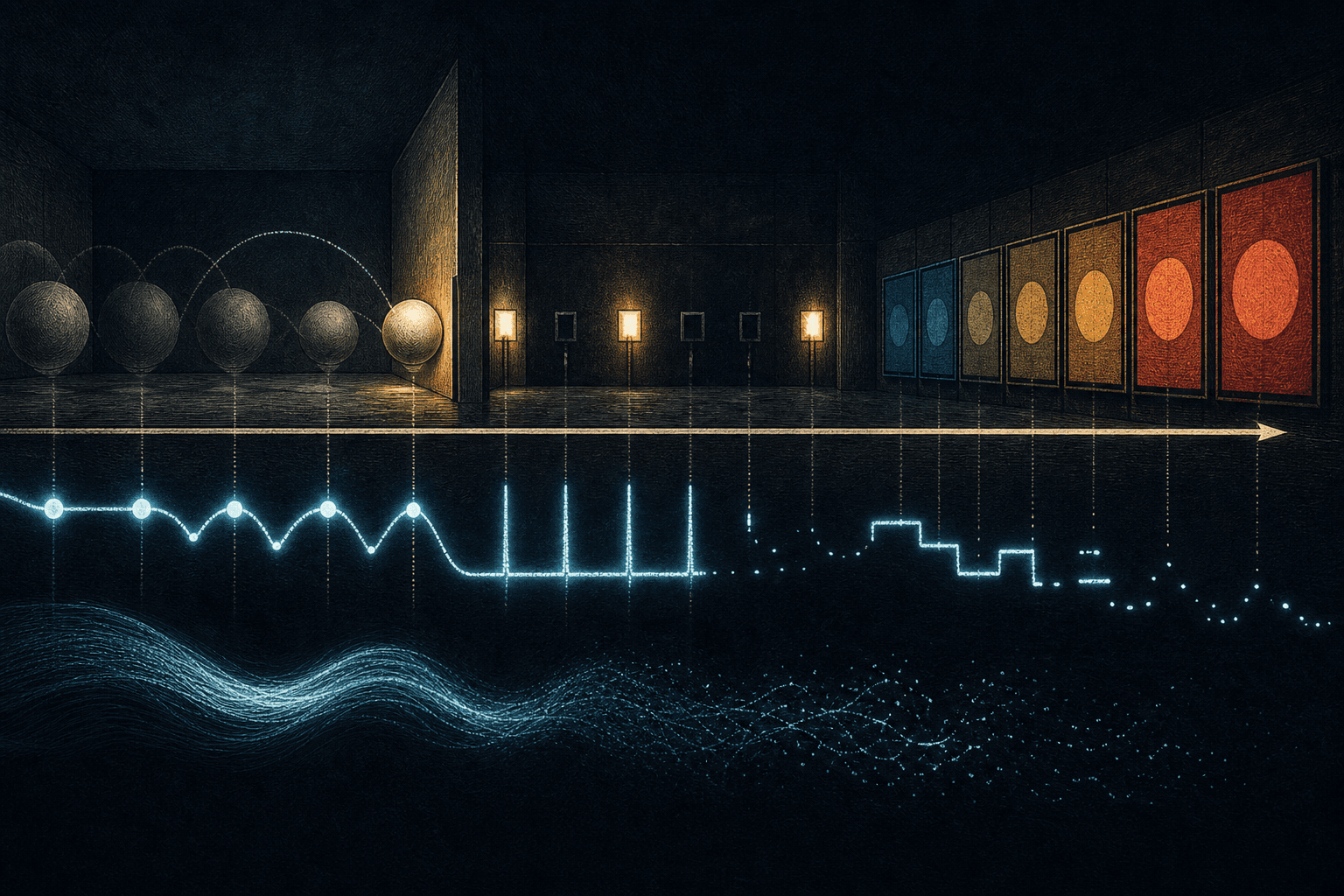
Original conceptual illustration of controlled video events outrunning a model's reported timeline; it is not a benchmark frame, model interface, trace plot or published figure. Original editorial illustration generated with built-in Codex Image Gen for The Machine Press, 2026-08-07.
Researchers generated 2,190 controlled videos of bouncing-ball contacts, blinks and categorical state changes, each paired with an executable event trace. At an 80 percent reliability threshold, Gemini 3.6 Flash counted persistent state transitions up to 12 events at 0.5 and 1 hertz, yet showed no reliable positive-count region for transient blinks; in the high-count, high-frequency regime only 0.2 percent of final counts were correct. Sampling more frames improved bouncing-ball answer accuracy from 19.6 to 29.3 percent, but the reported event sequence matched ground truth only 3.7 percent of the time. These are author-reported preprint results from controlled and benchmark videos, not a universal audit of every video model or real-world deployment.
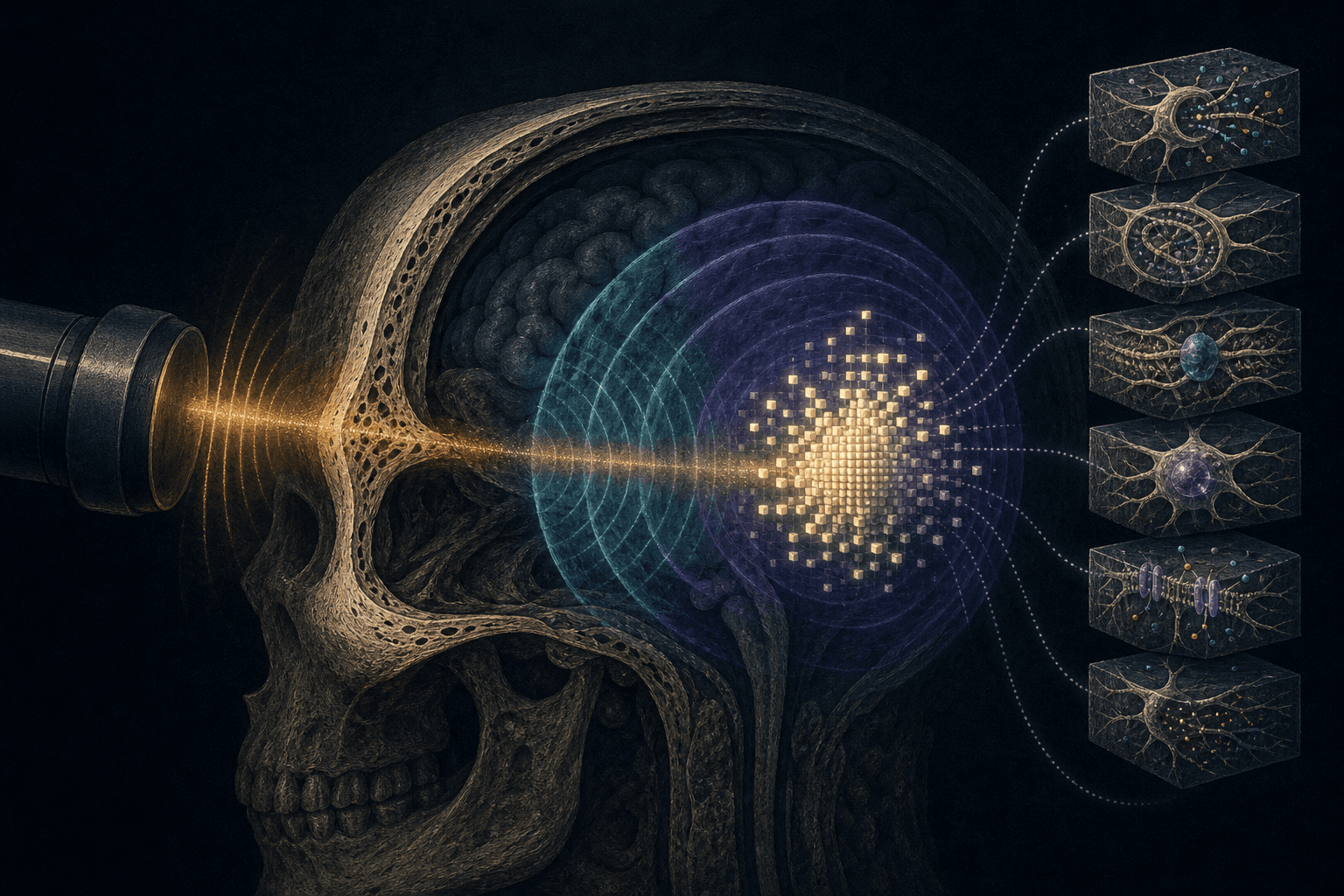
Original conceptual illustration of a computational ultrasound-to-neural-firing pipeline; it is not a patient scan, established mechanism, treatment result or published figure. Original editorial illustration generated with built-in Codex Image Gen for The Machine Press, 2026-08-07.
An open framework couples skull acoustics, tissue mechanics, heat and six candidate neural pathways into voxel-resolved predictions.
A new computational framework maps a transcranial focused-ultrasound field to predicted neural firing volumes registered to anatomy. It couples nonlinear acoustic propagation, viscoelastic shear waves, bioheat diffusion, a strain-to-membrane-tension model and a multi-compartment Hodgkin-Huxley neuron with six interchangeable candidate mechanisms. In a demonstration through a micro-CT human-skull specimen toward the left dorsal anterior cingulate cortex, the model predicted a focal firing volume of about 8,500 cubic millimeters while its calculated thermal rise stayed within cited consensus safety envelopes. This is a preprint modeling framework designed to produce falsifiable predictions; it does not resolve the biological mechanism, demonstrate treatment in living patients or establish clinical safety.
PyOMES packages dynamic and steady-state process simulation into an open Python framework meant for experimentalists and experienced modelers.
PyOMES presents a modular environment for biological, chemical and biochemical process models under one interface. The paper demonstrates several use cases and reports agreement with the established PHREEQC benchmark software. It is an introductory software-and-architecture paper, not evidence that every process model is validated or that the package replaces domain-specific experimental checks.
Illustrative dark code-screen file image; it does not depict TrajDebug, an agent trajectory, a benchmark, an error trace or the reported results. Markus Spiske / Pexels; cropped, resized, metadata stripped, and converted to WebP by The Machine Press.
TrajDebug follows mistakes through long agent runs to distinguish resolved detours from failures that still reach the terminal state.
TrajDebug compresses long histories, identifies evidence for local errors and tracks whether each error was resolved or remained responsible for a failed outcome. Its companion TrajErrBench contains 486 manually annotated failed trajectories from Tau2Bench and SWE-Bench Pro. The authors report stronger critical-error detection than their baselines and actionable downstream diagnoses; the preprint does not establish perfect attribution in production agents.
GAUGE measures simulators and video world models against calibrated trajectories instead of judging whether their output merely looks right.
GAUGE collects 22 controlled task families spanning rigid bodies, cables, textiles and volumetric deformable objects. Tests of three physics engines found no uniformly faithful system, with the largest gaps in impulsive contact, fast textile motion and volumetric deformation; six image-to-video models sometimes reproduced the expected equation form while recovering wrong acceleration, momentum transfer or oscillation timing. The results are benchmark diagnostics, not a ranking of every simulator or world model.
Plausible but outdated history flipped nearly a third of decisions a compact model had made correctly on the clean trajectory.
A paired benchmark holds current tools, policy, request and correct next action constant while comparing original, polluted and oracle-state histories. On Qwen3-1.7B, misleading history flipped 32.1 percent of decisions that were correct on the original trajectory. A teacher-transfer method raised balanced tool-use accuracy to 87.0 percent and up to 91.9 percent with an 8B teacher, according to the authors; these are benchmark results, not guarantees against stale production context.
OPERA evaluates autonomous optical actions with physical residuals, separating reward movement from measurable experimental progress.
OPERA represents experimental actions as optical operators and judges outcomes with physically interpretable residuals against withheld references. Across three tasks, score-only feedback increased the score without physical improvement in 23.6 to 39.0 percent of decisions, compared with 0.9 to 1.9 percent under operator-residual feedback. Protocols chosen in digital twins transferred to three optical instruments, but the preprint does not establish general laboratory autonomy.
Deep-silicon photon-counting CT estimated narrowing more closely than conventional CT in twelve static coronary phantoms.
Researchers scanned 12 realistic calcified coronary-vessel sections with energy-integrating CT, deep-silicon photon-counting CT and micro-CT ground truth. Photon counting reduced whole-profile mean absolute stenosis error from 3.10 to 1.62 percent and vessel-area error from 0.55 to 0.31 square millimeters. The study used static, resolution-optimized phantoms and explicitly calls for dynamic and clinical evaluation.
Conceptual Visualising AI file image with embedded explanatory text; it does not depict a crop-and-zoom tool, evaluated model, benchmark question, returned observation or result. Wes Cockx / Google DeepMind / Pexels; cropped, resized, metadata stripped, and converted to WebP by The Machine Press.
A causal audit found many visual-tool calls either irrelevant to the answer or informative but scheduled without a coherent plan.
Researchers intervened at policy, trajectory and individual-step levels to ask whether crop-and-zoom observations causally changed multimodal-model answers. Across six models and five fine-grained perception benchmarks, they identify calls whose returned image had no causal effect and cases where useful evidence arrived through an incoherent call schedule. Aggregate gains were concentrated in a calibrated minority, making this a diagnosis of benchmark rollouts rather than proof that visual tools are never useful.
An atom-referenced dual-laser architecture pushed a compact cesium beam clock into the 10^-13 short-term stability regime.
A compact cesium beam clock uses a Faraday anomalous-dispersion filter and modulation-transfer spectroscopy to suppress pump-laser frequency noise and drift. The authors report a 2.12-kilohertz laser linewidth, signal-to-noise ratio of 46,365 in one hertz and fractional Allan deviation of 7.7 times 10^-13 divided by the square root of averaging time. The preprint presents a laboratory prototype and pathway for deployable timing, not a field-qualified navigation product.
Changing pulse duration and intensity selected different electron pathways and extended extreme-ultraviolet emission in an insulator.
Experiments tuned laser pulses from 5 to 29 femtoseconds and intensities from 0.8 to 74 terawatts per square centimeter. Moderate many-cycle pulses accumulated carriers across cycles, while few-cycle pulses near 22 terawatts per square centimeter drove subcycle multiband motion reaching 25 to 50 electron-volt photons before decoherence suppressed emission. The result is a materials-and-optics control study, not a finished light source.
A low-power abdominal sensor distinguished stress-induction phases in a small preliminary dataset without analog amplification.
A force-sensitive resistor in an abdominal belt connects to a custom Bluetooth Low Energy board and records expansion through a mechanical holder. Signals remained visible across breathing maneuvers, body positions and light movement; in a 12-person stress protocol, the best classifier reached 88.0 percent test accuracy. The experiment is preliminary and does not establish diagnosis, generalization or performance during unrestricted daily activity.
In unimpaired adults, transcutaneous spinal stimulation initially increased ankle-localization error and narrowed side-to-side gait.
Fourteen unimpaired adults received transcutaneous spinal cord stimulation during proprioceptive testing and training, with another 14 completing the same training without stimulation. Acute stimulation increased ankle-localization error while strength stayed unchanged and gait became modestly more constrained; continued training reduced the error and improvement persisted after stimulation. This small study in unimpaired adults does not establish rehabilitation benefit or clinical safety for patients.
Illustrative laboratory-glassware file image; it does not depict Pistachio data, a condensed reaction graph, a reaction, yield measurement, institution or result. Rodolfo Clix / Pexels; cropped, resized, metadata stripped, and converted to WebP by The Machine Press.
RxnCLF encodes reactants and products together so pretraining can learn the transformation rather than two disconnected molecular snapshots.
RxnCLF uses a condensed reaction graph and contrastive pretraining on 1.7 million Pistachio reactions. The representation captures reaction-center and side-chain context, then outperformed reported graph and sequence baselines after fine-tuning on public and proprietary yield-prediction sets. The author-reported results concern benchmark and high-throughput-experiment datasets; they do not establish laboratory yield for arbitrary new reactions.
Across EEG datasets, richer activity distributions were less stable, while mild cognitive impairment and Alzheimer's reduced both measures.
Researchers modeled windowed EEG patterns as distributions, using Wasserstein distance for temporal stability and intrinsic dimensionality for complexity. Healthy aging showed higher dimensionality and lower stability, while mild cognitive impairment and Alzheimer's disease showed a joint collapse of both; posterior regions were generally richer and less stable than frontal regions. The preprint proposes a measurement framework and potential biomarker, not a diagnostic test.
MetaboLLM turns retrieved metabolomics descriptions into graph structures used for two downstream prediction tasks.
MetaboLLM combines continual pretraining, supervised tuning and structured retrieval, then converts its biochemical descriptions into metabolite graphs for a graph neural network. The authors report AUCs of 0.8616 for stress hyperglycemia after coronary bypass and 0.8123 for postmenopausal hormone-regimen classification, ahead of their tested alternatives. These retrospective benchmark results do not establish prospective clinical utility or causal biochemical mechanisms.
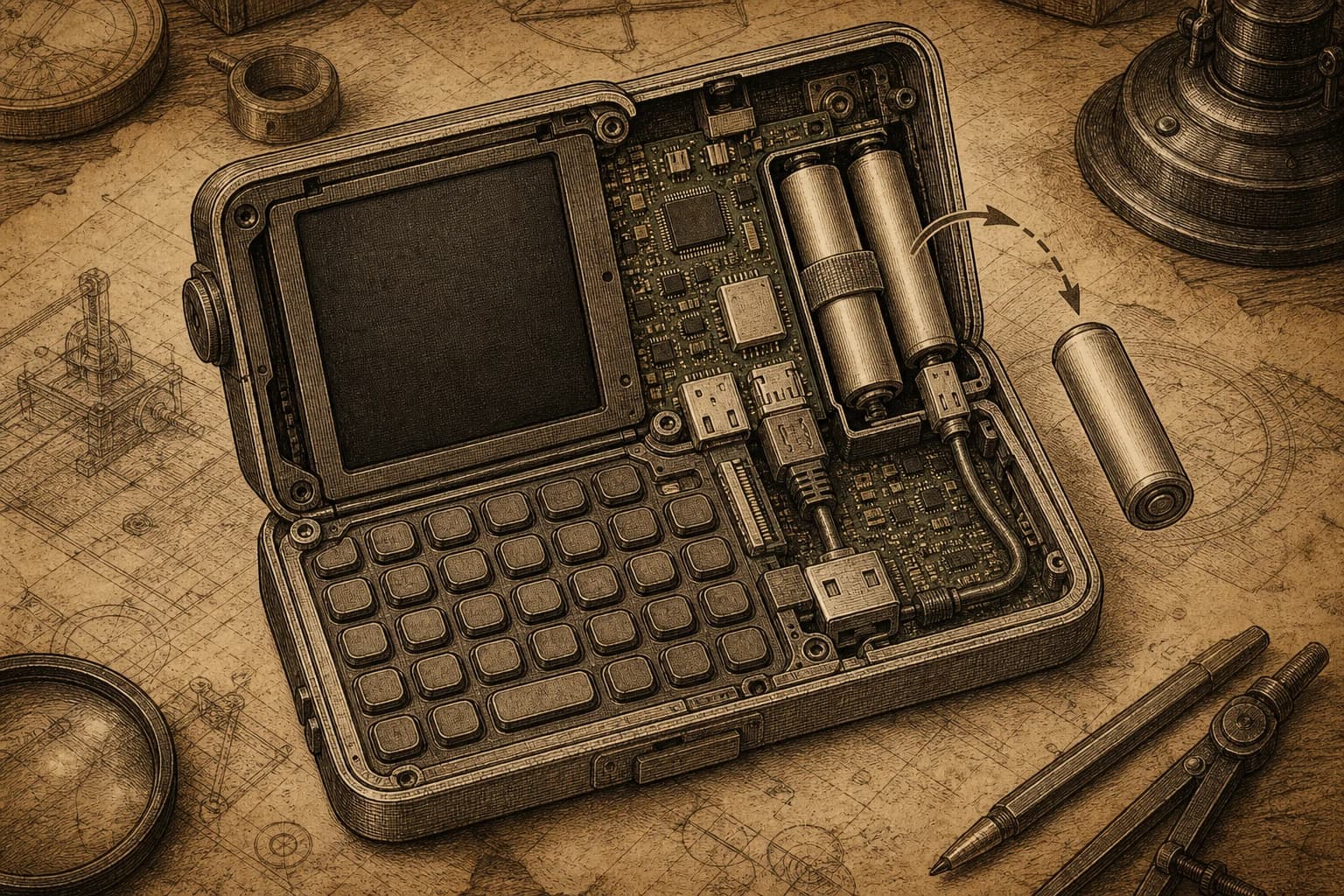
Packs a Raspberry Pi Zero 2W, square display, thumb keyboard, three USB ports, swappable batteries, and accessible storage into a palm-size Linux terminal.
Visit Hackberry Pi ZeroOriginal editorial concept art generated with built-in Codex Image Gen for The Machine Press, 2026-08-02; carried into the 2026-08-07 edition.
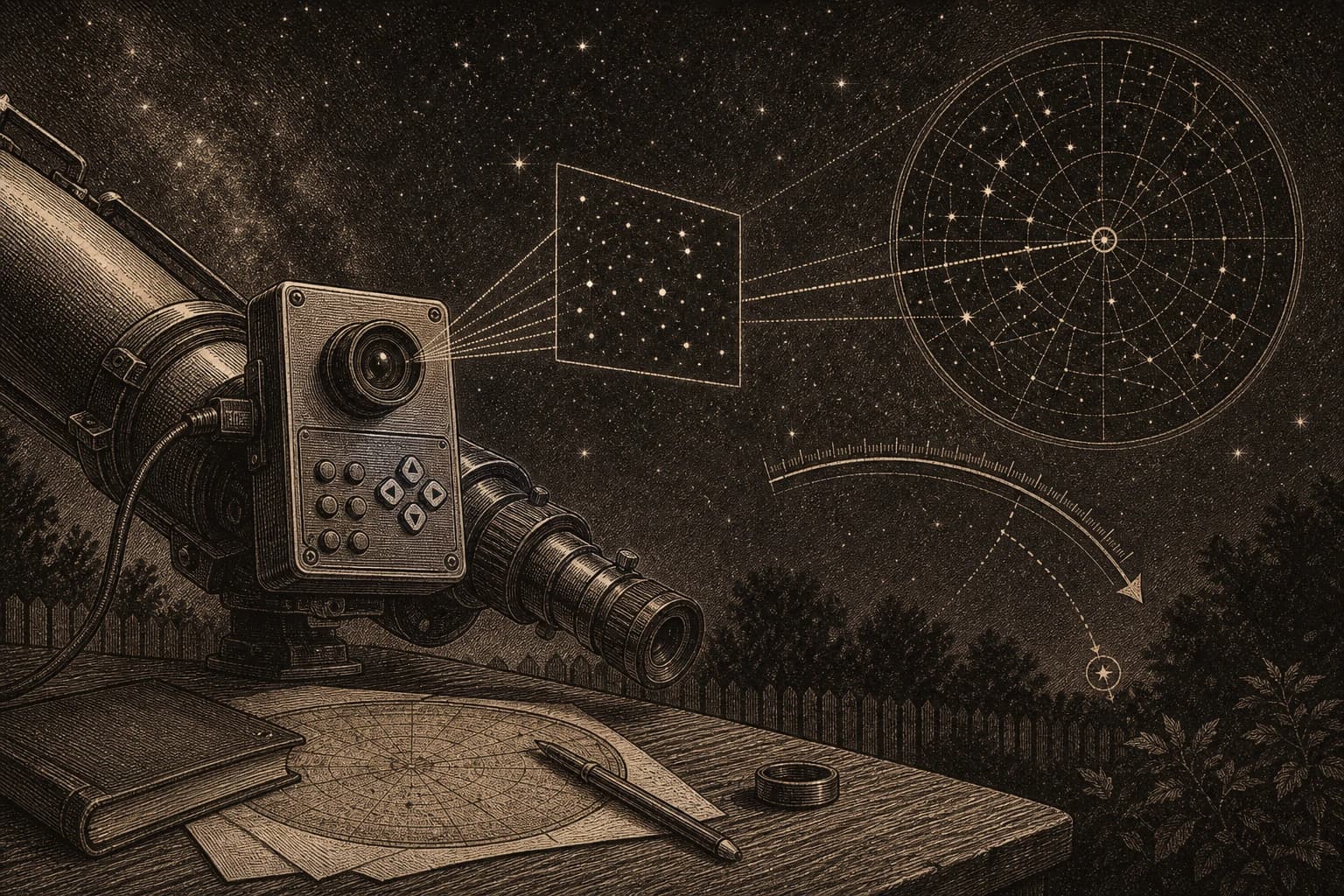
Mounts a Raspberry Pi camera beside a telescope, plate-solves the star field, and combines GPS and inertial sensing to guide push-to observing without a separate alignment routine.
Visit PiFinderOriginal editorial concept art generated with built-in Codex Image Gen for The Machine Press, 2026-08-02; carried into the 2026-08-07 edition.
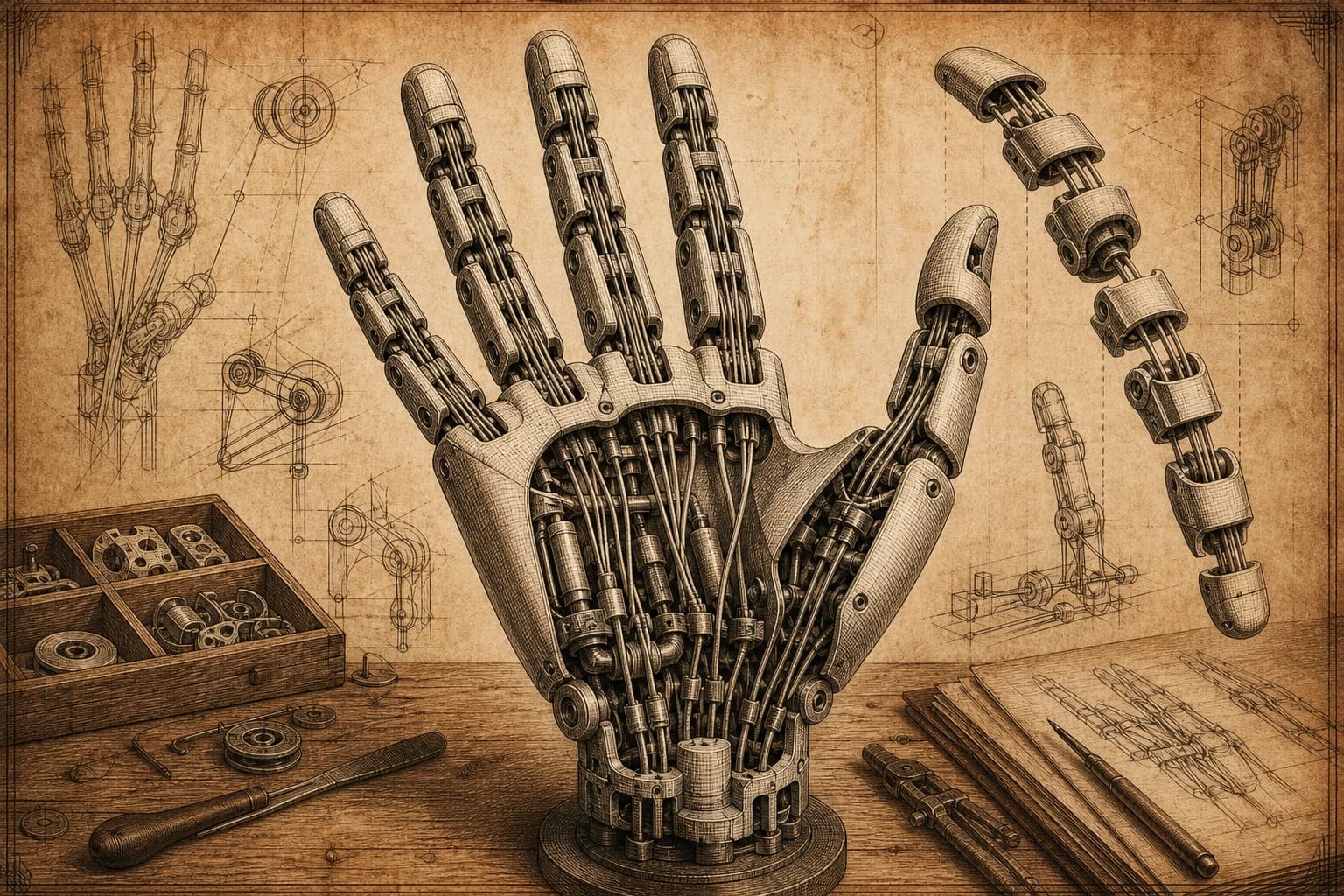
Routes tendons through a modular five-finger, 16-joint hand with seven controlled degrees of freedom, printable parts, firmware, an SDK, ROS 2 tools, and simulation assets.
Visit Aero Hand OpenOriginal editorial concept art generated with built-in Codex Image Gen for The Machine Press, 2026-08-02; carried into the 2026-08-07 edition.
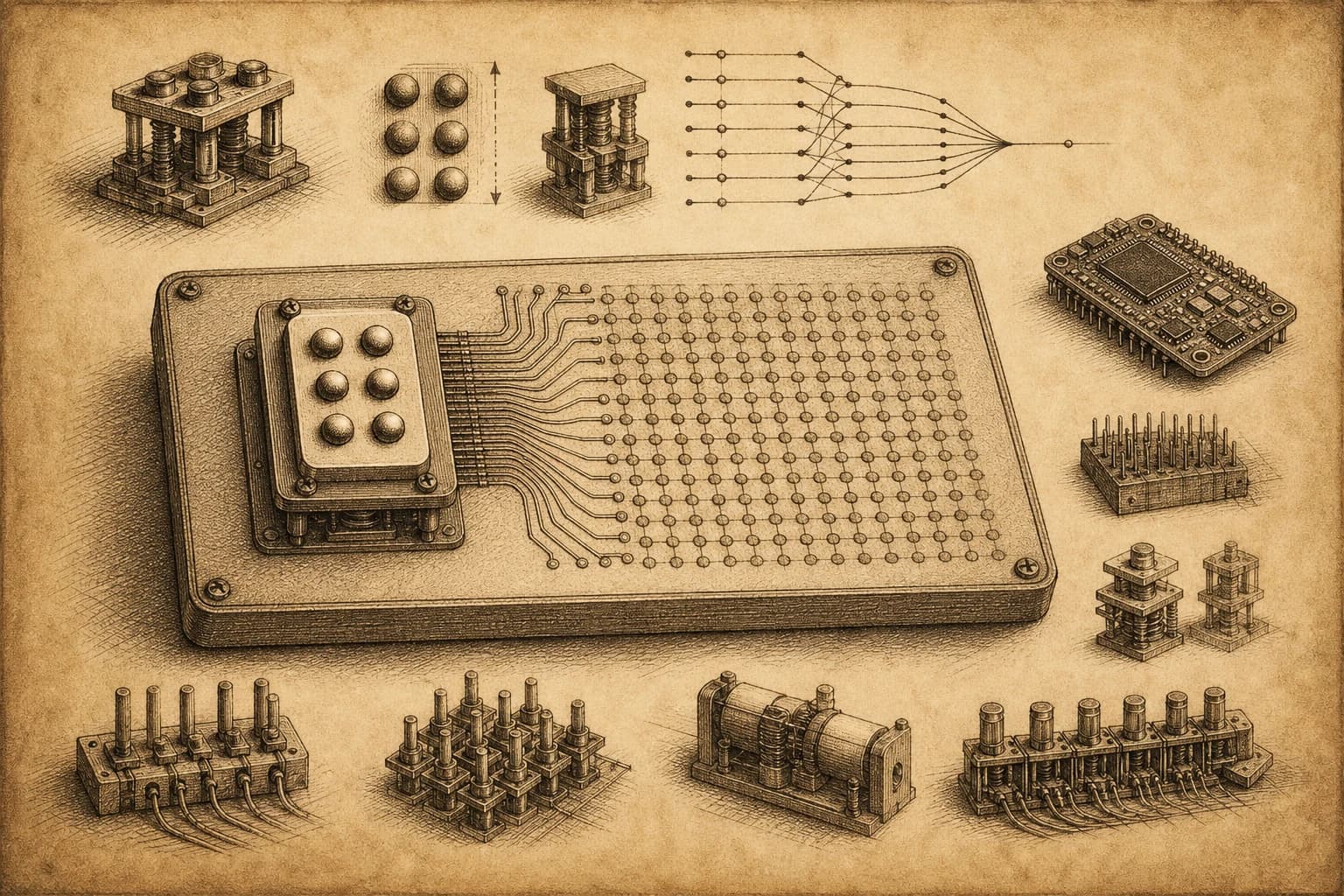
Explores pairing one physical refreshable Braille cell with a tactile sensor matrix representing virtual character positions, reducing the amount of moving hardware under study.
Visit BrailleTouchOriginal Codex Image Gen concept art from 2026-07-10; carried forward from the validated 2026-08-01 edition.
Desk Picks are selected by the newsroom. Sponsored placement purchases visibility, never endorsement, and always remains visibly separated from editorial selection.
 Editorial illustration