research
The Companion May Be Wearing Betelgeuse's Light
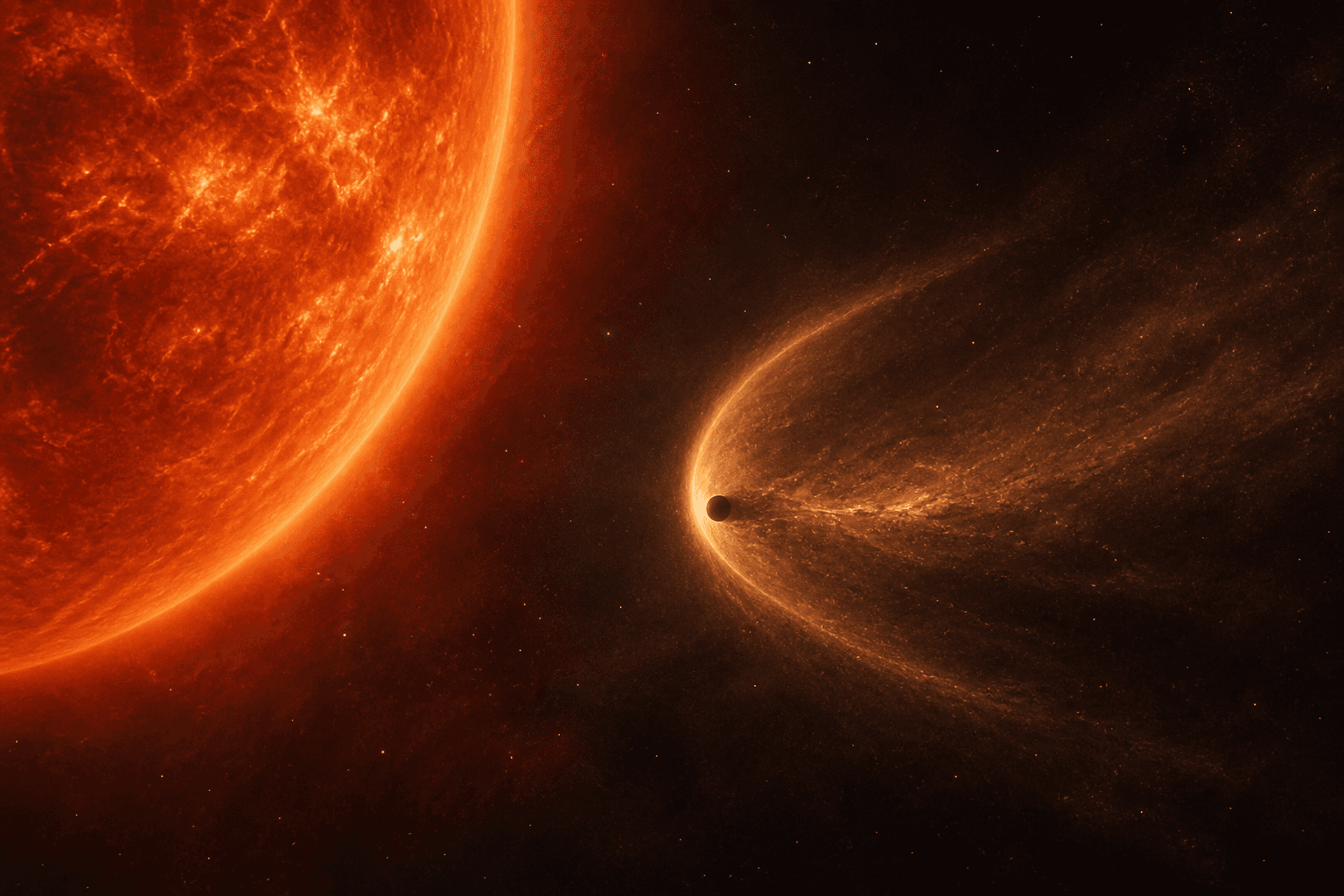
A dusty bow shock could scatter enough of the red supergiant's own light to explain a bright companion candidate without requiring the hot star that ultraviolet limits resist.
Summary
A dusty bow shock could scatter enough of the red supergiant's own light to explain a bright companion candidate without requiring the hot star that ultraviolet limits resist.
Recent optical detections near Betelgeuse imply a source roughly one-thousandth as luminous as the supergiant and have been interpreted as a hot, two-to-three-solar-mass companion. That interpretation conflicts with a far-ultraviolet non-detection. Using filter-specific stellar models and idealized Athena++ simulations, the authors propose that a lower-mass companion's bow shock and dusty wake could instead reflect Betelgeuse's light at ratios of roughly one part in a thousand to one in ten thousand. The calculation is a reconciliation hypothesis awaiting multi-wavelength tests, not a direct bow-shock detection.
Why it matters
A dusty bow shock could scatter enough of the red supergiant's own light to explain a bright companion candidate without requiring the hot star that ultraviolet limits resist.
Limits and context
- The calculation is a reconciliation hypothesis awaiting multi-wavelength tests, not a direct bow-shock detection.
Key claims
A dusty bow shock could scatter enough of the red supergiant's own light to explain a bright companion candidate without requiring the hot star that ultraviolet limits resist.
Qualification: The calculation is a reconciliation hypothesis awaiting multi-wavelength tests, not a direct bow-shock detection.
Evidence: source-2026-08-13-002
Sources
- arXiv preprint 2608.11672arXiv · primary research
Corrections
No corrections have been recorded for this story.