Deep Hubble imaging revealed evidence for the first globular-cluster stellar stream beyond the Milky Way—and a new handle on an ultra-diffuse galaxy's dark matter halo.
Editorial illustration
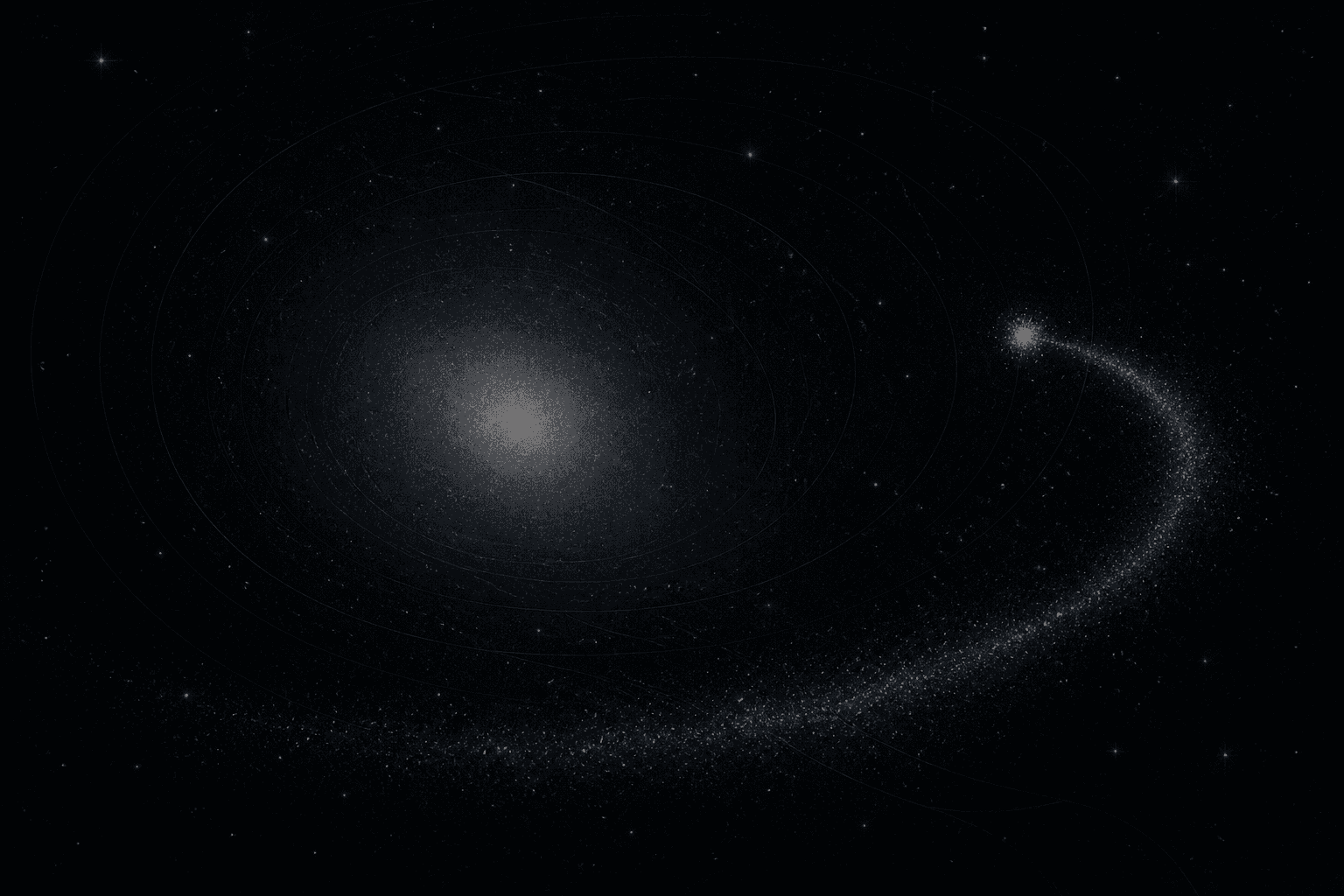
Conceptual illustration: deep imaging and modeling provide evidence for an extragalactic globular-cluster stream and a massive host halo; dark matter is not directly visible. Original editorial concept art generated with built-in Codex Image Gen for The Machine Press, 2026-08-13.
In the ultra-diffuse galaxy UGC9050-Dw1, the authors identify a long, narrow feature whose color, morphology and association with a compact source support an origin in stars tidally stripped from a globular cluster. Simulated stellar populations reproduce the observed surface brightness, and generative stream modeling fits the feature's shape to constrain both its progenitor and host halo. The models favor a globular-cluster origin and a massive dark-matter halo. This is evidence from deep imaging and modeling, not a direct image of dark matter or a final dynamical measurement.
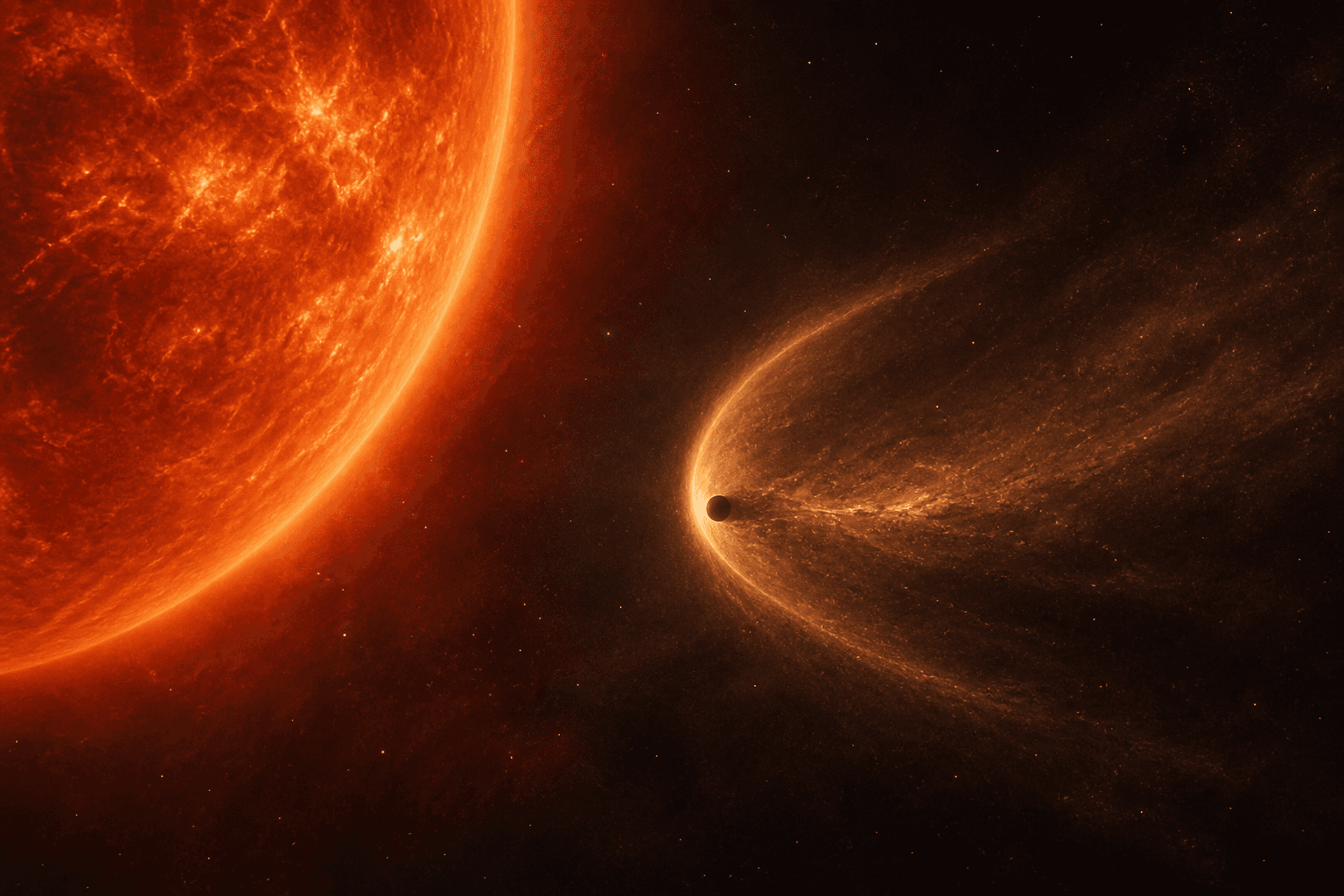
Conceptual illustration: the paper proposes that a dusty bow shock reflects Betelgeuse's light; the structure has not been directly imaged as shown. Original editorial concept art generated with built-in Codex Image Gen for The Machine Press, 2026-08-13.
A dusty bow shock could scatter enough of the red supergiant's own light to explain a bright companion candidate without requiring the hot star that ultraviolet limits resist.
Recent optical detections near Betelgeuse imply a source roughly one-thousandth as luminous as the supergiant and have been interpreted as a hot, two-to-three-solar-mass companion. That interpretation conflicts with a far-ultraviolet non-detection. Using filter-specific stellar models and idealized Athena++ simulations, the authors propose that a lower-mass companion's bow shock and dusty wake could instead reflect Betelgeuse's light at ratios of roughly one part in a thousand to one in ten thousand. The calculation is a reconciliation hypothesis awaiting multi-wavelength tests, not a direct bow-shock detection.
A constellation-emissions model says a direct-to-device harmonic can already cost geodetic VLBI at least 59 percent of its usable data.
The analysis uses measured intended, spurious and unintended satellite emissions, then models aggregate power at Australian geodetic VLBI stations from today's roughly 12,000 catalogued spacecraft through much larger filed constellations. It finds single-dish protection criteria exceeded in two primary radio-astronomy bands and attributes at least 59 percent current VLBI data loss to the 5,240-megahertz second harmonic of a 2,620-megahertz downlink. The figures are the authors' modeled interpretation of survey measurements and proposed protection thresholds, not a regulatory finding.
Illustrative code-screen file image; it does not show the reported harnesses, benchmark tasks, model outputs or measured scores. Daniil Komov / Pexels; cropped, resized, metadata stripped, and converted to WebP by The Machine Press.
Builder models nearly doubled weaker models' average benchmark scores by writing deterministic test-time harnesses instead of changing their weights.
On four theory-of-mind benchmarks, stronger builder models used five percent of each dataset to iteratively design an inference harness for a weaker target model. Average target performance rose from 0.49 to 0.91 without parameter updates. The largest gains came from moving brittle reasoning into deterministic code, routing cases and enforcing answer formats rather than simply eliciting more chain-of-thought. The result is benchmark-specific scaffolding, not a general transfer of every capability.
Reinforcement-trained persuaders drove a target model toward false conclusions in one turn and transferred some of that attack to unseen models.
The researchers trained persuader agents to change a model's initially correct answer with one targeted argument. Against the training-time target, reported success rose from about 24 percent with static prompts to more than 93 percent; transfers reached 83 percent on Qwen-14B, 79 percent on Llama-3.1-8B and 25 percent on GPT-4o-mini. A curriculum raised the latter to 38 percent. The attacks increasingly used fabricated citations and false authority, making persuasion resistance a concrete agent-safety test.
An audit traced Blackwell Ultra's default INT8 failure through the ISA, kernel library and two serving engines.
The audit begins with a roughly 30-to-one dense-throughput ratio between FP8 and INT8 in published B300 specifications, then follows support through PTX, CUTLASS, vLLM and SGLang. It reports no fifth-generation integer tensor-core path for the target ISA, skipped INT8 kernel generation, a vLLM runtime failure after model load and SGLang kernels that stop at an earlier architecture. A Triton reroute can provide an escape hatch. The finding is about the tested full software stack, not a claim that integer arithmetic is absent from the chip.
A proposed optical sensor turns microscopic delayering or drilling into a measurable sideways shift in reflected light.
The design couples a reflected beam into a high-index sensing layer through frustrated total internal reflection. Numerical simulations show an approximately linear response below 250 nanometers of layer thickness and 5.3 nanometers of beam displacement for each nanometer removed—nearly three times the modeled response of a conventional structure. Drilling depth and width also produce monotonic changes. This is a simulated co-packaged tamper-sensor proposal, not fabricated security hardware or a field test.
A tunable photonic interposer combined gigahertz spectral tuning, fast spin control and fiber readout on one proposed repeater-node stack.
Tin-vacancy centers in diamond naturally vary in frequency, making photons distinguishable. The demonstrated silicon-nitride photonic platform uses strain tuning and a multiphysics digital twin to bring emitters into alignment. On one node, the team reports gigahertz-scale optical tuning, electron-spin gates under 80 nanoseconds, nuclear-spin detection and commercial fiber-array readout. A separate simulation projects 99.96 percent connectivity across roughly one thousand emitters; that scale is a modeled architecture, not a deployed network.
Illustrative fiber-network file image; it does not show the reported silicon photonic engine, channels, chip or transmission experiment. Brett Sayles / Pexels; cropped, resized, metadata stripped, and converted to WebP by The Machine Press.
A silicon photonic engine integrated spatial and polarization processing, then self-configured up to six channels over 300 meters of fiber.
The chip monolithically combines transceivers, spatial and polarization multiplexers and optical signal processors. Experiments exceeded 1.8 terabits per second per wavelength, identified two, four or six concurrent channels and mitigated dynamic crosstalk. The authors report more than five-thousandfold lower processing power and latency than the compared six-order digital signal processor, plus full-duplex communication over 300 meters. Those comparisons apply to the reported prototype and test conditions, not a general data-center deployment.
A foundation model used a few measurements from a new sample to prioritize combination-drug experiments without molecular profiling or fine-tuning.
ScreenShot was pretrained across 40 drug-screening datasets covering 3,700 drugs and 6,000 biological samples. Given a small context from a held-out patient sample, it predicts responses to drug combinations directly from functional measurements. On four held-out datasets it outperformed the reported baselines, and an active-learning strategy using its representations matched uniform screening's hit detection with one-third of the experimental budget. The work supports experiment selection; it does not prescribe treatment or establish patient outcomes.
GenFAR trained a general MRI representation across eleven cohorts and seventeen tasks, then transferred it to new prediction problems.
The framework trained on MRIs from 49,246 people across 11 cohorts, using 17 tasks spanning cognition, diagnosis, demographics and biomarkers. An analysis of 5,000 task orderings selected six-task sequences and identified five strong donor tasks, including age and cognitive measures. The resulting representation improved accuracy and sample efficiency on secondary tasks not included in the original sequence. These are retrospective modeling results, not a clinical diagnostic system or evidence that one representation fits every population.
Annual Earth-observation embeddings improved site-level temperature and wind estimates derived from roughly 25-kilometer atmospheric grids.
The downscaler compresses 10-meter TESSERA surface embeddings into a local descriptor alongside coarse ERA5 fields. Across five climate regions and stations held out in space and time, the authors report CRPS improvements of 11.5 percent for two-meter temperature and 6.2 percent for ten-meter wind speed. Gains persisted when Aurora forecasts replaced reanalysis and at new stations without regional histories. The study tests statistical downscaling, not a replacement for physical observing networks.
A probabilistic neural model produced stable multi-year upper-ocean and sea-ice ensembles under atmospheric forcing.
DLESyM-Ocean is trained with a patch energy-score loss to simulate global upper-ocean and sea-ice conditions. When driven by atmospheric forcing, it produced spatially coherent ensembles with limited bias relative to reanalysis and remained stable during multi-year autoregressive runs. Case studies included a sea-ice extreme, a marine heatwave, the 2023 El Niño transition and the 2023 global-temperature spike. The evidence is comparison with reanalysis and selected historical cases, not a coupled operational forecast deployment.
Illustrative empty laboratory-glassware file image; it does not show ionic liquid, a thruster, impact chemistry, simulation data or reported results. Rodolfo Clix / Pexels; cropped, resized, metadata stripped, and converted to WebP by The Machine Press.
Atomistic foundation models reproduced several DFT collision outcomes for ionic-liquid thruster impacts at a fraction of the reported wall time.
The benchmark compares two pretrained interatomic potentials with density-functional-theory molecular dynamics and a reactive force field for 10-to-100-electron-volt ionic-liquid impacts on a gold surface. The learned models recovered dissociation, high-energy fragmentation and hydrogen-fluoride formation seen in DFT/MD but absent from the ReaxFF runs. Two-picosecond trajectories finished in 2.54 and 5.12 minutes—about four orders of magnitude faster than the reported DFT reference. Broader thruster-lifetime use would still require targeted fine-tuning and validation.
A unifying theory specifies when a physical computing system can generate the adjoint field needed to train itself on-device.
The work derives sufficient conditions for formally exact physical gradients. Linear systems may tolerate damping or gain when reciprocity is preserved, while nonlinear trajectory systems require reciprocity of the linearized dynamics and a time-reversal mirror. The framework recovers several previously separate physical-learning schemes and extends through a broader intertwining condition to some non-reciprocal systems. It is a theoretical synthesis and construction guide, not a single new hardware demonstration.
InViStream masks both color and depth at the camera side so hidden objects cannot reappear when multiple views fuse in the cloud.
Ordinary frame redaction can fail in volumetric video because another camera or the depth map may restore a private object. InViStream propagates public/private decisions across calibrated RGB-D views and sends only sanitized point clouds to fusion. On synthetic and real office-like scenes, the authors report recall near 0.89 and 0.91, structural similarity above 0.98 in synthetic tests and throughput above 30 frames per second. The evaluation covers the reported datasets and object policy, not every capture environment or privacy threat.
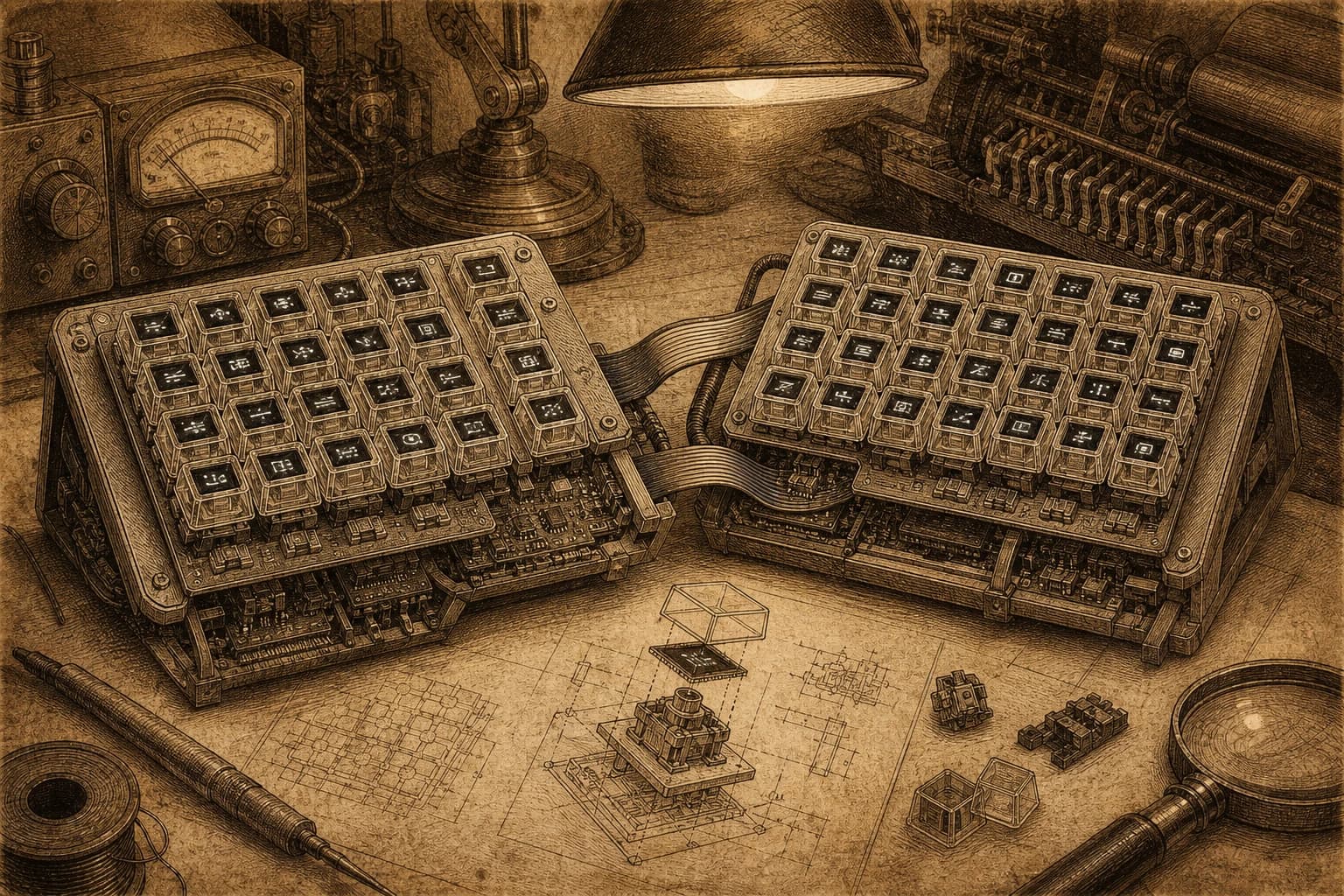
Splits 72 mechanical keys between two halves and puts a tiny OLED beneath each transparent keycap so displayed legends can change with layouts and languages.
Visit PolyKybdOriginal editorial concept art generated with built-in Codex Image Gen for The Machine Press, 2026-08-09.
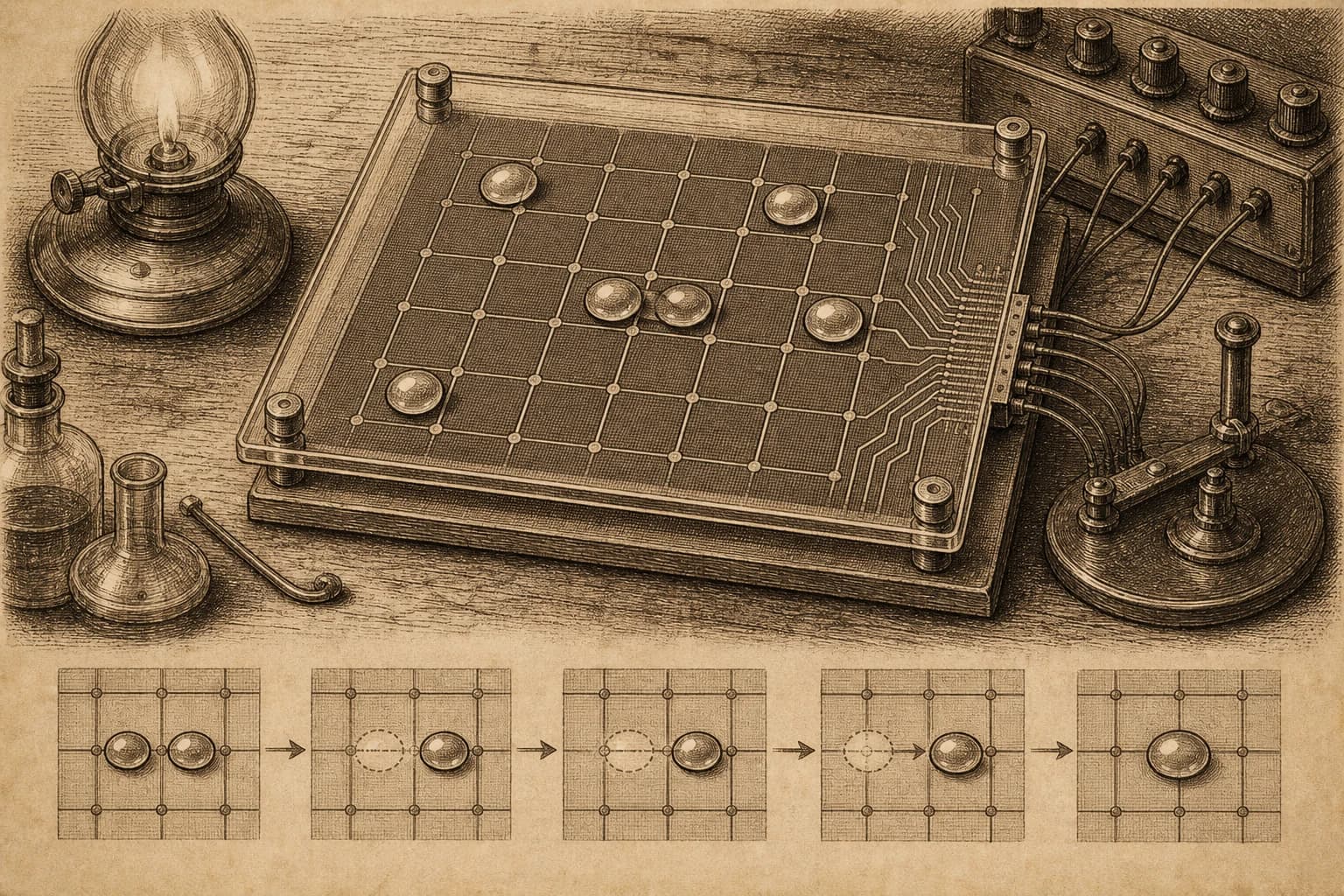
Moves and combines small liquid droplets across an addressable electrode grid, providing an open tabletop platform for digital microfluidics experiments.
Visit OpenDropOriginal editorial concept art generated with built-in Codex Image Gen for The Machine Press, 2026-08-09.
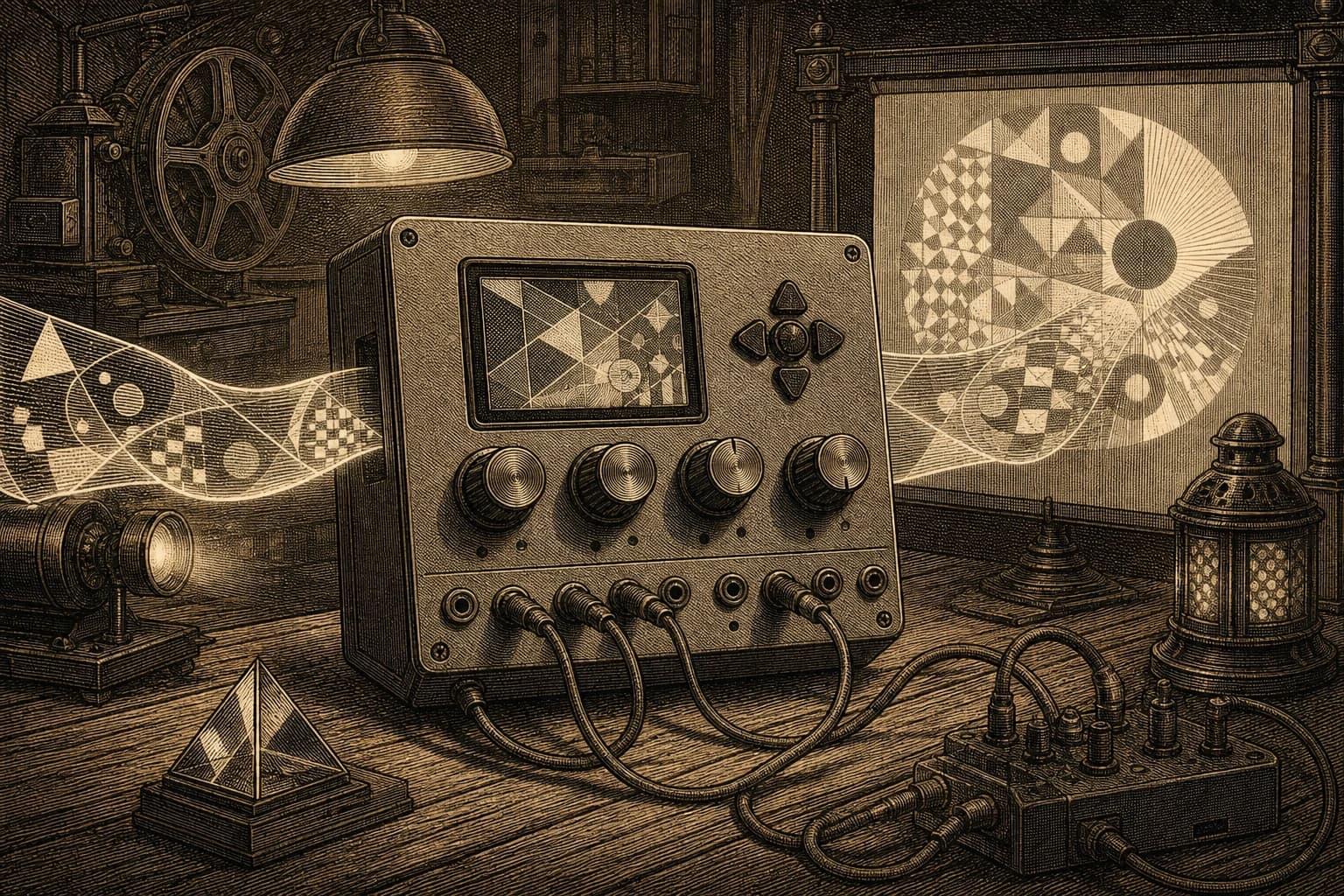
Runs video samples and shaders on a Raspberry Pi Zero, exposes four knob or control-voltage inputs, and can pass compatible external capture through visual effects.
Visit recurBOYOriginal editorial concept art generated with built-in Codex Image Gen for The Machine Press, 2026-08-09.
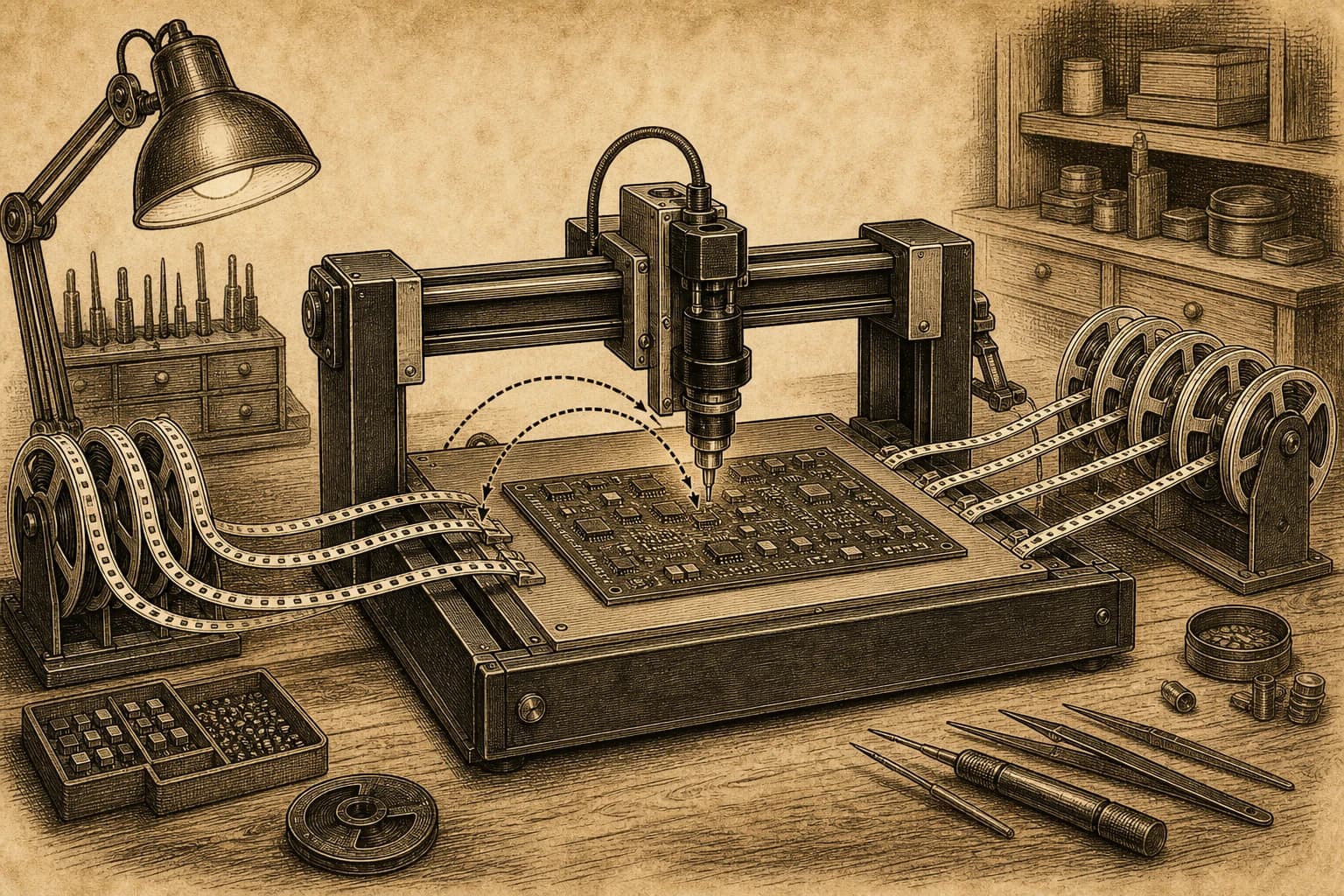
Uses a desktop gantry, placement head, and component feeders to assemble electronic parts onto circuit boards; its primary repository says machines run in active production.
Visit LumenPnPOriginal Codex Image Gen concept art from 2026-07-10; carried forward from the validated 2026-08-08 edition.
Desk Picks are selected by the newsroom. Sponsored placement purchases visibility, never endorsement, and always remains visibly separated from editorial selection.
 Editorial illustration