robotics
The Robot Predicted Which Command Could Survive
A behavior world model learned terrain contact, rejected implausible commands and reported 99.3 percent fall recovery in its test regime.
Summary
A behavior world model learned terrain contact, rejected implausible commands and reported 99.3 percent fall recovery in its test regime.
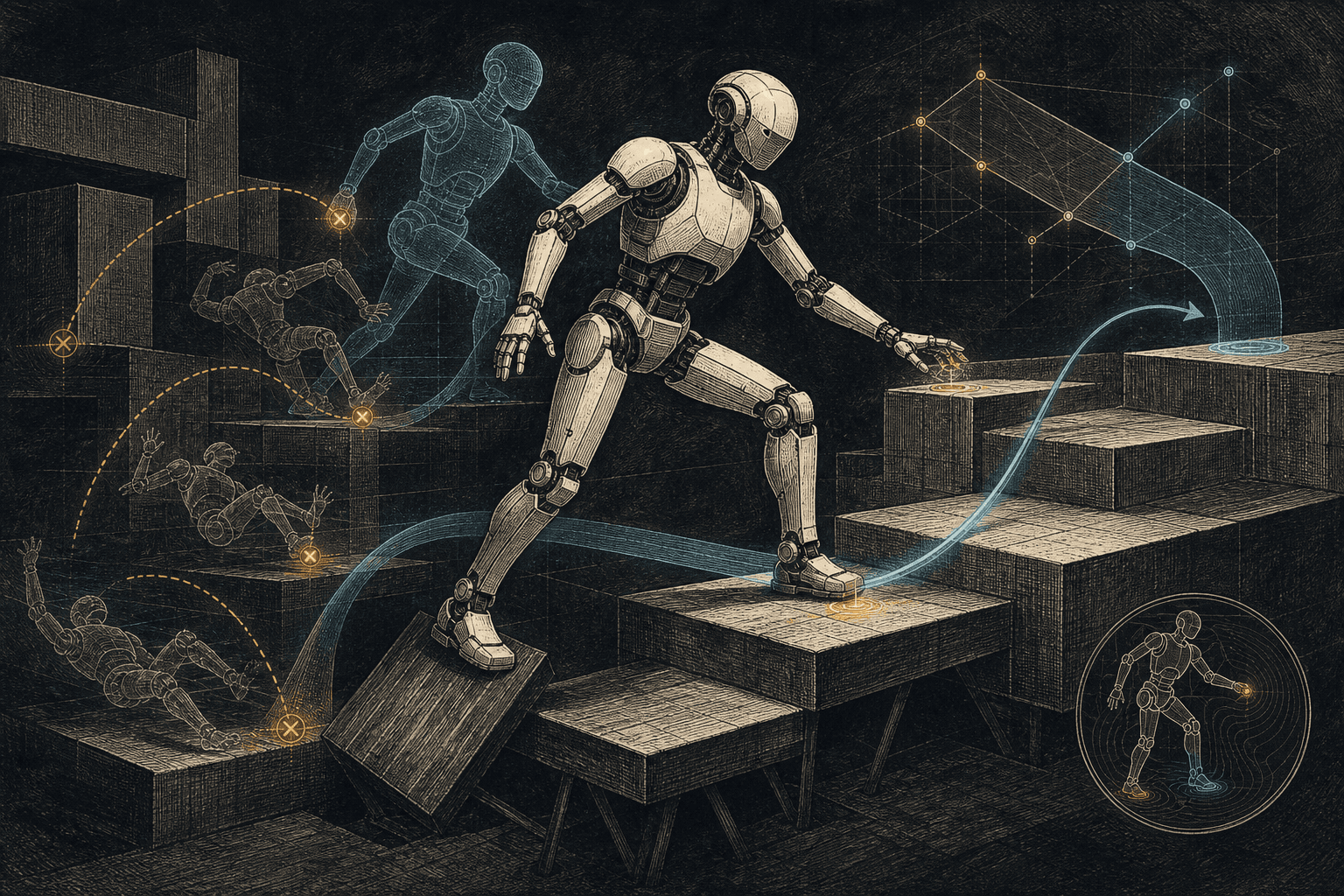
Whole-body trackers usually learn to follow motion on flat, empty ground. GigaBrain-WBC-0.5 instead trains one causal Transformer to predict its next action, next body state and a distribution over the next feasible behavior command. A terrain-annotation pipeline supplies contact geometry, and the predicted distribution lets the deployed controller retract implausible requests toward learned behaviors rather than blindly attempt them.
Across the authors’ comparisons, the policy reported 81.3 percent success on terrain interaction, 83.1 percent under implausible commands and 99.3 percent fall recovery. Hardware trials included missing supports and disturbances, and a checkpoint was fine-tuned across two robot bodies. Those figures describe the paper’s controlled regimes and baselines; they do not establish general-purpose humanoid autonomy or universal safety.
Why it matters
A behavior world model learned terrain contact, rejected implausible commands and reported 99.3 percent fall recovery in its test regime.
Limits and context
- Those figures describe the paper’s controlled regimes and baselines; they do not establish general-purpose humanoid autonomy or universal safety.
Key claims
A behavior world model learned terrain contact, rejected implausible commands and reported 99.3 percent fall recovery in its test regime.
Qualification: Those figures describe the paper’s controlled regimes and baselines; they do not establish general-purpose humanoid autonomy or universal safety.
Evidence: source-2026-08-20-001
Sources
- arXiv preprint 2608.18234arXiv · primary research
Corrections
No corrections have been recorded for this story.