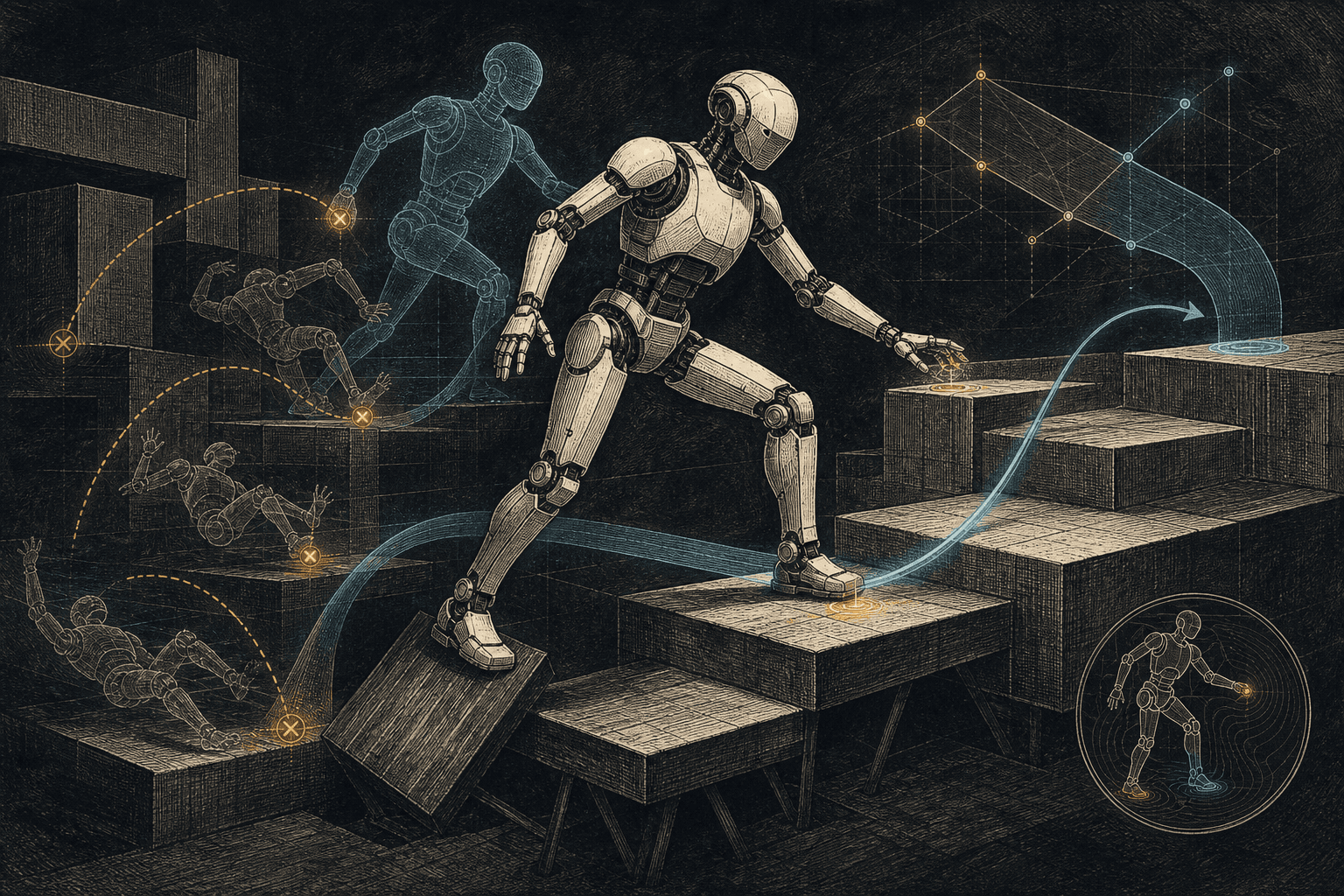
A behavior world model learned terrain contact, rejected implausible commands and reported 99.3 percent fall recovery in its test regime.
Editorial illustration
Conceptual illustration: a behavior world model selected feasible whole-body actions across terrain and disturbances in the paper’s test regimes; this is not a product image or universal autonomy claim. Original editorial concept art generated with built-in Codex Image Gen for The Machine Press, 2026-08-20.
Whole-body trackers usually learn to follow motion on flat, empty ground. GigaBrain-WBC-0.5 instead trains one causal Transformer to predict its next action, next body state and a distribution over the next feasible behavior command. A terrain-annotation pipeline supplies contact geometry, and the predicted distribution lets the deployed controller retract implausible requests toward learned behaviors rather than blindly attempt them.
Across the authors’ comparisons, the policy reported 81.3 percent success on terrain interaction, 83.1 percent under implausible commands and 99.3 percent fall recovery. Hardware trials included missing supports and disturbances, and a checkpoint was fine-tuned across two robot bodies. Those figures describe the paper’s controlled regimes and baselines; they do not establish general-purpose humanoid autonomy or universal safety.
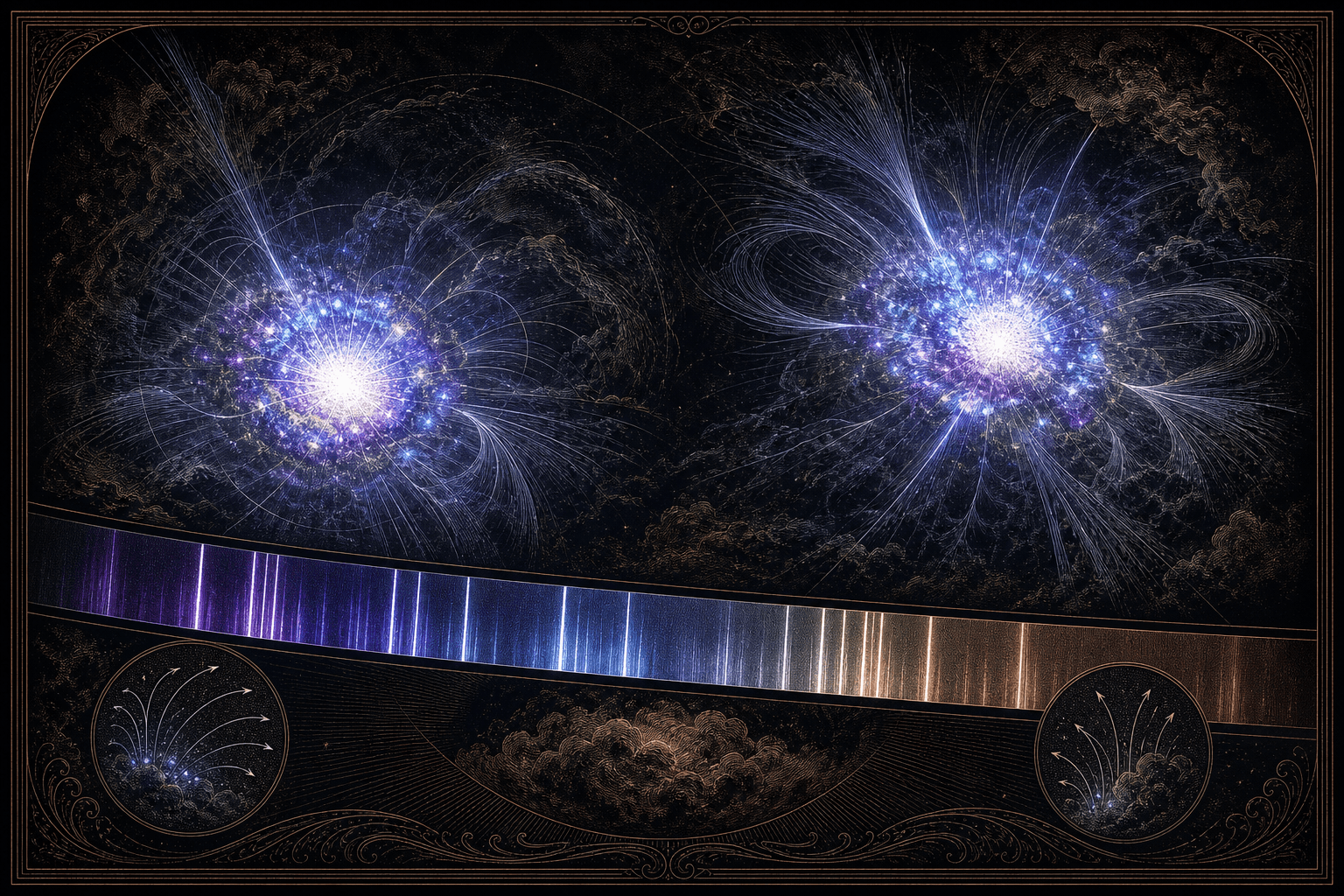
Conceptual illustration: spectra and population models reclassified two cosmic-dawn sources as UV-bright galaxies powered by very massive stars; individual stars were not directly resolved. Original editorial concept art generated with built-in Codex Image Gen for The Machine Press, 2026-08-20.
JWST spectra and ALMA observations reclassified two cosmic-dawn sources and favored stellar populations extending above 225 solar masses.
J1450-0144 and J1429-0104 were selected as faint quasars where the bright ends of the galaxy and quasar populations overlap. JWST/NIRSpec instead found blue ultraviolet continua, stellar-wind P Cygni profiles, broad helium emission and narrow nebular lines. Models that include dedicated winds from very massive stars fit that combination better than standard stellar populations, reclassifying both sources as extraordinarily UV-luminous galaxies.
The favored models imply star-formation rates of roughly 300 to 540 solar masses per year. For J1429-0104, line diagnostics point to an upper stellar mass above about 225 Suns; J1450-0144 lies beyond even the tested 475-solar-mass grid. ALMA also detected bright carbon emission in both and an offset dust component in one. These are model-dependent population constraints—not direct images or individual stellar weighings—but they show how stellar winds can make an early galaxy masquerade as a quasar.
A coding loop solved Push-T without demonstrations, then extended its generated simulator curriculum from A through Z.
For the classic Push-T benchmark, an LLM coding agent searched for the simulation, experimented with push mechanics and iteratively wrote a policy. The authors report 100 percent simulated success with 46 percent fewer steps than a diffusion policy trained on 200 demonstrations, then extend the method to alphabet-shaped blocks and two simulated robot arms. Videos and fuller details were still promised, so the striking claims remain an early short-paper result rather than independent verification.
NASA OSAM-1 file image used only as generic robotics context; it does not depict GuideFetch, robot dogs, the simulated study or results, and use does not imply NASA endorsement. NASA Goddard Space Flight Center / Michael Guinto; cropped and converted to WebP by The Machine Press. Use does not imply NASA endorsement.
A validated schedule let one assistive robot guide a user while another fetched an object, cutting mean completion time by 41.3 percent in matched successes.
GuideFetch normalizes targets and skills, validates an LLM-produced four-action schedule against robot capabilities, then tracks robot and object state during sequential or parallel execution. Across 360 controlled runs, online plans matched their scripted counterparts; among 56 cases completed under both schedules, parallel execution reduced mean makespan by 41.3 percent. The result belongs to simulated task combinations, not unsupervised public deployment.
Generalized Pauli checks mapped higher-dimensional errors to ancilla readouts and exceeded 97.5 percent mitigated fidelity in numerical tests.
The proposed check pairs extend Pauli Check Sandwiching from qubits to arbitrary-dimensional qudits with Heisenberg-Weyl operators. The authors prove that each modeled error maps to a distinct ancilla readout and validate the construction from dimension two through nine, reporting error-mitigated fidelities above 97.5 percent under simulated depolarizing noise. Hardware overhead and real-device behavior remain open engineering questions.
Nearly two decades of spectra exposed recurrent magnesium absorption without a matching optical-brightness cycle.
Annual-scale spectroscopy from 2008 to 2025 shows candidate four-year rest-frame variability in the broad absorption of quasar J1333+0012. Optical light curves do not show a comparable cycle, while coherent changes across velocity components are consistent with a rotating, uneven shielding structure. Because only a few cycles are sampled and the ionizing ultraviolet continuum is unobserved, the authors stop short of declaring strict periodicity.
A stereo-distance signal held a 0.927 macro F1 across new surgical tasks and phantoms while an RGB baseline fell to 0.320.
The detector reduces stereo depth around a surgical tool boundary to one distance-derived scalar and models contact as a two-state process. Trained on six palpation sessions and tested on four held-out sessions, it reached 0.927 macro F1 and 0.980 AUPRC across same- and cross-phantom settings. The comparison uses silicone phantoms, so the study supports a transferable cue rather than clinical performance in living tissue.
Three-dimensional simulations found recombination could widen near-parabolic tidal debris to roughly 30 stellar radii.
As a disrupted star’s stream cools, hydrogen recombination and molecular formation return heat to the gas. Simulations with a realistic equation of state find that this added energy ends self-gravitational confinement before bound debris reaches apocenter and expands the stream by factors from a few to a few tens. The work supplies improved initial conditions for later emission models; it is not a direct observation of one tidal disruption event.
Illustrative file image of The National Archives server room; it does not depict the tested models, GPU, storage tiers or throughput measurements. The National Archives (UK), via Wikimedia Commons, CC BY 3.0; cropped and converted to WebP by The Machine Press.
Locality training cut cache misses by as much as 60 percent but failed a preregistered one-percent perplexity limit.
Measurements of a 235-billion-parameter mixture-of-experts model on an 8 GB GPU exposed a memory-bandwidth wall at 0.44 tokens per second. Smaller preregistered training runs made routing more cacheable, including a 99 percent static-pin hit rate, but every configuration missed the quality gate. A training-free rerouting stack reached about 80 percent fewer misses at up to 3.4 percent perplexity cost, making the tradeoff explicit rather than free.
New bounds constrain how strongly two-dimensional plates can repel and point flat Chern bands toward shorter crossover distances.
The analysis connects the sign and magnitude of long-range Casimir forces to the quantum geometric tensor. It limits the benefit of simply increasing Chern number and predicts that flat Chern bands can widen the repulsive regime and move it toward more accessible distances, with twisted molybdenum ditelluride offered as one platform. The result is a theoretical optimization map, not an experimental force measurement.
Simulation-grounded action estimates improved collision, displacement and reward measures across four highway scenarios.
GAPL asks a language model to estimate an action’s effects, checks those estimates against simulator rollouts and distills the grounded result into a reinforcement-learning policy. Across four Highway-env scenarios, the authors report lower collision and displacement errors plus a 1.44 average reward gain over their baselines. These are simulator results and do not establish road readiness or safety certification.
Twenty-four years of detector damage tracked the solar cycle several years out of phase, resisting a tidy physical fit.
Hubble’s CCDs act as long-running radiation dosimeters in low Earth orbit. Empirical functions can correct more than 99.5 percent of the image-quality effect, but the most accurate fits require physically implausible parameters; realistic parameter choices fit worse. The mismatch highlights how local radiation environments complicate forecasts of spacecraft degradation and useful life.
Sequential Bell measurements let separated inputs feed optimal probabilistic telecloning without a global measurement.
The protocol distributes N copies of an unknown state to M receivers using sequential or parallel Bell-state measurements. Successful runs saturate the no-cloning fidelity bound with success probability independent of receiver count; even unsuccessful measurements can reveal partial information about the nearest Pauli basis. The paper analyzes resources and bounds theoretically rather than reporting a deployed quantum network.
Illustrative generic code file image; it does not depict Redakto, personal information, the legal or medical evaluation data, or a privacy guarantee. Pixabay / Pexels; cropped, resized, metadata stripped, and converted to WebP by The Machine Press.
An open local tool redacted or pseudonymized legal and medical text while preserving utility in the authors’ evaluations.
Redakto exposes personal-information handling through a web app, REST interface and model-context hooks that can run on modest local hardware. Evaluations on legal and medical text found downstream utility comparable to the original text across the tested strategies. That does not guarantee perfect privacy: effectiveness depends on the detector, domain and configuration, and any missed identifier could still reach the downstream model.
A 34-event search recovered two known periodic light curves and added SN 2020sgf as a promising candidate.
A statistically controlled search of Zwicky Transient Facility photometry recovered periodic undulations in SN 2022jli and SN 2022esa and identified SN 2020sgf as another candidate. Injection tests quantify what periods and amplitudes the survey could recover, and population models with roughly 20 percent intrinsic periodicity remain consistent with the detections. The new object is a candidate, not a confirmed binary mechanism.
A personalized inverse model cut interaction torque by up to 73 percent without force or physiological sensors on a test rig.
The controller models pneumatic artificial muscles with hysteresis and linear dynamics, personalizing the inverse plant from 140 seconds of movement data. On a wrist test rig it reduced interaction torque by up to 73 percent and key muscle activation by up to 47 percent across tested speeds. The result is task-agnostic assistance in an emulated setup; clinical benefits and everyday wear remain unproven.
Four independently verified builder projects from the active August 16–22 cycle, plus one disclosed house-example sponsored slot and one placement CTA. Weekly images are carried over from the validated Sunday handoff.
Four editorial selections
$7 for seven days
Paid work is clearly labeled
Placement is never endorsement
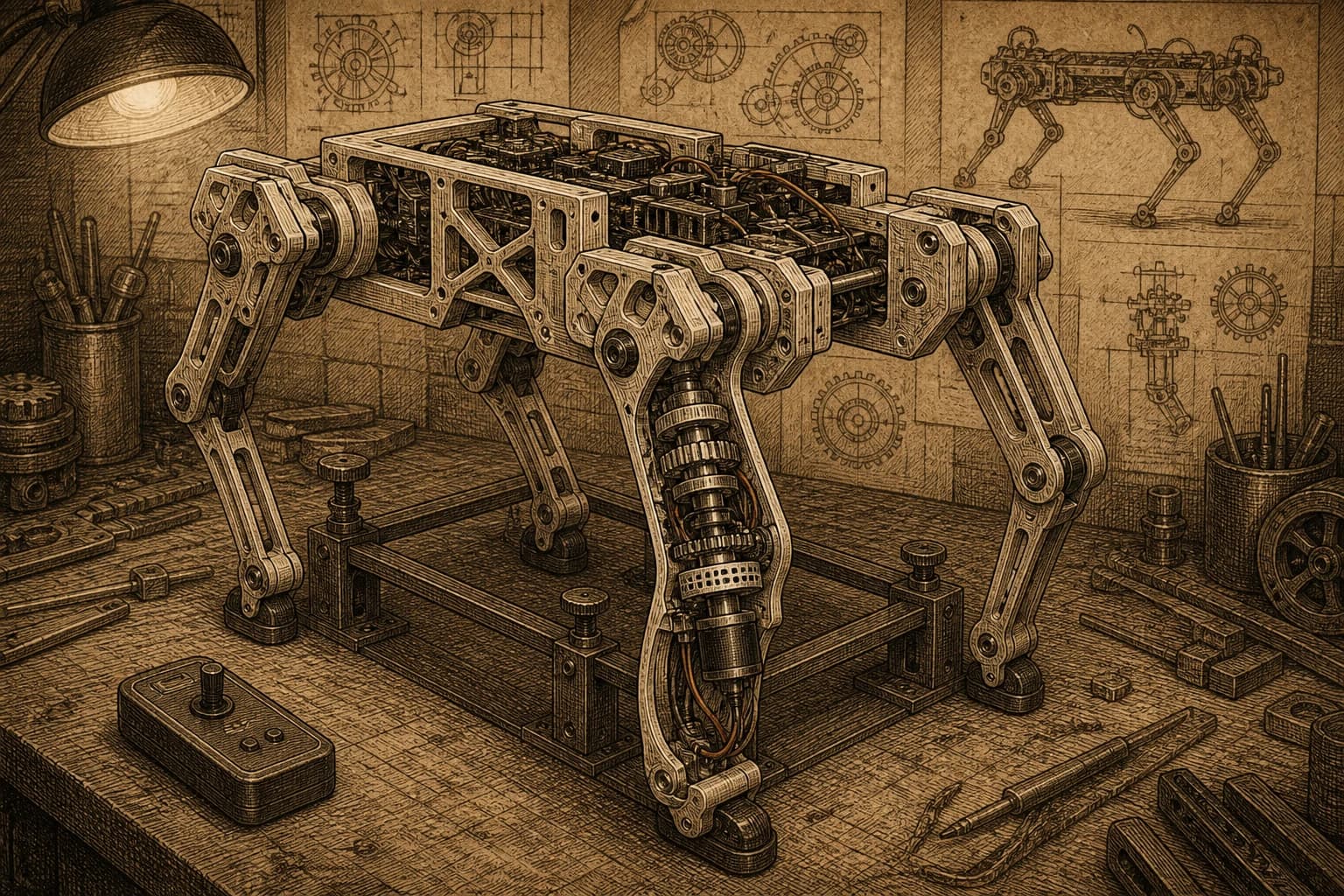
Original editorial concept art generated with built-in Codex Image Gen for The Machine Press, 2026-08-16.
Supplies CAD, code, and a bill of materials for a PLA-printed quadruped with motor-driven joints, closed-loop controls, and an inverse-kinematics walking mode.
Visit openDogV3Original editorial concept art generated with built-in Codex Image Gen for The Machine Press, 2026-08-16.
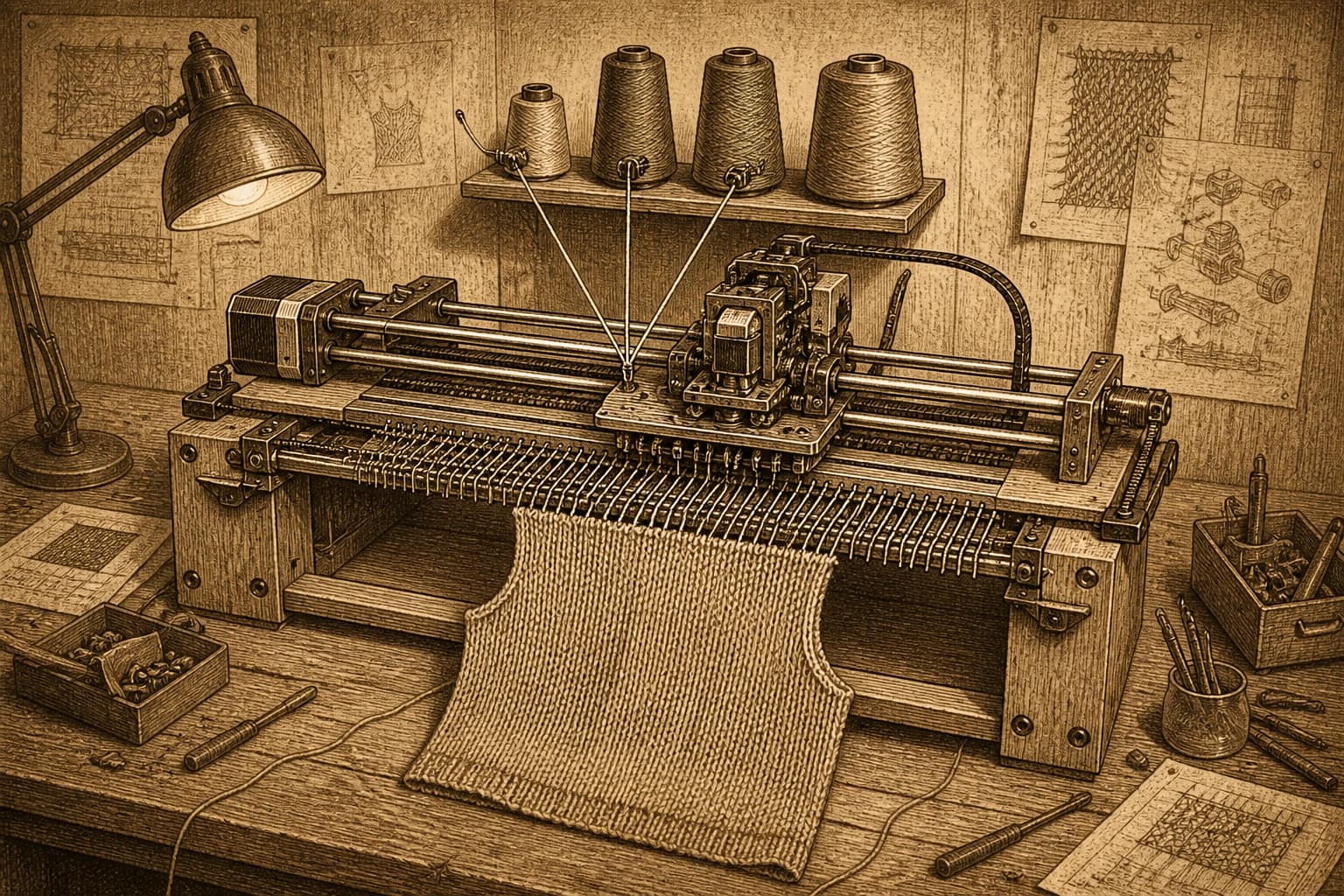
Aims to turn digital garment files into knitted pieces on an open-source machine; its smaller Wally120 design is easier to assemble, but the project remains early beta hardware.
Visit OpenKnitOriginal editorial concept art generated with built-in Codex Image Gen for The Machine Press, 2026-08-16.
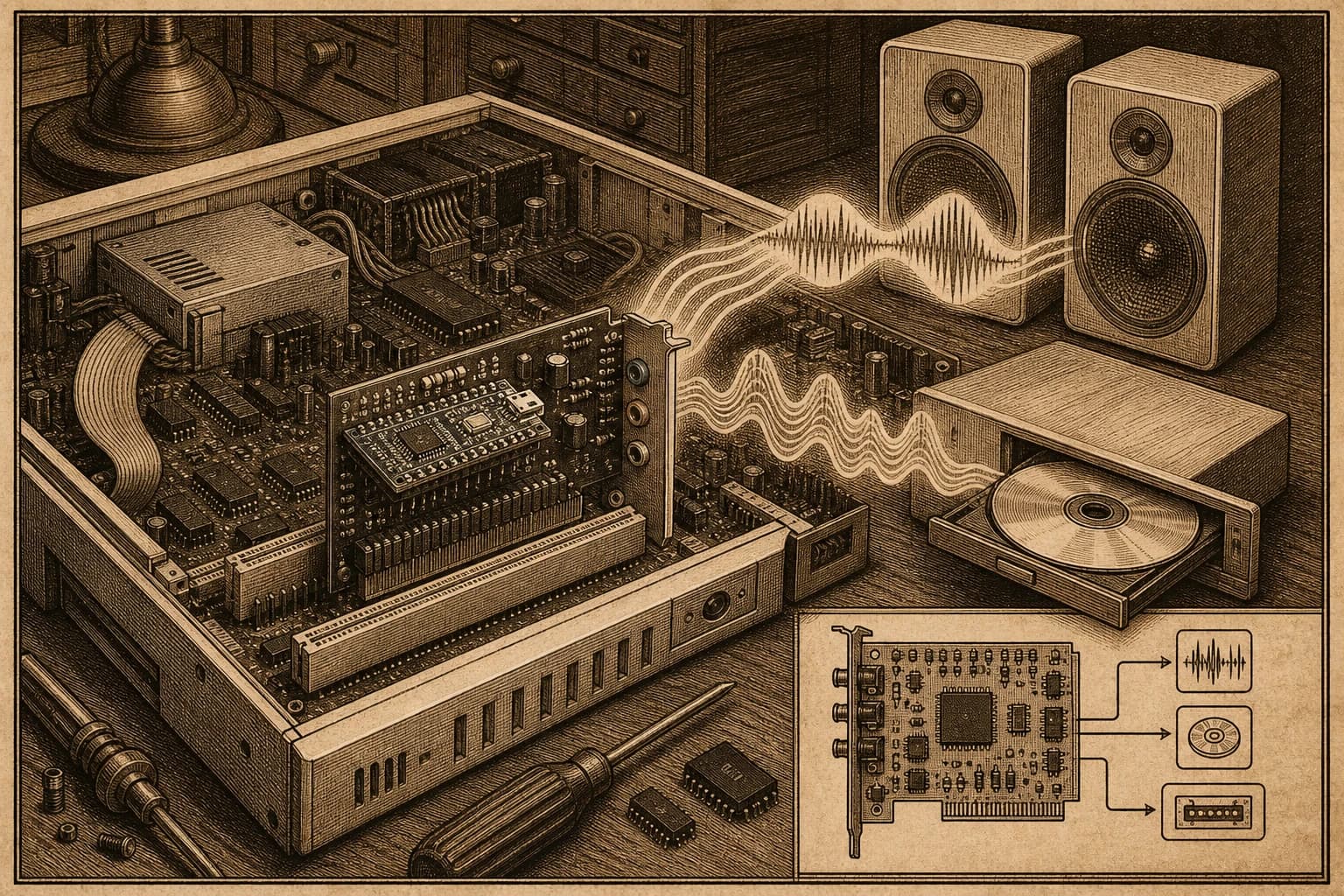
Uses an RP2040 microcontroller to emulate several ISA sound cards and a period CD-ROM interface for retro PCs, with open hardware files and assembled cards available.
Visit PicoGUSOriginal editorial concept art generated with built-in Codex Image Gen for The Machine Press, 2026-08-16.
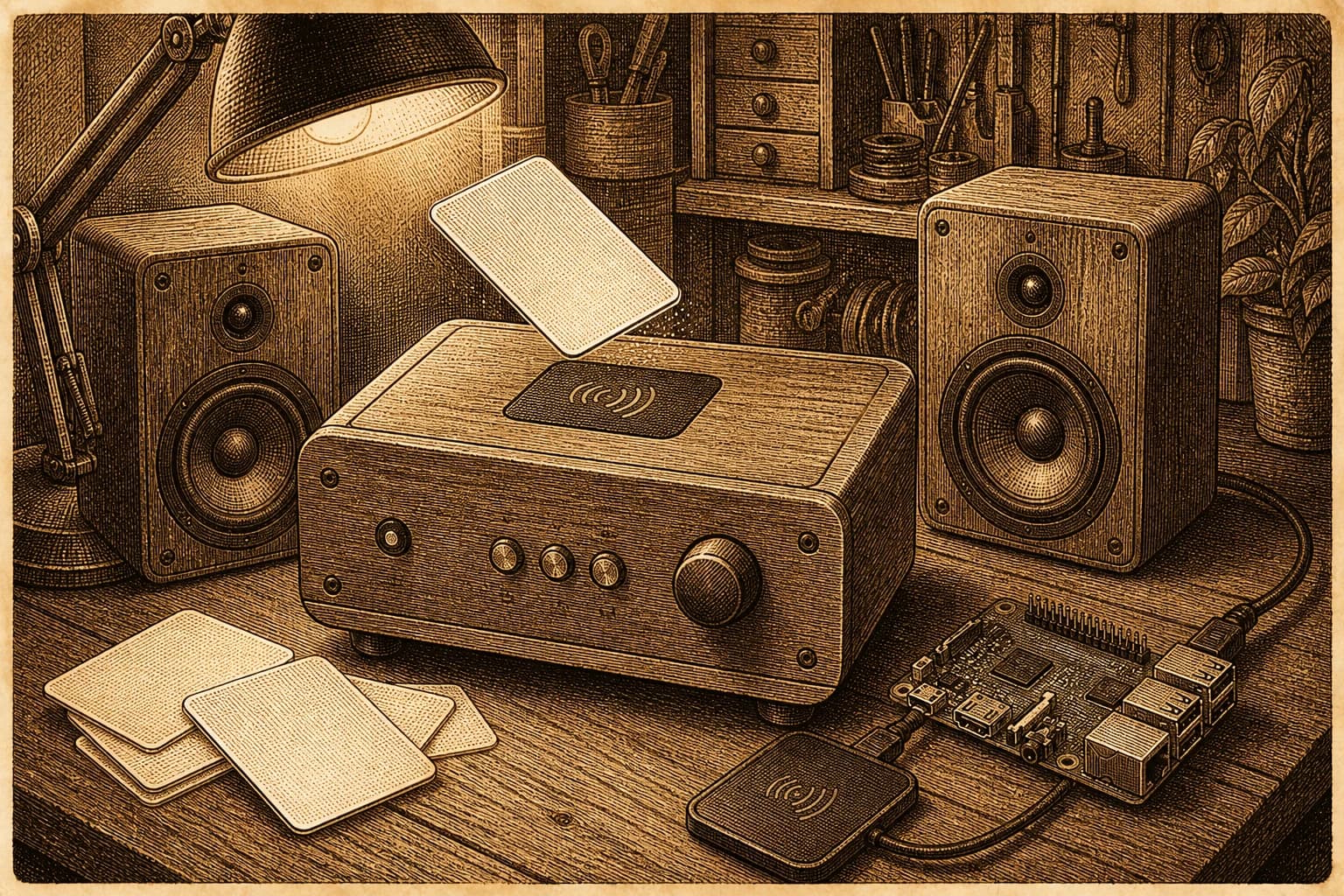
Turns RFID cards into selectors for local audio, playlists, podcasts, and web streams on a Raspberry Pi, with USB-reader setups and optional physical controls.
Visit PhonieboxOriginal Codex Image Gen concept art from 2026-07-10; carried forward from the validated 2026-08-15 edition.
Desk Picks are selected by the newsroom. Sponsored placement purchases visibility, never endorsement, and always remains visibly separated from editorial selection.
 Editorial illustration