research
The Quasars Were Galaxies Full of Giant Stars
JWST spectra and ALMA observations reclassified two cosmic-dawn sources and favored stellar populations extending above 225 solar masses.
Summary
JWST spectra and ALMA observations reclassified two cosmic-dawn sources and favored stellar populations extending above 225 solar masses.
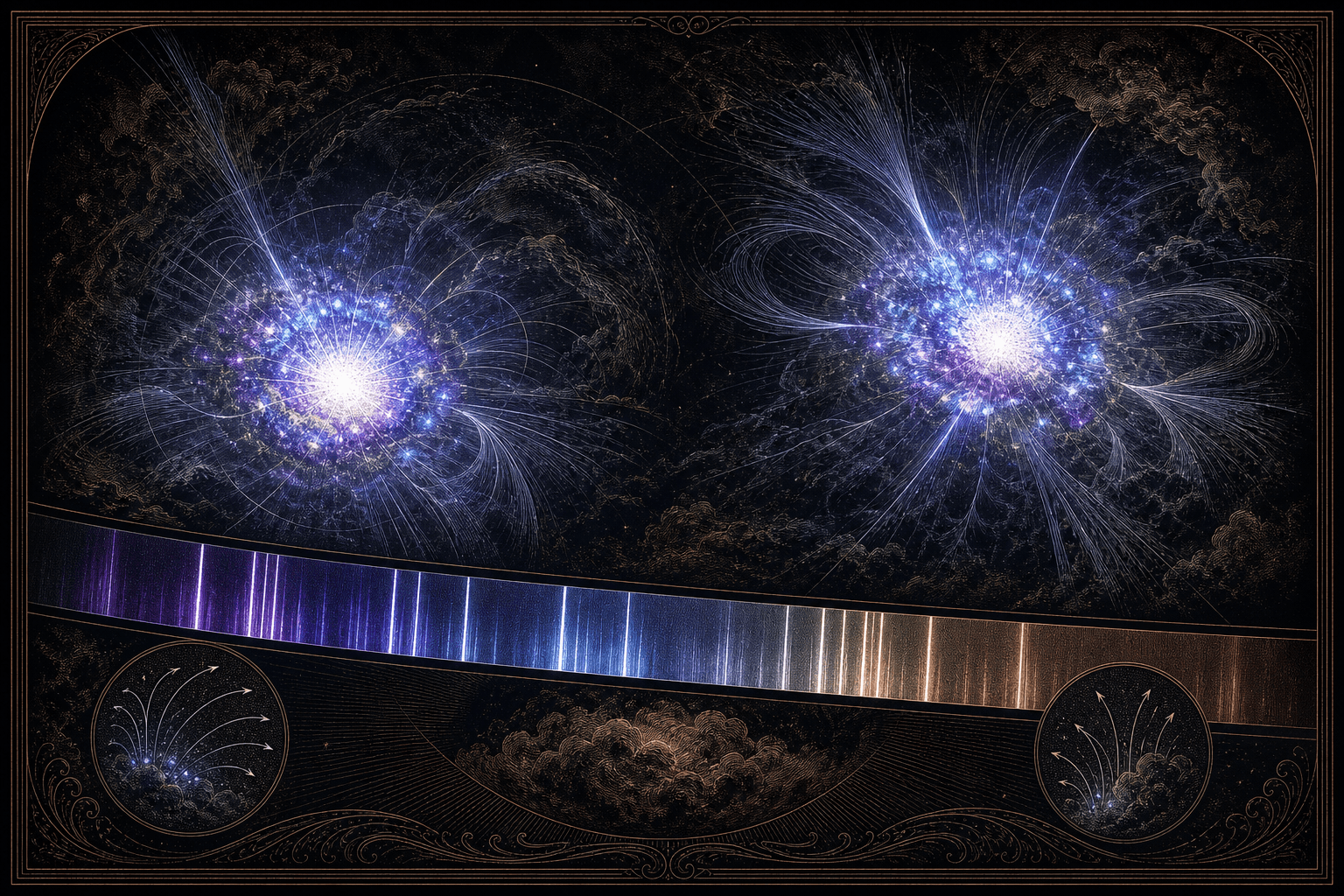
J1450-0144 and J1429-0104 were selected as faint quasars where the bright ends of the galaxy and quasar populations overlap. JWST/NIRSpec instead found blue ultraviolet continua, stellar-wind P Cygni profiles, broad helium emission and narrow nebular lines. Models that include dedicated winds from very massive stars fit that combination better than standard stellar populations, reclassifying both sources as extraordinarily UV-luminous galaxies.
The favored models imply star-formation rates of roughly 300 to 540 solar masses per year. For J1429-0104, line diagnostics point to an upper stellar mass above about 225 Suns; J1450-0144 lies beyond even the tested 475-solar-mass grid. ALMA also detected bright carbon emission in both and an offset dust component in one. These are model-dependent population constraints—not direct images or individual stellar weighings—but they show how stellar winds can make an early galaxy masquerade as a quasar.
Why it matters
JWST spectra and ALMA observations reclassified two cosmic-dawn sources and favored stellar populations extending above 225 solar masses.
Limits and context
- These are model-dependent population constraints—not direct images or individual stellar weighings—but they show how stellar winds can make an early galaxy masquerade as a quasar.
Key claims
JWST spectra and ALMA observations reclassified two cosmic-dawn sources and favored stellar populations extending above 225 solar masses.
Qualification: These are model-dependent population constraints—not direct images or individual stellar weighings—but they show how stellar winds can make an early galaxy masquerade as a quasar.
Evidence: source-2026-08-20-002
Sources
- arXiv preprint 2608.18212arXiv · primary research
Corrections
No corrections have been recorded for this story.