infrastructure
The Voice Broke at the Jitter Boundary
In a 105,000-person stadium field test, shared-network push-to-talk audio failed nonlinearly while priority-managed channels stayed coherent.
Summary
In a 105,000-person stadium field test, shared-network push-to-talk audio failed nonlinearly while priority-managed channels stayed coherent.
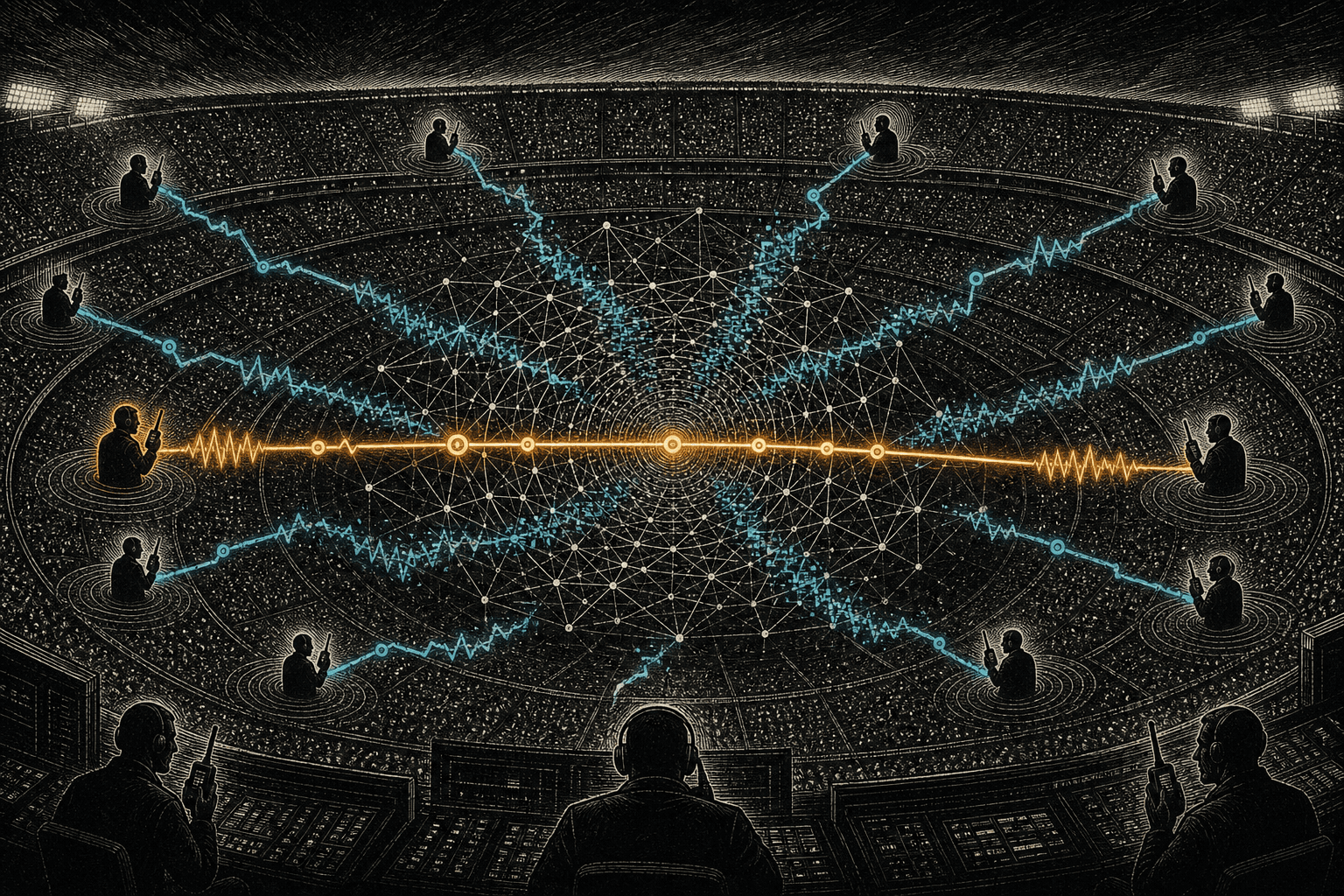
Mission-critical push-to-talk increasingly rides on commercial broadband, but a crowded event can turn ordinary resource contention into a safety problem. Researchers placed twelve identical smartphones across multiple physical sectors of Texas A&M University's Kyle Field during a football game attended by more than 105,000 people. Automated calls crossed carriers and service types while the team measured connection rates, packet delivery and perceptual audio quality.
The reported failure was not a gentle decline. Once transport jitter crossed the de-jitter buffer's effective boundary, the voice path developed structural audio loss even though the devices themselves were not the bottleneck. Priority-managed channels bypassed that congestion in the tested setup. The experiment supports dedicated resources and end-to-end prioritization for emergency communications in dense venues; it does not prove that every carrier, stadium or priority configuration will behave the same way.
Why it matters
In a 105,000-person stadium field test, shared-network push-to-talk audio failed nonlinearly while priority-managed channels stayed coherent.
Limits and context
- The reported failure was not a gentle decline.
- Once transport jitter crossed the de-jitter buffer's effective boundary, the voice path developed structural audio loss even though the devices themselves were not the bottleneck.
- The experiment supports dedicated resources and end-to-end prioritization for emergency communications in dense venues; it does not prove that every carrier, stadium or priority configuration will behave the same way.
Key claims
In a 105,000-person stadium field test, shared-network push-to-talk audio failed nonlinearly while priority-managed channels stayed coherent.
Qualification: The reported failure was not a gentle decline.
Evidence: source-2026-08-22-001
Sources
- arXiv preprint 2608.19554arXiv · primary research
Corrections
No corrections have been recorded for this story.