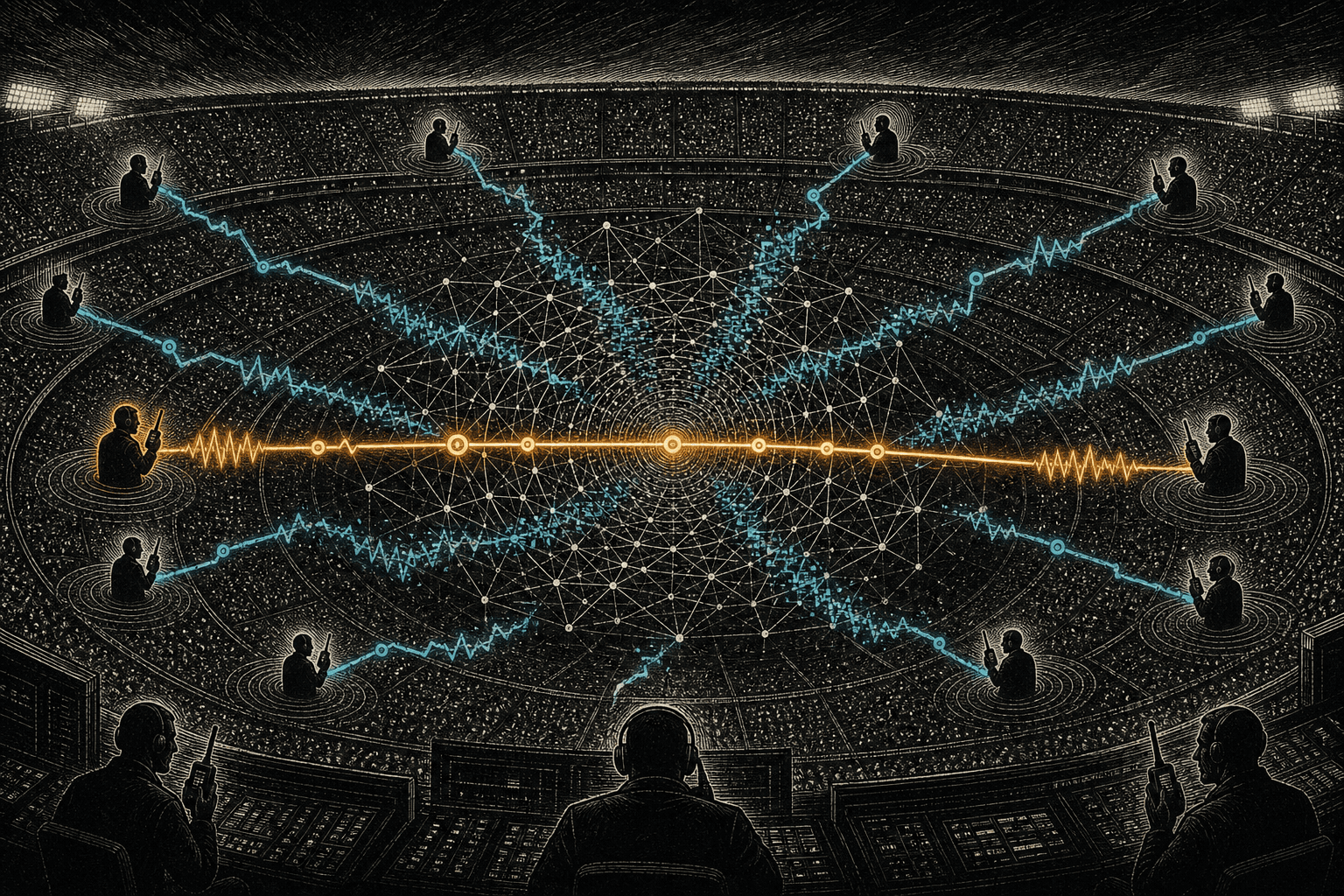
In a 105,000-person stadium field test, shared-network push-to-talk audio failed nonlinearly while priority-managed channels stayed coherent.
Editorial illustration
Conceptual illustration: the reported field test found a nonlinear jitter boundary for ordinary voice paths while priority-managed channels remained coherent in the tested stadium conditions. Original editorial concept art generated with built-in Codex Image Gen for The Machine Press, 2026-08-22.
Mission-critical push-to-talk increasingly rides on commercial broadband, but a crowded event can turn ordinary resource contention into a safety problem. Researchers placed twelve identical smartphones across multiple physical sectors of Texas A&M University's Kyle Field during a football game attended by more than 105,000 people. Automated calls crossed carriers and service types while the team measured connection rates, packet delivery and perceptual audio quality.
The reported failure was not a gentle decline. Once transport jitter crossed the de-jitter buffer's effective boundary, the voice path developed structural audio loss even though the devices themselves were not the bottleneck. Priority-managed channels bypassed that congestion in the tested setup. The experiment supports dedicated resources and end-to-end prioritization for emergency communications in dense venues; it does not prove that every carrier, stadium or priority configuration will behave the same way.
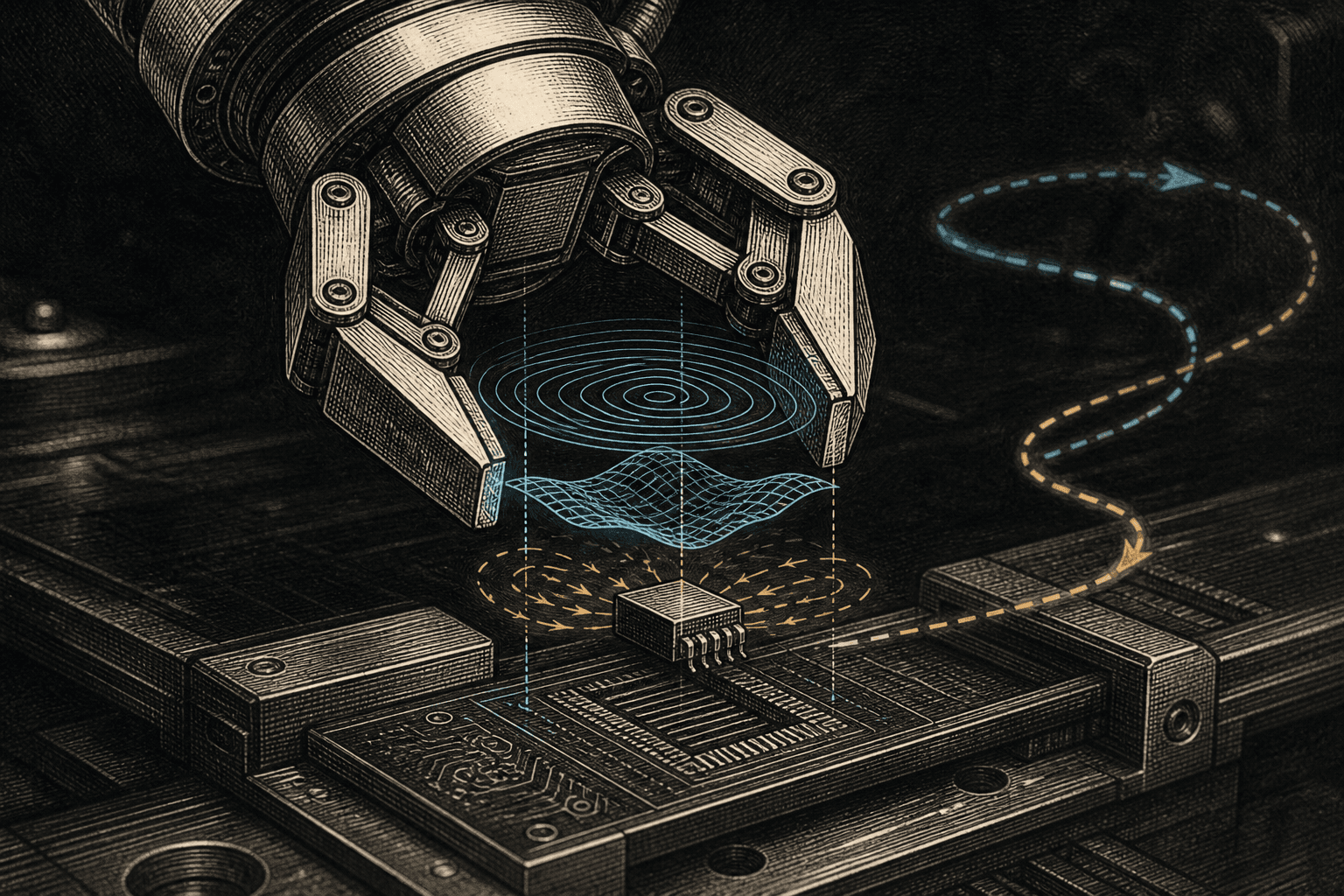
Conceptual illustration: HiTac-WAM forecast contact, deformation and slip for candidate actions and replanned when observed touch diverged in the reported tests. Original editorial concept art generated with built-in Codex Image Gen for The Machine Press, 2026-08-22.
A tactile world-action model forecast contact, deformation and slip for candidate motions, then replanned when the real touch stopped matching.
Vision-action models can propose a movement before a robot touches an object, but delicate manipulation depends on what happens at contact. HiTac-WAM forecasts a hierarchy of future tactile states for each candidate action chunk: whether contact occurs, how the surface deforms in three dimensions and whether it may slip. The model ranks actions with those forecasts and task progress, then keeps the chosen forecast as a reference during execution. Persistent disagreement between predicted and observed touch triggers replanning.
Under matched training budgets, the authors report mean contact F1 of 0.921, a 17.6 percent reduction in deformation error against a deformation-only predictor and a 60.4 percent gain in slip AUPRC against a slip-only predictor. Across chip grasping, blackboard erasing and USB insertion, forecast-guided selection raised average real-robot success from 31.1 to 61.1 percent; the complete system reached 72.2 percent. Those results apply to the reported tasks and platform, not arbitrary manipulation.
Selective abstention cut in-domain sentence error below 2 percent, but found no useful clean subset under extreme social-media shift.
The study stress-tested financial named-entity recognizers across SEC filings, financial news and general social media. Whole-output probability was the best in-domain error signal but deteriorated under shift; span probability and self-consistency were more robust. Abstention reduced sentence error from 34.3 percent to below 2 percent on the most confident 40 percent of in-domain inputs and remained useful on news, but failed to recover a usefully large clean subset on the extreme out-of-domain tier. The result favors upstream shift detection before confidence gating.
Illustrative generic server-hardware file image; it does not depict the tested edge device, models, datasets, compressor or measurements. panumas nikhomkhai / Pexels; cropped, resized, metadata stripped, and converted to WebP by The Machine Press.
Edge-RAG measurements found an adaptive middle range that cut SoC energy by up to 48.2 percent without a reported quality penalty.
Context compression can shorten a retrieved prompt, but the compressor also consumes time and energy on the same edge device. Tests on a Jetson AGX Thor found generation accounted for roughly 90 percent of latency and 91 percent of GPU energy for tested 7B–8B generators. Intermediate compression reduced GPU energy by up to 53.2 percent and SoC energy by up to 48.2 percent with negligible reported quality loss; the best setting still depended on workload and device telemetry.
Audio barely changed decisions until prosody was converted into an explicit intermediate state.
Hear2Act pairs 480 task scenarios with hidden concerns conveyed either in words or primarily through prosody. For two audio-capable models, adding audio to a transcript moved average optimal-solution rate only from 14.6 to 15.3 percent. When the model first inferred the concern into text and then selected an action, the rate rose to 39.6 percent, close to 40.7 percent with the ground-truth state. The benchmark tests two models and structured scenarios, not all spoken assistants.
A controlled Java study found no statistically reliable universal energy winner among Serial, Parallel and G1.
Across three applications, three workload intensities and two JDK distributions, Parallel posted the lowest raw mean energy use, but the collector effect did not reach statistical reliability in the study's blocked analysis. Workload intensity was the consistent driver, and execution time had only a moderate association with energy. The result argues for measurement on the target system rather than a universal collector ranking.
A parameter-free odometry method detected when covariance regularization made an unobservable direction look healthy.
LF-GICP replaces a misleadingly well-conditioned translation block with a voxel-normal localizability field that separates directional anisotropy from simple information dilution. Frozen rules produced the lowest reported KITTI relative translation error and generalized across four sensor types without retuning. The authors also show that a straight uniform tunnel remains unobservable along its axis for LiDAR-only registration; the method detects and manages the gap rather than inventing information.
Backchannels and head movements increased perceived attentiveness and co-presence in a 35-person study.
Researchers added real-time verbal backchannels and predicted head nods to an avatar that already used voice cloning and language-model responses. In a within-subjects study with 35 participants, those listening behaviors significantly increased ratings of attentiveness, resemblance to the real person and co-presence. The small study measures perception in a particular clone setup; it does not establish broader psychological or social effects.
Staged technology file image; it does not depict AEGIS, private training text, a real gradient attack or the reported evaluations. Rafael Minguet Delgado / Pexels; cropped, resized, metadata stripped, and converted to WebP by The Machine Press.
AEGIS masked attention, embedding and MLP leakage paths in federated language-model fine-tuning.
The paper identifies three structural signals that gradient-inversion attacks can use to recover private training text: attention-projection subspaces, sparse embedding rows and an MLP expansion signal. AEGIS freezes or perturbs those backward paths and uses the same masked gradient locally and at the server boundary. Across 11 models and six datasets, the authors report near-zero token recovery with utility preserved or improved; deployment claims still depend on the tested attacks and threat model.
UniLang let a pretrained language model generate structured symbols directly alongside ordinary tokens.
UniLang expands a pretrained model's vocabulary and embedding space with grounded machine-native symbols, avoiding a forced translation of every structured entity into prose. On sequential recommendation and legal-precedent prediction, the authors report consistent gains over comparison systems. The evidence spans two tasks and does not establish a universal interface for arbitrary symbolic systems.
A visual teacher trained cross-sensor point-cloud descriptors that ran camera-free at inference.
CVSD-Reg distills semantic structure from a frozen vision model into point-cloud representations, then adapts them for correspondence and pose estimation. One checkpoint reached strict registration success rates of 97.7, 99.0 and 99.3 percent on KITTI, nuScenes and HeLiPR, including 97.3 percent on sparse 16-beam scans. These are benchmark results; field robustness beyond those datasets remains unproven.
A 73-person interface study found lower interaction effort without a significant completion-time gain.
Participants completed 16 content-management scenarios with a conventional interface, an agent-first design or a hybrid of both. AI assistance cut clicks, navigation and scrolling, but task duration did not differ significantly. Delegation varied more by participant than by operation type, with individual differences accounting for roughly half the variance in assistant use. The experiment does not establish behavior in higher-stakes production systems.
A frozen vision-language model used its own first prediction to route a higher-resolution second pass.
Label-Free Precision Refinement sends predicted-small regions through one localized re-observation, then accepts a candidate only under fixed geometric guards. It improved multiple grounding datasets and two released specialist models, with the strongest strict-IoU gains in prospective and specialist tests, at roughly twice the latency. An unguarded control regressed, showing that the routing rule—not simply another pass—carried the result.
Illustrative unidentified grid-infrastructure file image; it does not depict the modeled heat pump, facility, hardware-in-the-loop setup or results. Robert So / Pexels; cropped, resized, metadata stripped, and converted to WebP by The Machine Press.
A differentiable vapor-compression model unified equipment sizing, transient simulation and predictive control.
The JAX framework uses the same compiled finite-volume physics for machine sizing, stiff transient integration and model-predictive control, avoiding a separate controller surrogate. Against open experimental benchmarks without parameter fitting, it reported 7.37 percent mean absolute percentage error for cooling capacity across 16 mini-split runs and 1.19–1.62 percent on-period cooling error on hardware-in-the-loop traces. Those validations do not by themselves establish field deployment readiness.
A 4D reconstruction reward modeled scene dynamics instead of treating motion as geometric error.
Streaming video generators can learn to freeze because a rigid 3D consistency critic penalizes genuine object motion. Stream4D replaces that critic with feed-forward 4D reconstruction, adds a motion prior and retains a perceptual anchor. Across tested autoregressive backbones and horizons, the authors report better 4D reconstruction, motion retention and human-aligned preference. The abstract does not claim removal of every long-horizon artifact.
A strong fixed heuristic left no useful headroom for agents until safety-critical demand changed mid-run.
A deadline-first contract-net heuristic completed 90.2 percent of time-critical tasks across 60 simulated instances, beating 15 baselines and reaching 0.87 of an optimization upper bound. Under stationary load, the auction, per-window language-model policy and adaptation added nothing. During a mid-run safety-critical surge, the agent control plane improved over both the fixed heuristic and a bandit. The evidence is released simulation, not an autonomous-vehicle deployment.
Four independently verified builder projects from the active August 16–22 cycle, plus one disclosed house-example sponsored slot and one placement CTA. Weekly images are carried over from the validated Sunday handoff.
Four editorial selections
$7 for seven days
Paid work is clearly labeled
Placement is never endorsement
Original editorial concept art generated with built-in Codex Image Gen for The Machine Press, 2026-08-16.
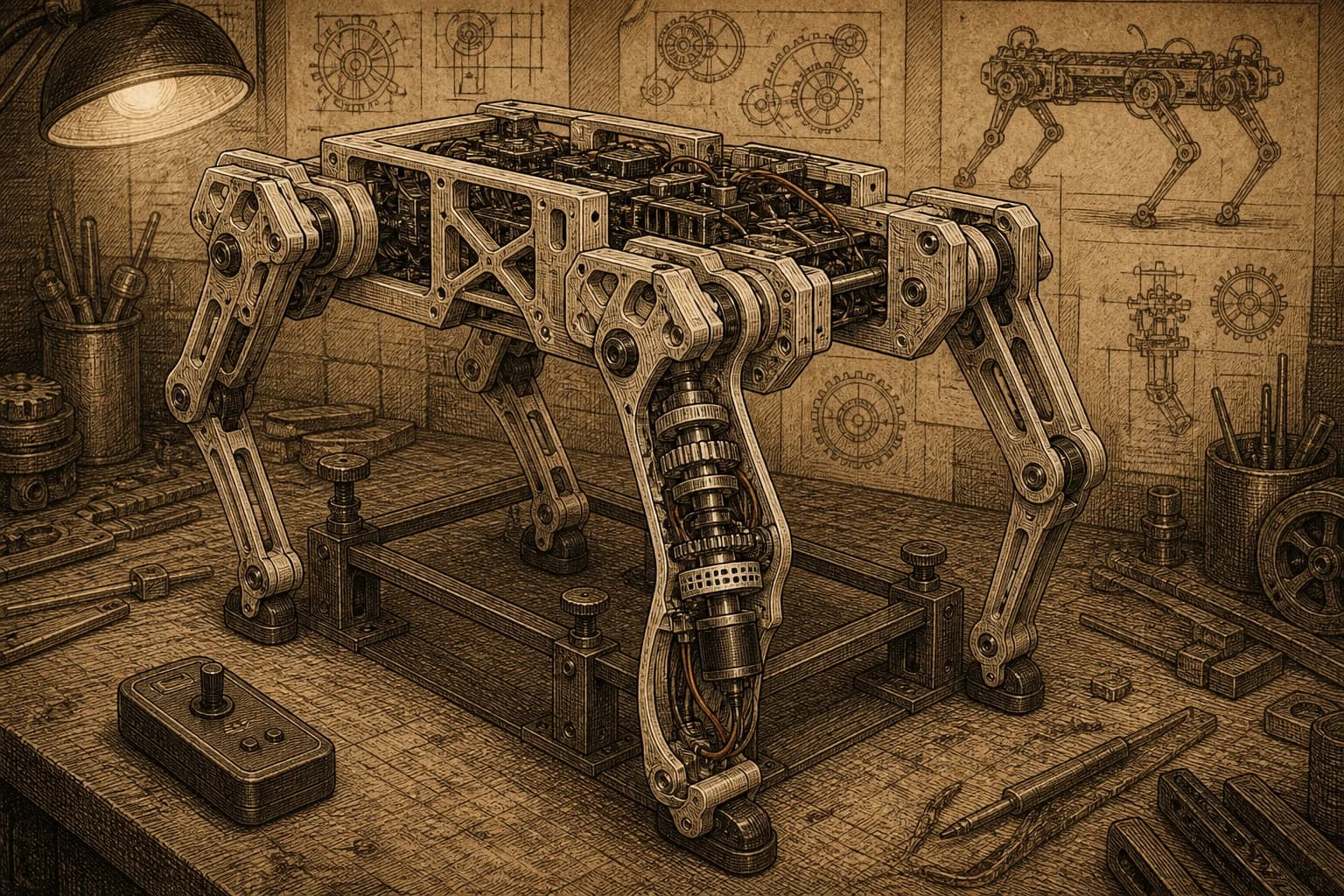
Supplies CAD, code, and a bill of materials for a PLA-printed quadruped with motor-driven joints, closed-loop controls, and an inverse-kinematics walking mode.
Visit openDogV3Original editorial concept art generated with built-in Codex Image Gen for The Machine Press, 2026-08-16.
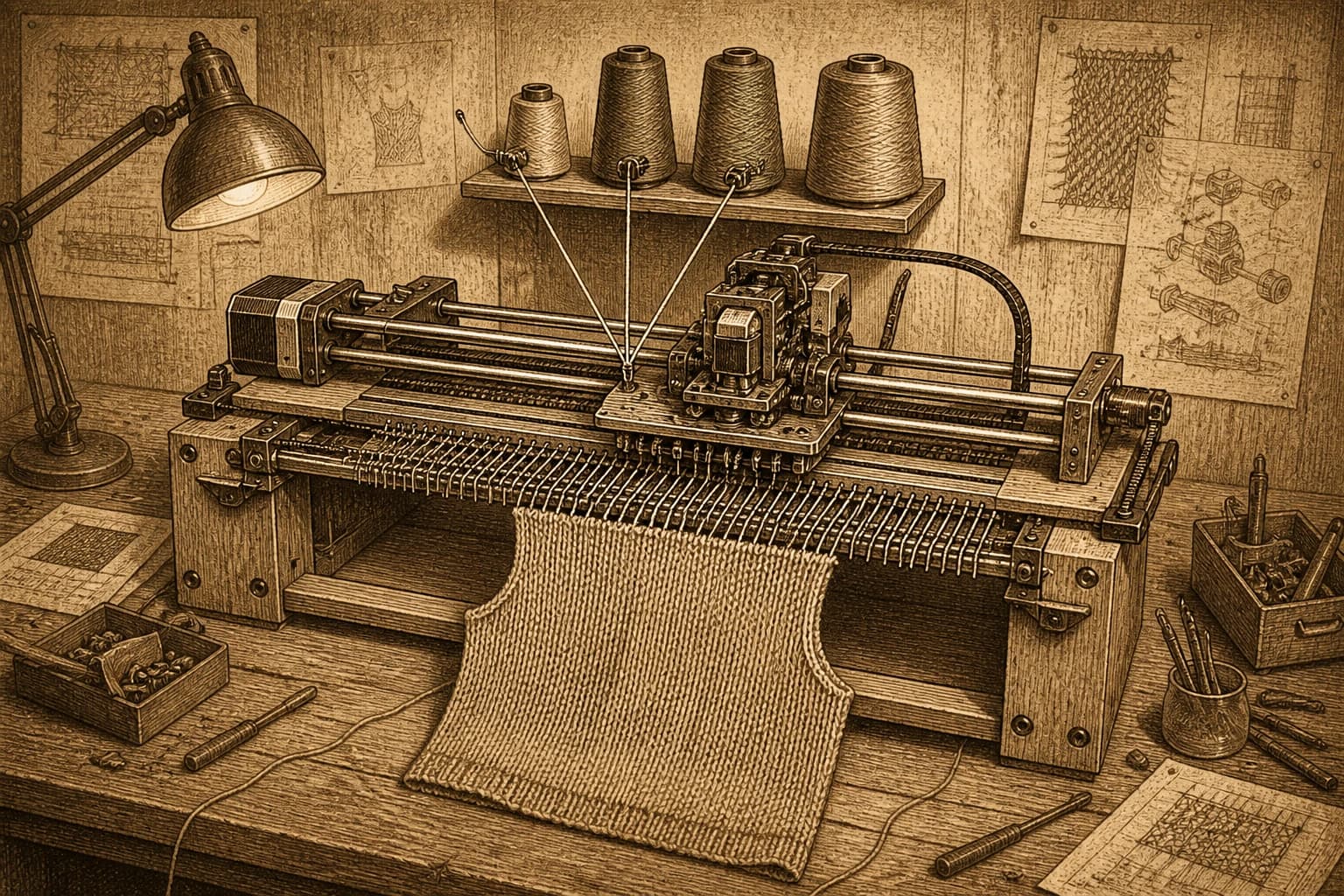
Aims to turn digital garment files into knitted pieces on an open-source machine; its smaller Wally120 design is easier to assemble, but the project remains early beta hardware.
Visit OpenKnitOriginal editorial concept art generated with built-in Codex Image Gen for The Machine Press, 2026-08-16.
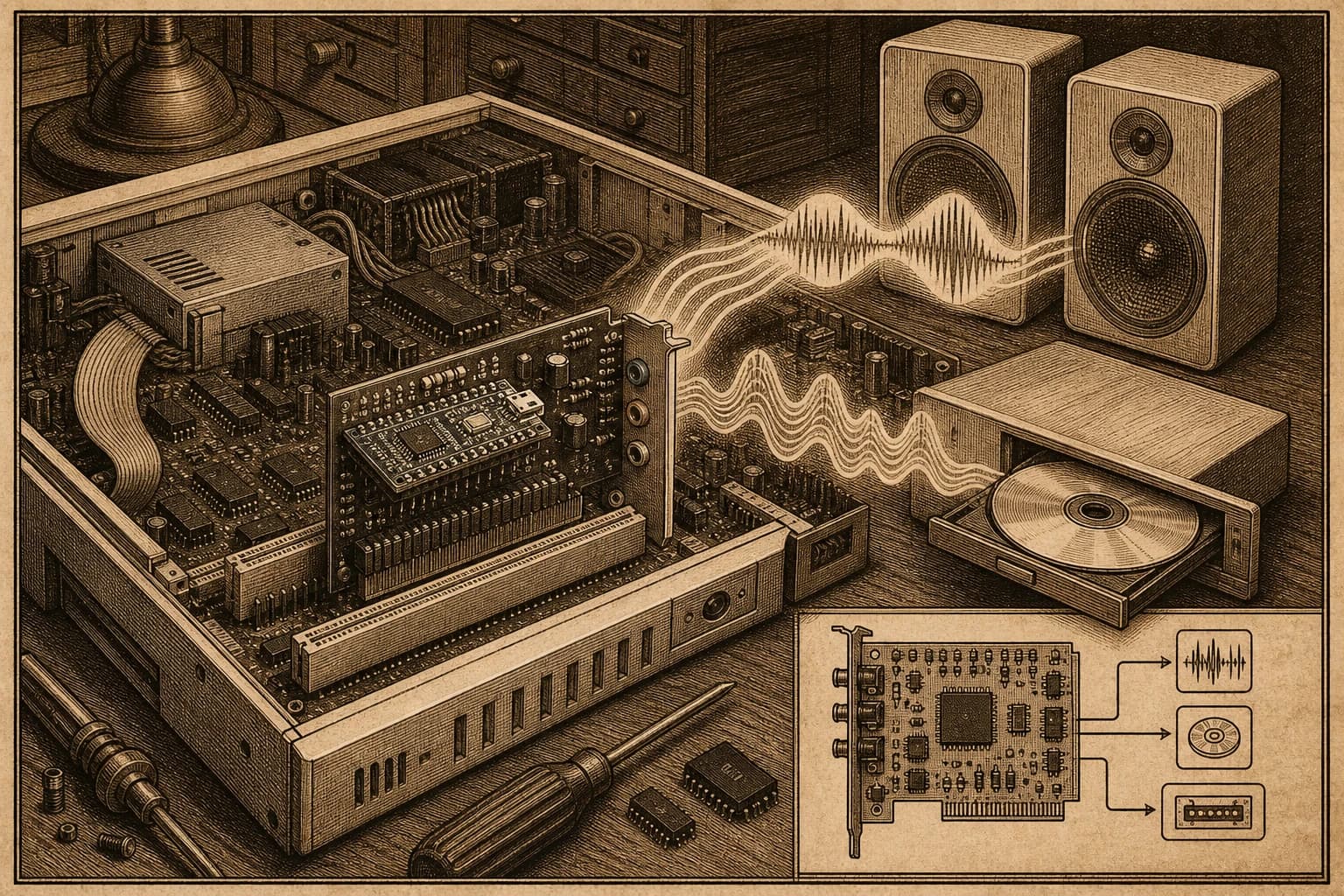
Uses an RP2040 microcontroller to emulate several ISA sound cards and a period CD-ROM interface for retro PCs, with open hardware files and assembled cards available.
Visit PicoGUSOriginal editorial concept art generated with built-in Codex Image Gen for The Machine Press, 2026-08-16.
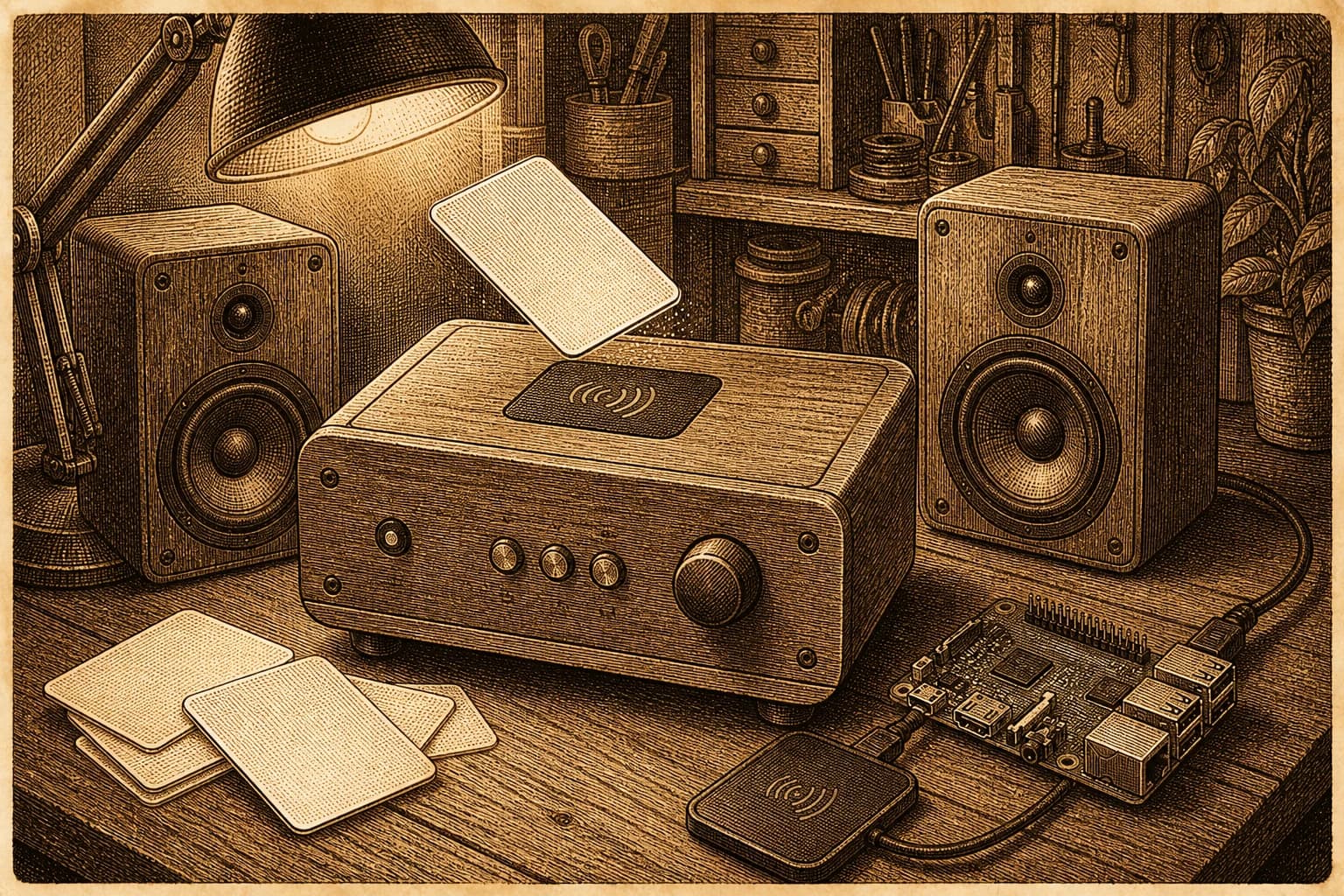
Turns RFID cards into selectors for local audio, playlists, podcasts, and web streams on a Raspberry Pi, with USB-reader setups and optional physical controls.
Visit PhonieboxOriginal Codex Image Gen concept art from 2026-07-10; carried forward from the validated 2026-08-15 edition.
Desk Picks are selected by the newsroom. Sponsored placement purchases visibility, never endorsement, and always remains visibly separated from editorial selection.
 Editorial illustration