robotics
The Gripper Predicted Touch Before It Committed
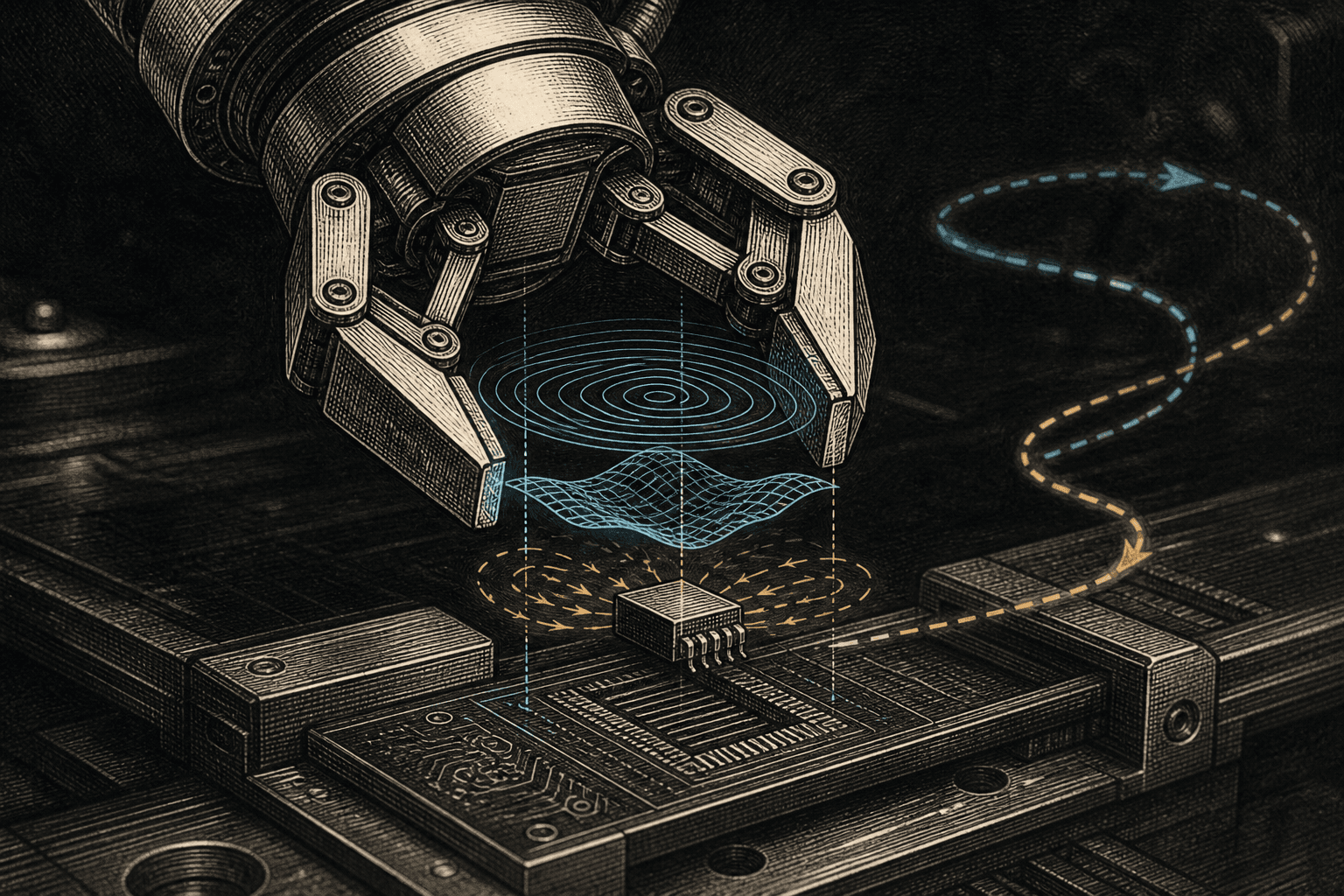
A tactile world-action model forecast contact, deformation and slip for candidate motions, then replanned when the real touch stopped matching.
Summary
A tactile world-action model forecast contact, deformation and slip for candidate motions, then replanned when the real touch stopped matching.
Vision-action models can propose a movement before a robot touches an object, but delicate manipulation depends on what happens at contact. HiTac-WAM forecasts a hierarchy of future tactile states for each candidate action chunk: whether contact occurs, how the surface deforms in three dimensions and whether it may slip. The model ranks actions with those forecasts and task progress, then keeps the chosen forecast as a reference during execution. Persistent disagreement between predicted and observed touch triggers replanning.
Under matched training budgets, the authors report mean contact F1 of 0.921, a 17.6 percent reduction in deformation error against a deformation-only predictor and a 60.4 percent gain in slip AUPRC against a slip-only predictor. Across chip grasping, blackboard erasing and USB insertion, forecast-guided selection raised average real-robot success from 31.1 to 61.1 percent; the complete system reached 72.2 percent. Those results apply to the reported tasks and platform, not arbitrary manipulation.
Why it matters
A tactile world-action model forecast contact, deformation and slip for candidate motions, then replanned when the real touch stopped matching.
Limits and context
- Under matched training budgets, the authors report mean contact F1 of 0.921, a 17.6 percent reduction in deformation error against a deformation-only predictor and a 60.4 percent gain in slip AUPRC against a slip-only predictor.
- Those results apply to the reported tasks and platform, not arbitrary manipulation.
Key claims
A tactile world-action model forecast contact, deformation and slip for candidate motions, then replanned when the real touch stopped matching.
Qualification: Under matched training budgets, the authors report mean contact F1 of 0.921, a 17.6 percent reduction in deformation error against a deformation-only predictor and a 60.4 percent gain in slip AUPRC against a slip-only predictor.
Evidence: source-2026-08-22-002
Sources
- arXiv preprint 2608.19574arXiv · primary research
Corrections
No corrections have been recorded for this story.