robotics
The Sleeve Kept Moving, So the Robot Changed Its Path
A dressing policy learned from static demonstrations, then tracked arm motion while clothing was already in contact—with a nine-person study reporting better progress, movement and comfort than baselines.
Summary
A dressing policy learned from static demonstrations, then tracked arm motion while clothing was already in contact—with a nine-person study reporting better progress, movement and comfort than baselines.
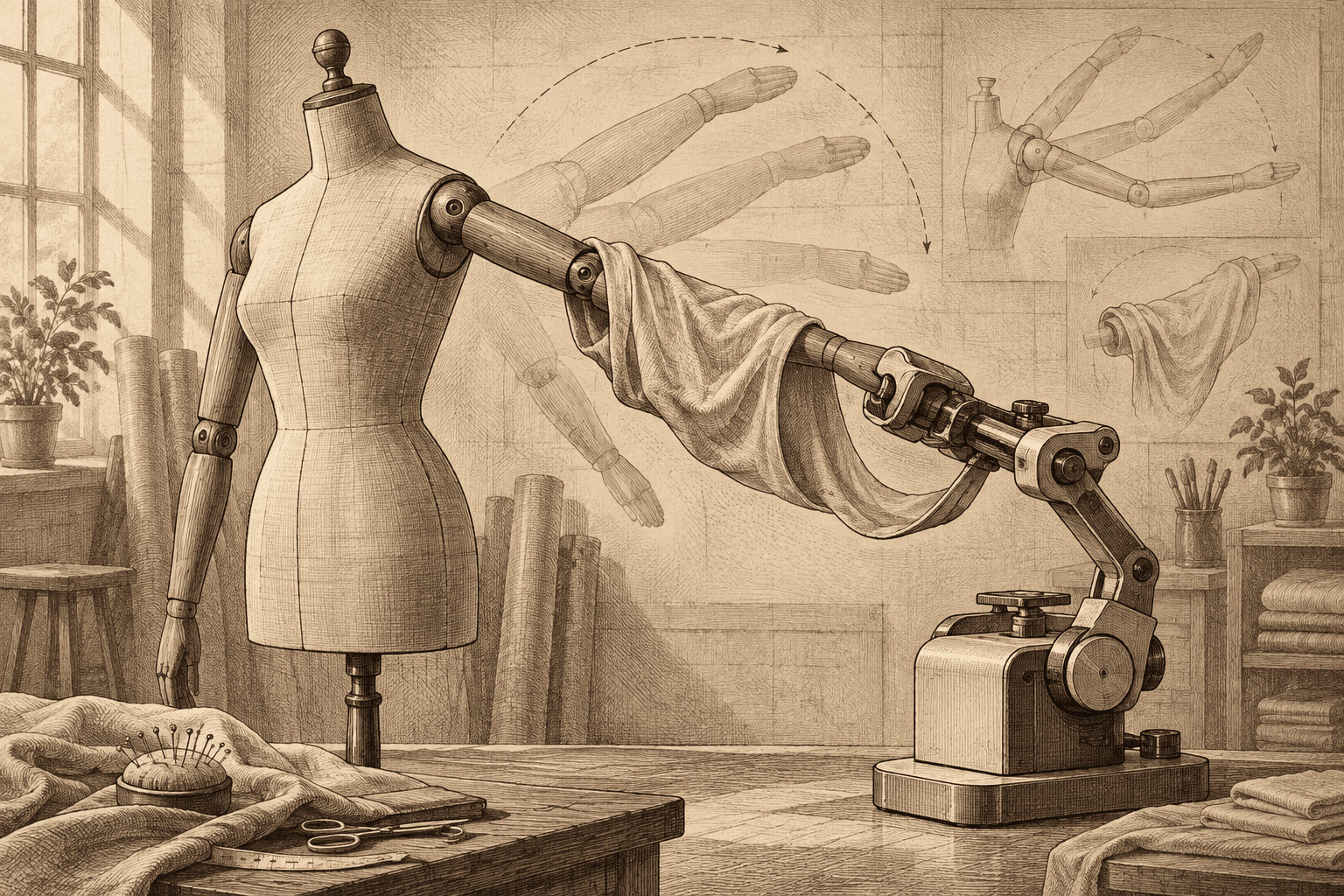
Robot-assisted dressing becomes difficult once a person moves: cloth hides contact, bends unpredictably and changes the route the robot should take. The proposed policy learns garment-handling geometry from partially observed point clouds and static expert demonstrations. An object-centered representation models the arm's axis; motion-relevant regions are registered across observations so the robot can adjust its trajectory as the arm moves. The authors tested the approach in simulation and with nine participants, three garment types and six arm-motion patterns, reporting gains over their baselines in dressing progress, freedom of movement and user comfort. This remains an early study with a small participant group, not evidence that autonomous dressing assistance is ready for unsupervised care.
Why it matters
A dressing policy learned from static demonstrations, then tracked arm motion while clothing was already in contact—with a nine-person study reporting better progress, movement and comfort than baselines.
Limits and context
- This remains an early study with a small participant group, not evidence that autonomous dressing assistance is ready for unsupervised care.
Key claims
A dressing policy learned from static demonstrations, then tracked arm motion while clothing was already in contact—with a nine-person study reporting better progress, movement and comfort than baselines.
Qualification: This remains an early study with a small participant group, not evidence that autonomous dressing assistance is ready for unsupervised care.
Evidence: source-2026-09-08-002
Sources
- arXiv preprint 2609.04759arXiv · primary research
Corrections
No corrections have been recorded for this story.