ElderBench collected 249 smartphone tasks from older adults across 20 apps—and found that indirect, ambiguous and underspecified instructions sharply reduced agent performance.
Editorial illustration
Concept illustration: ElderBench tests the gap between agents trained on explicit commands and older adults' naturally phrased smartphone requests; this is not the benchmark interface. Original editorial illustration generated with built-in Codex Image Gen for The Machine Press, 2026-09-08.
ElderBench asks mobile agents to work from naturally elicited requests rather than the explicit, goal-shaped commands common in GUI benchmarks. The researchers collected 249 smartphone tasks from older adults across 20 applications, then characterized how their wording differed syntactically, semantically and pragmatically from existing test instructions. Mainstream GUI agents and vision-language models performed substantially worse on the older-adult-oriented requests in both online and offline settings. Controlled normalization and failure analysis tied part of that decline to indirect speech, referential ambiguity and missing details. The result is a benchmark finding, not a measure of any older person's ability: it identifies a design gap in agents that expect users to phrase needs like test cases.
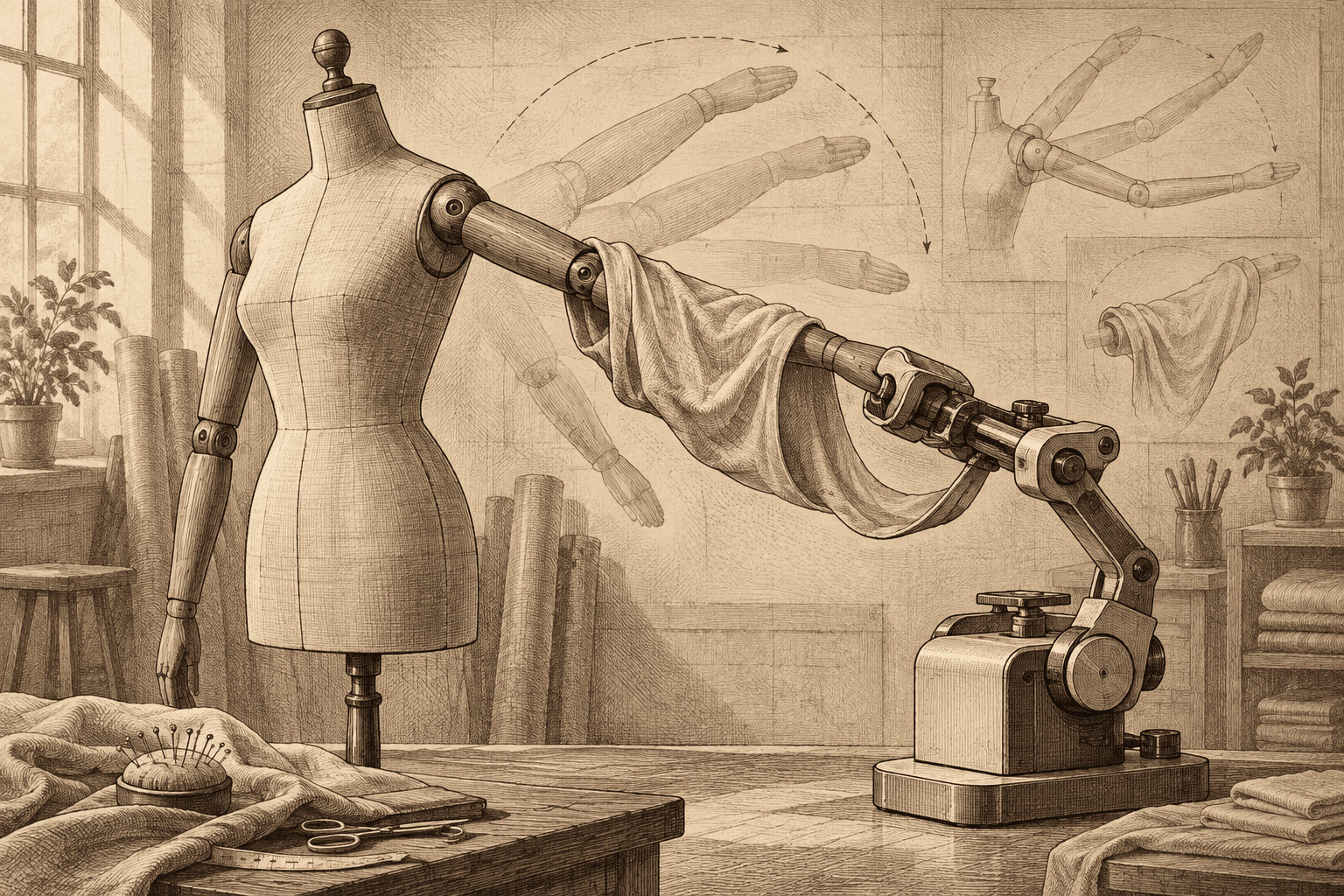
Concept illustration: the reported policy adjusts a dressing trajectory as an arm moves; the image does not depict a participant or the study's literal apparatus. Original editorial illustration generated with built-in Codex Image Gen for The Machine Press, 2026-09-08.
A dressing policy learned from static demonstrations, then tracked arm motion while clothing was already in contact—with a nine-person study reporting better progress, movement and comfort than baselines.
Robot-assisted dressing becomes difficult once a person moves: cloth hides contact, bends unpredictably and changes the route the robot should take. The proposed policy learns garment-handling geometry from partially observed point clouds and static expert demonstrations. An object-centered representation models the arm's axis; motion-relevant regions are registered across observations so the robot can adjust its trajectory as the arm moves. The authors tested the approach in simulation and with nine participants, three garment types and six arm-motion patterns, reporting gains over their baselines in dressing progress, freedom of movement and user comfort. This remains an early study with a small participant group, not evidence that autonomous dressing assistance is ready for unsupervised care.
Spectra of 3I/ATLAS detected five ions and set a lower limit on nitrogen-to-carbon monoxide above most Solar System comet values.
Post-perihelion observations with the William Herschel Telescope's WEAVE large integral-field unit detected N2+, CO+, CO2+, H2O+ and CH+ in the anti-solar plasma tail of 3I/ATLAS. Using fluorescence factors, the team derived a lower limit of 0.023 plus or minus 0.001 for N2/CO, describing the interstellar comet as nitrogen-rich relative to Solar System comets and consistent with cold formation conditions. The authors warn that ratios among the other ions cannot directly determine neutral abundances; a decrease in CH+ with distance was only marginal.
Conceptual file image about language models; it does not depict a biomedical paper, a retired model or the study's extraction system. Wes Cockx / Google DeepMind / Pexels; cropped, resized, metadata stripped, and converted to WebP by The Machine Press.
A review of 5,242 papers found that many relied on commercial models already retired at publication or scheduled to disappear within two years.
Researchers searched PubMed for biomedical studies from 2022 through March 2026 that applied a named language model. After normalizing 8,931 mentions in 5,242 publications to the 50 most frequently used models, they found that 77.7 percent referred to commercial closed-weight systems. Forty-two percent involved a model already retired by official publication or scheduled for retirement within two years; the median interval from publication to retirement was 538 days. The figures depend on the authors' extraction and lifecycle records, but they expose a preservation problem: a method can remain in print after the computational object it used is no longer available.
TacPAC compared live tactile images with the contact a plan expected, lifting average success from 22 to 64 percent across five real-robot tasks.
Vision-first world-action models predict before execution, while the decisive touch signal arrives during contact. TacPAC caches the contact prediction and plan representation, then lets a tactile expert compare each new tactile image with that expectation and correct only the actions not yet executed. The authors report that one correction costs 20.7 times less than regenerating the full action chunk. Across five tasks involving insertion, fragile objects, reorientation and long-horizon manipulation, the method led every task and raised average success from 22 percent for the vision-only base model to 64 percent. Those figures are specific to the reported robots, tasks and baseline.
Dual nitrogen-vacancy centers and a dedicated sensing chip improved nanoscale temperature sensitivity by an order of magnitude over prior reports.
The team used isotopically purified nanodiamonds containing two nitrogen-vacancy centers with a purpose-built quantum sensing chip. It reports robust temperature measurements with 682-microkelvin error, experimental sensitivity below 50 millikelvin per square-root hertz and a shot-noise-limited value of 9.6 millikelvin per square-root hertz. The setup also measured heating from its own excitation laser and observed transient heat from mixing dimethyl sulfoxide with water at nanometre scale. The work demonstrates a sensing platform; proposed uses in living systems and catalyst assessment remain future applications.
SHAQ decomposed a document into generated queries so stored embeddings revealed less source text while preserving retrieval performance.
Embedding-inversion attacks try to reconstruct text from vectors stored for retrieval. SHAQ changes what is stored: a language model generates diverse shadow queries for each document, and the system embeds those queries rather than the original document itself. Across the authors' retrieval datasets, the defense lowered one reported recovery rate to 0.2104, protected up to 19.50 percent more tokens than baseline defenses and reached as much as 0.7967 MAP@10, including utility gains up to 5.53 percent. These are benchmark results for the paper's attack and retrieval settings, not a guarantee against every inversion technique.
JWST found no moon around LP 890-9c, but excluded objects comparable in size to several Solar System moons across the planet's Hill region.
The search combined twelve JWST transits of the rocky temperate-zone exoplanet LP 890-9c. It found no exomoon and reports a 95-percent exclusion of moons at 0.1 Earth radii across the full Hill region, a scale that includes analogs of Europa, Rhea and Umbriel. The authors caution that LP 890-9c orbits at 0.04 astronomical units, where tides already make long-term survival of larger moons unlikely. The main instrument result is sensitivity: pairing a noisy transit with one clean epoch restored limits comparable with other two-epoch combinations.
Generic code-screen file image, used illustratively; it does not show Discovery Loop, Packomania, a candidate solver or a verified packing result. Markus Spiske / Pexels; cropped, resized, metadata stripped, and converted to WebP by The Machine Press.
An LLM-guided optimization loop improved ten accepted Packomania results in 15 iterations, with an independent verifier keeping only valid gains.
Discovery Loop starts with a simple solver, asks a language model to propose algorithmic changes, scores each candidate with an independent verifier and retains only improvements. Applied to a variable-radius circle-packing benchmark, the system improved the best known solutions for ten values of N between 101 and 114 by 2.4 to 5.4 percent. The run took 15 iterations and $27.72 in reported model cost, and the results were accepted by Packomania. This is a narrow optimization result, but it shows how inexpensive search can matter when claims are checked by a deterministic judge.
A conditioning analysis found that oblique joints helped a thumb while leaving long fingers worse—and tendon coupling reversed the advantage by digit.
The framework separates a hand's kinematics from its actuation, then studies the task Jacobian, actuation matrix and their product. Comparing the Shadow Dexterous Hand with an anatomically modeled biomechatronic hand, the authors found no uniform benefit from anatomical fidelity. Oblique axes improved thumb conditioning but worsened the long fingers relative to an orthogonal design; a branching tendon network improved the long fingers' effective control mapping while significantly worsening the thumb, where actuator authority concentrated on opposition. Reinforcement-learning experiments across three tasks were used to test the metric-based predictions.
A deterministic source combined fast excitation with system efficiency to deliver more than 500 megahertz of in-fiber single-photon flux.
The photonic source reports more than 500 million single photons per second delivered in fiber while producing over 100 picowatts of optical power. That level is high enough to measure with an off-the-shelf power meter, offering a direct route to estimating the source's fiber efficiency. The paper's contribution is the simultaneous combination of excitation rate and system efficiency in one deterministic source; the abstract does not establish performance inside a complete quantum network or computing system.
A persistent skill library improved a fixed computer-use stack across four observed domains—but repeated accepted revisions did not always recover a task.
The framework turns interaction trajectories and evaluator feedback into versioned procedures that become available on later iterations without changing model weights. After a five-iteration empty-library warm-up, the full system's post-warm-up mean evaluator score exceeded a matched empty-library control in all four OSWorld domain runs by 5.7 to 18.6 percentage points. A provenance study in GIMP found skills crossing task-of-origin boundaries, but also revision churn: repeated accepted edits could fail to recover the task that created the skill. The evidence supports conditional, auditable memory gains—not automatic compounding improvement.
An algorithm learns stabilizer generators without knowing the code's structure first, and scales polylogarithmically for quantum LDPC codes.
Stabilizer codes are usually described by generators that identify their protected subspace. The proposed algorithm infers those generators from copies of states in the codespace using random measurements on individual qubits, without prior structural knowledge. The authors give bounds on the copy count and success probability and note that the same procedure can verify whether a device implements its intended code. For quantum low-density parity-check codes, the required number of states scales polylogarithmically with the number of qubits. This is a theoretical characterization result rather than a full fault-tolerant implementation.
Unidentified data-center file image, used illustratively; it does not depict the tested memory stores, embedding indexes, models or migration experiment. Brett Sayles / Pexels; cropped, resized, metadata stripped, and converted to WebP by The Machine Press.
Fixed-schema knowledge graphs transferred almost unchanged, while compressed notes swung by as much as 13.28 points depending on migration direction.
The controlled study preserved the same 48 synthetic histories across long-context reading, retrieval chunks, model-compressed notes and fixed-schema knowledge graphs, then changed the sub-10-billion-parameter model reading or writing them. Fixed-schema graph accuracy changed by only 0.0004 points, within a 0.0020 uncertainty band. Compressed notes moved asymmetrically by plus 9.91 or minus 13.28 percentage points depending on direction. A half-migrated embedding index captured only 4.96 points of the 11.90-point gain from full re-embedding. Repairing notes without raw history never reached the 90-percent recovery target, while keeping source history succeeded in 34 of 48 cases in one direction.
A real-robot benchmark separates instructions that should preserve an action from those that should change it, then adds multiple constraints.
One Word, Different Action builds paired instructions around physical decision states and executable actions. Some wording changes leave the task intact and test decision invariance; others change the task and test decision sensitivity. Modern models approached saturation when a single constraint changed, according to the authors, but several degraded when one action decision had to integrate multiple requirements. The benchmark suggests the remaining problem is less about noticing an isolated word and more about composing constraints reliably under real visual grounding.
Role-matched replacements preserved much of the task score but made independently formed teams communicate far more for each unit of progress.
The study formed eight teams per setting from the same base model, let each agent keep a private notebook over ten formation episodes and then traded role-matched agents between teams. Compared with a placebo roster disruption, swaps changed task score little but increased communication per unit of progress by 16 to 63 percent. In Hanabi, a swapped agent could cost more than an inexperienced one; in Collab-Overcooked, replacing the agenda setter shifted much of the extra communication onto the agent that stayed. The penalty tracked how far team conventions had drifted, suggesting role capability and coordination fit are different forms of interchangeability.
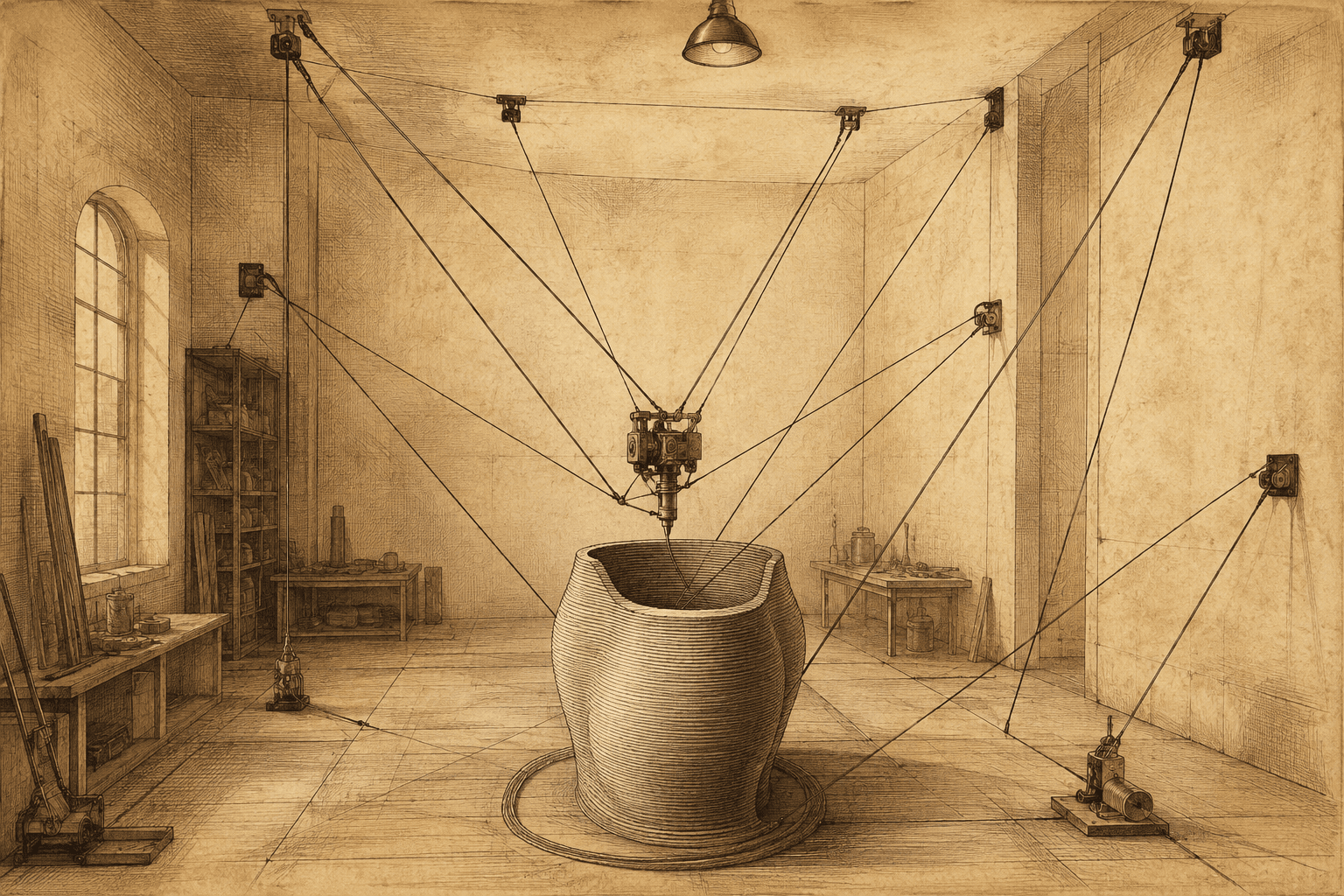
BuilderTorbjørn Ludvigsen (tobben) and Hangprinter contributors
Suspends a print head from tensioned lines anchored around a room, replacing a rigid gantry with cable geometry so an open RepRap can work across an unusually large build space.
Visit HangprinterOriginal editorial concept art generated with built-in Codex Image Gen for The Machine Press, 2026-09-06.
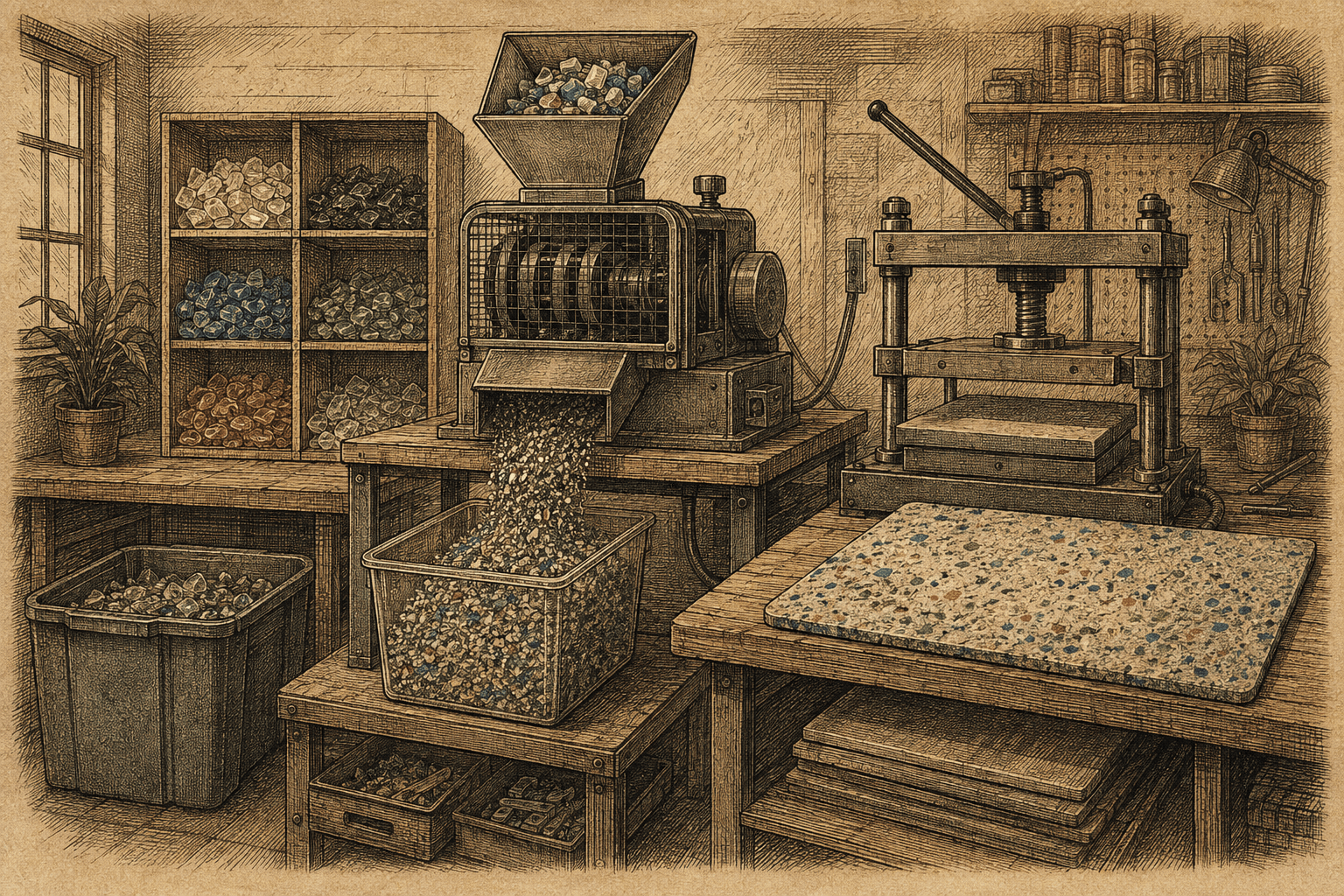
BuilderDave Hakkens and Precious Plastic contributors
Publishes replicable shredders, presses, workspace plans, and shared know-how so small local teams can sort waste plastic and turn it into reusable flakes and sheet material.
Visit Precious PlasticOriginal editorial concept art generated with built-in Codex Image Gen for The Machine Press, 2026-09-06.
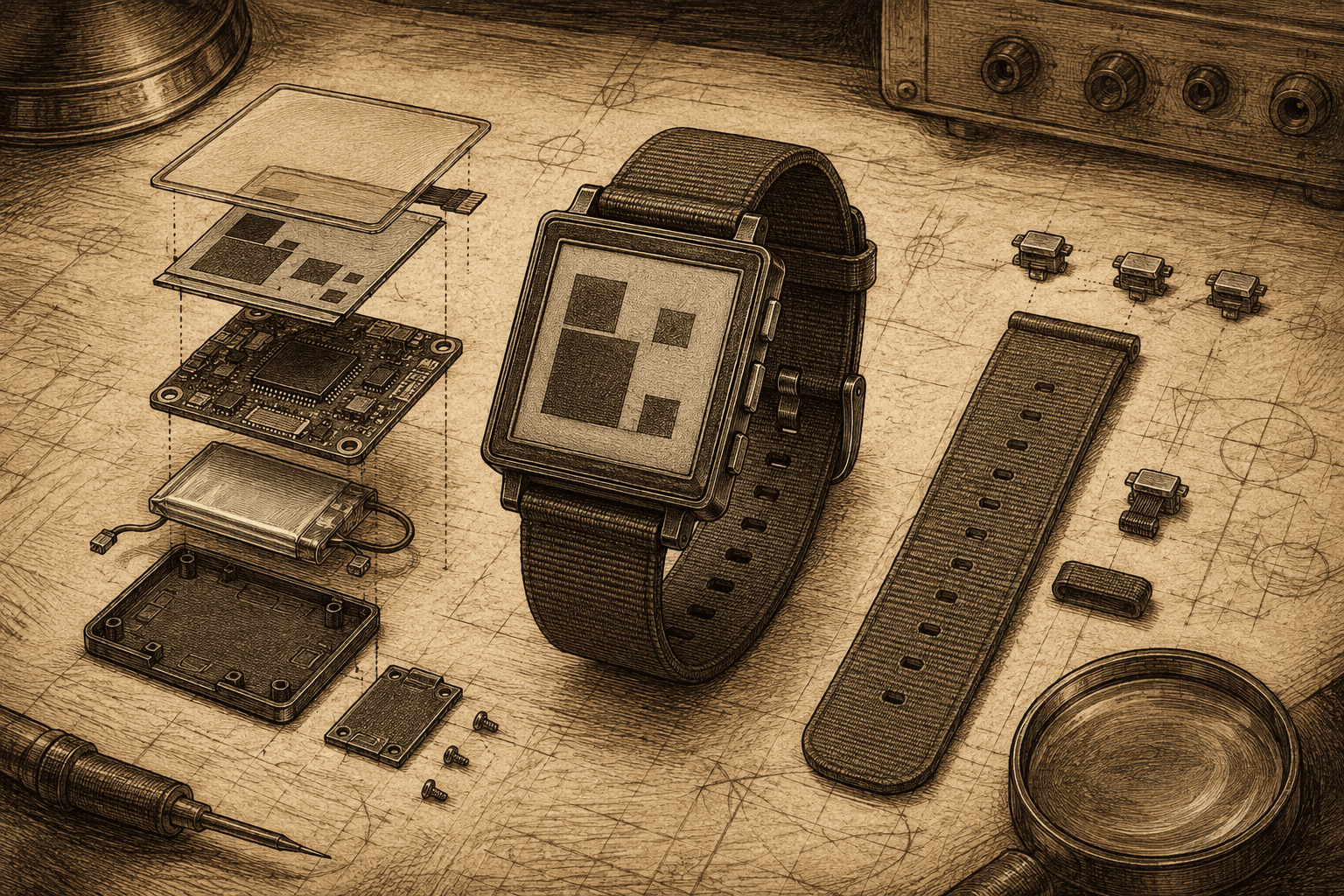
Pairs a square e-paper display with an ESP32-S3 and publishes the hardware, software, documentation, and case files so owners can build and program their own watch faces.
Visit WatchyOriginal editorial concept art generated with built-in Codex Image Gen for The Machine Press, 2026-09-06.
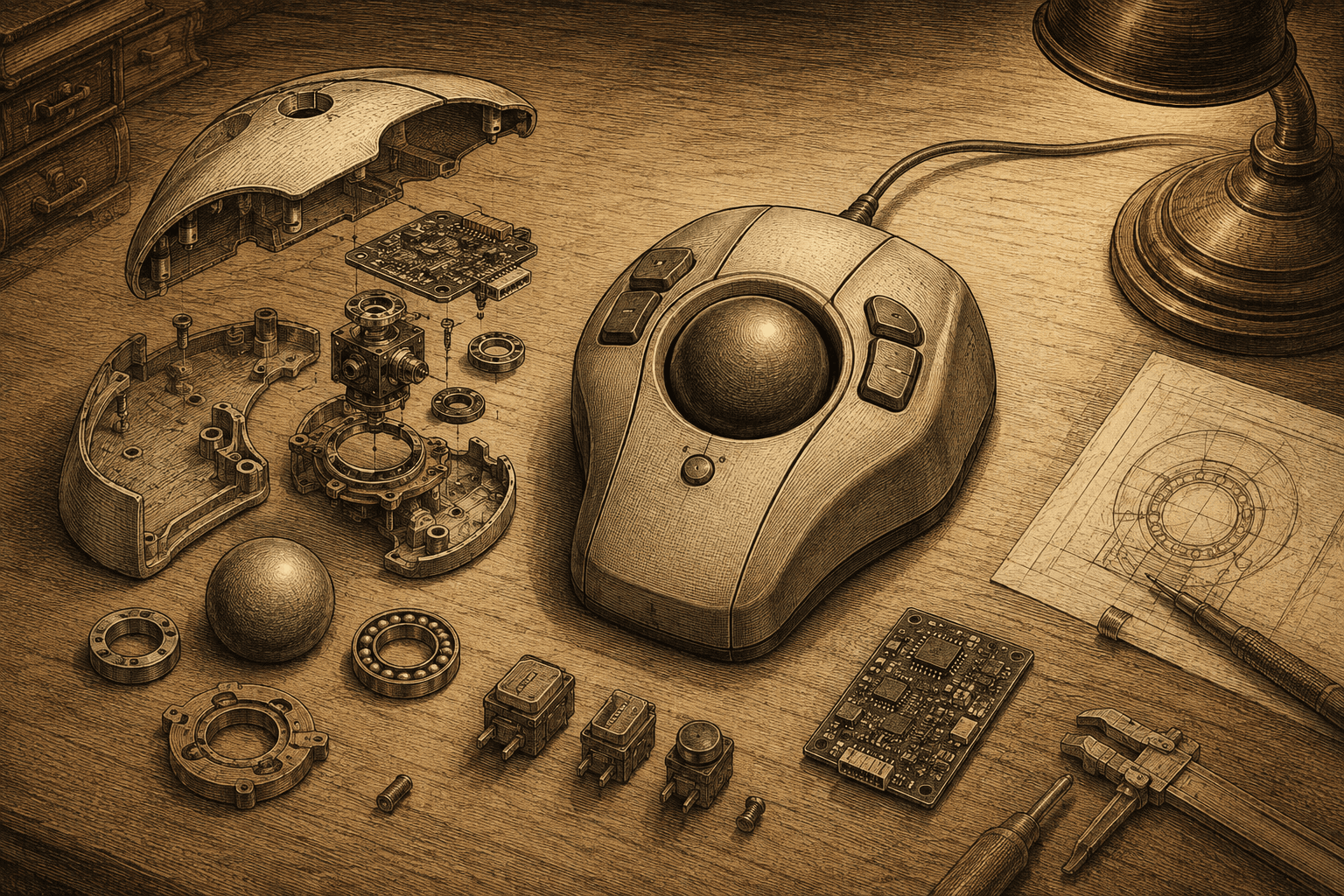
Turns a desktop trackball into an inspectable kit by publishing its mechanical and electrical design files, assembly documentation, and programmable QMK firmware.
Visit Ploopy Classic 2Original Codex Image Gen concept art from 2026-07-10; carried forward from the validated September 7 edition.
Desk Picks are selected by the newsroom. Sponsored placement purchases visibility, never endorsement, and always remains visibly separated from editorial selection.
 Editorial illustration