research
The Detectors Made Two Photon Sources Agree
Integrated microresonators reached 0.992 interference visibility without spectral filters or background subtraction.
Summary
Integrated microresonators reached 0.992 interference visibility without spectral filters or background subtraction.
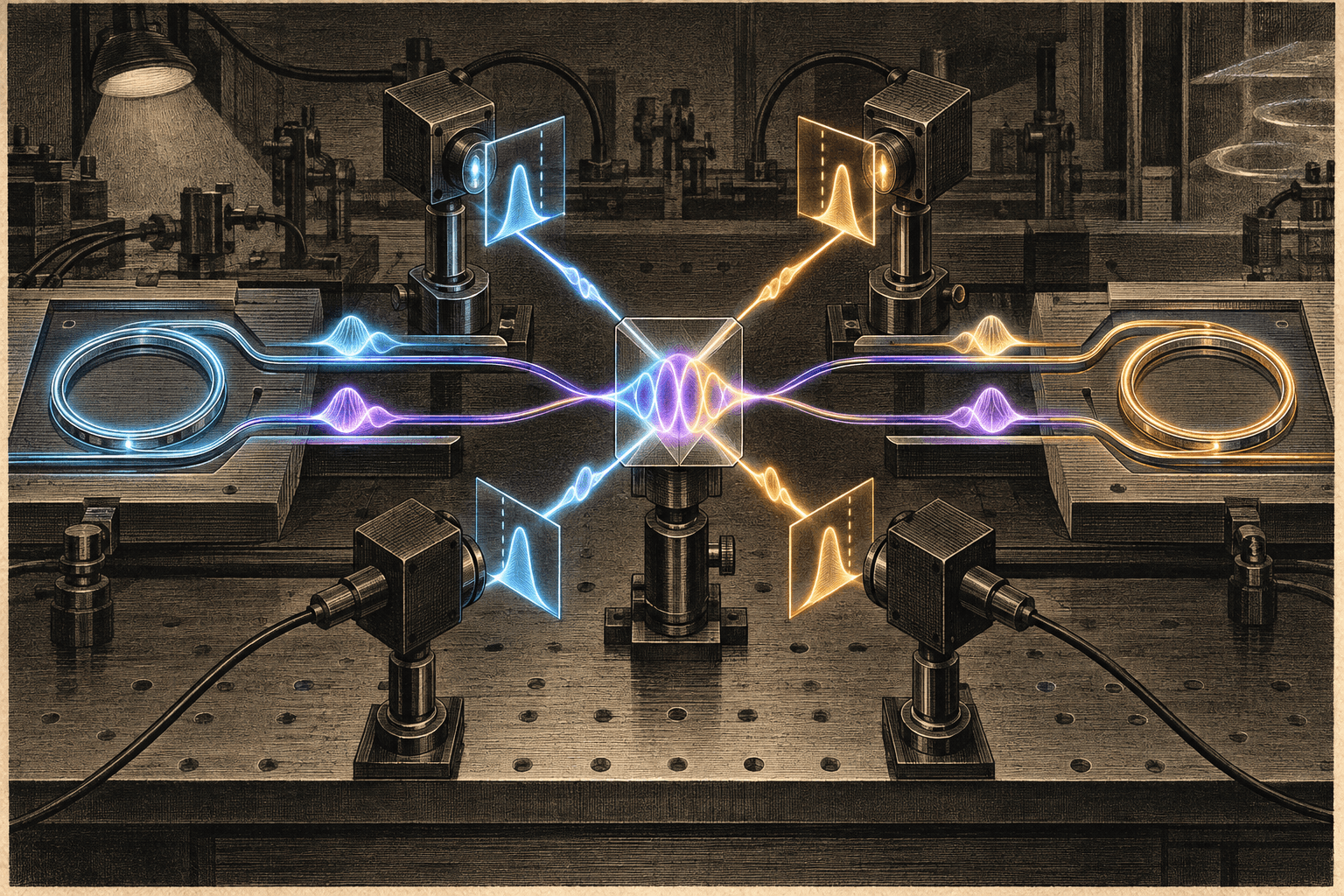
A source-only spectral model predicts almost no Hong–Ou–Mandel interference between photons from independent, continuously driven microresonators. This experiment shows why the detector belongs in the description. Finite detection windows condition the heralded state, and independently tuning the idler and signal windows can bring both indistinguishability and intrinsic heralding efficiency toward unity without spectral filters. With integrated high-Q silicon-nitride microresonators, the team measured visibilities of 0.992(8) and 0.942(12), without background subtraction, at fourfold rates of 4.5(3) and 12.2(6) hertz. The result makes a specific source-and-detection architecture more credible for scalable quantum-network primitives.
Why it matters
Integrated microresonators reached 0.992 interference visibility without spectral filters or background subtraction.
Limits and context
- A source-only spectral model predicts almost no Hong–Ou–Mandel interference between photons from independent, continuously driven microresonators.
Key claims
Integrated microresonators reached 0.992 interference visibility without spectral filters or background subtraction.
Qualification: A source-only spectral model predicts almost no Hong–Ou–Mandel interference between photons from independent, continuously driven microresonators.
Evidence: source-2026-09-17-002
Sources
- arXiv preprint 2609.18575arXiv · primary research
Corrections
No corrections have been recorded for this story.