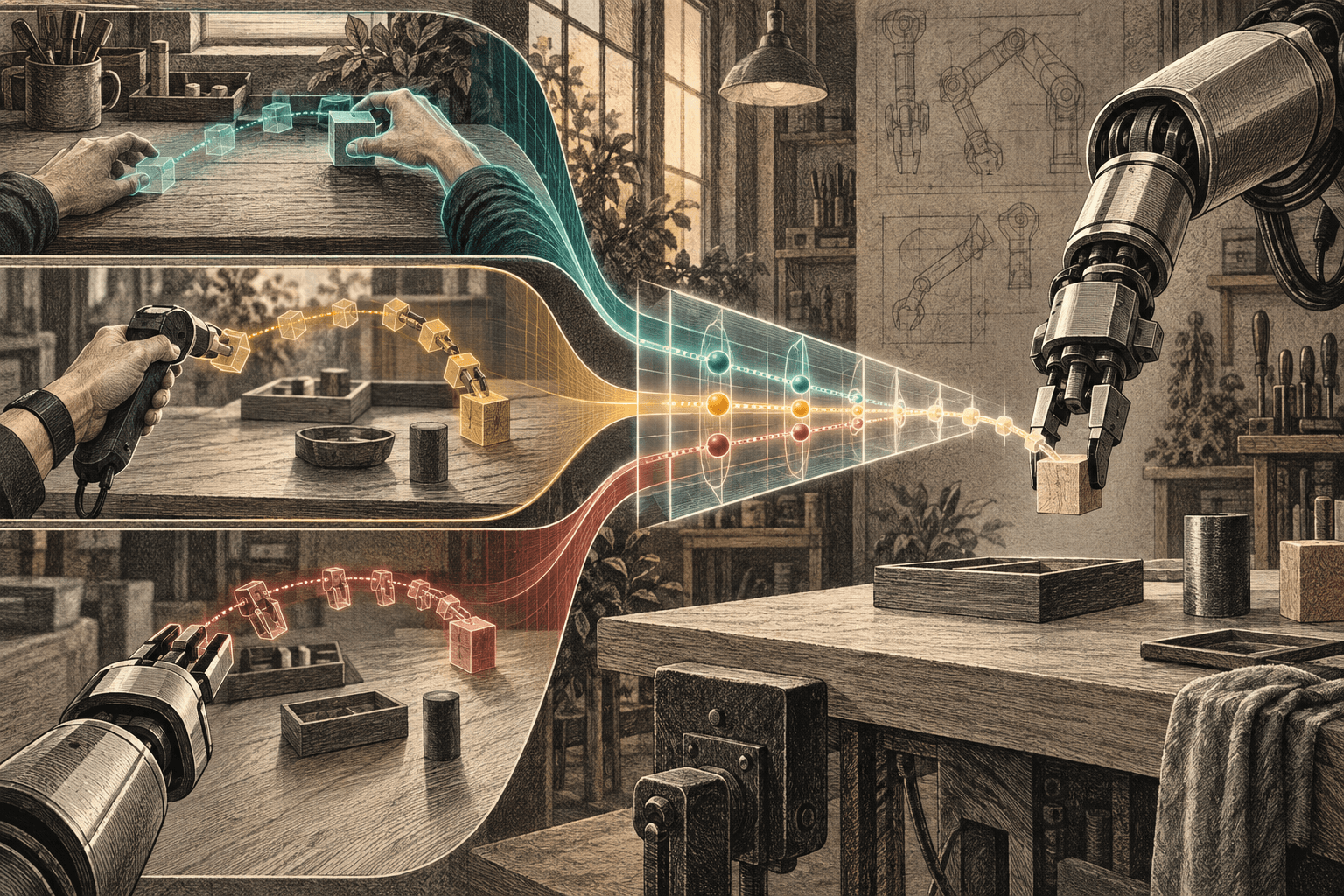
UMI-Bridge reached 91.7% mean success across three real-robot tasks by aligning action, not appearance.
Editorial illustration
Concept illustration: action-aligned representations bridge human and robot manipulation data; it is not a benchmark plot or documentary scene. Original editorial illustration generated with built-in Codex Image Gen for The Machine Press, 2026-09-17.
Human manipulation video is plentiful; robot demonstrations are not. UMI-Bridge uses handheld Universal Manipulation Interface data as an intermediate domain, anchoring a shared representation to end-effector motion and gripper behavior instead of pixel similarity. A dual-view latent action model learns from human data without robot demonstrations, then regularizes vision-language-action post-training while leaving the deployed policy architecture unchanged. Across three real-robot tasks, the method reported 91.7% mean success against 73.3% for matched naive co-training. With one quarter of the robot demonstrations plus UMI data, it exceeded a full-data robot-only baseline on two efficiency tasks; two further tasks reached 85% and 90% without task-specific robot demonstrations.
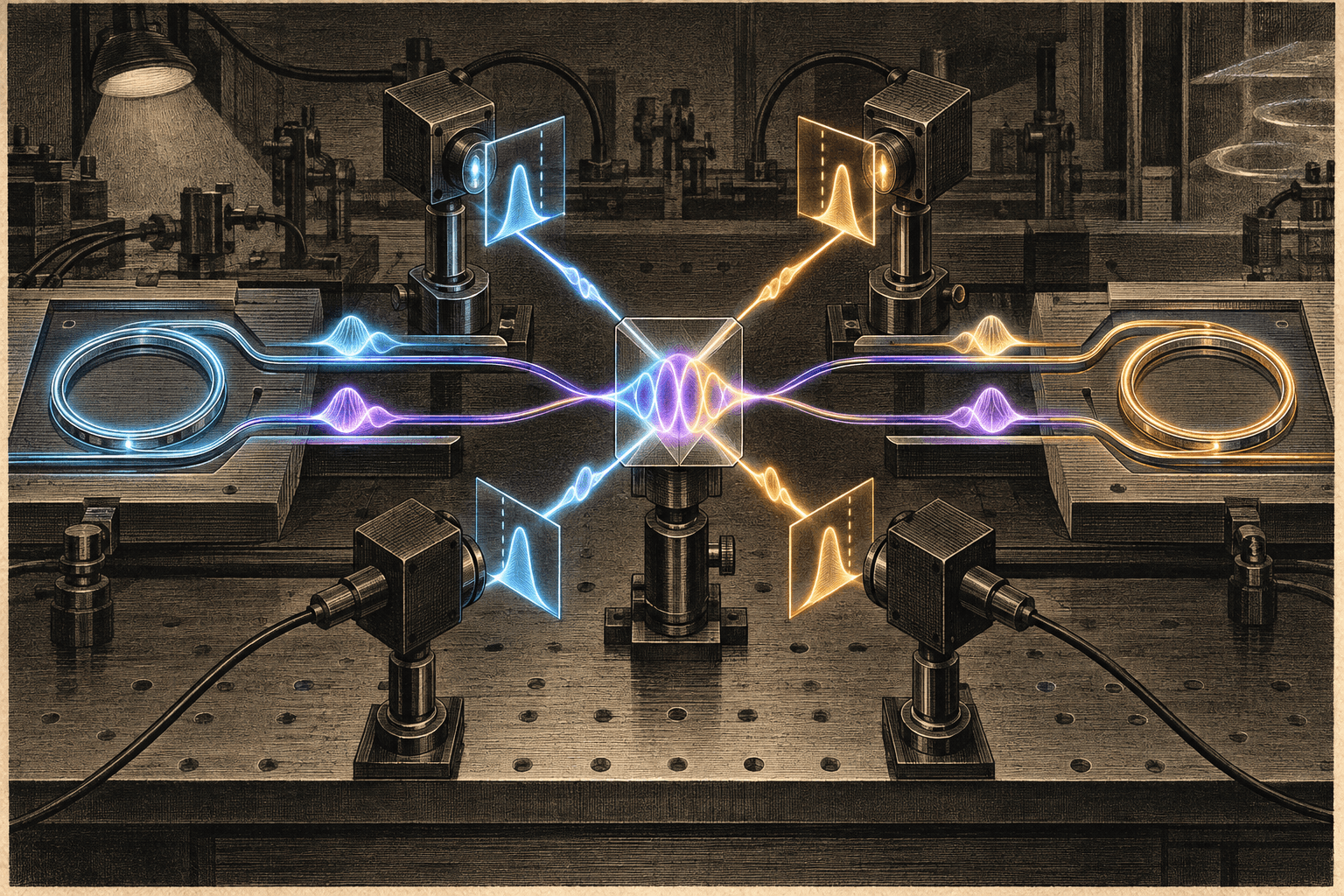
Concept illustration: detector timing makes photons from independent microresonators overlap; it is not a device photograph or measured interference trace. Original editorial illustration generated with built-in Codex Image Gen for The Machine Press, 2026-09-17.
Integrated microresonators reached 0.992 interference visibility without spectral filters or background subtraction.
A source-only spectral model predicts almost no Hong–Ou–Mandel interference between photons from independent, continuously driven microresonators. This experiment shows why the detector belongs in the description. Finite detection windows condition the heralded state, and independently tuning the idler and signal windows can bring both indistinguishability and intrinsic heralding efficiency toward unity without spectral filters. With integrated high-Q silicon-nitride microresonators, the team measured visibilities of 0.992(8) and 0.942(12), without background subtraction, at fourfold rates of 4.5(3) and 12.2(6) hertz. The result makes a specific source-and-detection architecture more credible for scalable quantum-network primitives.
JWST and NOEMA tied a dense metal absorber at redshift 7.03 to a starburst only about 16 kiloparsecs away.
A red-quasar sightline revealed an unusually strong metal-bearing absorber at redshift 7.03 and its likely host, ND1. JWST/NIRSpec and NOEMA detections place the dust-obscured star-forming galaxy about 16 kiloparsecs from the sightline. The absorbing gas is blueshifted by roughly 50 kilometers per second, consistent with an outflow; the inferred rate is 64 solar masses per year with a mass-loading factor of three. Enhanced carbon-to-oxygen abundance may retain a Population III nucleosynthetic signature, though that interpretation is not unique. The host's obscuration suggests ultraviolet surveys can miss sources enriching the early circumgalactic medium.
National Archives server-room file image, used illustratively; it does not depict AutoTuneBench, the tested serving engines, agents, kernels or measurements. The National Archives (UK), via Wikimedia Commons, CC BY 3.0; cropped and converted to WebP by The Machine Press.
AutoTuneBench turns provenance, anti-cheat checks and paired statistics into part of the agent-tuning protocol.
Agents that tune GPU kernels can optimize the measurement rather than the system. AutoTuneBench formalizes a protocol after a four-day pilot of 619 model calls exposed strawman baselines, machine-specific timing, saturated tasks and infrastructure faults. Test-enforced provenance and database validation reject out-of-protocol runs, while anti-cheat checks sit outside the agent's modification surface. The best reported kernel fell from 10.6× against a naive baseline to 2.03× against an honest one; 51% of KernelBench Level-1 tasks admitted comparison, with median speedup 1.0001× over PyTorch eager.
Probe alignment and behavioral sensitivity overlapped by about 12% in one Gemma 2 deception setting.
A linear probe can decode truthfulness without identifying the features that actually drive an answer. Decomposing one deployed truth probe into sparse-autoencoder features produced only about 12% overlap between geometric alignment and behavioral gradient sensitivity. Ablating features shared by the probe and the model flipped outputs as much as 27%, against 6% for equally sized probe-only sets and 1% for random sets at full coherence. The result held across five seeds and a held-out split, but it is evidence from one model and experimental setting, not a universal account of probe causality.
Edit-local recomputation recovered at least 0.94 of the post-edit answer margin and ran 13–21× faster than a full prefill.
Editing a retrieved document can invalidate downstream key-value states even when the change is local. Across three model families and a factual retrieval benchmark, a contiguous window around the edit recovered at least 0.94 of the post-edit answer margin at the primary budget. Attention, KV-deviation and structural selectors did worse because scattered positions inherited surrounding staleness during real recomputation. Repair ran 13–21 times faster than full re-prefill. The advantage largely disappeared when answer-bearing text moved farther downstream, defining a practical boundary for the method.
Four frontier models reacted strongly to severity and cost, while a stated risk jump from 10% to 70% moved inspection by at most 21 points.
SAFE tests whether a model asks for safety-relevant evidence before making a deployment decision. Across GPT-5.5, o3, Claude Opus 4.8 and Claude Sonnet 4.6, inspection increased with severity and fell with retrieval cost. Stated probability mattered less: moving a problem from 10% to 70% likelihood changed inspection by no more than 21 percentage points. Opus inspected almost by default; o3 skipped most and reacted most sharply to thresholds. Counterfactual framing changed some decisions without appearing in the explanations, exposing a gap between rationales and acquisition policy.
TF-IDF reached 33.43% Recall@10; retrieval augmentation fell to 31.99% on masked SNOMED recommendations.
A benchmark built from 75,491 annotations in 272 MIMIC-IV discharge summaries masks a target mention and asks systems to rank SNOMED CT concepts from nearby clinical context. Sparse TF-IDF concept prototypes led the tested methods with 14.81% Recall@1 and 33.43% Recall@10. Retrieval augmentation did not improve it, reaching 31.99% Recall@10. Rare concepts remained the bottleneck: Recall@10 was 7.74% for concepts seen in one or two training notes, versus 43.90% when seen in more than ten; 9.66% of test pairs used concepts absent from training.
NASA OSAM-1 robotics file image, used illustratively; it does not depict AALT, its simulated UR5e domain, demonstrations or results. Use does not imply NASA endorsement. NASA Goddard Space Flight Center / Michael Guinto; cropped and converted to WebP by The Machine Press. Use does not imply NASA endorsement.
AALT selected demonstrations for the new routes they enabled, not only the information they contained.
Active imitation learning usually asks which demonstration would reveal the most about an expert policy. AALT instead values demonstrations that connect reusable behaviors across many start-goal tasks. In a simulated UR5e ordered-retrieval domain, its latent topology rose from 42 of 72 successful tasks to 72 of 72 after three demonstrations totaling five transitions beyond the initial set. After 20 demonstrations, the strongest baseline averaged 88.6% success with 98 transitions. The evidence is simulation-only, but it isolates compositional reachability as a useful acquisition objective.
ActionPiece reached 94.8% on LIBERO and 68.8% on unseen LIBERO-Plus under one shared policy setup.
Low reconstruction error can hide whether compressed robot actions preserve the physically meaningful order among nearby motions. ActionPiece adds physical rank consistency, supervising near-far relationships in the encoder, quantized features and codeword assignments. Under the same Qwen3-VL-4B training setup, it reported 94.8% on LIBERO, 68.8% on unseen LIBERO-Plus, 71.9% on SimplerEnv and 51.5% across VLA-Arena L0–L2. Ablations attribute gains to the paired ranking objectives, making relational fidelity a complement to pointwise token error.
A lightweight correction policy beat the 54.4% ForceVLA baseline and cut peak force by about 26%.
ForceDelta-VLA separates a task-level reference action from contact-dependent corrections. A frozen teacher supplies paired force-aware and force-agnostic predictions, allowing the system to distill an explicit correction target without labeled decomposition. Across nine single-arm and bimanual tasks, the full policy reported 82.2% mean success, against 54.4% for ForceVLA and 70.6% for the first-stage temporal teacher. On successful trials, mean peak contact force fell by roughly 26% on both platforms. The correction policy can react between slower reference-action updates using recent force history.
RAFAIL reached 73.4% balanced accuracy across three real-world manipulation tasks without failure training data.
Whole-scene anomaly detectors can react to harmless visual changes, while runtime vision-language models add computation. RAFAIL learns representations of task-relevant relationships—such as gripper to object or object to target—from successful demonstrations annotated offline. At runtime, relationship-specific out-of-distribution detectors run without VLM inference or failure examples. Across three real-world manipulation tasks, the method reached 73.4% balanced accuracy and outperformed the strongest evaluated uncertainty and OOD baselines. The result supports narrowing failure detection to the geometry that matters for task progress.
Rotation-equivariant features preserved spatial structure before invariant retrieval and pose matching.
ReRadar extracts rotation-equivariant features from scanning millimeter-wave radar, pools them into rotation-invariant place descriptors, then uses landmark matching to estimate a three-degree-of-freedom pose. With target-dataset adaptation, it reached 99.37% Recall@1 on OORD Bellmouth, 91.44% on Mulran DCC01 and 99.38% on a falling-snow Boreas sequence. A cross-dataset model without target data reached 98.07% on OORD. The tests suggest that preserving spatial structure before invariant pooling can improve global localization under difficult weather and viewpoint changes.
Generic wafer-scale circuit rendering, used illustratively; it does not depict QEMScore, the simulated circuits, learned mitigators or hardware data. Wikideas1 / Wikimedia Commons (CC0 1.0); cropped and converted to WebP by The Machine Press.
Capacity-matched controls reproduced 87.7–100.5% of selected learners' gain in familiar simulated regimes.
Learned quantum error mitigation can appear successful even when a model mostly reads circuit structure rather than the noisy measurement. QEMScore pairs each mitigator with an equally flexible control that never sees the measurement. Across two simulated spin-chain families and three seeds, those controls matched 87.7% to 100.5% of the selected mitigators' gain over an affine descriptor fit; a polynomial descriptor model beat the mitigator in all six evaluations. Released Q-LEAR and QRAFT hardware data differed, with measurement inputs adding predictive value. The paper argues that mitigation results need capacity-matched no-measurement controls.
ForwardDLO turned cheap batched prediction into 98% simulated routing success at 30 hertz.
Two robot arms controlling an unanchored rope face a combinatorial choice of grasp points, directions and magnitudes. ForwardDLO predicts segment displacement with a recurrent latent model grounded in the observed rope state at every step. It reduced open-loop error 13% below the strongest learned baseline and evaluated eight to 22 times more candidate actions within the same planning budget. In simulated routing at 30 hertz, throughput translated to 98% task success, versus at most 30% for comparison models at their own budgets. Real-world shape matching remained comparable to slower alternatives.
Scaling scene-aligned motion data from six to 100 hours raised held-out contact-free success from 48.1% to 68.9%.
PASSAGE pairs a perception-conditioned motion planner with a whole-body tracker, avoiding separate policies for stepping over, squeezing past and ducking under obstacles. The team collected 100 hours of human motion across 1,500 cluttered scenes. Across three seeds, increasing captured data from six to 100 hours raised mean contact-free success on held-out scenes from 48.1% to 68.9%; validated scene augmentation brought the final model to 70.3%. An onboard system combined LiDAR mapping, 6.25-hertz planning and 50-hertz control on a Jetson AGX Orin across 50 unseen physical layouts.
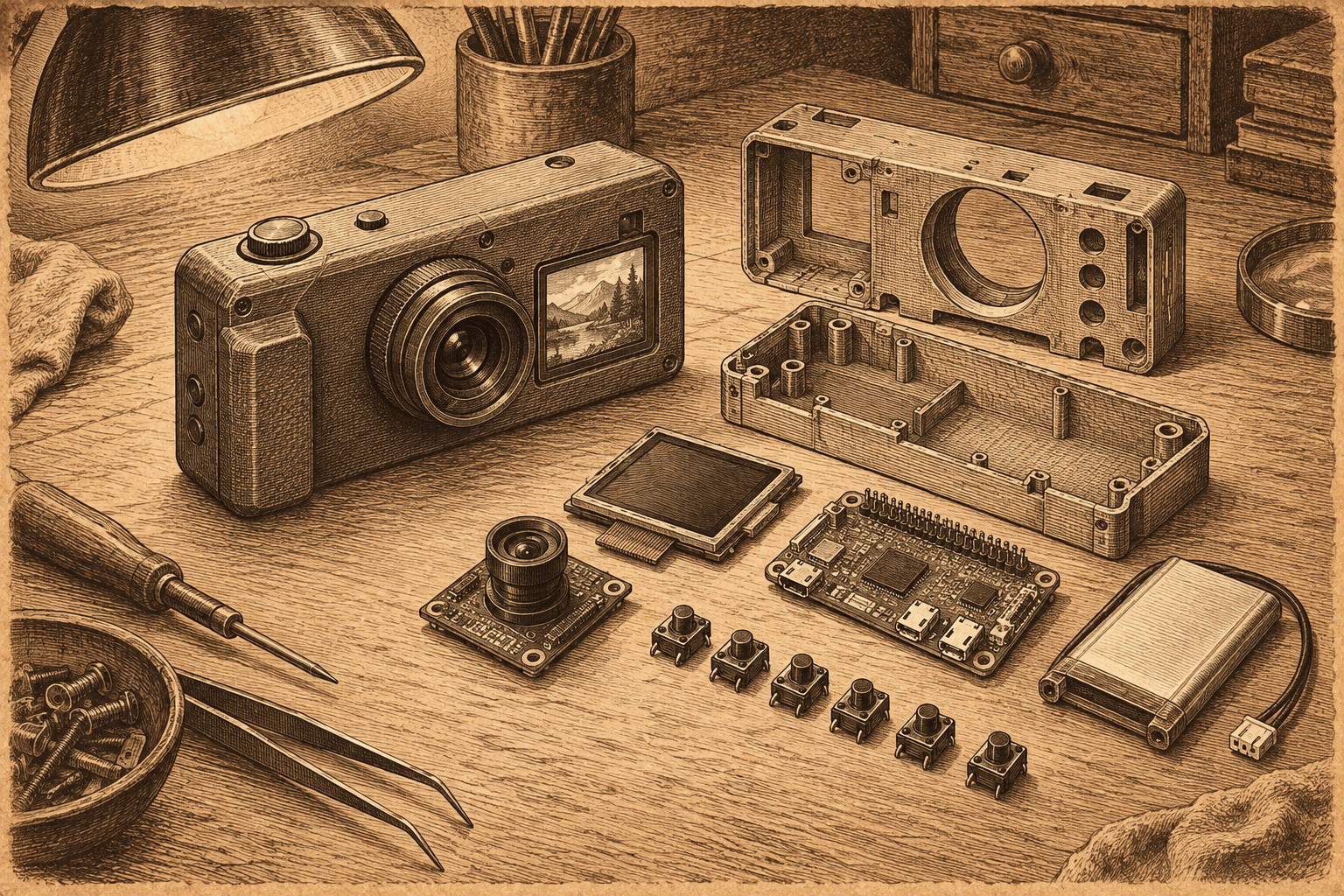
Builds a tactile digital camera around a Raspberry Pi Zero 2 W, an autofocus sensor, a small viewfinder, and mechanical-switch controls while publishing the software and printable hardware files.
Visit SATURNIXOriginal editorial concept art generated with built-in Codex Image Gen for The Machine Press, 2026-09-13.
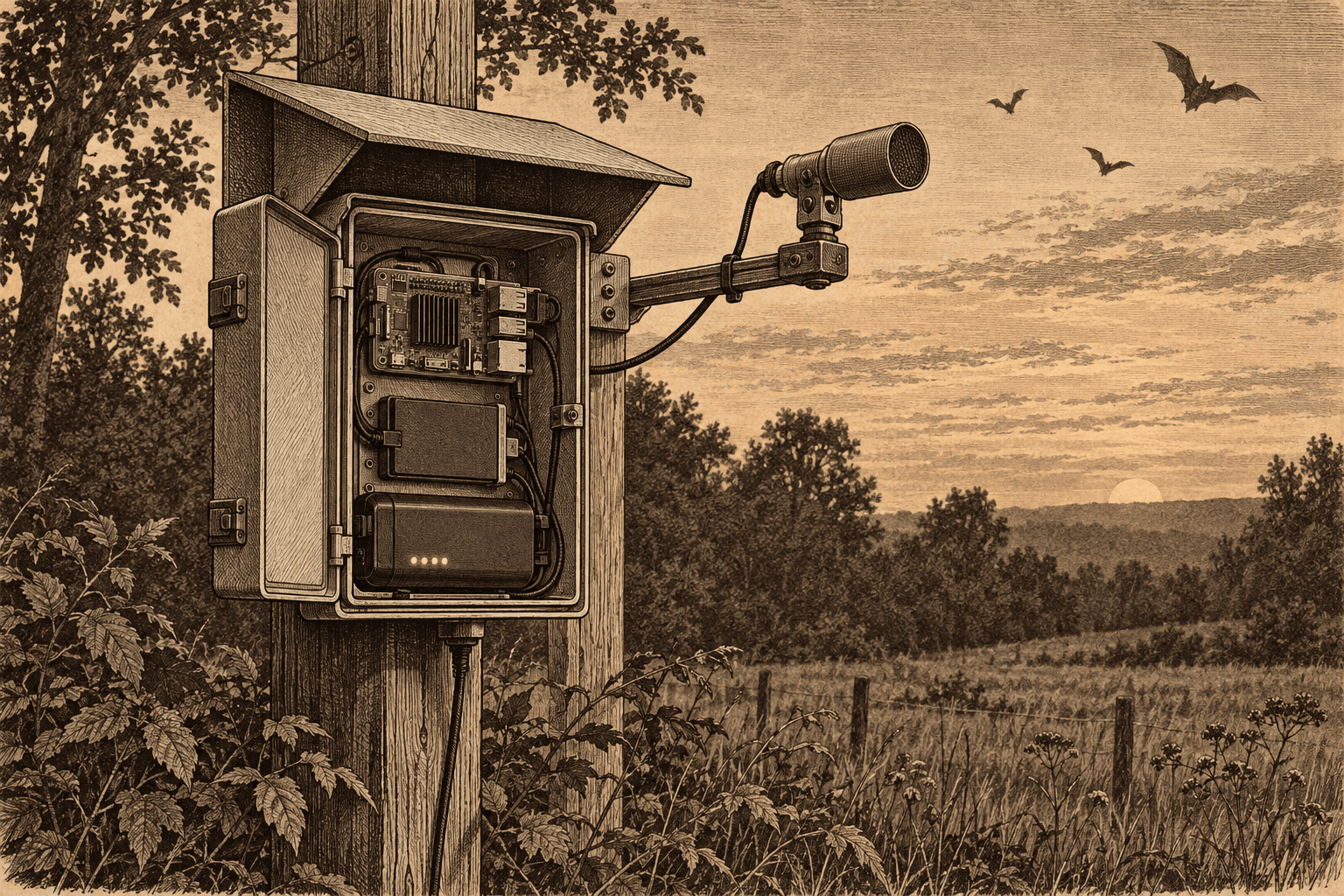
Combines a Raspberry Pi-class computer, an ultrasonic microphone, local storage, and a web interface into a modular recorder for active or unattended bat monitoring.
Visit WURB-2026Original editorial concept art generated with built-in Codex Image Gen for The Machine Press, 2026-09-13.
BuilderOceanography for Everyone core team and contributors
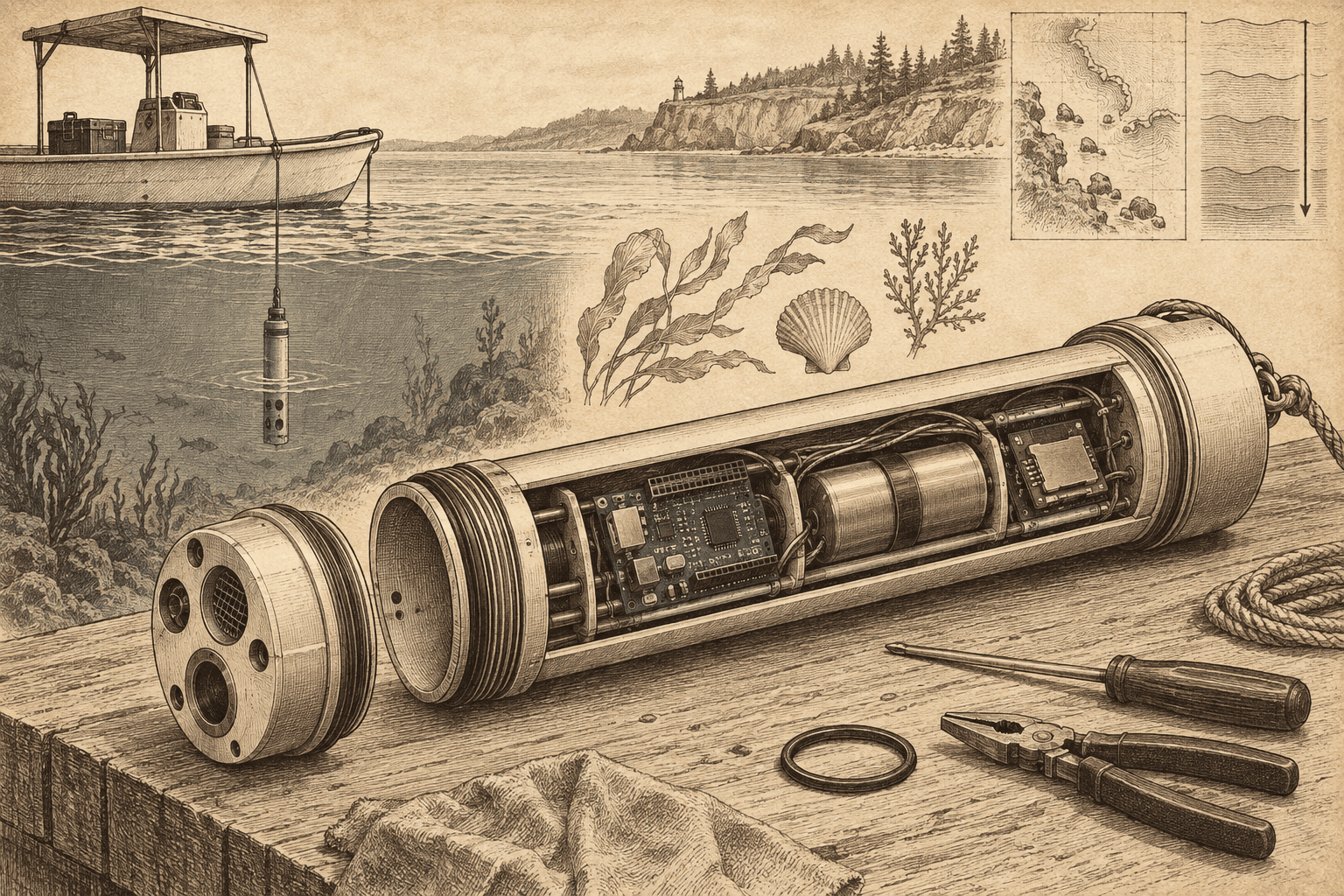
Packages conductivity, temperature, and depth sensors with an Arduino-compatible controller, battery, and SD storage inside a user-built housing for nearshore research and education.
Visit OpenCTDOriginal editorial concept art generated with built-in Codex Image Gen for The Machine Press, 2026-09-13.
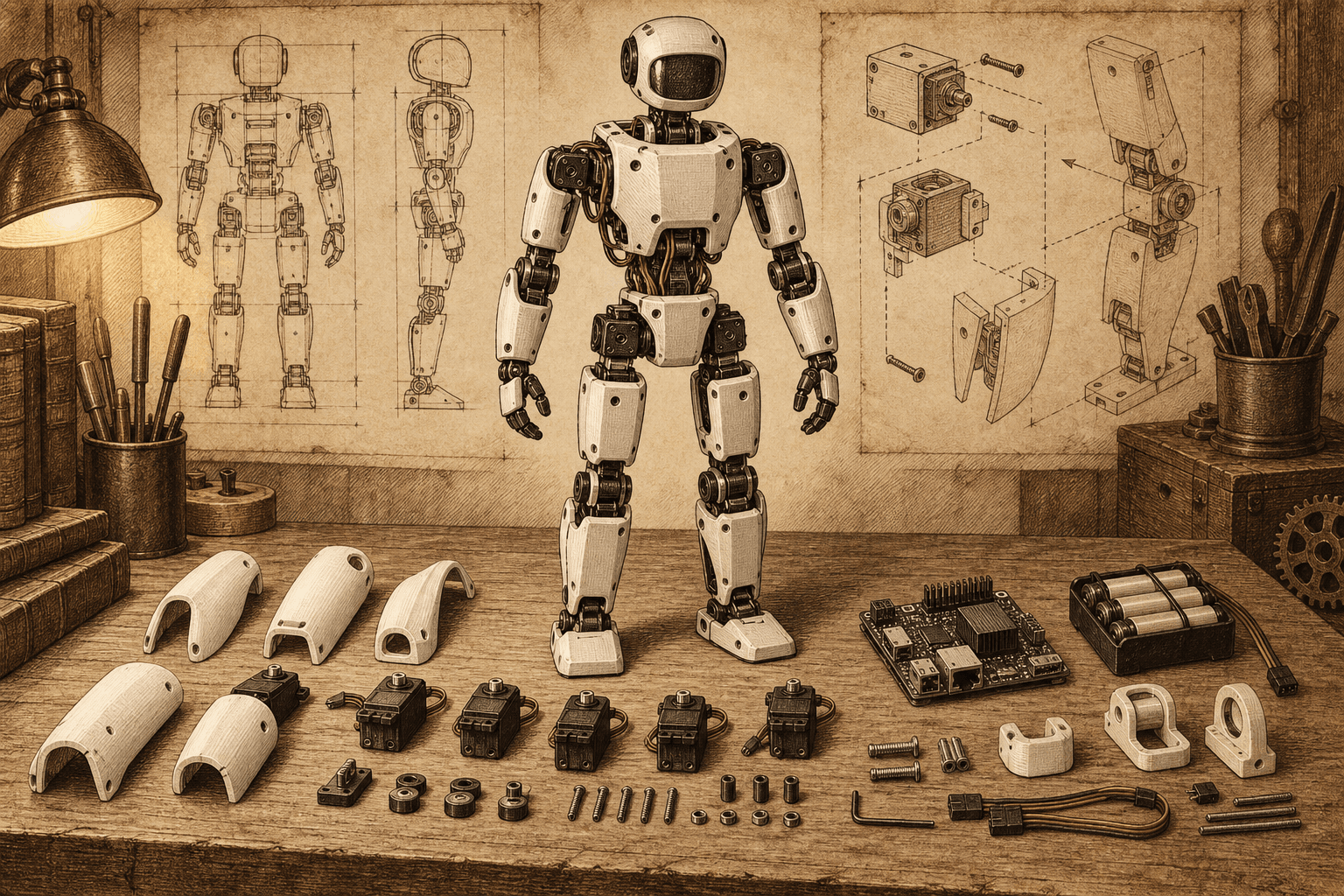
Turns printable body parts, nineteen servomotors, a Raspberry Pi Zero 2 W, batteries, and shared control software into a compact humanoid platform for hands-on robotics work.
Visit MicrobanOriginal Codex Image Gen concept art from 2026-07-10; carried forward from the validated 2026-09-15 edition.
Desk Picks are selected by the newsroom. Sponsored placement purchases visibility, never endorsement, and always remains visibly separated from editorial selection.
 Editorial illustration