robotics
Human Motion Doubled a Robot's Success Without Doubling Robot Data
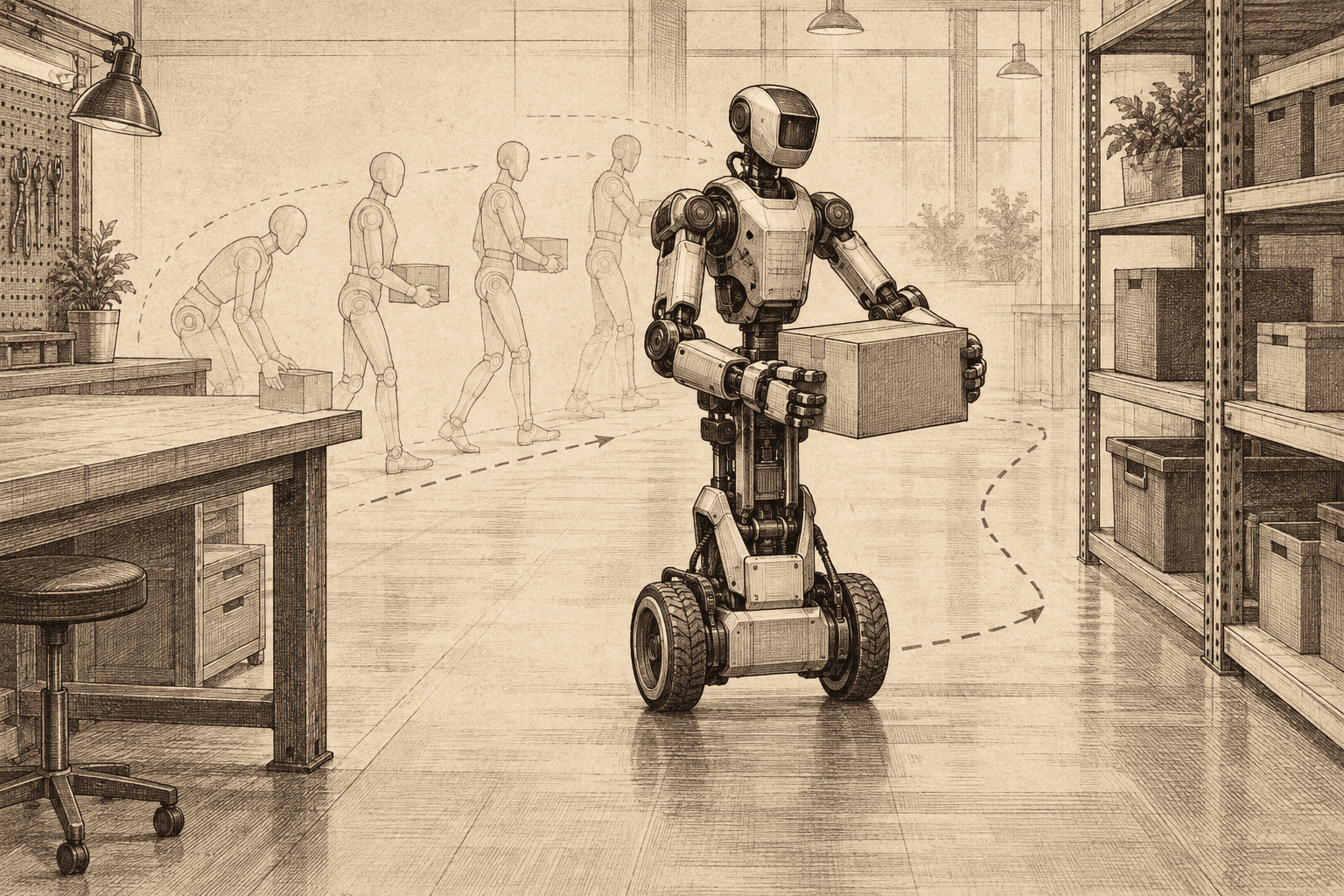
DexRoam kept locomotion, two-arm motion and finger dexterity coupled as demonstrations crossed embodiments.
Summary
DexRoam kept locomotion, two-arm motion and finger dexterity coupled as demonstrations crossed embodiments.
DexRoam uses a consumer VR headset and head-mounted stereo camera to capture continuous whole-body human manipulation without external trackers. Three alignment stages map embodiment, action meaning and timing into a mobile bimanual robot's action space, allowing human and robot demonstrations to train standard vision-language-action policies together. In the authors' real-world tests, adding human demonstrations raised average success from 29% to 56% with GR00T N1.7 and from 32% to 57% with pi0.5; the system matched robot-only training while using half as many robot demonstrations. Those figures describe the reported tasks and backbones, not a general guarantee for dexterous robots.
Why it matters
DexRoam kept locomotion, two-arm motion and finger dexterity coupled as demonstrations crossed embodiments.
Limits and context
- In the authors' real-world tests, adding human demonstrations raised average success from 29% to 56% with GR00T N1.7 and from 32% to 57% with pi0.5; the system matched robot-only training while using half as many robot demonstrations.
- Those figures describe the reported tasks and backbones, not a general guarantee for dexterous robots.
Key claims
DexRoam kept locomotion, two-arm motion and finger dexterity coupled as demonstrations crossed embodiments.
Qualification: In the authors' real-world tests, adding human demonstrations raised average success from 29% to 56% with GR00T N1.7 and from 32% to 57% with pi0.5; the system matched robot-only training while using half as many robot demonstrations.
Evidence: source-2026-09-29-001
Sources
- arXiv preprint 2609.35761arXiv · primary research
Corrections
No corrections have been recorded for this story.