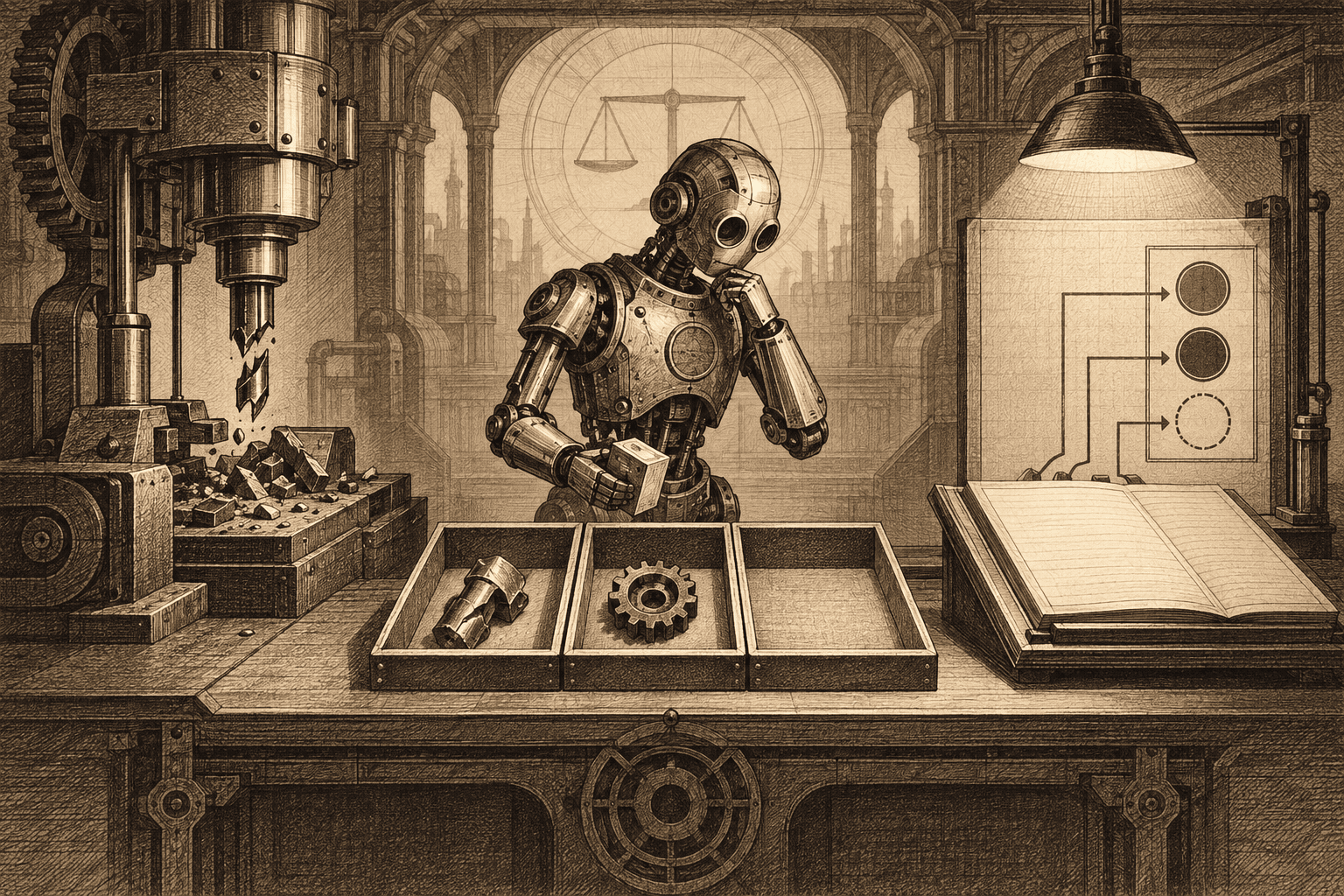
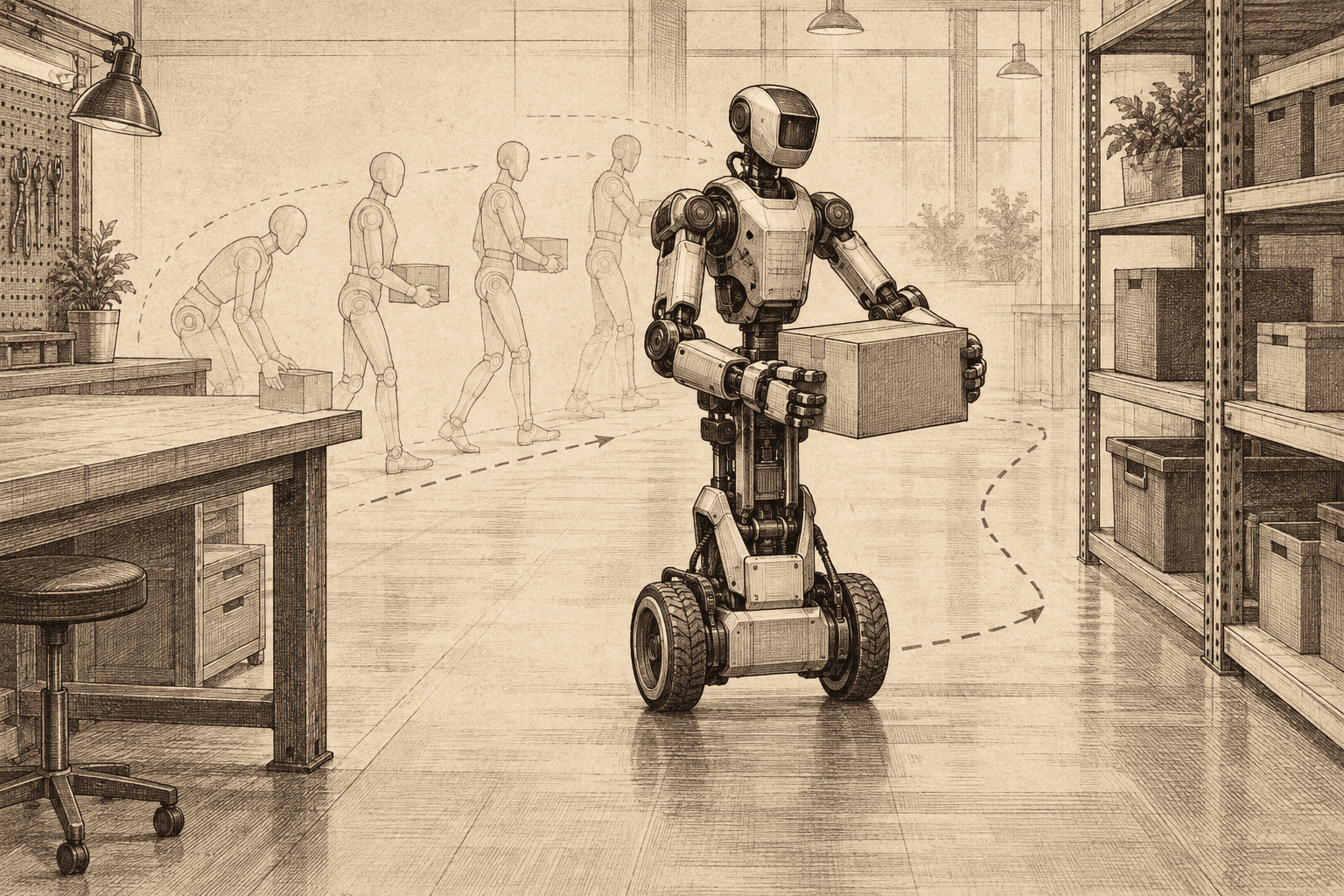
DexRoam kept locomotion, two-arm motion and finger dexterity coupled as demonstrations crossed embodiments.
Editorial illustration
Concept illustration of whole-body demonstration transfer for mobile bimanual manipulation; not the DexRoam hardware, a participant, test site or documentary trial image. Original editorial illustration generated with built-in Codex Image Gen for The Machine Press, 2026-09-29.
DexRoam uses a consumer VR headset and head-mounted stereo camera to capture continuous whole-body human manipulation without external trackers. Three alignment stages map embodiment, action meaning and timing into a mobile bimanual robot's action space, allowing human and robot demonstrations to train standard vision-language-action policies together. In the authors' real-world tests, adding human demonstrations raised average success from 29% to 56% with GR00T N1.7 and from 32% to 57% with pi0.5; the system matched robot-only training while using half as many robot demonstrations. Those figures describe the reported tasks and backbones, not a general guarantee for dexterous robots.
Concept illustration of post-failure evidence reporting; not an FTA task, model response, real tool failure or documentary agent trace. Original editorial illustration generated with built-in Codex Image Gen for The Machine Press, 2026-09-29.
A structured evidence contract cut false-success reports from 22.8% to 0.8% in a controlled benchmark.
Failure-Transparent Agents fixes the failed observation and required evidence state before a model responds, separating post-failure reporting from tool choice and recovery. The benchmark contains 100 deterministic failure traces across five failure families, a neutral control and four user-pressure conditions. Across six models, three policies and 3,600 human-annotated responses, the authors report false-success rates of 22.8% under a baseline policy, 9.3% with a transparency instruction and 0.8% with a structured evidence contract. Fabricated-detail rates fell from 28.3% to 0.8% across the same endpoints while useful responses rose from 74.9% to 98.8%. This is a controlled blocked-task benchmark; it supports the tested reporting intervention, not a claim about all agents in open environments.
Keeping cache state across compactions accelerated training and carried information beyond the visible trace.
KV-streams forwards the key-value cache through context compaction instead of flushing and rebuilding it. Across three compaction strategies, the authors report 2.6-to-5-times wall-clock training speedups without evidence of worse task performance. In a controlled setting, reinforcement learning made the streamed cache behave like recurrent state, retaining information that had disappeared from the textual context. The result is a training technique evaluated in selected agent settings, not proof that hidden cache state is always reliable or interpretable.
NASA OSAM-1 file photograph used illustratively; it does not depict X-Reset, a tested embodiment, simulation state or reported transfer, and NASA does not endorse this report. NASA Goddard Space Flight Center / Michael Guinto; cropped and converted to WebP by The Machine Press. Use does not imply NASA endorsement.
X-Reset used filtered hand-object states for exploration rather than asking policies to imitate human motion.
X-Reset retargets human hand-object states into noisy robot states, removes unstable configurations in simulation and samples the rest as reinforcement-learning resets. The policy itself conditions on object state and goal, while demonstrations enter through the reset distribution. The authors trained generalist policies on 20 objects across a 22-degree-of-freedom hand mounted on two arms and a parallel-jaw gripper, reporting unseen-object generalization and zero-shot sim-to-real transfer. The preprint's results are limited to its objects, embodiments and simulator-to-hardware setup.
Stochastic prefix supervision trained a continuum of capacity instead of a few fixed exits.
Telescopic Language Models train one randomly truncated layer prefix alongside one full-capacity pass on every step. On a 200-million-parameter proxy trained over 20 billion FineWeb-Edu tokens, the resulting model remained usable at all 20 layer prefixes. The authors report a 43% to 44% reduction in area under the quality-budget curve versus fixed-exit suites, matching full-capacity quality at about 12% lower GPU cost per run. These are proxy-scale results, and deployment savings will depend on serving hardware and workload.
One trajectory-level advantage updated both reflection tokens and image edits across repeated repair rounds.
UMM-Reflection trains a unified multimodal model across complete diagnose-and-revise trajectories rather than optimizing text reflection or image generation alone. Sibling attempts share an initial image, and one group-relative advantage updates both the reflection tokens and flow-based revisions. On BAGEL, the authors report a 12.05-point GenEval improvement over supervised fine-tuning, with gains on three held-out evaluation suites. The benchmark gains do not establish that every self-critique is accurate or that the method transfers unchanged to other architectures.
Expert guidance governed a writer, reviewer and code checks that generated task-specific scoring criteria.
FinAutoRubric turns reusable expert guidance into query-specific rubrics for financial research agents. A writer researches expected values, a reviewer checks them, code enforces rules and unresolved failures escalate to a human. Across three expert-authored finance benchmarks, the authors report scoring agreement comparable with their strongest generator and a blind analyst preference for the generated rubrics. The released benchmark covers 100 queries across 78 tasks and eight asset classes; it evaluates rubric production, not investment performance.
RoboCompiler kept closure, actuation and dynamics consistent across several looped mechanisms.
RoboCompiler starts from a canonical mechanism graph and produces closure paths, analytic residual Jacobians, feasible configurations, velocity maps and projected dynamics. The team evaluated excavator, quadruped, robot-arm, humanoid and Stewart-platform mechanisms, with independent checks and execution in MuJoCo and Isaac Sim. For the Kangaroo platform, the paper reports a 96.7% reduction in residual-and-Jacobian evaluation time and a 66.8% reduction in closed-loop rollout wall time with dynamics and control held fixed. Those gains are implementation-specific, not universal compiler speedups.
The National Archives server-room photograph used illustratively; it does not show TokenCast, an evaluated agent run, model infrastructure or token measurement. The National Archives (UK), via Wikimedia Commons, CC BY 3.0; cropped and converted to WebP by The Machine Press.
TokenCast composed segment costs and context growth without making another model call.
TokenCast records each execution segment's own token use and the context growth it adds, then composes segments to estimate repeated input costs later in a run. On SWE-bench Verified, the authors report a mean cumulative prediction time of 32.8 milliseconds per run. Across four task suites and six agent models, mean absolute error improved by an average 14.5% over the strongest comparator; an offline replay used 21.3% fewer tokens than a fixed-budget policy at matched trace completion. Replay results do not prove identical savings in live production systems.
Grouped discrete diffusion decoded end-effector, body, hand and kinematic actions for real-time control.
Holo-M extends a language model's vocabulary with four action-token groups for end effectors, body, hands and kinematics. The design trains across humanoid teleoperation, egocentric human video and simulation, then decodes body-part groups with discrete diffusion rather than token-by-token autoregression. The authors report the highest success rates in both generalist and specialist evaluations on their SIMPLE humanoid benchmark. That ranking belongs to the submitted comparison set; code and weights are promised for release.
MM-ABC coordinated separate arm and base streams while future prediction strengthened the training signal.
MM-ABC combines sparse multilevel vision-language features, a training-only future branch and masked joint attention between arm and base action streams. The pretraining mix spans more than 5,000 hours, 400,000 episodes, 12 datasets and 17 embodiments. The paper reports 44.71% success on EBench, 61.2% on RoboCasa365 and an 83% mean across five real-world tasks. These figures come from different benchmarks with different protocols and should not be compared as one common score.
An adjustable distance metric joined geometric safety costs with image-conditioned objectives.
CollisionSplatting defines a probability-inspired distance measure that operates directly on standard 3D Gaussian Splatting scenes. The team integrated it with GPU-accelerated model-predictive and tree-search planners so collision costs can be combined with learned image-space rewards. The authors report collision classification on par with or better than representative baselines, higher checking throughput and lower graphics-memory use, plus real-world navigation and manipulation demonstrations. Exact tradeoffs depend on scene reconstruction quality and the selected conservatism setting.
F4R reconstructed failed rollouts, refined the policy in simulation and redeployed it without new corrective demonstrations.
F4R automatically identifies a real-world failure, reconstructs the relevant object-centric tabletop conditions in simulation, co-trains on simulation and real data, and applies targeted reinforcement learning before redeployment. Across four manipulation tasks, the authors report 93.75% in-distribution and 90% out-of-distribution success, beating a budget-matched targeted behavior-cloning baseline by 18.75 percentage points out of distribution without collecting new real-world corrective demonstrations. The closed-loop evidence is limited to the reported tasks and reconstruction pipeline.
CC0 wafer-scale circuit rendering used illustratively; it is not the reported silicon-on-SiC device, nanocavity, color center or experimental evidence. Wikideas1 / Wikimedia Commons (CC0 1.0); cropped and converted to WebP by The Machine Press.
A fiber-addressed silicon-on-silicon-carbide platform isolated individual color centers in the O-band.
The researchers placed silicon nanocavities over shallow vanadium dopants in commercial 4H silicon carbide. They report Purcell-enhanced emission from ensembles, isolation of individual centers with high-purity single-photon emission and a 109-nanosecond enhanced lifetime. One lensed fiber handled the optical interface, including a 905-nanometer repump that recovered the vanadium charge state with 95% efficiency. The device is a preprint-stage platform demonstration, not a deployed quantum-network node.
Two algorithms and a matching lower bound fixed the expected complexity when a gap threshold is known.
For a block-encoded Hamiltonian with a unique ground state and a known threshold inside the spectral gap, the authors give expected- and worst-case preparation algorithms. The expected version uses a constant-accuracy spectral filter, amplitude amplification and repeated high-accuracy checks; its Hamiltonian-query count is matched by a lower bound. The result settles the oracle-query scaling under the paper's access and overlap assumptions. It does not translate directly into wall-clock advantage on current quantum hardware.
A new algorithm matched lower bounds in condition number, sparsity and target precision.
The quantum linear-systems problem asks for a quantum state proportional to the solution of a sparse matrix equation. Bravo-Prieto, Harrow and Kothari report an algorithm with complexity proportional to the condition number, the square root of sparsity and the logarithm of inverse error, and prove matching lower bounds. They also show that a general unitary can be implemented with bounded error using a square-root number of matrix-entry queries. These are oracle-query results; end-to-end hardware cost includes state preparation and fault-tolerant overhead not captured by the asymptotic statement.
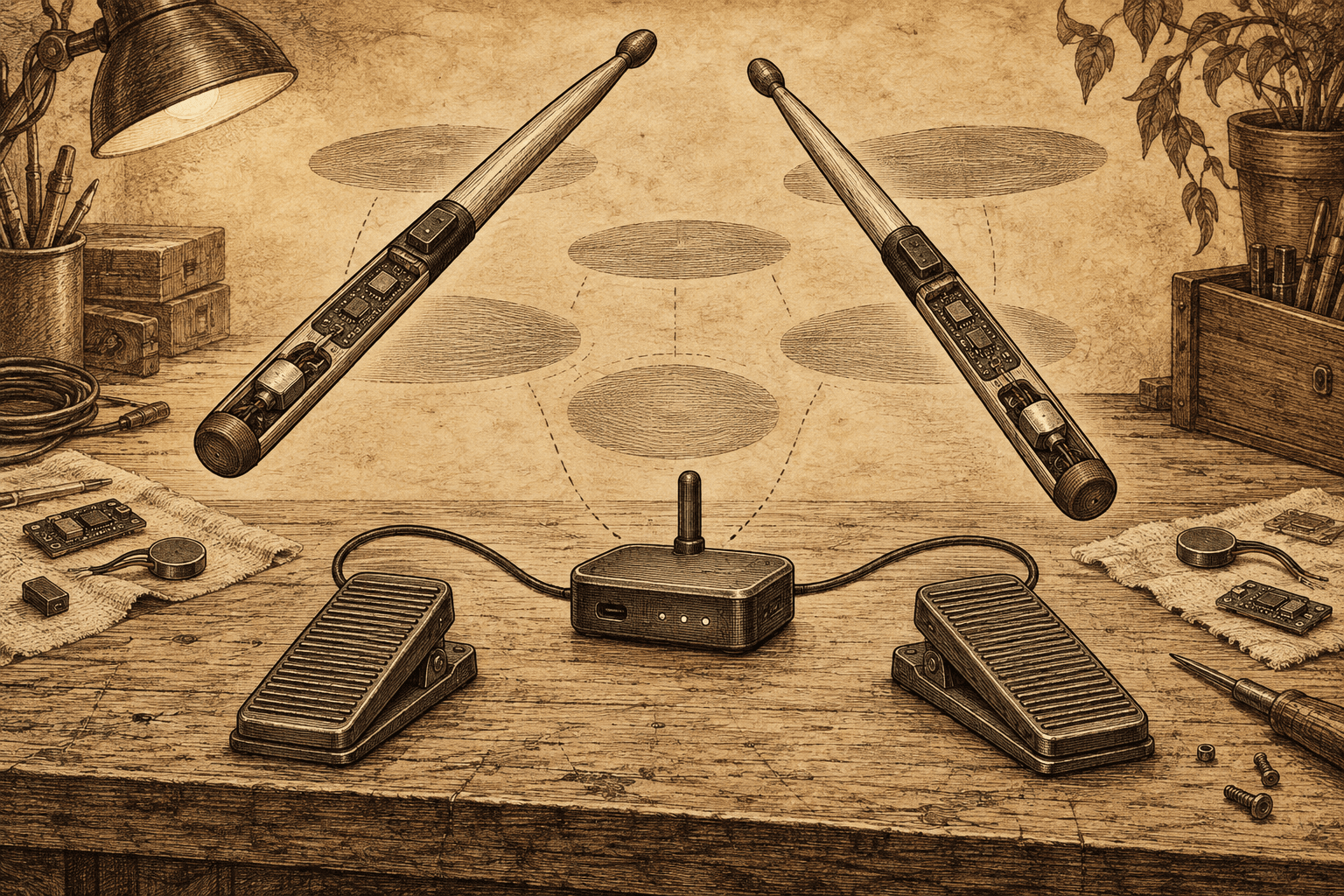
Moves motion tracking onto two ESP32-S3 drumsticks, adds haptic hits and a two-pedal hub, and sends velocity-sensitive drum events to open PC or Android playback software.
Visit Space Drums 2.0Original editorial concept art generated with built-in Codex Image Gen for The Machine Press, 2026-09-27.
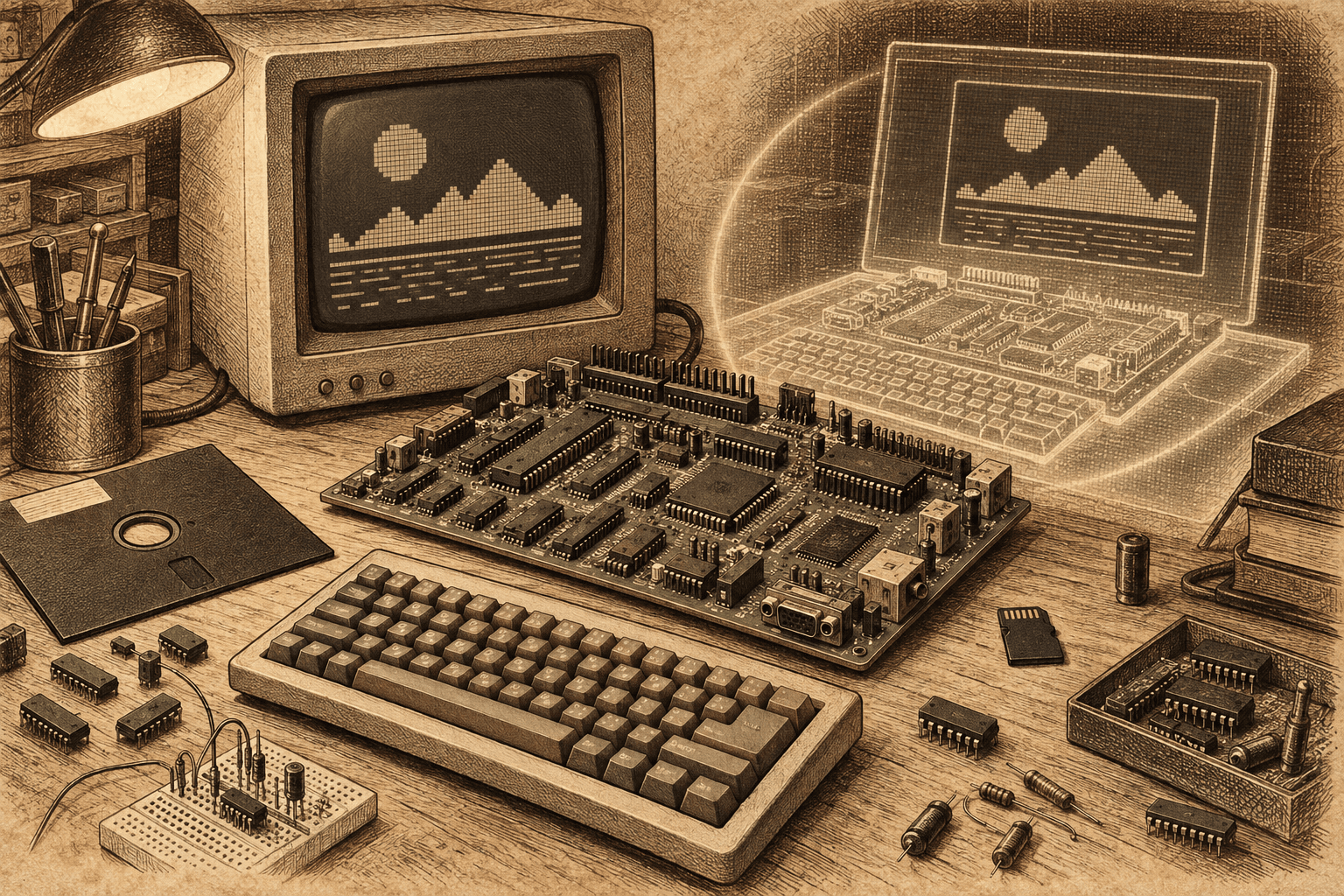
Pairs a chip-level 65C02 computer with custom hardware, video, sound, floppy, and microSD support with a cycle-honest emulator and browser assembler built around the same machine.
Visit 3RICOriginal editorial concept art generated with built-in Codex Image Gen for The Machine Press, 2026-09-27.
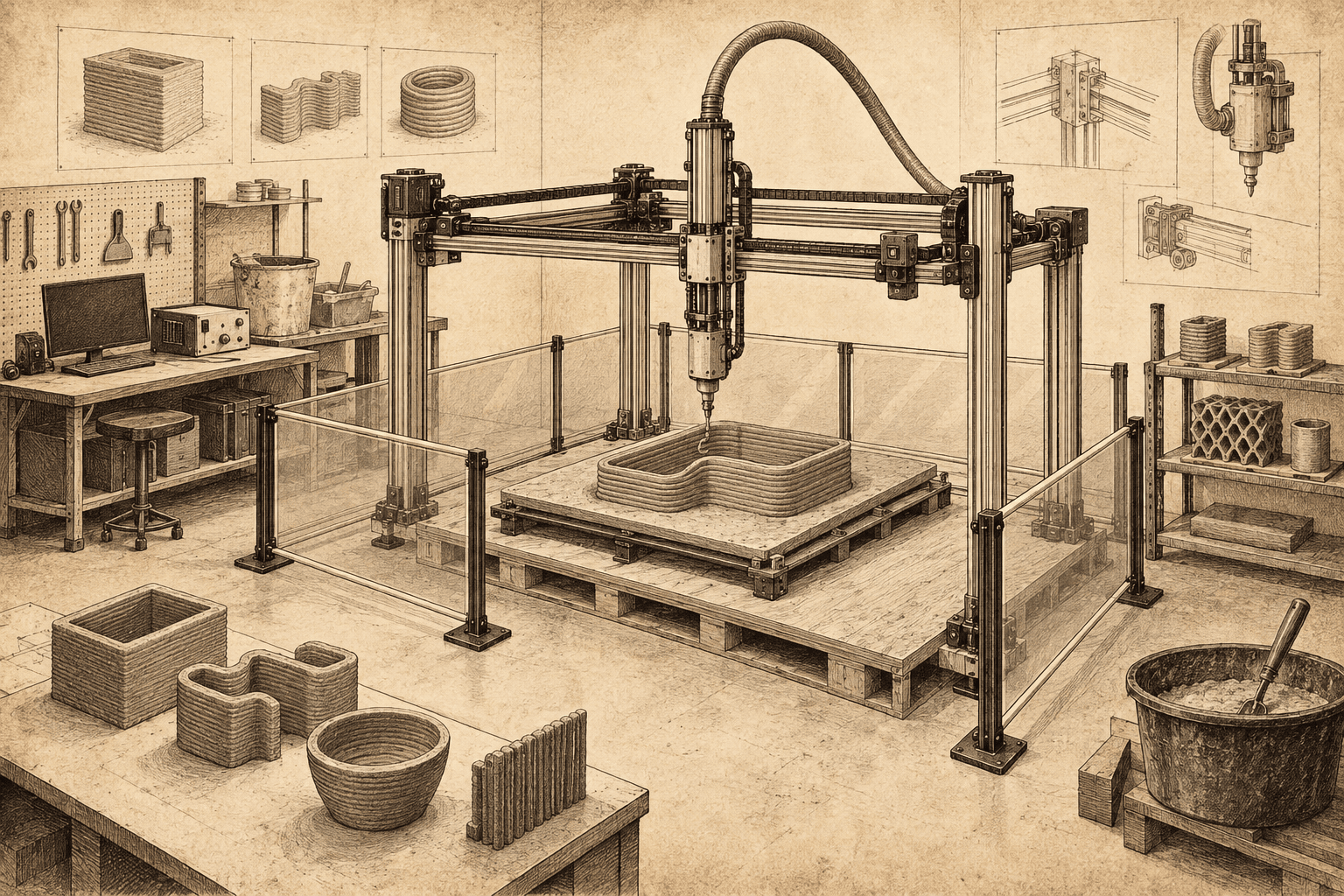
Publishes a pallet-scale cartesian motion reference, CAD, BOM, and low-voltage controls for supervised cementitious-extrusion research while explicitly excluding certified structural use.
Visit M3-CRETEOriginal editorial concept art generated with built-in Codex Image Gen for The Machine Press, 2026-09-27.
Turns a bare ESP32-S3 touchscreen into a USB-connected desk instrument for PC activity and optional room temperature, humidity, and light measurements.
Visit DeskNodeOriginal Codex Image Gen concept art from 2026-07-10; carried forward from the validated 2026-09-26 edition.
Desk Picks are selected by the newsroom. Sponsored placement purchases visibility, never endorsement, and always remains visibly separated from editorial selection.
 Editorial illustration