research
A Radio Circle Spans Two Million Light-Years
ASKAP data reveal a faint 0.63-megaparsec ring around the brightest galaxy in Abell 3639, placing ORC J1928-5056 among the largest single odd radio circles known.
Summary
ASKAP data reveal a faint 0.63-megaparsec ring around the brightest galaxy in Abell 3639, placing ORC J1928-5056 among the largest single odd radio circles known.
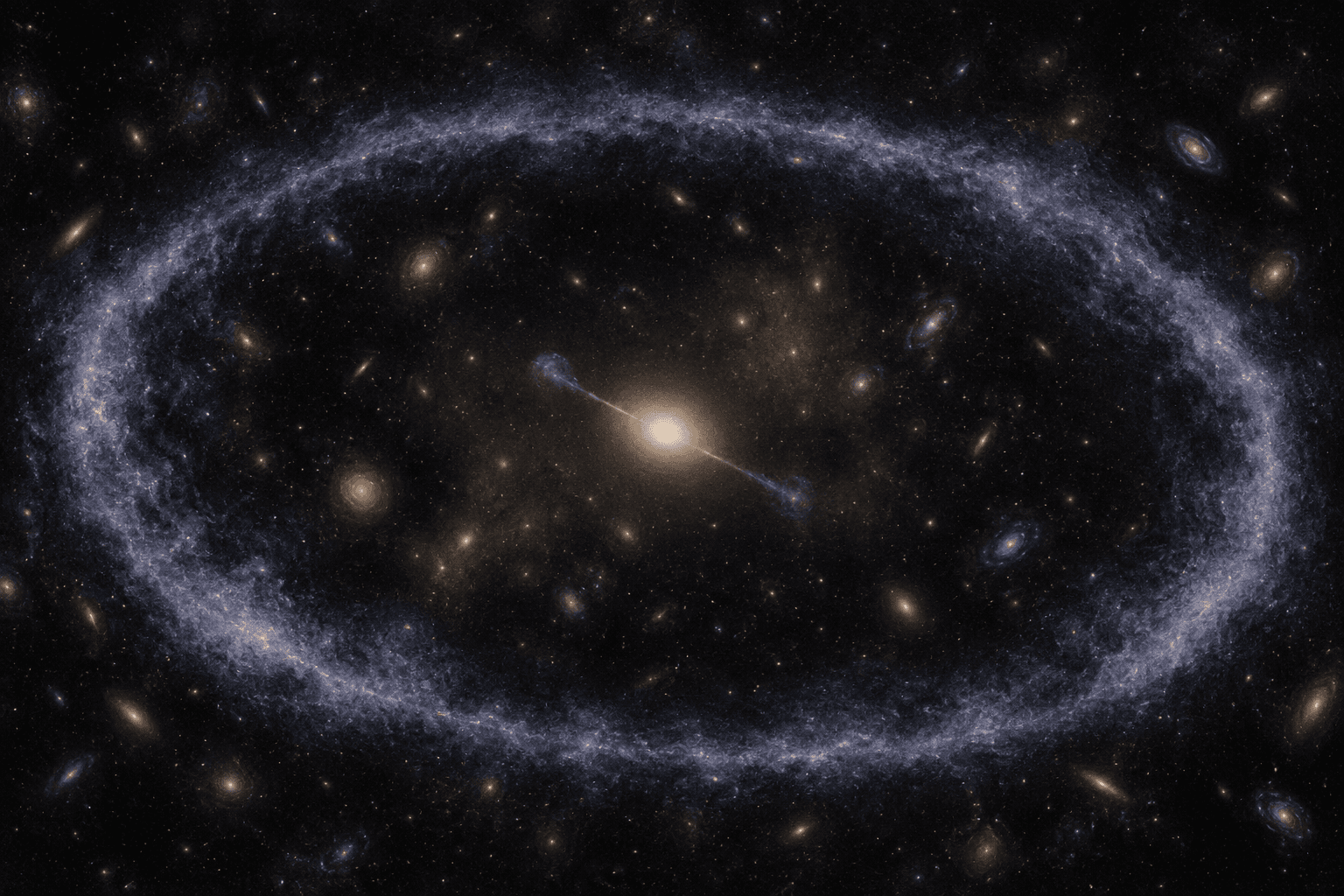
Odd radio circles are faint, roughly circular radio structures whose origins remain unsettled. Researchers report ORC J1928-5056 in 856-megahertz ASKAP continuum data as a mildly elliptical ring four arcminutes across. At the central galaxy's measured redshift of 0.1507, that angle corresponds to 0.63 megaparsecs, or roughly two million light-years. After subtracting the host's radio nucleus, the ring carries 73 millijanskys across about twelve square arcminutes and a rest-frame 1.4-gigahertz luminosity of 2 × 10^24 watts per hertz. The central object is a massive passive elliptical galaxy and brightest cluster galaxy with a radio jet. The observation establishes the size and radio properties of this candidate; it does not yet settle which proposed mechanism formed the circle.
Why it matters
ASKAP data reveal a faint 0.63-megaparsec ring around the brightest galaxy in Abell 3639, placing ORC J1928-5056 among the largest single odd radio circles known.
Limits and context
- Odd radio circles are faint, roughly circular radio structures whose origins remain unsettled.
- The observation establishes the size and radio properties of this candidate; it does not yet settle which proposed mechanism formed the circle.
Key claims
ASKAP data reveal a faint 0.63-megaparsec ring around the brightest galaxy in Abell 3639, placing ORC J1928-5056 among the largest single odd radio circles known.
Qualification: Odd radio circles are faint, roughly circular radio structures whose origins remain unsettled.
Evidence: source-2026-10-28-002
Sources
- arXiv preprint 2610.36512, original v1arXiv · primary research
Corrections
No corrections have been recorded for this story.