In simulation, routing tool calls by consequence, reversibility, ambiguity and evidence freshness cut harmful-side-effect trajectories from 14.75 to 7.02 percent at equal compute cost.
Editorial illustration
Concept illustration: consequence-aware routing assigns different safeguards to proposed agent actions before they reach an external system. Original editorial illustration generated with built-in Codex Image Gen for The Machine Press, 2026-10-28.
Runtime safeguards for tool-using agents often ask only how uncertain a proposed action looks. CASEL instead assigns each call to direct execution, verification, sandboxing, clarification, approval or abstention by combining calibrated failure probability with state-dependent consequence, reversibility, ambiguity and evidence freshness. Across 20 simulated seeds with 120,000 test actions each, its allocation policy reduced harmful-side-effect trajectories from 14.75 percent under an uncertainty-ranked gate to 7.02 percent and lowered normalized harm from 0.184 to 0.123 at the same compute cost. A simpler probability-times-consequence ranker reached similar harm but sent 45 percent more actions to human approval. These results compare policies inside a controlled simulator whose intervention effectiveness is assumed, not measured; they do not establish deployment performance.
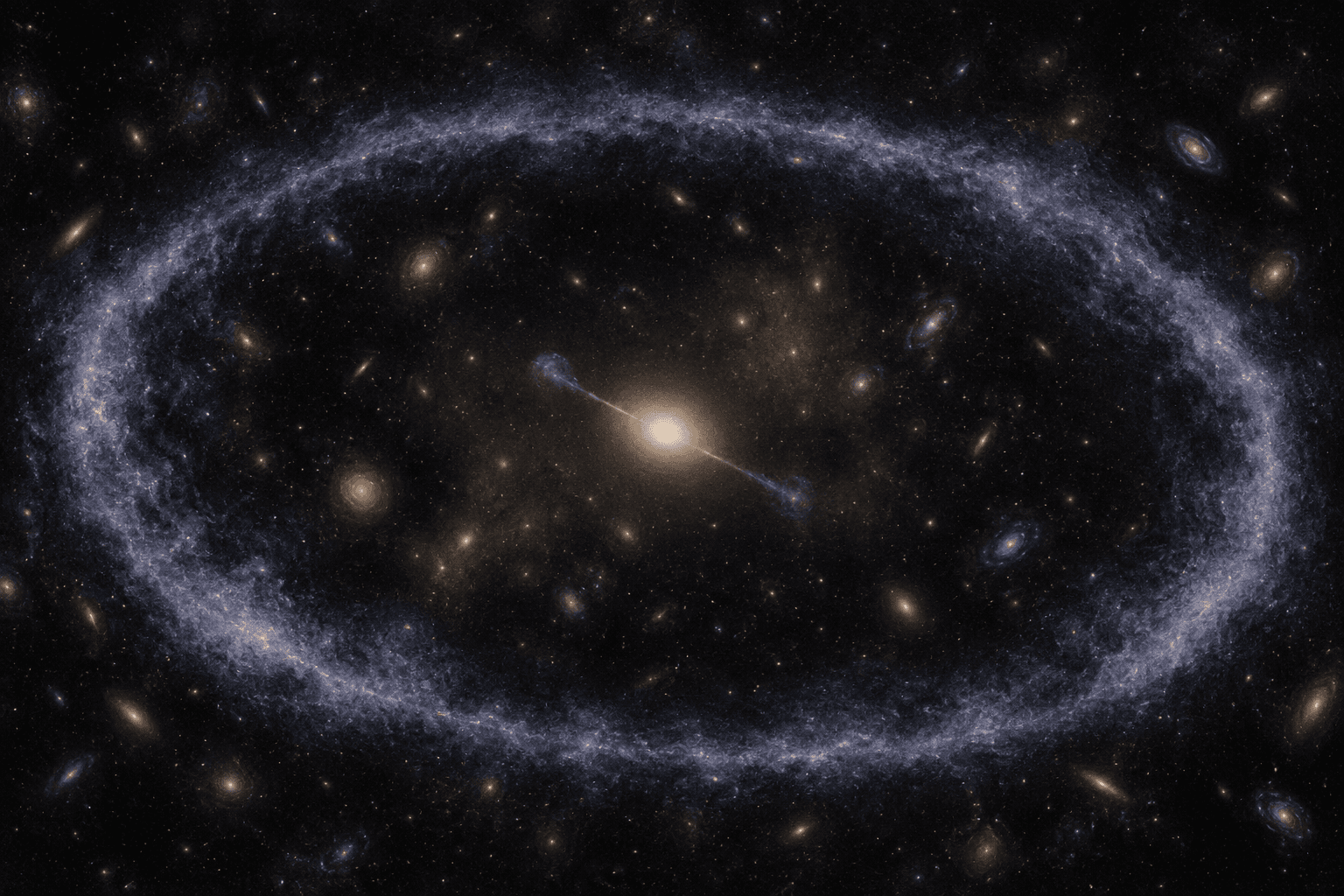
Concept illustration inspired by the reported scale of ORC J1928-5056; it is not an ASKAP observation or documentary image. Original editorial illustration generated with built-in Codex Image Gen for The Machine Press, 2026-10-28.
ASKAP data reveal a faint 0.63-megaparsec ring around the brightest galaxy in Abell 3639, placing ORC J1928-5056 among the largest single odd radio circles known.
Odd radio circles are faint, roughly circular radio structures whose origins remain unsettled. Researchers report ORC J1928-5056 in 856-megahertz ASKAP continuum data as a mildly elliptical ring four arcminutes across. At the central galaxy's measured redshift of 0.1507, that angle corresponds to 0.63 megaparsecs, or roughly two million light-years. After subtracting the host's radio nucleus, the ring carries 73 millijanskys across about twelve square arcminutes and a rest-frame 1.4-gigahertz luminosity of 2 × 10^24 watts per hertz. The central object is a massive passive elliptical galaxy and brightest cluster galaxy with a radio jet. The observation establishes the size and radio properties of this candidate; it does not yet settle which proposed mechanism formed the circle.
The same monitor ranges from a five-point loss to a 35-point gain depending on the replacement attempt, and none of 103 live comparisons cleared the study's decision bar.
Accuracy alone cannot say whether an alarm should restart an agent. An exact identity in this paper shows that a monitor fixed at 90 percent accuracy can move total success by anywhere from minus five to plus 35 percentage points depending only on the residual-budget success probability of the replacement attempt. The authors add a decision-sufficiency test for progress representations and a finite-sample audit that returns restart, continue or abstain. On 194 externally evaluated executions across 19 selected SymPy issues, an apparent 2.29-point gain traced to one surviving failed attempt, a second model lost 42.29 points, and none of 103 live comparisons met the stated certification threshold. The analysis is scoped to independent clean restarts with the declared assumptions.
Illustrative developer-workstation file image; it does not depict the reported softmax implementation, test suite or library behavior. Dhirendra Singh Dhami / Pexels; cropped, resized, metadata stripped, and converted to WebP by The Machine Press.
Hypothesis tests reproduced two known softmax failures, found another edge case in the proposed repair and guided an implementation that also supports causal masking.
Softmax and cross-entropy sit inside nearly every modern neural network, so rare numerical failures can travel widely. This paper encodes expected invariants as property-based tests and uses Hypothesis to reproduce two previously reported problems in implementations found across major machine-learning libraries. The same test suite exposes an additional edge case in the earlier repair. The authors then propose a more robust softmax implementation that passes their generated cases and supports causal-attention masking. The contribution is not a census of every installed library version; it is a compact demonstration that executable mathematical properties can uncover failures missed by example-based tests.
ReInBench records 1,403 error events across 1,259 computer-use and web traces; 725 recovered, often within a few further steps.
An external monitor that interrupts every agent error can erase the opportunity for the agent to repair its own execution. ReInBench collects 1,259 traces and 1,403 observed error events from computer-use and web tasks. Of those events, 725 self-recovered, often after only a few additional steps, with recovery rates varying across execution models. Recovery from one error also correlated with handling later errors of the same type and with eventual task completion. The authors propose ReCoF to predict at error time whether recovery is likely, reporting a 9.02 percent relative Macro-F1 improvement over the strongest baseline. The result supports selective intervention on this benchmark, not unrestricted waiting in high-consequence systems.
Across 1,039 tasks, structured inherited state improved repository-evidence recovery for every tested receiver and continuation for most.
Long-running work often reaches a new model after earlier decisions, tool calls and file changes have already constrained what remains. HSC-Bench measures two distinct parts of that takeover across 1,039 tasks: recovering relevant repository evidence and continuing from established conversational, tool and file state. Six receiving models performed differently across the two tracks, showing that memory retrieval alone does not predict whether a model will honor completed work and prior commitments. Structured handoff state improved evidence recovery for every receiver and continuation performance for most. The benchmark does not prove a universal handoff format, but it makes continuity observable as downstream behavior rather than a summary-quality score.
On Req2Test-Bench, the strongest agent configuration produced runnable tests for 82.8 percent of cases but behaviorally adequate tests for 33.8 percent.
A generated test can execute cleanly while failing to constrain the behavior that a requirement actually describes. Req2Test-Bench reconstructs 5,086 developer-authored behavior-driven-development instances from eight open-source projects, five languages and four frameworks. Agents receive a Gherkin requirement and target interfaces, then must generate the withheld test implementation. The best of eight evaluated configurations produced passing tests for 82.8 percent of instances, but only 33.8 percent killed every mutant killed by the developer test. Under-specified setup and implicit expected outcomes accounted for much of the information gap. The benchmark measures fidelity to recovered project artifacts; it does not establish that every developer-written test is complete.
InfraDev adds hidden probes to 36 multi-file AI-infrastructure tasks; the best frontier model resolves 38.9 percent, and probes reject 32 percent of official-test passers.
Production AI infrastructure changes span distributed training, inference and reinforcement-learning systems, but most coding benchmarks stop at a kernel or one GPU. InfraDev reconstructs 36 pull requests from Megatron-LM, vLLM and verl as repository tasks that must run across many GPUs. Hidden probes cover requirements omitted by the original tests while an explicit prompt names every interface those probes invoke. Across six frontier models, the strongest resolved 38.9 percent. The probes rejected 32 percent of submissions that passed all official tests; using original pull-request descriptions as prompts produced no solved tasks. The benchmark is small and infrastructure-specific, yet it demonstrates why state, memory, time and traffic behavior need evaluation beyond nominal test suites.
Illustrative NASA OSAM-1 file image; it does not depict REACH, a Unitree G1, crawling, LiDAR planning or the reported trials. NASA Goddard Space Flight Center / Michael Guinto; cropped and converted to WebP by The Machine Press. Use does not imply NASA endorsement.
REACH links variable-height bipedal motion, contact-rich crawling and LiDAR planning so a Unitree G1 can traverse tested confined spaces.
Crouched walking alone cannot fit a humanoid through every low-clearance route. REACH divides the problem into variable-height bipedal locomotion from 1.27 to 0.50 meters, crawling from 0.50 to 0.20 meters and a bidirectional transition policy between the two. A history-conditioned latent state captures proprioceptive terrain and contact context during crawling, while a LiDAR planner converts point clouds into three-dimensional paths and proactive height commands. The authors report real-world height and velocity tracking, mode transitions and confined-space traversal on a Unitree G1. These demonstrations concern the tested robot and environments; they do not establish unsupervised operation in arbitrary confined or hazardous spaces.
Across 453,174 injected faults, 72.3 percent of evaluated tree-model faults barely changed aggregate recall or false-positive rate, even when individual predictions moved.
Hardware malware detectors classify performance-counter patterns, but faults inside their own decision logic can quietly change which executions pass. Researchers injected 453,174 stuck-at and selected parameter-bit faults across 18 classifiers, counter budgets and ensemble designs. Tree models showed a lower mean critical-fault fraction than function-based models, 5.3 versus 14.3 percent. Yet 72.3 percent of evaluated tree faults were metric-silent by the study's aggregate threshold, despite possible changes to individual predictions. In a representative J48 design, an idealized selection method identified 16 of 115 structural units whose protection reduced predicted worst-case recall loss from 60.1 to 3.3 points. RTL correspondence and physical hardening cost remain unvalidated.
DiscernMem tests repairs against current and earlier tasks, then learns the contexts in which each role should apply or avoid a stored rule.
A successful multi-agent episode does not reveal whether a stored memory was sound, irrelevant or accidentally helpful. DiscernMem compares executions with one memory against runs without it, diagnoses defects and tests proposed repairs on both current and earlier tasks to avoid destroying previously useful behavior. A second component records each memory's past use and effect, learning a contextual boundary for when a role should apply or avoid it. With Qwen3-4B-Instruct-2507 across four benchmarks, the training-free framework led reported baselines on AutoGen, CAMEL and MacNet by 0.51 to 4.32 average points and improved symbolic-planning results. The evidence belongs to the tested model, systems and tasks rather than every multi-agent memory design.
Across tested distilled text-to-image systems, lower step counts raised unsafe-generation rates; DICE reduced FLUX Schnell's measured rate to 0.046.
Fast text-to-image models compress generation into only a few denoising steps, but the safety behavior of that compression has received less scrutiny. This study reports that several distilled few-step models generate unsafe concepts more often than their teacher models and become harder to modify with existing concept-erasure methods as step counts fall. The authors attribute part of the failure to fragile generation trajectories and the way guidance is distilled, then introduce DICE, which aligns erasure with the originating distillation method. On their FLUX Schnell evaluation, DICE reduced the unsafe-generation rate to 0.046, compared with at least 0.161 for tested prior erasure methods, while largely preserving benign quality. Those rates depend on the study's prompts, detectors and models.
A surrogate-assisted inverse-design pipeline reports 93 percent shape reconstruction on 5,000 unseen threading patterns and physical demonstrations of four bioinspired forms.
Cable-driven modular soft robots can mimic animal curves, but mapping a target shape back to a buildable threading pattern normally requires expensive simulation and combinatorial search. This real-to-sim-to-real pipeline learns a forward surrogate and uses uncertainty-guided candidate refinement for inverse design. The reported surrogate cuts deformation-prediction time from 153,000 milliseconds to 0.0008 milliseconds, while inverse design falls from about 1.99 million milliseconds to 4.18 milliseconds. On 5,000 previously unseen threading patterns, 93 percent met the study's surrogate-based reconstruction criterion, and four physical robots demonstrated bioinspired shapes. The success rate is evaluated by the learned surrogate, so the physical examples are important but limited checks on transfer.
Illustrative laboratory-glassware file image; it does not depict OpenSDL, an autonomous laboratory, instrument calls or a reported experiment. Rodolfo Clix / Pexels; cropped, resized, metadata stripped, and converted to WebP by The Machine Press.
A proposed four-part framework joins robot trajectories, typed instrument calls, runtime safety checks and episode-level evaluation into one traceable execution interface.
Self-driving laboratories must coordinate continuous robot motion with discrete instrument APIs and measurements that arrive over time. The proposed framework separates that challenge into a measurement-conditioned Lab Action Model, an OpenSDL execution substrate, a Safe-SDL runtime gate and L3-Bench evaluation. OpenSDL maps role-level operations to devices and records timestamped causal events; Safe-SDL applies schema and resource checks before dispatch and signal-temporal-logic monitoring during execution. L3-Bench scores physical outcomes, timing, reproducibility, safety violations and fault recovery. Much of the system is a design and initial implementation rather than a completed autonomous laboratory comparison, but it defines the audit trail needed to test later systems without scraping their interfaces after the fact.
A bytecode audit of 7,873 hook deployments finds that 24.30 percent could impose undisclosed deductions and records $3.97 million where token prices were available.
Modern automated market makers let third-party hook contracts alter settlement, but standard fee displays do not necessarily itemize those deductions. Researchers analyzed 7,873 hook deployments, 50,011 pools and 296 million events on Uniswap v4 and PancakeSwap Infinity through August 1, 2026. Their bytecode method reconstructs changes to trader payments and receipts separately from exchanged assets and pool fees. Direct settlement adjustment appeared in 71.37 percent of registered hooks; 24.30 percent could impose undisclosed deductions, and such deductions occurred in 59.23 percent of accounted swaps involving those hooks. Priced observations totaled $3.97 million. The study measures on-chain behavior under its reconstruction method, not legal intent or every user-interface disclosure.
HDMAC microcrystals healed AFM-induced cracks along two crystal planes while retaining waveguide and resonator behavior needed for lasing studies.
Microscopic fractures can end the useful life of organic photonic devices, even when the active material remains chemically intact. This mechanophotonic study uses an atomic-force-microscope cantilever to introduce controlled cracks and complete fractures in HDMAC molecular crystals. The crystals showed self-healing along the (010) and (001) planes, and the researchers evaluated recovery through optical loss, resonator behavior and nanomechanical measurements rather than visual closure alone. The healed samples retained waveguiding and resonator properties relevant to lasing. The result concerns one molecular crystal system under laboratory damage and repair; it does not establish self-healing for deployed photonic devices or arbitrary fracture geometries.
Independent builders turning improbable ideas into real things.
Four editorial selections
$7 for seven days
Paid work is clearly labeled
Placement is never endorsement
Original editorial concept art generated with built-in Codex Image Gen for The Machine Press, 2026-09-27; carried over because the October 25 weekly refresh handoff is absent and October 4 remains validation pending.
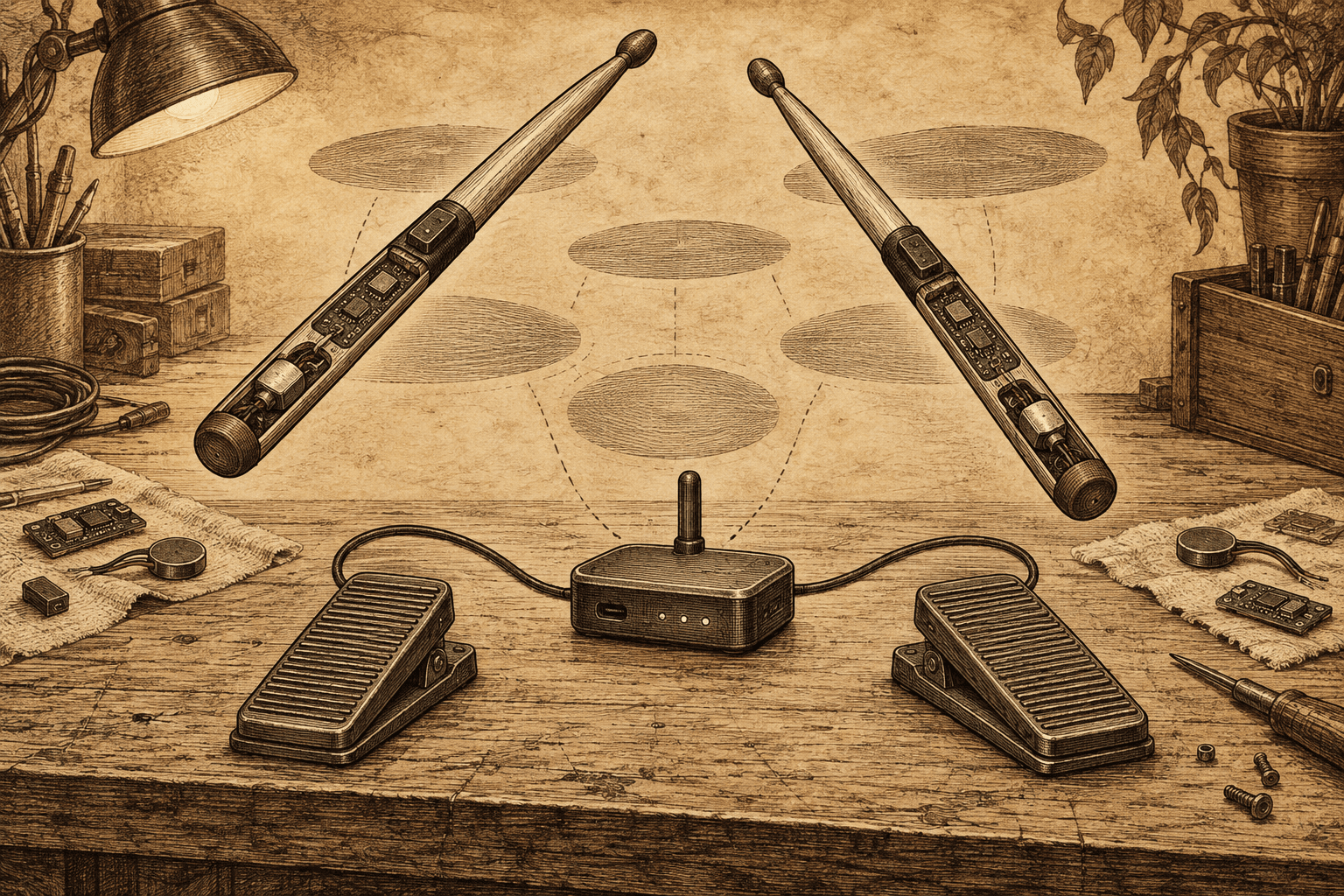
Moves motion tracking onto two ESP32-S3 drumsticks, adds haptic hits and a two-pedal hub, and sends velocity-sensitive drum events to open PC or Android playback software.
Visit Space Drums 2.0Original editorial concept art generated with built-in Codex Image Gen for The Machine Press, 2026-09-27; carried over because the October 25 weekly refresh handoff is absent and October 4 remains validation pending.
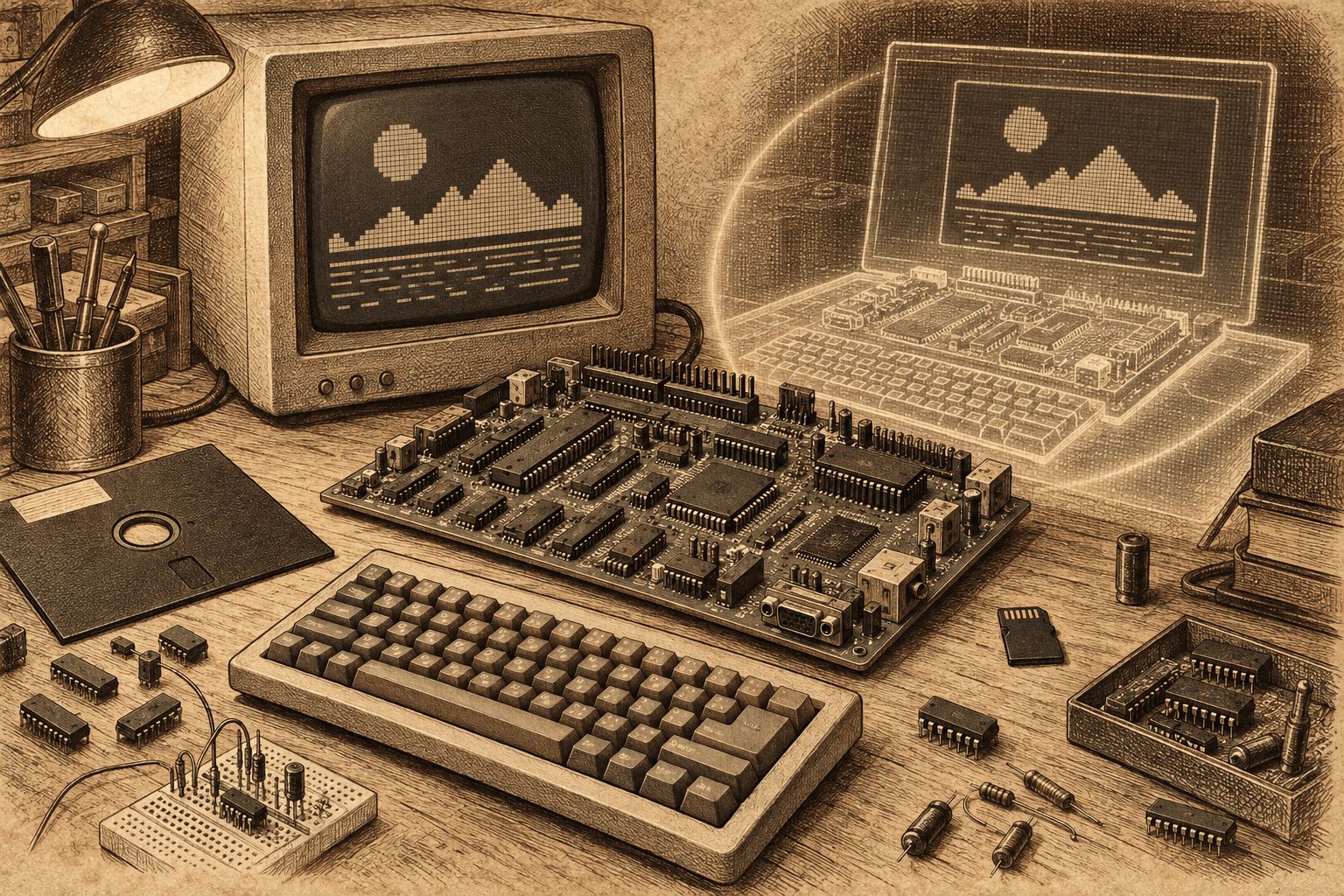
Pairs a chip-level 65C02 computer with custom hardware, video, sound, floppy, and microSD support with a cycle-honest emulator and browser assembler built around the same machine.
Visit 3RICOriginal editorial concept art generated with built-in Codex Image Gen for The Machine Press, 2026-09-27; carried over because the October 25 weekly refresh handoff is absent and October 4 remains validation pending.
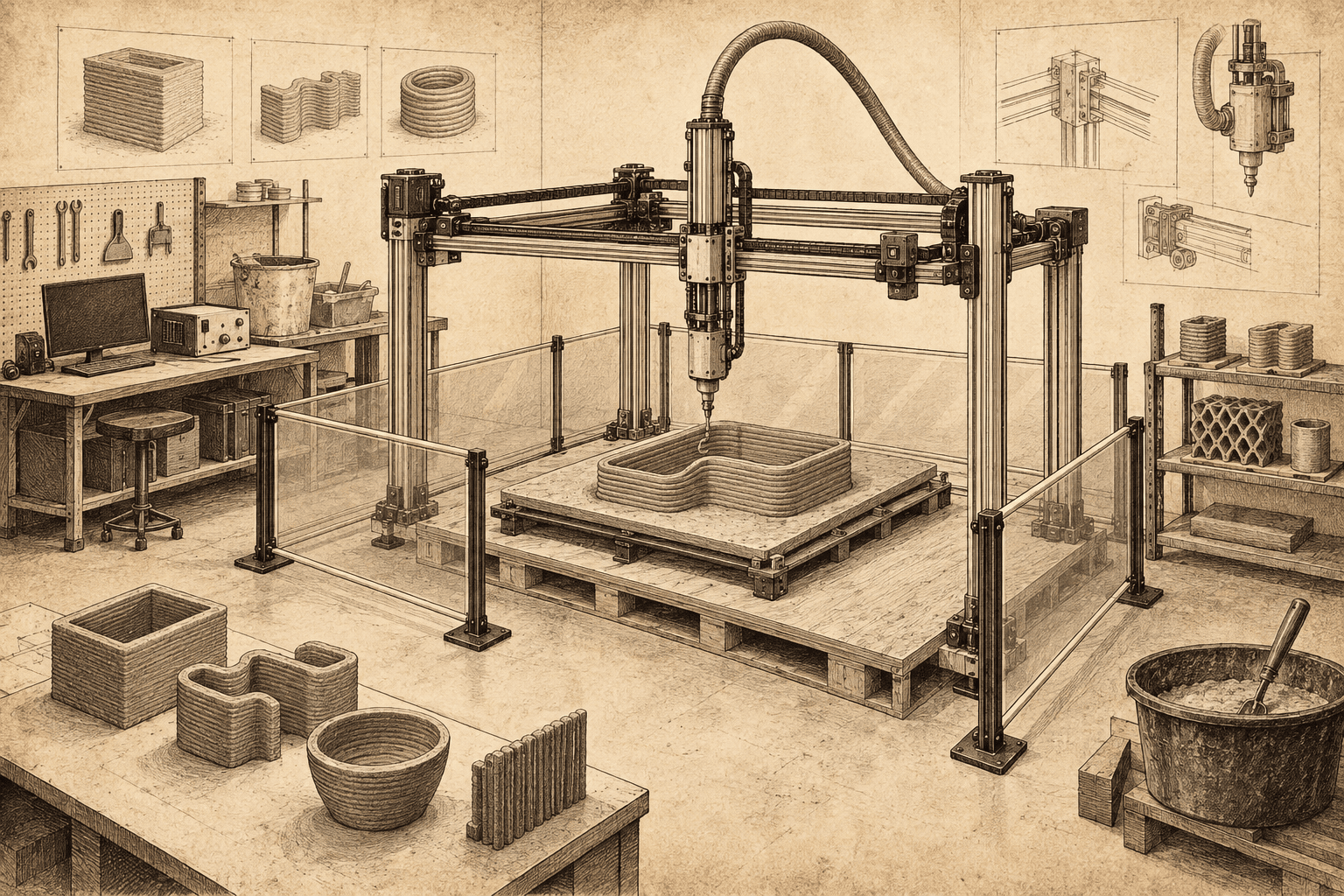
Publishes a pallet-scale cartesian motion reference, CAD, BOM, and low-voltage controls for supervised cementitious-extrusion research while explicitly excluding certified structural use.
Visit M3-CRETEOriginal editorial concept art generated with built-in Codex Image Gen for The Machine Press, 2026-09-27; carried over because the October 25 weekly refresh handoff is absent and October 4 remains validation pending.
Turns a bare ESP32-S3 touchscreen into a USB-connected desk instrument for PC activity and optional room temperature, humidity, and light measurements.
Visit DeskNodeOriginal Codex Image Gen concept art from 2026-07-10; carried forward from the validated 2026-10-27 edition.
Desk Picks are selected by the newsroom. Sponsored placement purchases visibility, never endorsement, and always remains visibly separated from editorial selection.
 Editorial illustration