robotics
The Hand Reaches Further—and Drops Less
Across 4,800 unseen goals, a simulated-to-real LEAP hand reached 95.2 percent within tolerance; an adjustable residual safety filter cut object drops by 75 percent.
Summary
Across 4,800 unseen goals, a simulated-to-real LEAP hand reached 95.2 percent within tolerance; an adjustable residual safety filter cut object drops by 75 percent.
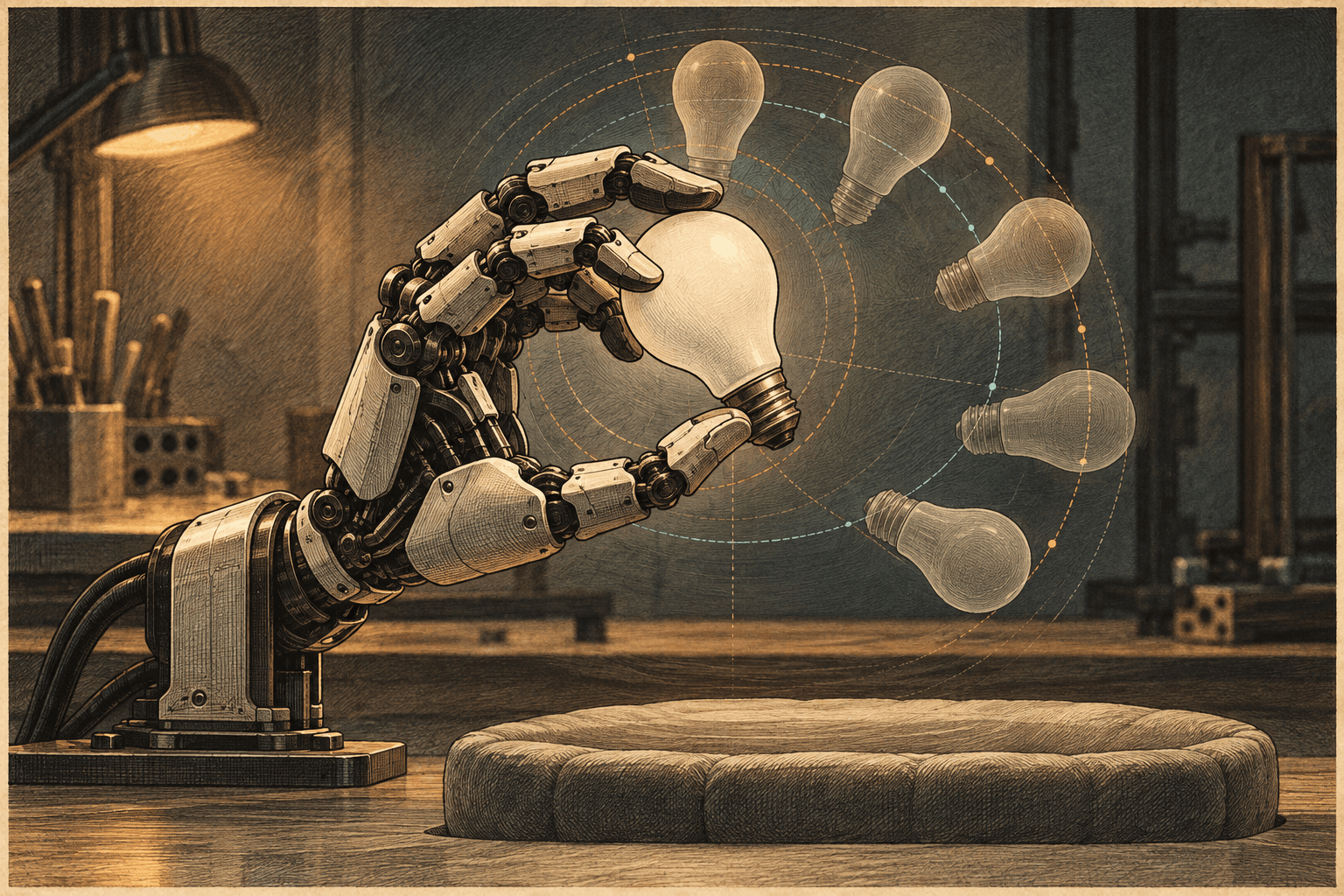
In-hand pose reaching asks a robot hand to move an object to many positions and orientations without releasing it, including through long sequences and changing wrist poses. The researchers train a LEAP-hand policy entirely in simulation using generated grasp resets, broad goals and an adaptive friction curriculum, then transfer it to a physical hand with either motion capture or a wrist depth camera. Across 13.3 hours, four objects and 4,800 unseen goals, the state-based policy reached 95.2 percent within two centimeters and 0.4 radians. A learned residual safety filter reduced drops by 75 percent while still reaching 91.5 percent of goals. The reported demonstrations include lightbulb turning and perturbations, but remain results for this hand, setup and object set.
Why it matters
Across 4,800 unseen goals, a simulated-to-real LEAP hand reached 95.2 percent within tolerance; an adjustable residual safety filter cut object drops by 75 percent.
Limits and context
- The reported demonstrations include lightbulb turning and perturbations, but remain results for this hand, setup and object set.
Key claims
Across 4,800 unseen goals, a simulated-to-real LEAP hand reached 95.2 percent within tolerance; an adjustable residual safety filter cut object drops by 75 percent.
Qualification: The reported demonstrations include lightbulb turning and perturbations, but remain results for this hand, setup and object set.
Evidence: source-2026-10-29-002
Sources
- arXiv preprint 2610.37652, original v1arXiv · primary research
Corrections
No corrections have been recorded for this story.