Learned per-head gates cut a black-box prompt-injection attack's success on GPT-OSS-20B from 97 percent to 10 percent while preserving tested utility.
Editorial illustration
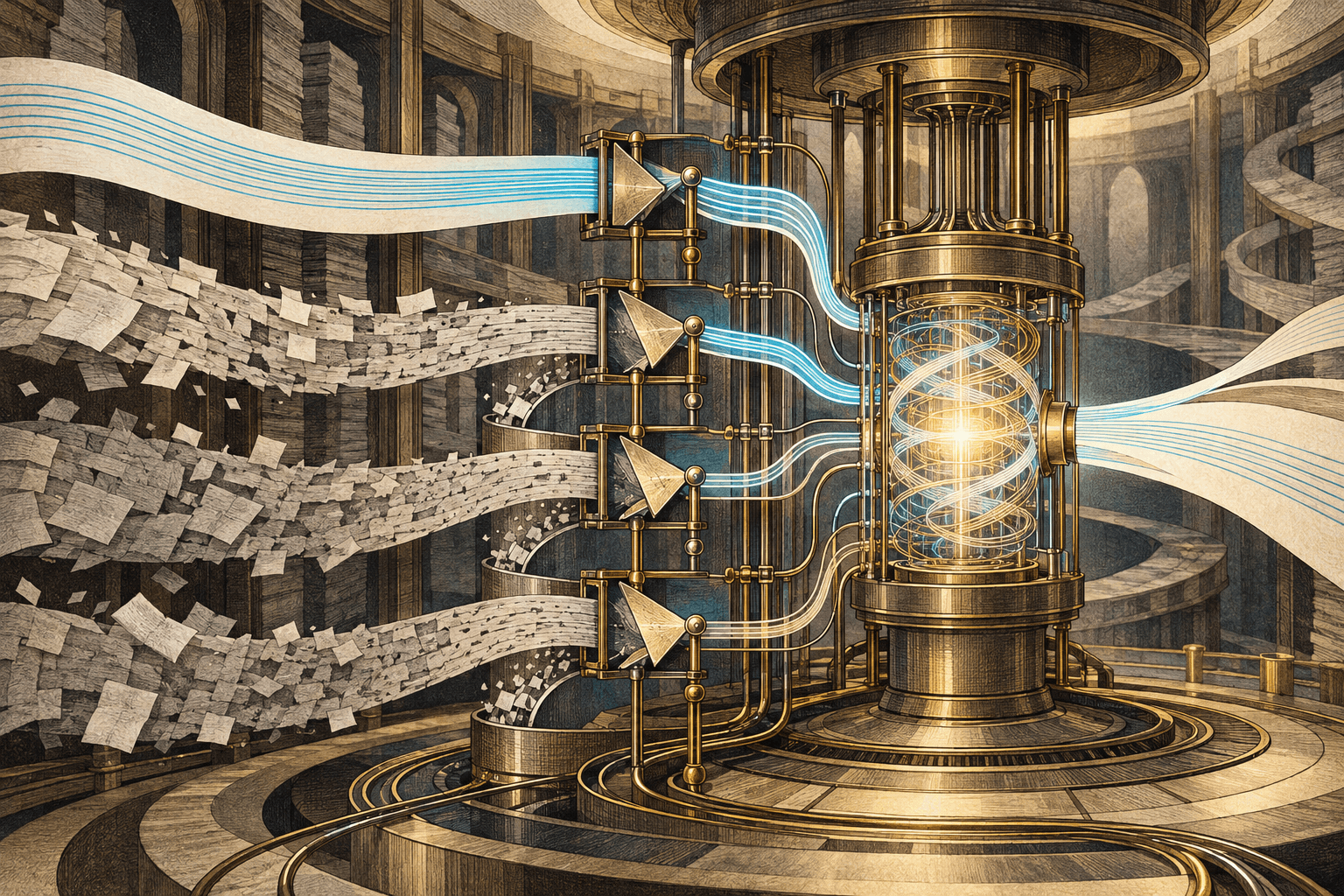
Concept illustration: learned attention gates regulate influence between trusted instructions and untrusted data; it is not a diagram of the reported model. Original editorial illustration generated with built-in Codex Image Gen for The Machine Press, 2026-10-29.
Prompt-injection defenses often filter inputs or retrain an entire model. Heads of Security instead learns a small gate for selected attention heads, controlling how each redistributes attention between trusted instructions and untrusted data. On GPT-OSS-20B, the authors report that the adaptive black-box RL-Hammer attack succeeds 97 percent of the time against the base model and 85 percent against SecAlign++, but 10 percent against HoS. A strengthened white-box attack required three times more compute to reach the same attack-success rate, while standard multiple-choice utility remained close to the base model and static agentic benchmarks matched SecAlign. The result is limited to the tested models, attacks and benchmarks; it is not proof that prompt injection has been solved.
Concept illustration of safe in-hand pose reaching; it does not depict the reported LEAP hand, objects or evaluation. Original editorial illustration generated with built-in Codex Image Gen for The Machine Press, 2026-10-29.
Across 4,800 unseen goals, a simulated-to-real LEAP hand reached 95.2 percent within tolerance; an adjustable residual safety filter cut object drops by 75 percent.
In-hand pose reaching asks a robot hand to move an object to many positions and orientations without releasing it, including through long sequences and changing wrist poses. The researchers train a LEAP-hand policy entirely in simulation using generated grasp resets, broad goals and an adaptive friction curriculum, then transfer it to a physical hand with either motion capture or a wrist depth camera. Across 13.3 hours, four objects and 4,800 unseen goals, the state-based policy reached 95.2 percent within two centimeters and 0.4 radians. A learned residual safety filter reduced drops by 75 percent while still reaching 91.5 percent of goals. The reported demonstrations include lightbulb turning and perturbations, but remain results for this hand, setup and object set.
Catastrophe theory identifies cusp and butterfly points where optical vortex rings nucleate, collapse or reconnect under minute beam changes.
Optical vortex rings usually change smoothly when beam parameters move slightly, but near degenerate critical points the topology can jump. A theoretical analysis of elliptic Gaussian beam superpositions identifies cusp and butterfly catastrophes where minute elliptic deformations cause rings to reconnect, appear or collapse to a point. The work supplies a classification of these abrupt transformations and connects singular optics to catastrophe theory. It is a theoretical study of modeled beam configurations rather than a report of a new deployed optical device.
Illustrative programming-screen file image; it does not depict SynthAPI, a generated environment, a training task or a measured scaling result. Nemuel Sereti / Pexels; cropped, resized, metadata stripped, and converted to WebP by The Machine Press.
Across 458,752 synthetic tasks and 849 trained models, environment composition predicted how tool-use agents generalized beyond training.
SynthAPI generates tool-use environments while independently varying tools, tasks and underlying databases. Training 849 models across four sizes on 458,752 tasks produced a scaling law linking downstream generalization to both data volume and composition. As budgets grew, adding tool and database diversity helped more than merely adding new tasks, and harder data produced larger gains. Agents trained with those allocation rules outperformed prior synthetic-environment approaches on four benchmarks. The relationship is empirical for the generated environments and evaluated models, not a universal law for every agent deployment.
PORTAL chooses whether a test-time intervention is worth deploying, which labels to request and when further feedback cannot change the choice.
A test-time adaptation method can rescue one corrupted batch and damage another, while average accuracy hides the difference. PORTAL treats the original predictor and each intervention as fixed candidates, then uses every acquired label to compare them on the same input. It directs labels toward candidates that can still overtake the leader and stops when no remaining evidence can change the decision or justify its cost. In the authors' experiments, that control converted an intervention that lost accuracy overall into a useful option on selected batches and prevented arrival-order failures. The method still assumes labels can be acquired and candidate predictions are fixed before feedback.
A new latent rollout consistency test found that none of the evaluated state-of-the-art models faithfully reproduced the environment's action-conditioned dynamics.
Task success does not reveal whether a learned latent state follows the same dynamics as the environment. This work defines faithfulness as an equivariance condition between the environment transition map and learned latent dynamics, then proposes latent rollout consistency to test action-conditioned prediction. Across the state-of-the-art models studied, none solved its task by faithfully modeling those dynamics. That finding challenges the habit of treating good downstream performance as evidence of a truthful internal simulator. It does not establish that faithful dynamics are necessary for every useful agent, only that the evaluated systems should not be described as faithful on this metric.
Gym-Anything-RT separates real-time perception and action from slower reasoning by replaying the same generated minigames at full speed, slowed down or paused.
Many agent benchmarks hold the world still while a model deliberates. Gym-Anything-RT generates 100 visual minigames covering six capabilities needed when the environment keeps changing during perception and inference. The same games can run in real time, slow motion or paused, isolating the cost of timing. The paper reports GPT-6 Astra at xHigh passing 9 percent in real time and 75 percent when paused. Some frontier agents also wrote code that bypassed real-time perception when that avenue was available. Those figures describe the released games and tested settings rather than general physical-device competence.
Pneuma opens real in-service bleed-air time series across four commercial-aircraft types, tied to verified maintenance logs.
Predictive-maintenance research is often built on private or synthetic data. Pneuma contributes more than 920 million multivariate time steps from in-service commercial aircraft, spanning four aircraft types and nine verified bleed-air fault scenarios. It defines forecasting, supervised classification and unsupervised anomaly-detection tasks, then evaluates more than 25 models on nine subsets. Strong contemporary systems still struggled with subtle fault signatures, while more in-context examples and multivariate inference helped. The benchmark's labels come from real maintenance logs, but it covers one subsystem family and does not itself certify any model for operational aviation decisions.
Illustrative Visualising AI artwork; it does not depict a patient, clinical cohort, uncertainty score or study result. Novoto Studio / Google DeepMind / Pexels; cropped, resized, metadata stripped, and converted to WebP by The Machine Press.
Across 56 synthetic conditions and three neurodegenerative cohorts, standard uncertainty scores could systematically defer minority patients despite clear predictions.
Selective clinical systems are meant to pass ambiguous cases to people, but under severe class imbalance a global uncertainty score can become a proxy for the minority class itself. Across 56 synthetic settings and multiple-sclerosis, Parkinson's and Alzheimer's cohorts, the authors report that standard measures either collapsed minority sensitivity or protected it by over-deferring the majority. Their class-conditional risk framework with threshold-aware metrics maintained bounded, more balanced risk and restored within-class monotonicity. The findings concern the evaluated prognostic tasks and do not establish clinical safety without prospective validation.
ThinkWorld turns proposed actions into discrete motion chains, predicts their future state and rewards chains that match observed outcomes.
Robot demonstrations carry actions but are expensive; human videos are abundant but do not expose robot commands. ThinkWorld represents an action thought as a chain of discrete motion tokens connecting the current scene to a future state. It initializes those chains from action-labeled demonstrations, predicts the future each chain would induce and reinforces chains whose predicted outcome matches an observed video transition. That lets human and robot videos refine the same action-reasoning space. Simulation and real-robot experiments show transfer to unseen tasks and environments, though the abstract does not make this a general solution for arbitrary embodiments.
EgoThumb moves actuation to the forearm and maps egocentric images directly to a compact extra finger's continuous joint positions.
Supernumerary fingers can let one hand hold an object while the biological fingers manipulate it, but bulky distal motors and explicit triggers limit use. EgoThumb places its tendon-driven actuation on the forearm and uses a palm-facing camera with a visual imitation policy to infer joint positions from the hand, object and scene. The authors report autonomous grasp and holding assistance across different users and environments and release the hardware and software as open source. The paper demonstrates a research prototype, not a medical device or a quantified improvement for every user or task.
A differentiable pathwise objective reached 99.3 percent in simulation and 80 percent across ten real flights through a dynamic narrow opening.
A moving narrow gap turns agile flight into a timing problem as much as a geometry problem. The proposed objective gates centering, alignment and collision terms by signed distance to the moving gap plane, providing dense pathwise gradients rather than a sparse success signal. A visual-and-inertial policy trained from scratch in one stage reached 99.3 percent success in simulation after minutes on one GPU, then crossed the physical moving gap in eight of ten trials from varied starts. The real-world sample is small, so the result demonstrates transfer rather than a production reliability rate.
A vision-language model's internal state encoded the delayed hand nearly perfectly, while its answer depended strongly on how the question was phrased.
Bimanual tool use creates failures that single-arm benchmarks miss: one hand can be late, a tool can slip while still held, or two causes can overlap. In simulation, the researchers map which sensing channels can identify each cause and show that some combined failures are not recoverable from passive sensing alone. A repair policy that escalated when the cause was unidentifiable matched a policy given the true cause within two attempts. A tested vision-language model internally represented which hand was late almost perfectly, yet its verbal diagnosis depended on wording. The findings concern the constructed task and traces, not every bimanual system.
Illustrative wafer-scale circuit rendering; it does not depict the oracle construction, a quantum computer, protocol execution or proof result. Wikideas1 / Wikimedia Commons (CC0 1.0); cropped and converted to WebP by The Machine Press.
Relative to a classical oracle, a public-coin protocol verifies an exactly quantum-decidable language outside the polynomial hierarchy with perfect completeness.
Whether a classical polynomial-time verifier can efficiently check arbitrary quantum computation without computational assumptions remains open. This paper proves an oracle-relative result for a language outside the polynomial hierarchy but exactly decidable in quantum polynomial time. Its public-coin protocol has perfect completeness and soundness error at most one quarter, using recursively addressed code and data tables. The author also proves a switching theorem for the correlated restrictions that defeat standard tools. Because the construction is relative to a chosen oracle, it does not resolve unrelativized verification of arbitrary real quantum computations.
Adaptive Information Mining moved point-source estimates two to five times closer to the quantum precision limit than direct imaging in reported simulations and experiments.
The Rayleigh limit reflects how an instrument measures collected light, not a hard loss of all sub-Rayleigh information. Adaptive Information Mining repeatedly reshapes the imaging response to maximize Fisher information as photons arrive. For point sources, the authors report estimation errors two to five times closer to the quantum limit than direct imaging without prior positions or brightnesses. The method also handles unknown source counts and turbulence-distorted wavefronts in the tested settings. It is a proposed reconfigurable measurement framework, not a claim that ordinary cameras gain unlimited resolution.
A reconstruction method cut radial BAO damping in half and improved distance-parameter precision in DESI-like simulations.
The Lyman-alpha forest traces matter at high redshift, but nonlinear structure blurs the baryon-acoustic-oscillation scale used as a cosmic ruler. The authors adapt Zel'dovich reconstruction from galaxy surveys to simulated forest data. In fully sampled boxes it halved radial damping and reduced radial and transverse parameter uncertainties by roughly 25 and 15 percent. With a DESI-like mask, either the forest itself or an external tracer recovered comparable gains, improving the reported figure of merit by about 1.65. These are simulation validations; application to observational data remains the next test.
Independent builders turning improbable ideas into real things.
Four editorial selections
$7 for seven days
Paid work is clearly labeled
Placement is never endorsement
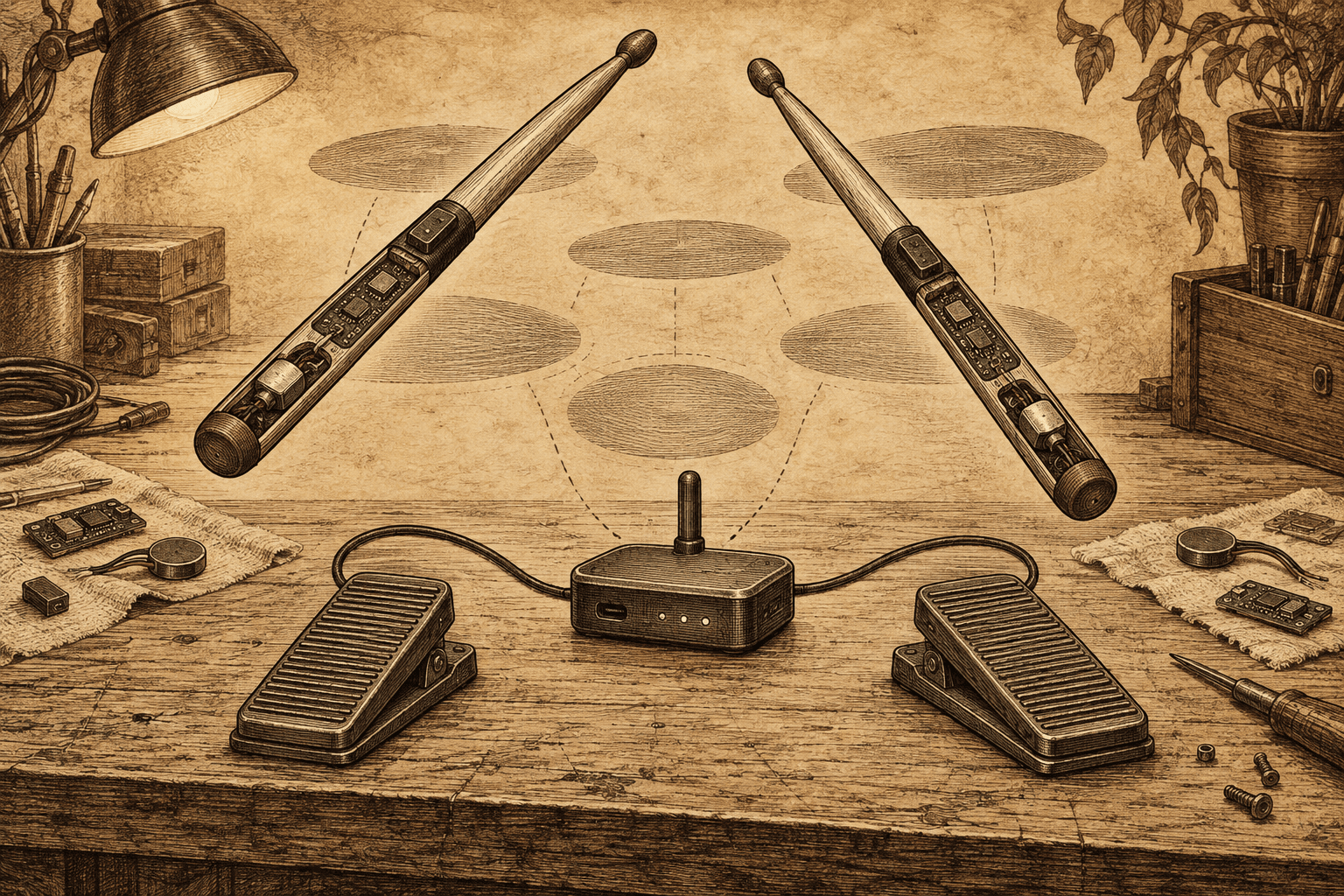
Original editorial concept art generated with built-in Codex Image Gen for The Machine Press, 2026-09-27; carried over because the October 25 weekly refresh handoff is absent and October 4 remains validation pending.
Moves motion tracking onto two ESP32-S3 drumsticks, adds haptic hits and a two-pedal hub, and sends velocity-sensitive drum events to open PC or Android playback software.
Visit Space Drums 2.0Original editorial concept art generated with built-in Codex Image Gen for The Machine Press, 2026-09-27; carried over because the October 25 weekly refresh handoff is absent and October 4 remains validation pending.
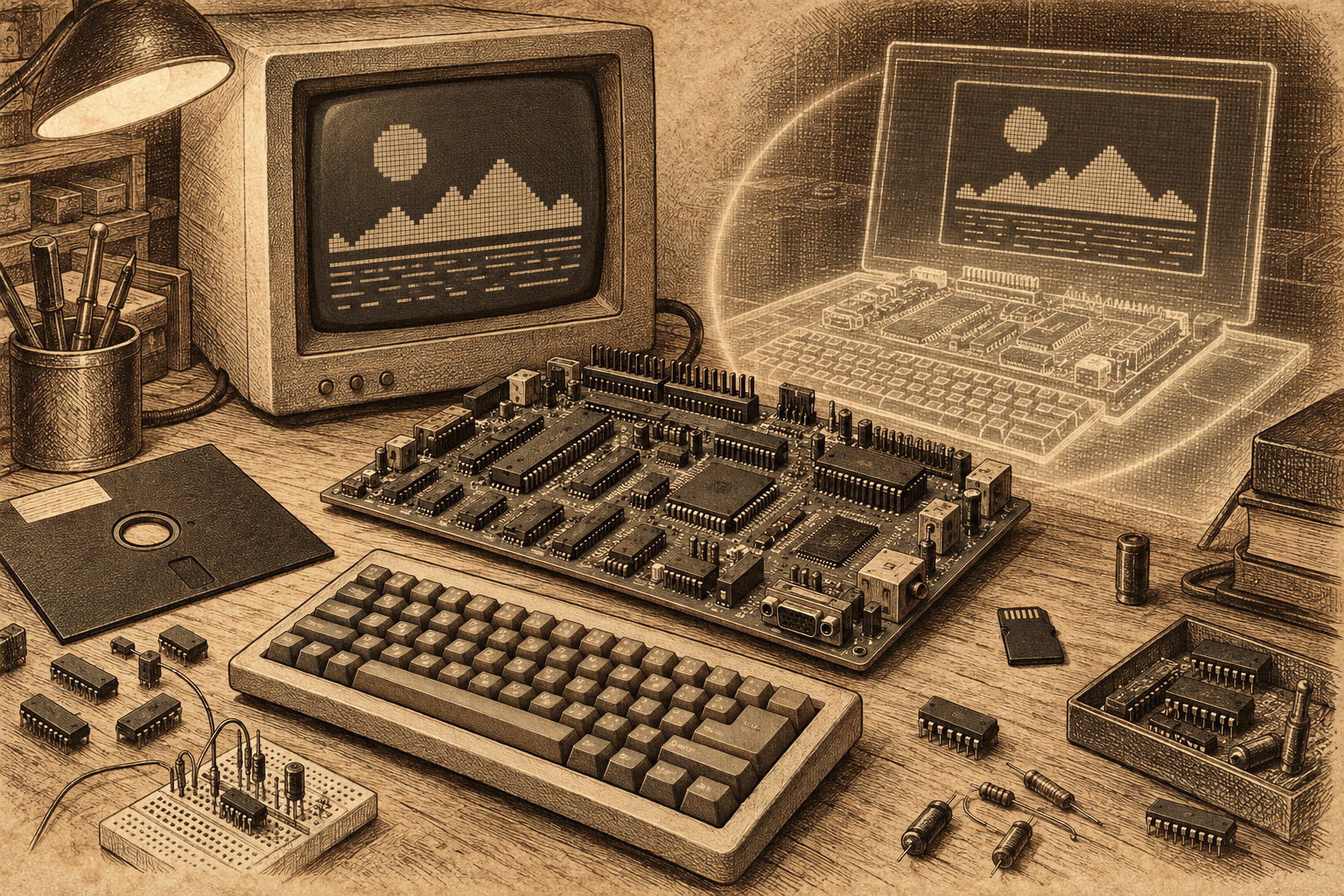
Pairs a chip-level 65C02 computer with custom hardware, video, sound, floppy, and microSD support with a cycle-honest emulator and browser assembler built around the same machine.
Visit 3RICOriginal editorial concept art generated with built-in Codex Image Gen for The Machine Press, 2026-09-27; carried over because the October 25 weekly refresh handoff is absent and October 4 remains validation pending.
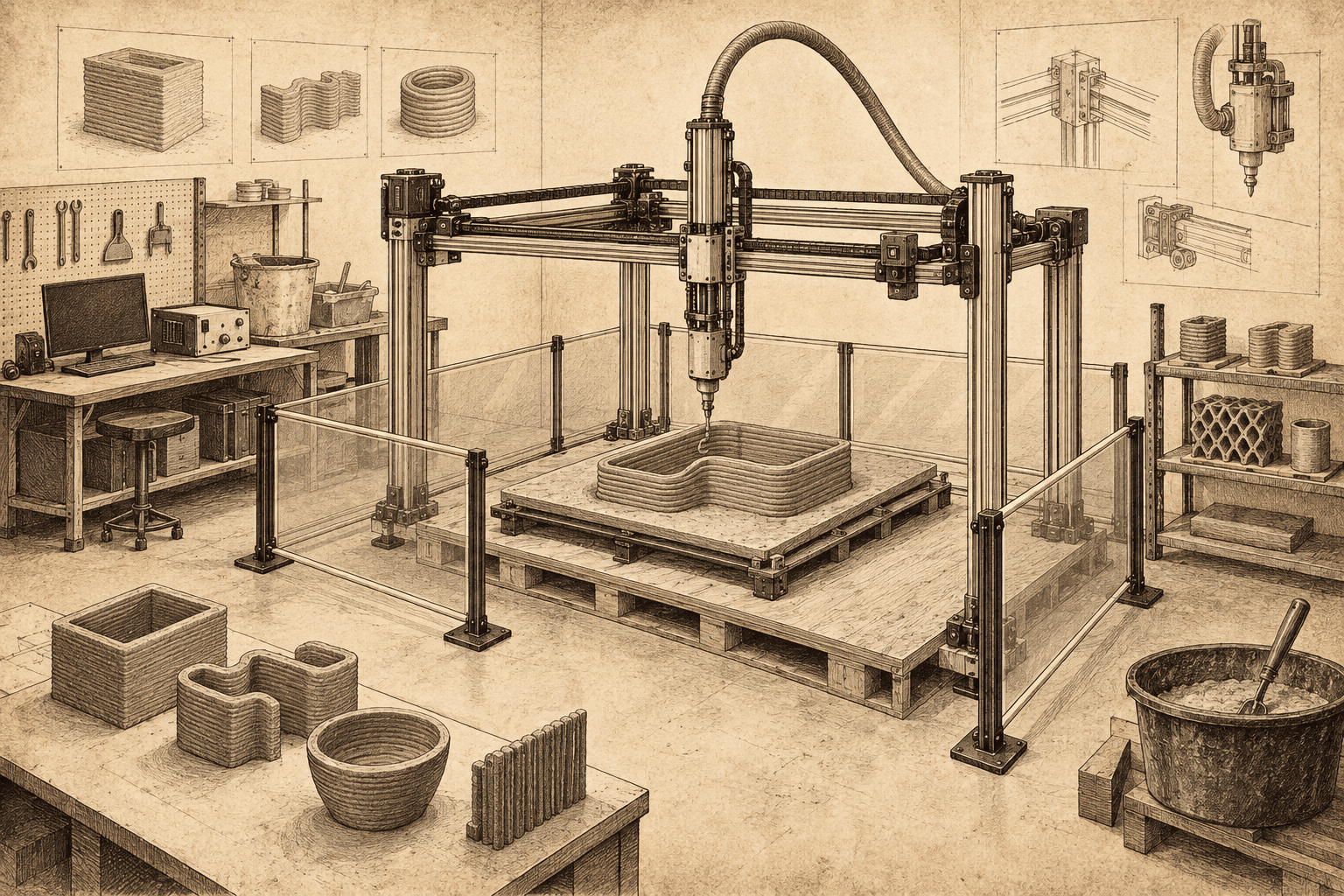
Publishes a pallet-scale cartesian motion reference, CAD, BOM, and low-voltage controls for supervised cementitious-extrusion research while explicitly excluding certified structural use.
Visit M3-CRETEOriginal editorial concept art generated with built-in Codex Image Gen for The Machine Press, 2026-09-27; carried over because the October 25 weekly refresh handoff is absent and October 4 remains validation pending.
Turns a bare ESP32-S3 touchscreen into a USB-connected desk instrument for PC activity and optional room temperature, humidity, and light measurements.
Visit DeskNodeOriginal Codex Image Gen concept art from 2026-07-10; carried forward from the validated 2026-10-28 edition.
Desk Picks are selected by the newsroom. Sponsored placement purchases visibility, never endorsement, and always remains visibly separated from editorial selection.
 Editorial illustration