research
The Clocks Feel the Tide
Two 800-kilometer optical-clock comparisons tracked Moon-and-Sun-driven changes in gravity potential and resolved the predicted signal within one day.
Summary
Two 800-kilometer optical-clock comparisons tracked Moon-and-Sun-driven changes in gravity potential and resolved the predicted signal within one day.
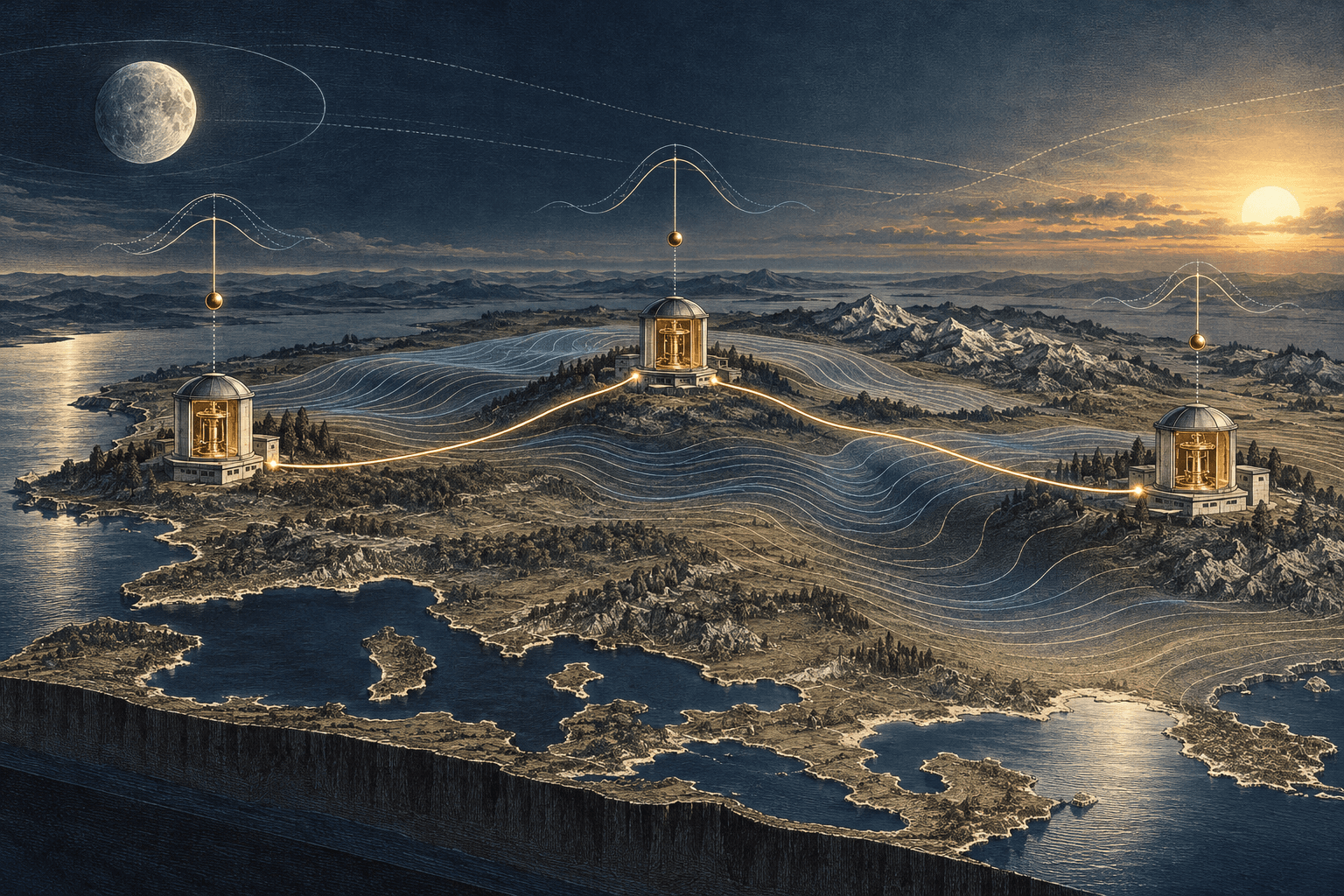
General relativity makes clocks at different gravity potentials tick at slightly different rates, an effect already used for static height comparisons. A European network of optical clocks and phase-stabilized fiber links has now measured the changing part: two distinct baselines of about 800 kilometers followed different combinations of daily and twice-daily tidal components, including one comparison that used a transportable clock as a remote sensor. The measured rate shifts resolved the predicted signal within one day and agreed with geophysical models. The demonstration tracks known tides rather than an unknown event, but it shows that future clock networks could monitor subtler mass redistribution or surface deformation if their stability and availability improve.
Why it matters
Two 800-kilometer optical-clock comparisons tracked Moon-and-Sun-driven changes in gravity potential and resolved the predicted signal within one day.
Limits and context
No additional limitation was separately recorded.
Key claims
Two 800-kilometer optical-clock comparisons tracked Moon-and-Sun-driven changes in gravity potential and resolved the predicted signal within one day.
Evidence: source-2026-10-31-001
Sources
- arXiv preprint 2610.39635, original v1arXiv · primary research
Corrections
No corrections have been recorded for this story.