Two 800-kilometer optical-clock comparisons tracked Moon-and-Sun-driven changes in gravity potential and resolved the predicted signal within one day.
Editorial illustration
Editorial concept illustration of an optical-clock network tracking tidal gravity-potential changes; it does not depict the reported instruments or sites. Generated with built-in Codex Image Gen for The Machine Press.
General relativity makes clocks at different gravity potentials tick at slightly different rates, an effect already used for static height comparisons. A European network of optical clocks and phase-stabilized fiber links has now measured the changing part: two distinct baselines of about 800 kilometers followed different combinations of daily and twice-daily tidal components, including one comparison that used a transportable clock as a remote sensor. The measured rate shifts resolved the predicted signal within one day and agreed with geophysical models. The demonstration tracks known tides rather than an unknown event, but it shows that future clock networks could monitor subtler mass redistribution or surface deformation if their stability and availability improve.
Editorial concept illustration of inference-time reaction precedents extending retrosynthesis coverage; it is not a laboratory result or model interface. Generated with built-in Codex Image Gen for The Machine Press.
With model weights fixed, adding reaction precedents raised top-one retrosynthesis accuracy from 13.0 to 58.0 percent on transformations excluded from training.
A retrosynthesis model normally inherits the chemical coverage of its training set. Researchers tested whether an inference-time archive could stretch that boundary by holding model parameters fixed while expanding only the retrievable reaction precedents. Across 2.71 million reactions, mean top-one accuracy on transformations excluded from training rose from 13.0 to 58.0 percent on a historical test and from 4.9 to 23.1 percent on a temporally held-out test. A model trained only on records before 2017 matched or exceeded a non-retrieval model trained through 2025 once newer precedents were available, and precedents improved all 14 tested general-purpose models. The work measures benchmark prediction rather than laboratory synthesis, but it isolates retrieval as a way to extend task coverage without changing weights.
A 150-gigahertz-wide survey reports the first interstellar detection of protonated isocyanic acid HNCOH+ toward a Galactic-center molecular cloud.
Only a handful of the roughly 350 known interstellar molecules contain the isocyanate group associated with peptide-bond chemistry. Using Yebes, IRAM and APEX observations spanning nearly 150 gigahertz, researchers report the first detection of HNCOH+ in the cloud G+0.693-0.027, with a column density of 9.9 times 10^12 per square centimeter. Its measured abundance was about 3.8 times that of the more stable protonated isomer, consistent with recent kinetic calculations. Detection broadens the molecular inventory; it is not evidence of proteins or life in the cloud.
Generic programming-screen file image used illustratively; it does not depict the Ramanujan Challenge, a submitted proof, Lean code or an evaluation verdict. Nemuel Sereti / Pexels; cropped, resized, metadata stripped, and converted to WebP by The Machine Press.
A pipeline for natural-language proofs, computer-algebra code and Lean formalizations found distinct solutions—and a proof of one published open conjecture—in Ramanujan Challenge submissions.
Research-level mathematics creates two problems for AI: proposing a proof and judging it. The Ramanujan Challenge analysis reports correct submissions distinct from official solutions and a proof of one published open conjecture, then evaluates a structured judging pipeline across prose, code and formal proofs. Compared with one-shot model judgment, the pipeline reduced false positives on natural-language proofs from 23 percent to 6 percent and raised supporting-code judgment accuracy from 46 percent to 58 percent. Those figures describe the challenge submissions and evaluation set, not a general guarantee that automated proof review is reliable.
A persistent local traversal head reached 0.95 mean return after 0.59 million training steps in a five-token MiniGrid test.
Long-context systems repeatedly search large stores from scratch, while recurrent compression must decide early what to keep. This proof of principle separates a memory's information value from its address and lets an agent traverse a persistent local neighborhood. On MiniGrid Memory with a five-token context, the local traversal head reached 0.95 mean return after 0.59 million training steps, compared with 0.94 million for Gaussian absolute addressing and more than 2 million for categorical addressing. The experiment used fixed geometry and did not test the paper's full learned-geometry or repeated-retrieval proposal.
Prefill-side decode-length predictors converged near the same bound once model, data and sampling conditions were fixed.
Inference schedulers would benefit from knowing how long a response will be before generation starts. This analysis treats decoding as a stopped stochastic process and argues that autoregressive sampling places a floor under any predictor that sees only prefill hidden states. Across several predictor designs, results under fixed model, dataset and sampling settings converged near the derived bound, suggesting system randomness dominated model-design differences. The authors propose benchmarking with fixed generation conditions and relative-error metrics; the paper derives and tests limits rather than a universal production scheduler.
Frontier models proposed candidate resolutions for roughly 60 percent of 200 sampled conjectures, with counterexamples about 1.3 times as common as proofs.
Evaluating only celebrated mathematical breakthroughs can overstate what language models routinely do. OpenConjecture sampled 200 conjectures from arXiv papers and ran frontier models through three reproducible passes without problem-specific guidance. Models produced candidate resolutions for about 60 percent, but some exploited underspecification or moved outside the authors' intent, and some proofs closely followed known results. The study did not claim expert verification of every candidate; it argues that correctness alone is too narrow without fidelity, attribution and contribution checks.
DynaRev injects additive, unconditional and runtime-conditioned revisions at semantic milestones across 181 web-agent tasks.
Web-agent benchmarks usually freeze the user's request before execution, unlike real interactions. DynaRev delivers revisions at task-defined milestones and scores correctness, responsiveness and efficiency across 181 tasks. Five evaluated models often completed only part of the revised requirements; rewriting the instruction while preserving browser state helped, while resetting the browser lost progress. The benchmark supplies a controlled testbed, not evidence that one revision strategy will generalize across deployed sites.
Generic data-center file image used illustratively; it does not depict the profiled hardware, a model provider, energy meter or measured workload. Brett Sayles / Pexels; cropped, resized, metadata stripped, and converted to WebP by The Machine Press.
Profiling found linear output scaling but both linear and quadratic components for long-input prefill compute time and energy.
Energy estimates for language models often count generated tokens and neglect the long prompts common in agent workflows. A profiling study varied both prefill and decode lengths and fit generalized linear models to compute time and measured energy. Decode cost scaled linearly with output length, while prefill showed linear and quadratic components as input grew; compute time also tracked energy closely enough to serve as a proxy in the tested setup. The work offers an estimation framework, not a measurement of every proprietary API or deployment stack.
SymAnt combines scene and knowledge graphs so users can edit action priors without retraining the model.
Anticipating a long sequence of human actions from a short observation is hard for purely neural systems to explain or adjust. SymAnt jointly searches scene and knowledge graphs to build a symbolic context of objects, relationships and affordances, then iteratively refines the predicted action sequence. Across five datasets—including Breakfast, EPIC-KITCHENS and Assembly101—the authors report particular gains when observation windows are short. The results are dataset evaluations, not evidence of safe real-time anticipation in open-world robot deployment.
DAWN separates screwdriver alignment and insertion from force-controlled removal, with a multimodal classifier deciding when to switch stages.
Automated unfastening remains difficult because a screwdriver must align precisely, engage the fastener and maintain stable force through removal. DAWN uses a diffusion policy for alignment, a multimodal transition classifier and a force-controlled unfastening policy. Tests on a Franka Emika robot reached alignment-and-insertion success comparable to trained human operators and robust removal across unseen scenarios, according to the authors. The abstract does not provide a single overall rate, and the results cover the tested fasteners and setup rather than general disassembly.
A contact-constrained design produced more tangential force than an alternating-spin layout in optimization and simulation.
Wheel-equipped quadrotors usually tilt to move sideways, which changes the attitude of the whole vehicle. This design tilts all four clockwise-spinning rotors and uses surface contact as a constraint, producing propulsion along the floor while keeping the body level. Force analysis and optimization found more tangential force than a conventional alternating-spin configuration, and simulations demonstrated hovering plus level horizontal surface motion. The result is analytical and simulated; the paper does not report a physical prototype trial.
A unitary-synthesis toolset identifies when native trapped-ion multiqubit gates can outweigh the engineering cost of a broader gate set.
Trapped-ion machines can offer long coherence, broad connectivity and native multiqubit operations, but additional gate flexibility also raises control complexity. The researchers use unitary synthesis as an application-neutral benchmark and build a toolset for comparing gate sets composed of native Mølmer-Sørensen operations. Their analysis identifies hardware requirements under which multiqubit gates become advantageous. It is a comparative design study, not a demonstration of quantum advantage on a particular processor.
Generic wafer-scale circuit illustration used illustratively; it does not depict a quantum channel, unitary algorithm, tested processor or query result. Wikideas1 / Wikimedia Commons (CC0 1.0); cropped and converted to WebP by The Machine Press.
The estimator uses order square-root-d over epsilon queries, matching the known lower bound for unknown unitary channels.
Diamond distance determines the best single-use probability of distinguishing two quantum channels. A new algorithm estimates that distance between unknown d-dimensional unitary channels to additive error epsilon using order square-root-d over epsilon calls to the channels and their inverses. The authors show this query complexity matches an existing lower bound, making it optimal in that model. The result is an algorithmic theorem, not a report of device-level runtime or noise performance.
A tabular foundation model matched or exceeded photometric-redshift baselines trained on more than 40,000 galaxies using 1,000 in-context examples.
Astronomers estimate galaxy distance from imaging when spectroscopy is scarce, but training samples are biased toward bright, easy targets. In benchmark tests, tabular foundation models predicted full redshift distributions in one pass and matched or exceeded bespoke estimators trained on more than 40,000 galaxies while using 1,000 in-context examples. Their advantage was largest with little calibration data and persisted after baselines received as many as 10,000 representative spectra. The claim is benchmark-specific and does not remove the need to test survey-specific selection effects.
The Zwicky Transient Facility search raised the published sample of eclipsing accreting ultracompact white-dwarf binaries from 21 to 30.
Eclipsing ultracompact binaries are unusually valuable because their masses and radii can be measured with limited dependence on formation models. A Zwicky Transient Facility light-curve search followed by Keck spectroscopy found nine new systems and reanalyzed four earlier reports, with orbital periods from 26 to 65 minutes. The nine discoveries increase the published eclipsing sample from 21 to 30; one hydrogen-only system may be the shortest-period member of its kind. Detailed model-independent mass and radius measurements remain future work.
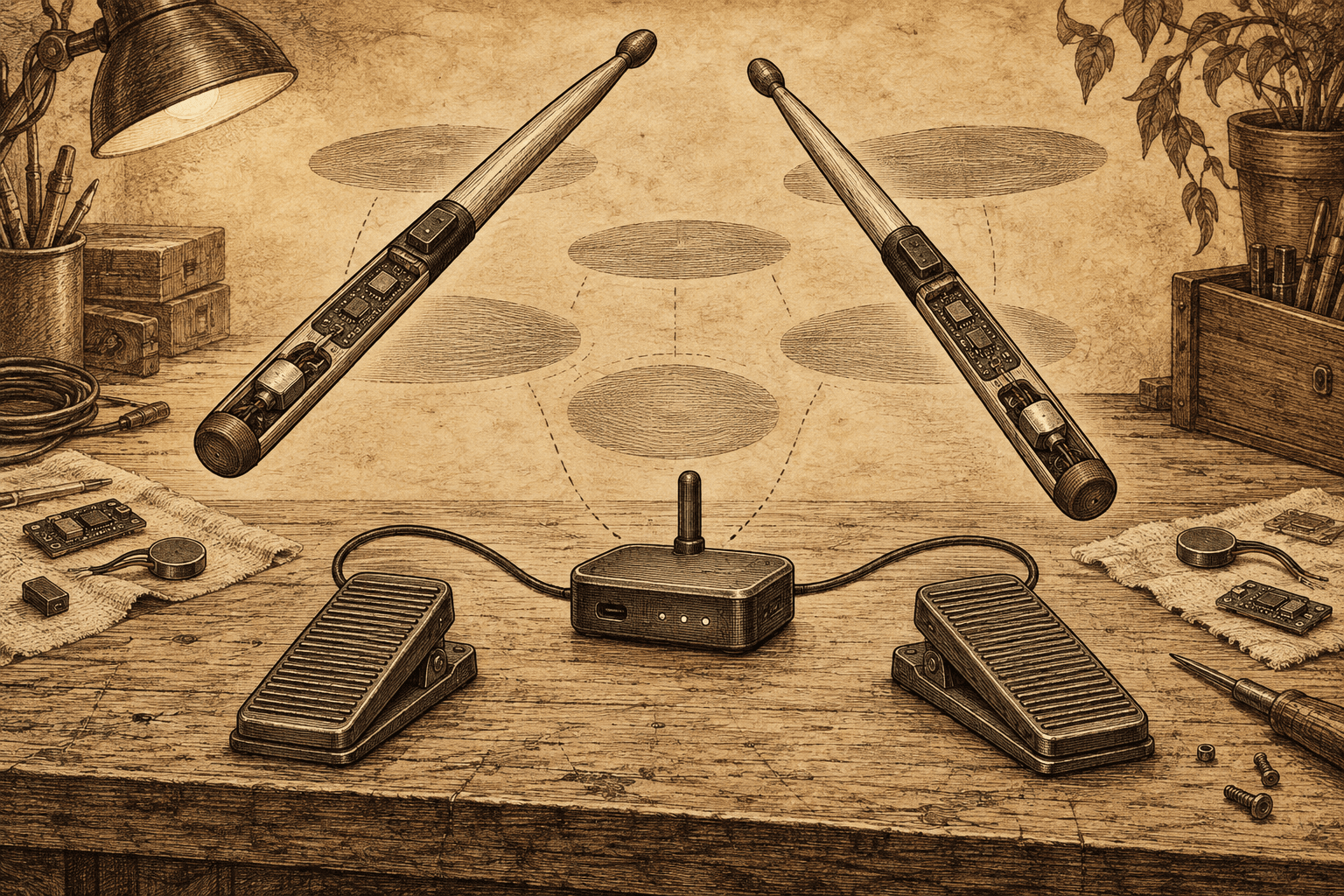
Moves motion tracking onto two ESP32-S3 drumsticks, adds haptic hits and a two-pedal hub, and sends velocity-sensitive drum events to open PC or Android playback software.
Visit Space Drums 2.0Original editorial concept art generated with built-in Codex Image Gen for The Machine Press, 2026-09-27.
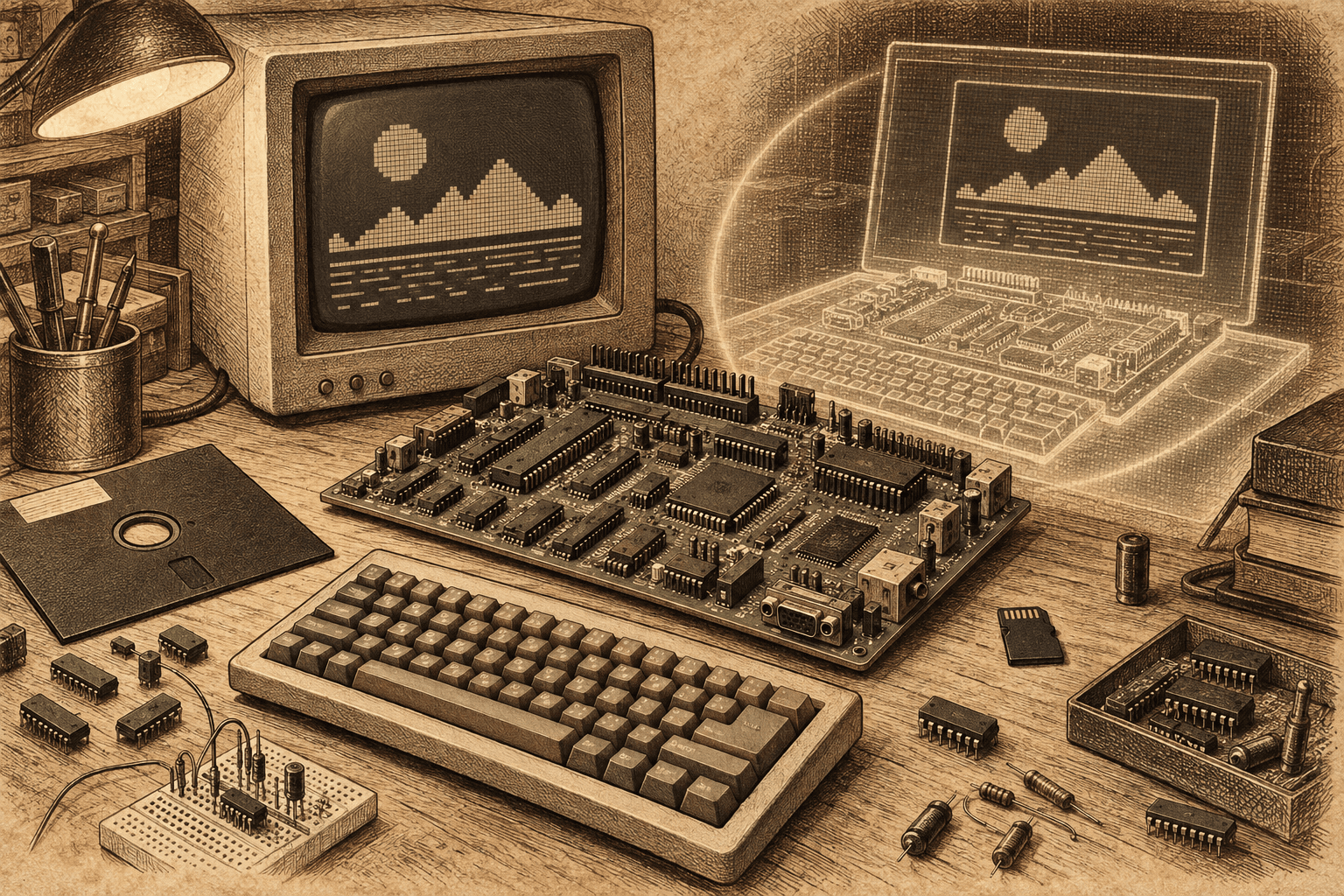
Pairs a chip-level 65C02 computer with custom hardware, video, sound, floppy, and microSD support with a cycle-honest emulator and browser assembler built around the same machine.
Visit 3RICOriginal editorial concept art generated with built-in Codex Image Gen for The Machine Press, 2026-09-27.
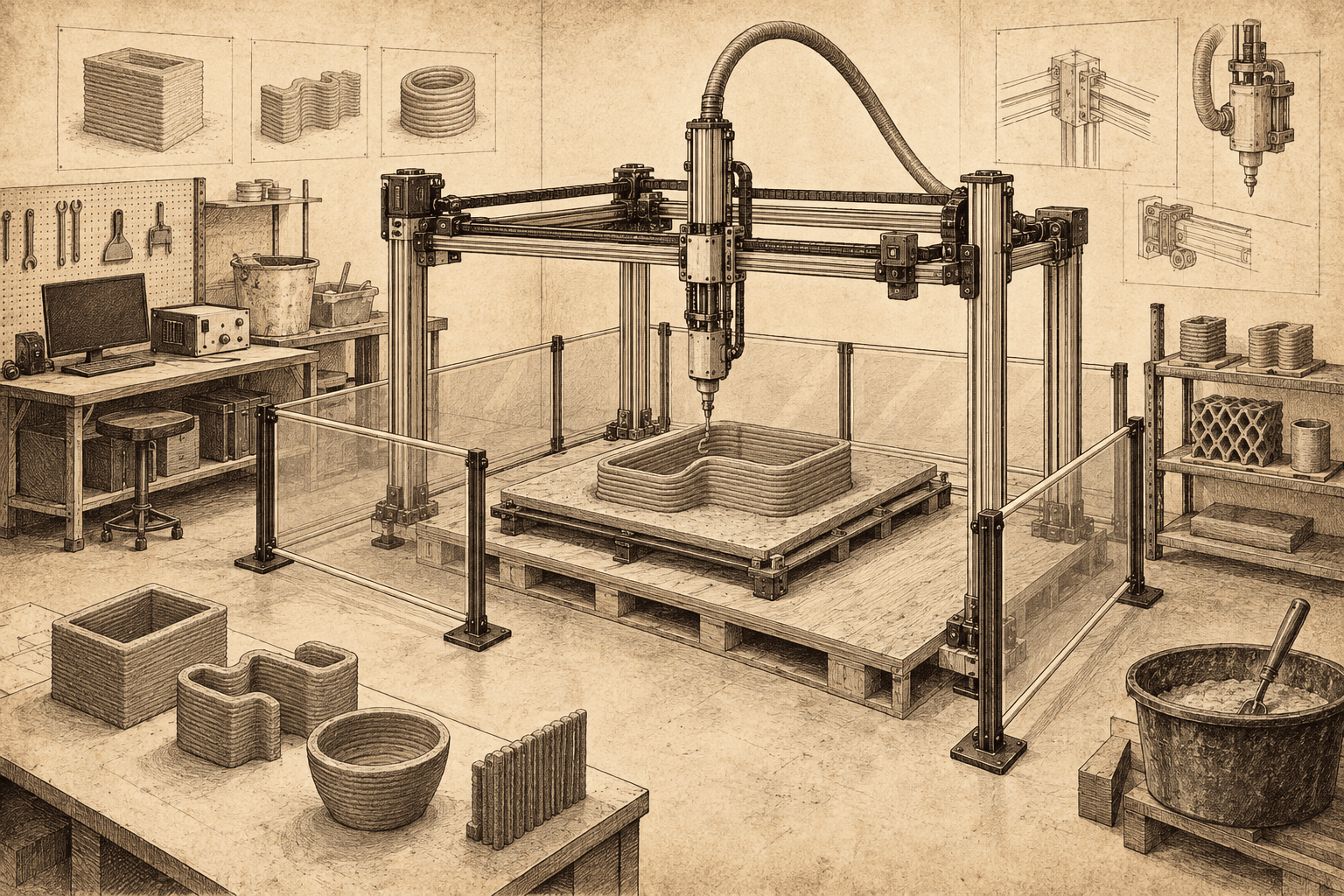
Publishes a pallet-scale cartesian motion reference, CAD, BOM, and low-voltage controls for supervised cementitious-extrusion research while explicitly excluding certified structural use.
Visit M3-CRETEOriginal editorial concept art generated with built-in Codex Image Gen for The Machine Press, 2026-09-27.
Turns a bare ESP32-S3 touchscreen into a USB-connected desk instrument for PC activity and optional room temperature, humidity, and light measurements.
Visit DeskNodeOriginal Codex Image Gen concept art from 2026-07-10; carried forward from the validated 2026-09-26 edition.
Desk Picks are selected by the newsroom. Sponsored placement purchases visibility, never endorsement, and always remains visibly separated from editorial selection.
 Editorial illustration